📖 About
RESQ-AI is an AI-driven disaster response and emergency coordination platform designed to empower citizens, volunteers, and first responders during critical crises. By leveraging natural language processing (NLP), computer vision, and real-time geospatial tracking, RESQ-AI automates the triage of emergency reports—categorizing urgency, detecting hazards, and routing critical information to rescue teams so they can prioritize life-saving efforts efficiently.
💡 Inspiration
During natural disasters and large-scale emergencies, the biggest hurdle isn't always a lack of resources, but rather the chaos of information. Traditional emergency hotlines easily become overwhelmed, and scattered distress signals on social media often get lost in the noise. Rescue coordinators struggle to quickly assess which areas require immediate attention versus those that are stable. RESQ-AI was inspired by this critical gap in crisis communication. The goal was to build a centralized, intelligent platform that cuts through the noise, intelligently parsing chaotic incoming data to provide first responders with a clear, prioritized map of where they are needed most.
⚙️ What it does
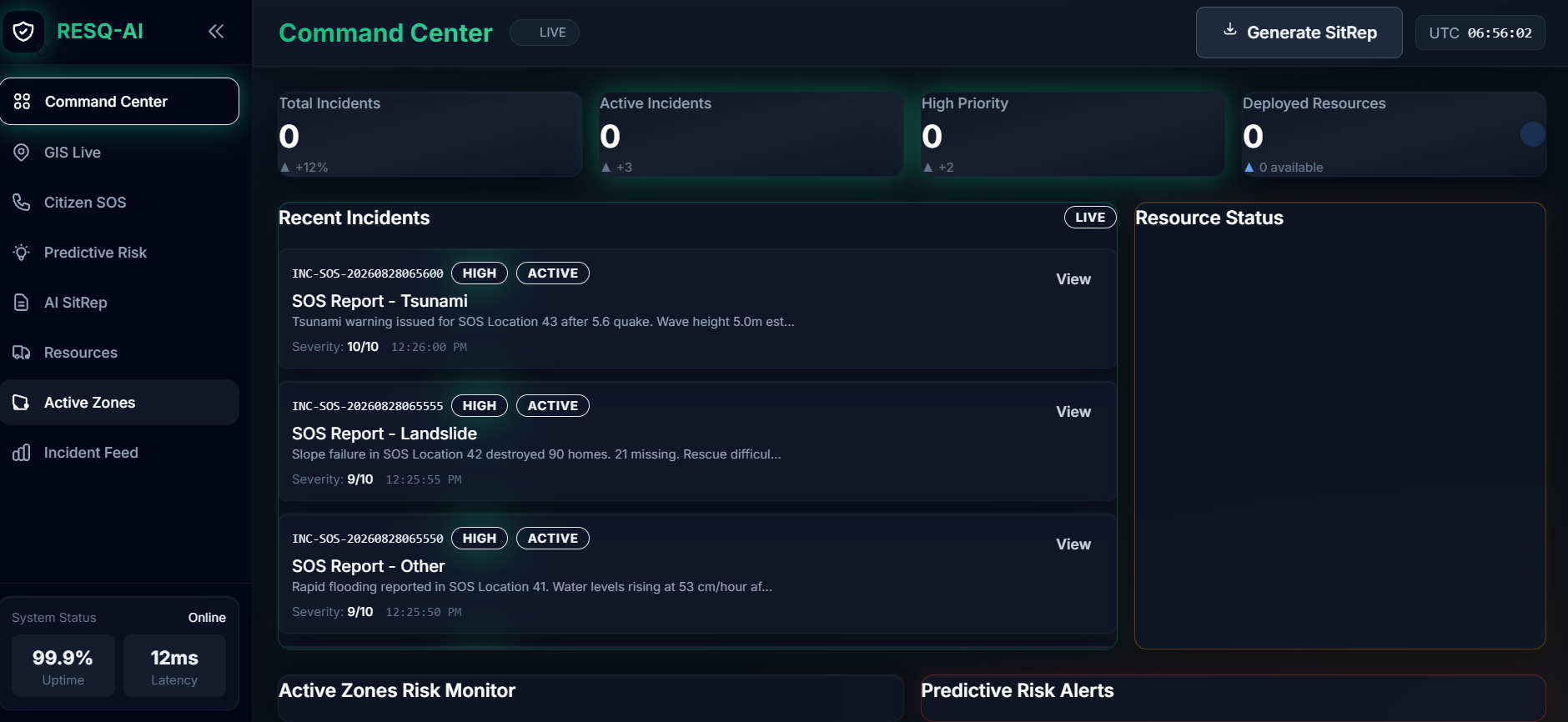
RESQ-AI serves as a comprehensive command center for emergency management:
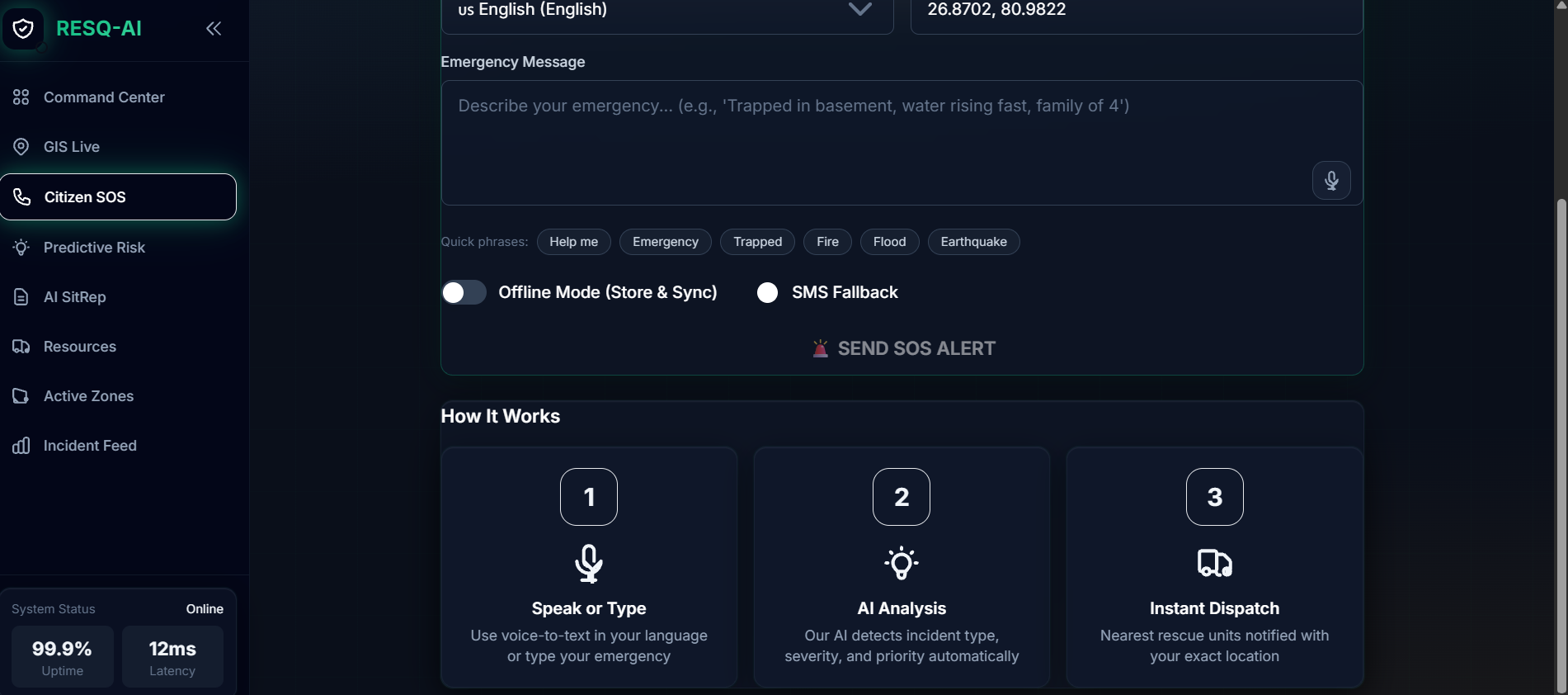
- Intelligent Incident Reporting: Citizens and volunteers can rapidly submit emergency reports (via text, voice, or image) through a lightweight, accessible web or mobile interface.
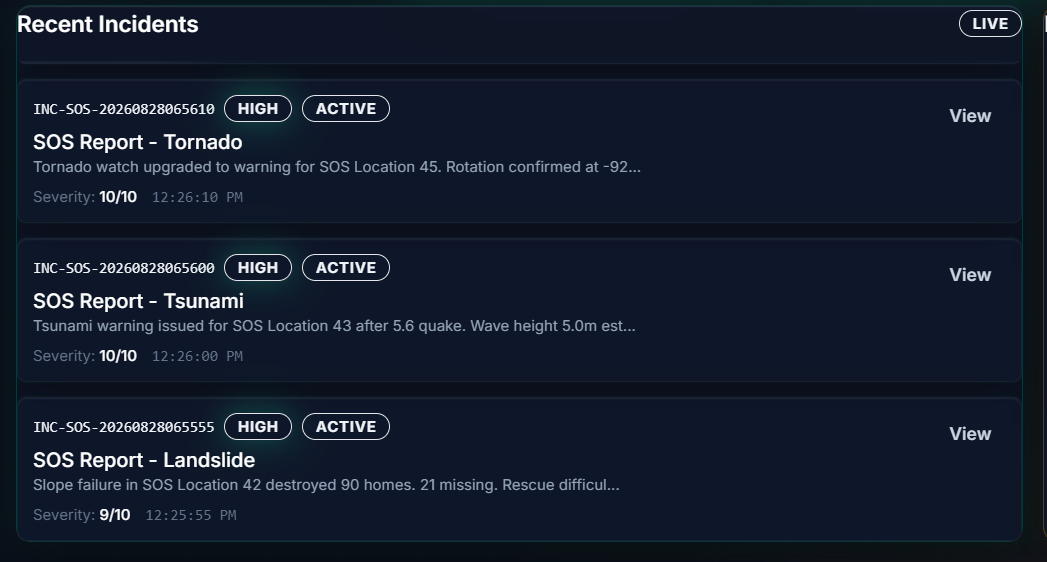
- AI-Powered Triage: Under the hood, an NLP engine scans incoming text to extract key context (e.g., trapped individuals, medical emergencies) and assigns an automatic urgency score. Concurrently, a computer vision model analyzes uploaded images to identify hazards like fires, floods, or structural damage.
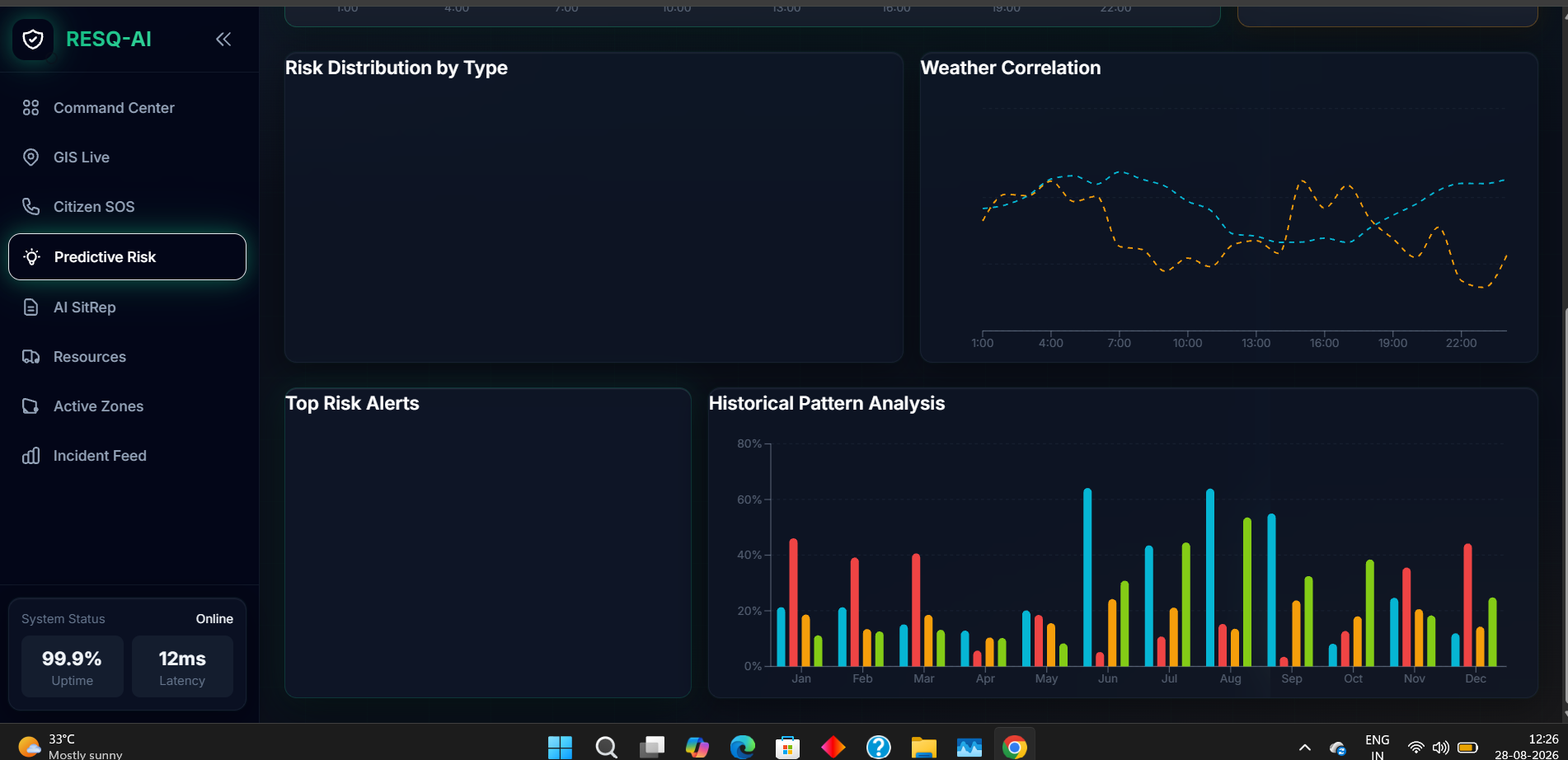
- Geospatial Command Dashboard: Emergency coordinators access a live, interactive map that visually clusters incidents by severity and type, updating in real time.
- Resource Allocation: The platform recommends the optimal deployment of nearby medical, fire, or rescue units based on the AI’s priority scoring and real-time location tracking.
🛠️ How we built it
The platform was architected as a highly scalable, real-time web application to ensure reliability when it matters most.
- Frontend UI: Built using a modern, responsive framework (React/Next.js) to ensure it loads quickly and remains accessible even on low-bandwidth connections.
- Backend & Real-Time Sync: A high-performance Python (FastAPI) backend handles the core logic, utilizing WebSockets for real-time bidirectional communication so the command dashboard updates instantly as new reports come in.
- AI Pipeline: We integrated customized machine learning models, including a robust NLP classifier to parse distress messages and a PyTorch-based computer vision model to detect hazards in user-uploaded images.
- Database & Cloud: Geospatial data and incident reports are securely stored in a scalable PostgreSQL database with PostGIS extensions, hosted on robust cloud infrastructure to handle sudden spikes in traffic.
⚠️ Challenges we ran into
One of the most complex challenges was ensuring high availability and low latency during simulated traffic spikes, a common reality during natural disasters. Implementing seamless WebSocket integration for real-time dashboard updates required precise state management. Additionally, tuning the AI pipeline to accurately prioritize ambiguous distress signals—avoiding false positives while never missing a critical life-and-death report—required extensive dataset curation and prompt engineering.
🏆 Accomplishments that we're proud of
We are incredibly proud of engineering a cohesive, real-time pipeline that successfully bridges the gap between chaotic on-the-ground reporting and organized, data-driven rescue operations. Building a composite scoring engine that instantly evaluates a situation's severity based on both visual and textual inputs was a major technical milestone for the platform.
🧠 What we learned
Building RESQ-AI provided invaluable experience in crisis engineering—developing software where speed, reliability, and accessibility are non-negotiable. We deepened our expertise in handling real-time data streams, configuring geospatial databases, and deploying machine learning models in a fast-paced, highly constrained web environment.
🚀 What's next for RESQ-AI
To make RESQ-AI truly resilient, our next focus is implementing offline-first capabilities using mesh networking (like Bluetooth/WiFi Direct) so citizens can relay distress signals even when cell towers are down. We also plan to integrate drone telemetry data to provide automated aerial reconnaissance in inaccessible disaster zones.

Log in or sign up for Devpost to join the conversation.