-
-
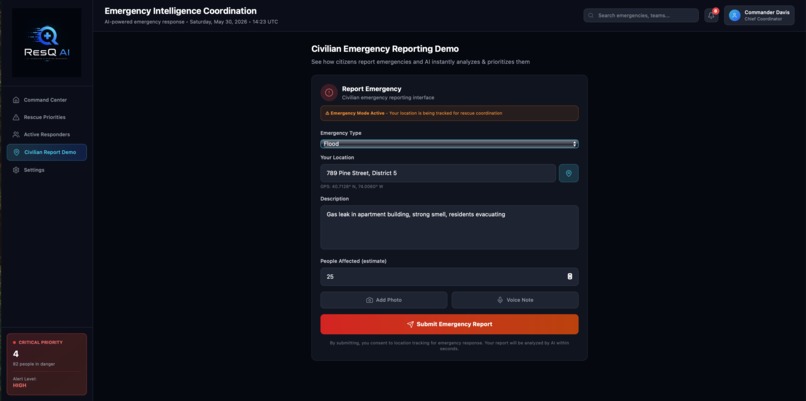
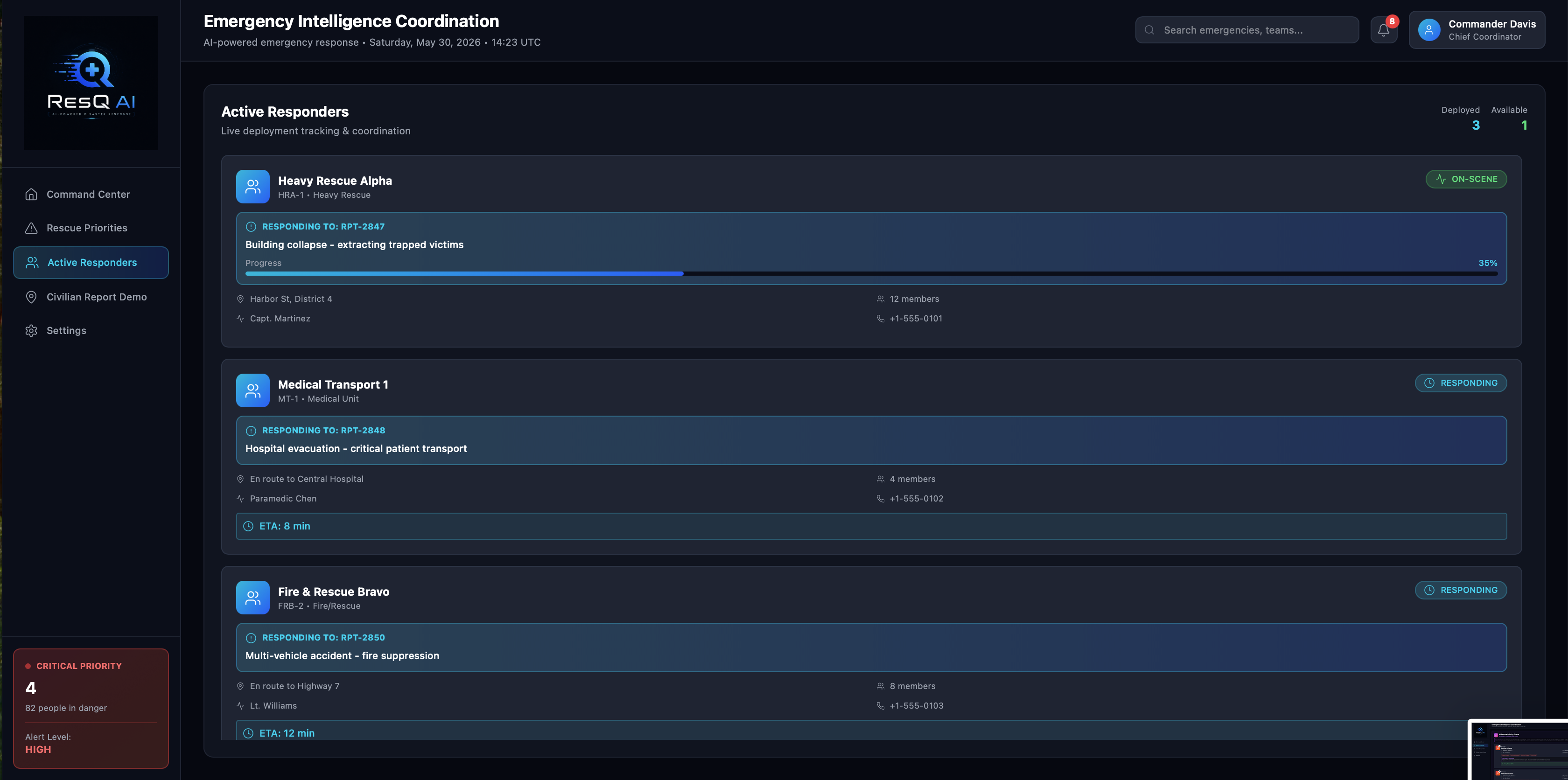
Active Responders Dashboard Live tracking of rescue teams and response progress.
-
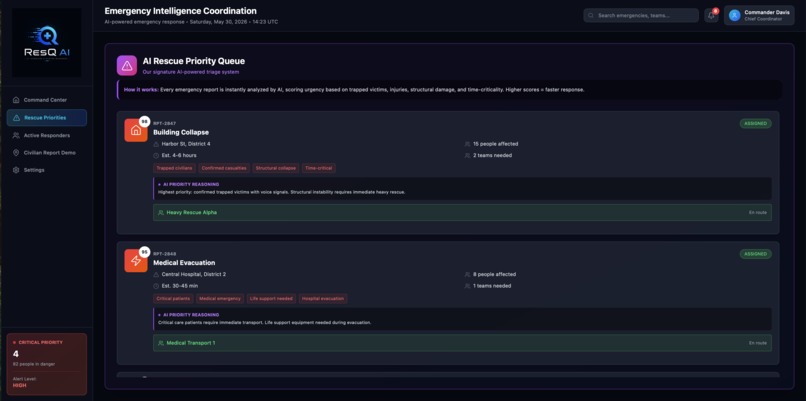
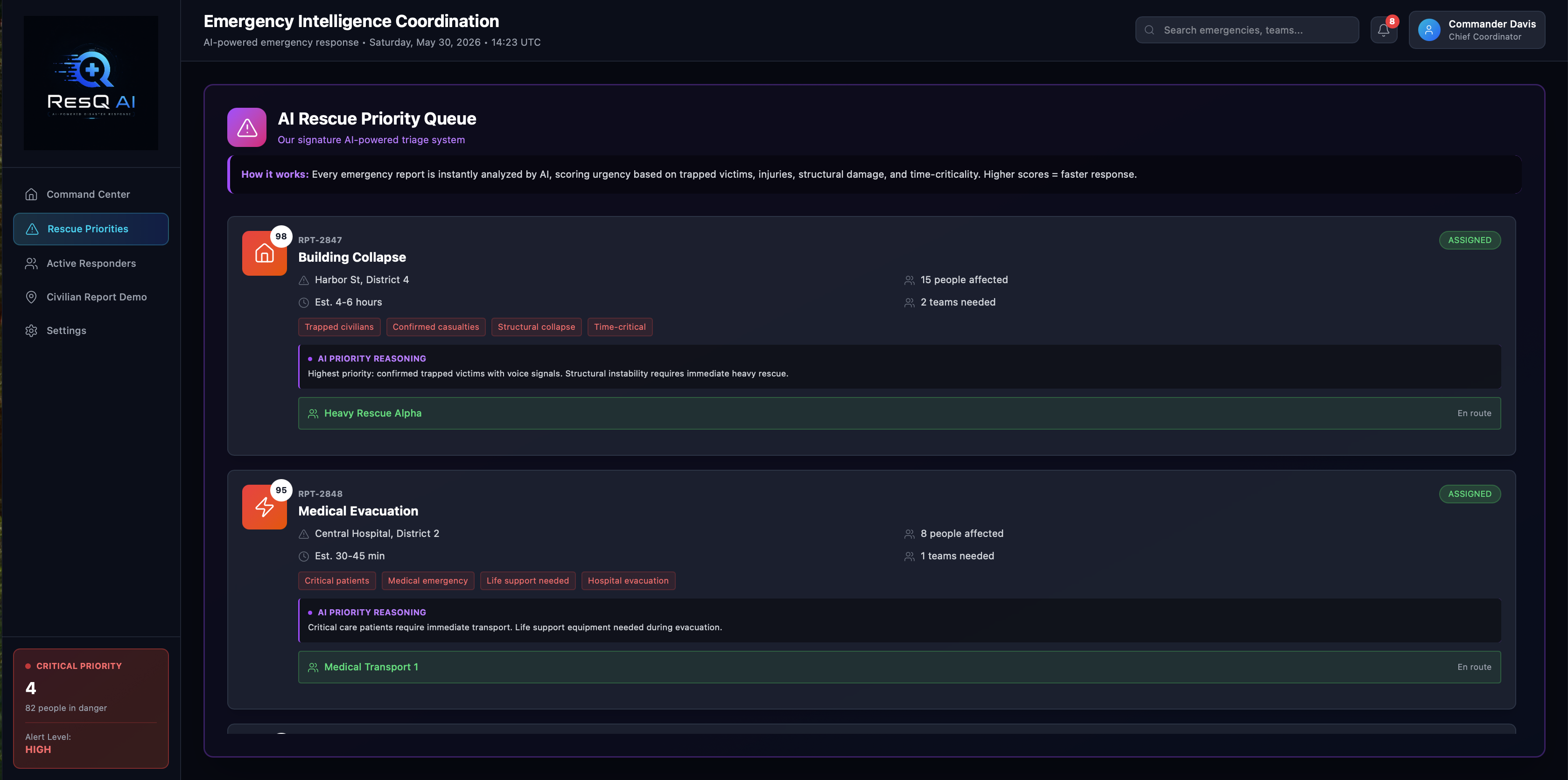
AI Rescue Priority Queue AI-powered prioritization of critical rescue incidents.
-
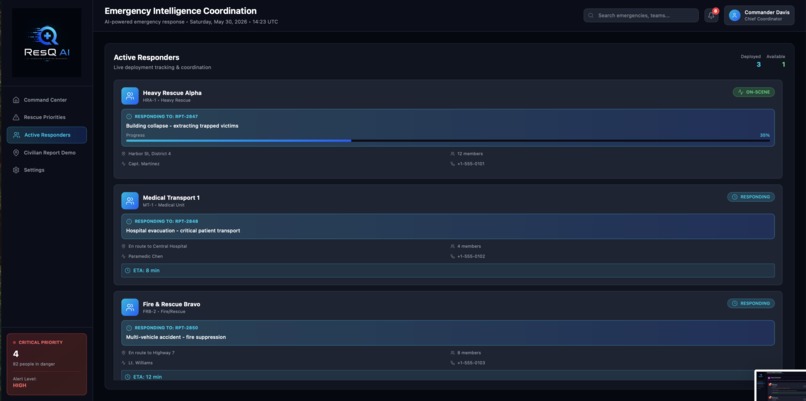
Active Responders Dashboard Live tracking of rescue teams and response progress.
-
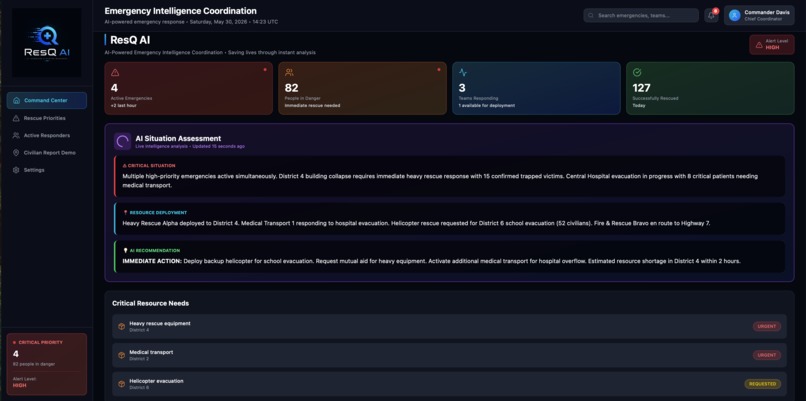
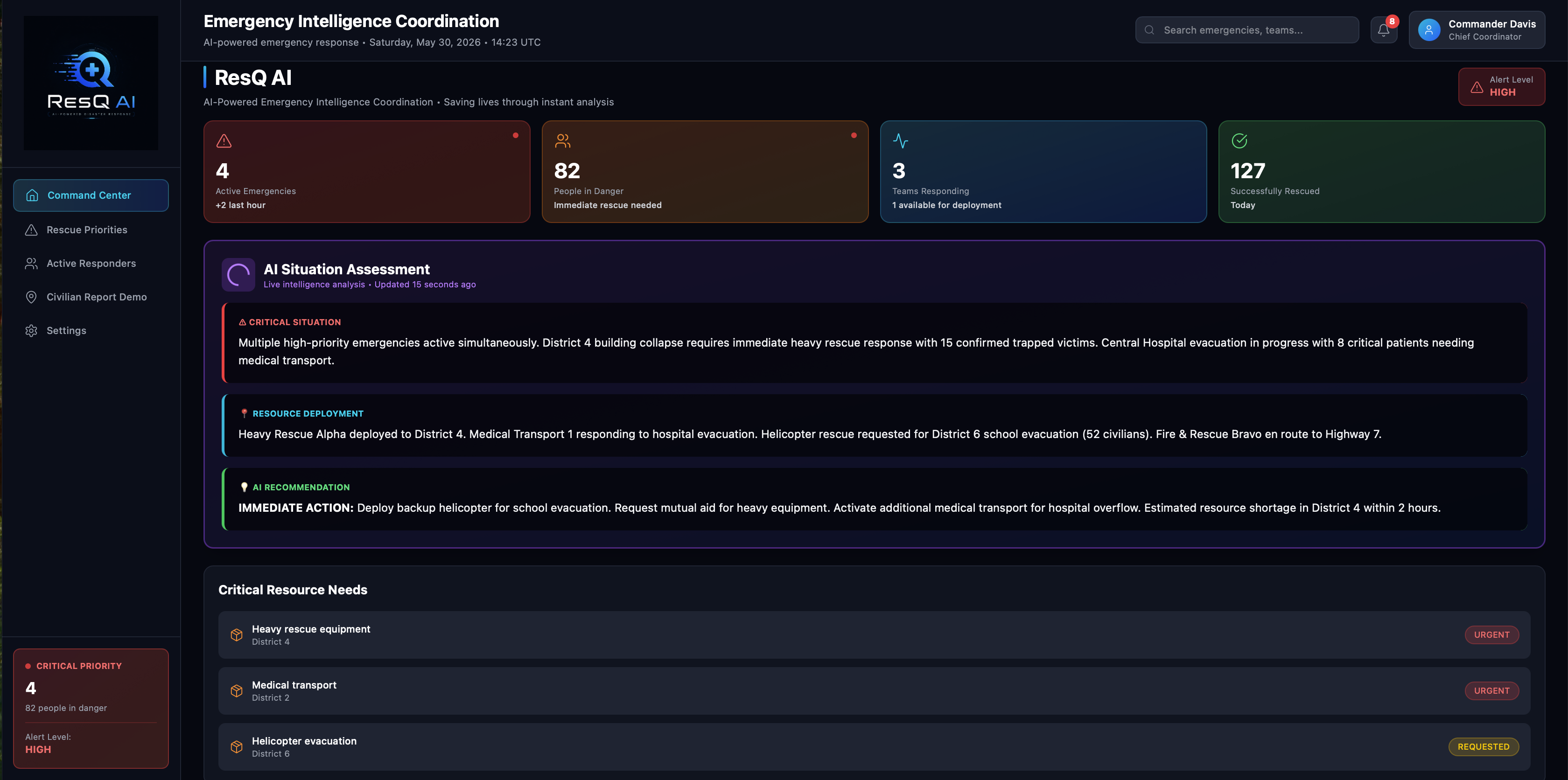
AI Situation Assessment AI-generated emergency analysis and response recommendations.
-
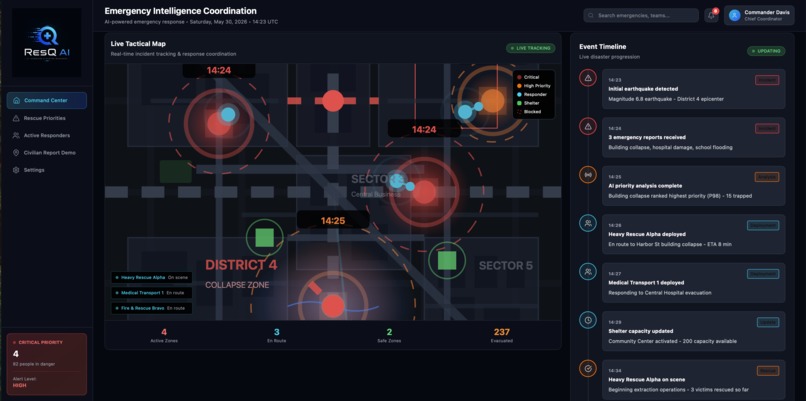
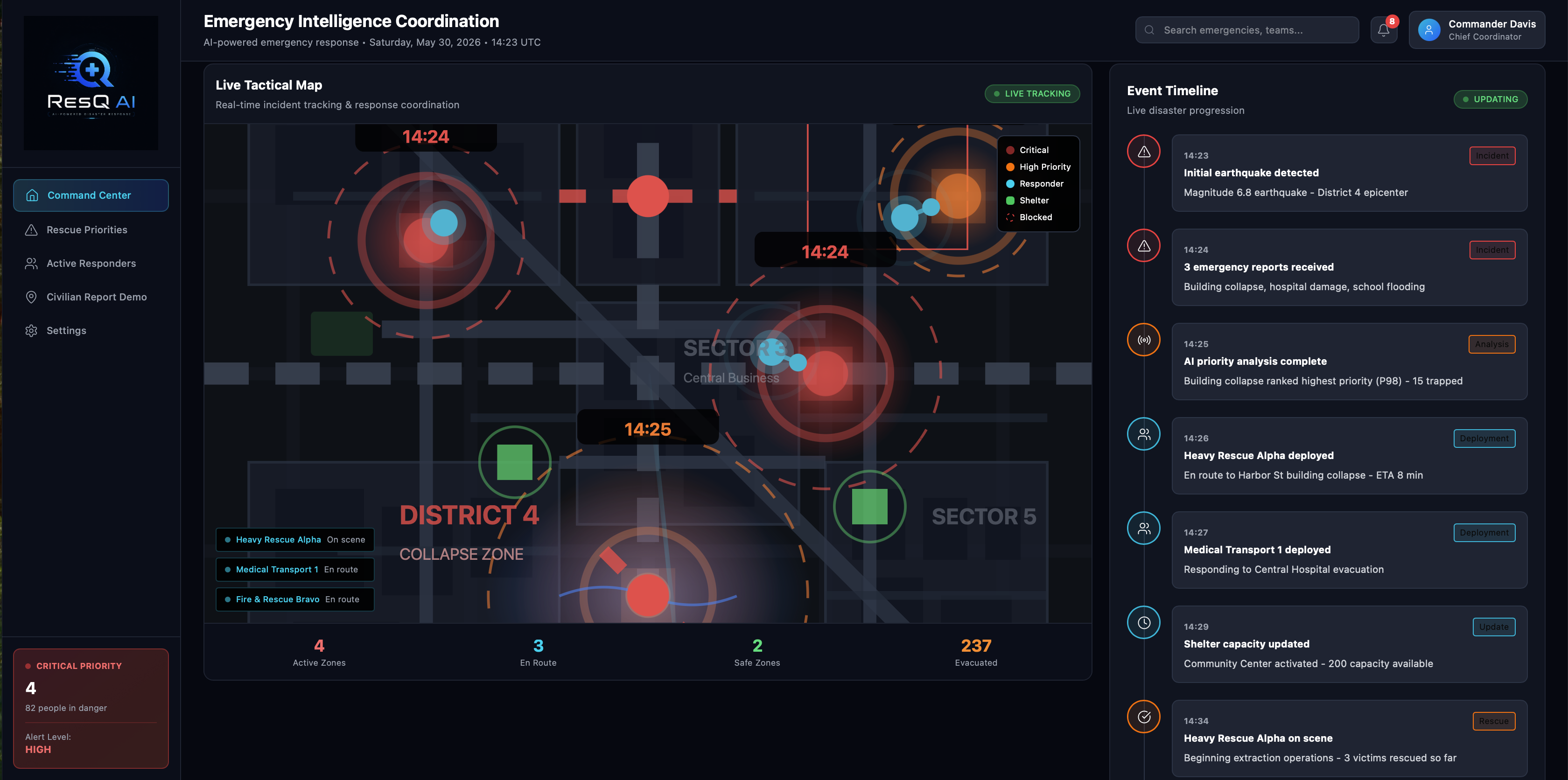
Live Tactical Map Real-time disaster tracking and emergency coordination.
ResQ AI
Turning Chaos Into Clarity With AI-Powered Emergency Intelligence
Inspiration
During disasters, one of the biggest challenges is not only the disaster itself, but the chaos that follows it. Emergency responders often deal with delayed communication, fragmented information, overwhelmed systems, and rapidly changing situations where every second matters.
We were inspired by the idea of using AI to transform scattered emergency reports into structured, actionable intelligence that can help responders make faster and smarter decisions during critical situations.
Instead of building a generic AI assistant, we wanted to design a platform that feels like real emergency infrastructure capable of supporting coordination, prioritization, and communication during disasters.
What it does
ResQ AI is an AI-powered emergency intelligence coordination platform designed to support disaster response operations in real time.
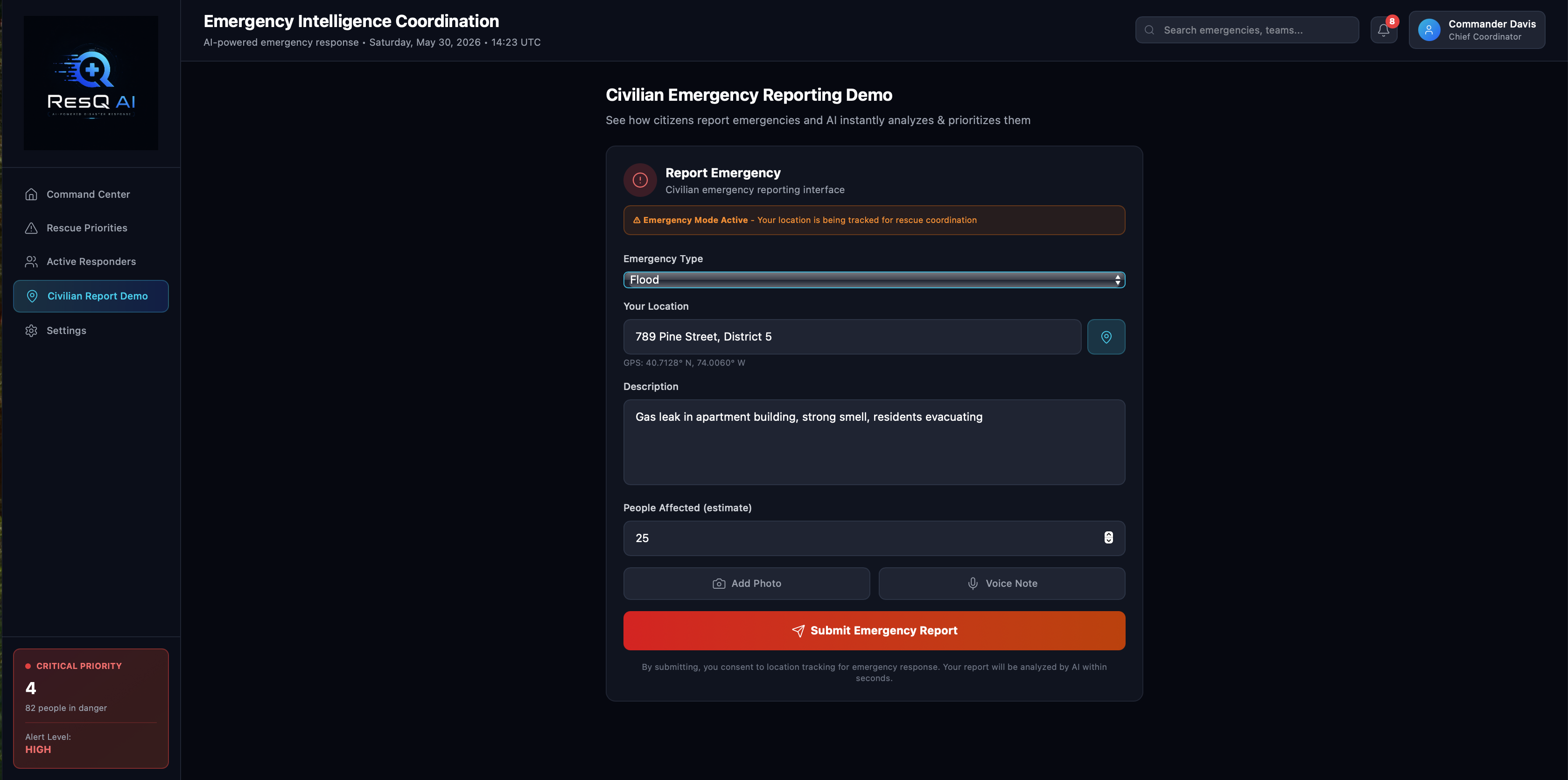
The platform allows civilians and responders to submit:
- SOS alerts
- text reports
- voice messages
- images
- live locations
AI systems analyze incoming reports to:
- classify emergency severity
- identify high-risk zones
- prioritize rescue operations
- detect resource shortages
- generate emergency summaries
- support responder coordination
The core workflow of the platform can be represented as:
Emergency Report→AI Analysis→Priority Detection→Responder Coordination
The platform also includes:
- live disaster mapping
- shelter and evacuation tracking
- emergency resource monitoring
- multilingual communication support
- low-connectivity emergency concepts
How we built it
We designed the platform using Figma and built the frontend using React, TypeScript, and Tailwind CSS. We focused on creating realistic emergency coordination workflows, AI-powered rescue prioritization systems, interactive disaster mapping interfaces, and real-time operational dashboards. A major part of development involved refining the user experience to ensure the platform remained visually clear, responsive, and usable during high-pressure emergency situations.
Challenges we ran into
One of the biggest challenges was balancing realism with technical scope. Disaster response systems are highly complex, and we had to carefully decide which features would create the most meaningful impact without making the platform overly complicated. Another challenge was designing information-heavy dashboards that still remained intuitive and usable during high-pressure situations. We also worked to ensure that the AI integration felt meaningful and operational instead of simply adding AI features without purpose. Designing systems for multilingual and low-connectivity environments also required us to think beyond standard application workflows and consider real-world emergency conditions.
Accomplishments that we're proud of
We are proud of creating a project that feels like a realistic emergency coordination platform rather than just a concept prototype.
ResQ AI combines:
- AI-powered intelligence
- disaster coordination
- live mapping
- operational dashboards
- emergency communication systems
into one cohesive platform with a clear mission and practical workflow.
We are especially proud of the platform’s:
- emergency coordination experience
- interactive disaster mapping
- AI-driven prioritization concepts
- operational dashboard design
- overall system realism
Most importantly, we are proud that the project focuses on human impact and explores how technology can support faster and more organized emergency response.
What we learned
Through this project, we learned a lot about:
- frontend engineering
- UI/UX design
- AI workflow integration
- real-time systems thinking
- operational interface design
- startup-oriented product development
We also learned how important clarity, prioritization, and communication are in mission-critical systems.
One of the biggest lessons we learned is that impactful technology is not about adding the most features, but about solving meaningful problems in realistic and accessible ways.
What's next for ResQ AI
In the future, we plan to expand ResQ AI with:
- advanced AI damage assessment
- satellite and drone imagery integration
- predictive disaster-risk systems
- mobile emergency reporting
- offline communication support
- real-time multilingual emergency systems
Our long-term vision can be summarized as: Faster communication and smarter coordination can lead to more effective disaster response systems. We envision ResQ AI evolving into a scalable emergency intelligence platform capable of supporting communities, NGOs, and emergency organizations during real-world disaster situations.
Built With
- figma
- lucide-react
- material-ui-(mui)
- radix-ui
- react
- react-router
- recharts
- tailwind-css
- typescript
- vite


Log in or sign up for Devpost to join the conversation.