-
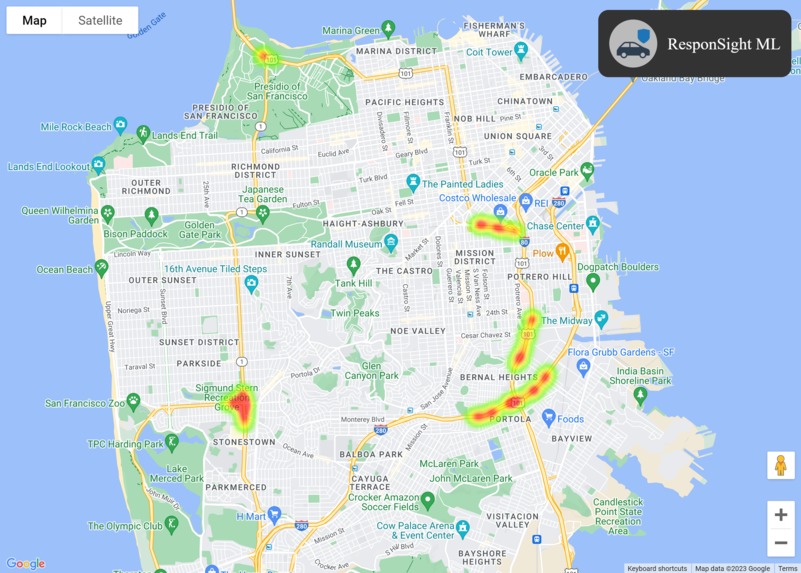
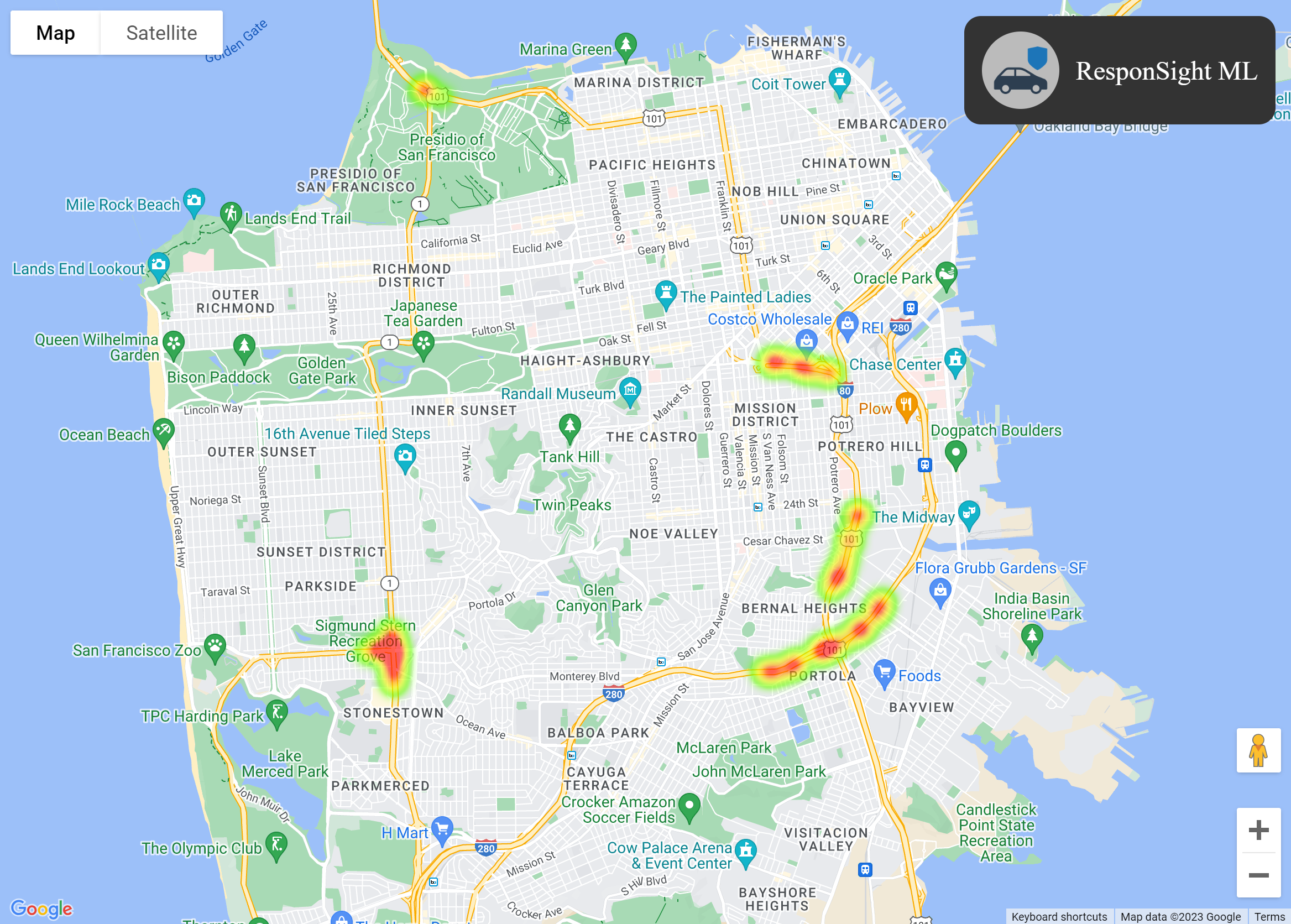
Heatmap of high risk areas in San Francisco
Inspiration
If you haven't personally needed help from emergency medical services (EMS), chances are someone you love has. Our team was inspired to create ReponSight from personal experiences; we've had loved ones who received care from and provided care as EMS personnel. The goal is to support EMS in delivering optimal care by enhancing efficiency and reducing response times.
What It Does
Response Sight provides an intuitive graphical interface, displaying a heatmap overlaid on Google Maps to identify areas where automotive collisions are likely to occur. The intention is to enable EMS to anticipate accidents and allocate personnel preemptively to high-risk areas. In urban environments, this ensures ambulances can reach people in critical condition without battling traffic. In rural areas, it minimizes travel distance to reach response-sites. These predictions are made by leveraging data on automotive collisions, weather conditions, and traffic flow to build a robust machine learning model for predicting the likelihood of accidents.
How We Built It
We were lucky enough to have a team of six. We divided according focusing on three key areas that we developed in parallel.
1. The Frontend
Pierce, our lead frontend engineer, stood our website up on an AWS bucket. We've used Google APIs to integrate a realtime map as the website background, and Vite for our build pipe-line.
2. The Backend
Marc, our AWS expert, established the infrastructure on AWS. An API Gateway was created to tunnel to a proxy service to query the INRIX API using a Lambda function. The Lambda function was also responsible for querying the Sagemaker endpoint. The code for the Lambda Function was created by Pierce, and peer programmed with Marc and Felix.
3. The Model
Cody, Ben, Willem, and Felix, focused on the data science and machine learning (ML) asepects of the project. When we investigated the data INRIX exposes via its APIs we found that while its a good start its not enough. For reasons explained in the challenges section we elected to generate synthetic data to build our demo. After creating our dataset we used Sagemaker's numerical prediction model to give the percent likelihood of an accident occuring. We deployed the model, and connected it to AWS's lambda function.
Challenges
Like any good hackathon we ran into our fair share of challenges.
1. API Woes
We originally intended to use ML to make recommendations for traffic camera placement based off integrating historic collision data and INRIX's API pertaining to traffic camera location. However, four hours into to building our project we discovered that the API we planned to use wasn't enabled for this hackathon. We should have validated that the API available before beginning development - oops!
2. Limited Data
Once we did get our API calls working, we realized we could not query historic data from Inrix. Furthermore, one of the return values of a relevant API was broken.
3. Deployment Fumbles
Our Sagemaker ML model wouldn't deploy. Turns out are account didn't have the proper permissions to deploy. After being issued a new account with the proper permissions we were back in the runninng!
Accomplishments
First, we are extremely proud to have a working demo in this short timeframe. However, there are a number of smaller achievments that we are feel worth noting:
1. Adaptability
We had originally come into the hackathon with a very different idea for what we wanted to do. After hitting a number of blockers (API issues) the team was able to pivot and create a deliverable with tools we were given.
2. Ease of Use
Much effort was put into devloping a clean and intuitive website that would make our product a joy to use.
3. Our First-Hackathon!
Out of our six team members, this was the first hackathon for five of them. Regardless of how we place we're proud to have participated and given it our best effort.
What We Learned
1. How to Deploy ML Models
Many of our group members have classroom expierience with machine learning. However, this was all of our's first time actually deploying a model for a project.
2. Communication
While we knew commuication is critical for an agile development environment, we gained hands on expierience practicing the theory!
3. Laugh a lot
There were many stressful moments during development. We kept the team cohesive by constantly joking - keeping morale high.
What's next for ResponSight
We hope to continue ResponSight as a collective personal project, building off the team synergy we've forged in this hackathon!
Built With
- amazon-web-services
- juypter
- kaggle
- sagemaker
- vite
- vuejs


Log in or sign up for Devpost to join the conversation.