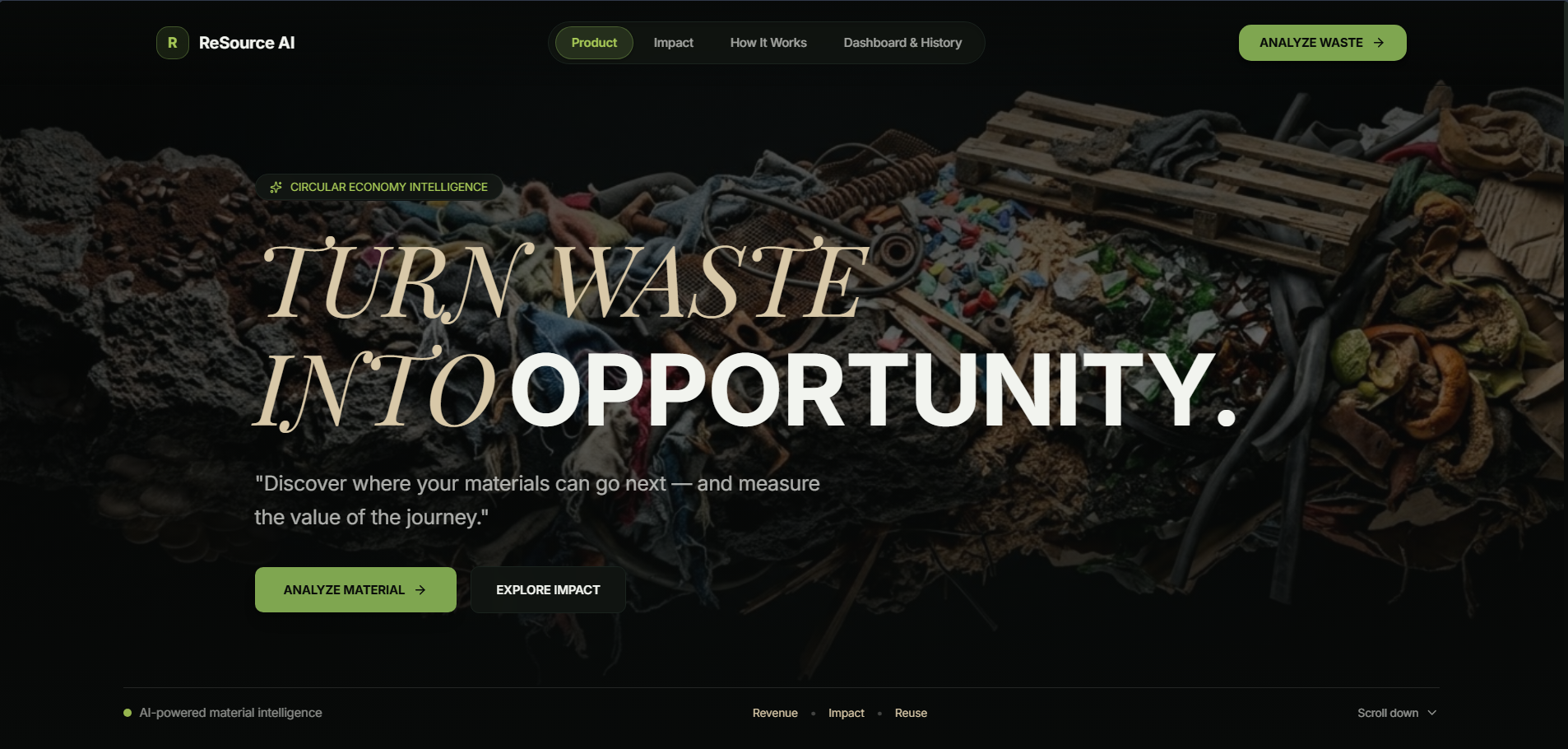
Inspiration
Factories generate huge amounts of usable byproducts every day — sawdust, coffee grounds, fly ash, polymer scraps, and more.
The problem is that one company's waste can be another company's raw material, but finding that connection isn't easy. Waste is described differently by every business, buyers are difficult to discover, and companies often can't clearly see the financial or environmental benefit of reuse.
We built ReSource AI to solve that.
Simply describe a waste stream, and ReSource AI finds potential buyers, estimates the financial opportunity, and calculates the potential carbon impact.
What it does
Describe the waste Enter a simple description like: “We produce 4 tons of clean wood shavings every week in Chakan.”
Find potential buyers ReSource AI matches the material with nearby businesses based on compatibility, capacity, distance, and value.
Calculate carbon impact The system estimates avoided landfill emissions, virgin material displacement, and transportation emissions.
Compare scenarios See the difference between landfill disposal and potential reuse in terms of cost, revenue, and carbon impact.
Take action Get compatibility notes, quality-check suggestions, and a ready-to-send B2B outreach email.
Track impact Previous analyses are saved in a dashboard with financial, environmental, and network insights.
How we built it
AI: Google Gemini 2.5 Flash + Pydantic Used for natural-language understanding, material extraction, matching explanations, and outreach generation.
Backend: FastAPI + Python Handles material matching, geographic calculations, carbon accounting, financial calculations, and SQLite storage.
Frontend: React + TypeScript + Vite Built with Tailwind CSS, Motion, Recharts, and Lucide Icons.
A key design decision was keeping AI and calculations separate. Gemini understands the data, while our backend performs the actual carbon and financial calculations.
Challenges
Reliable carbon calculations LLMs can produce inconsistent numbers, so we moved all carbon calculations into deterministic backend logic using fixed emission factors.
Messy industrial terminology Users don't always use standardized material names. We combined AI extraction with normalization and fallback rules.
Choosing the right buyer The closest buyer isn't always the best one. Our matching system considers capacity, compatibility, distance, and commercial value.
What we're proud of
- Fast waste-to-match analysis
- Auditable carbon calculations
- Financial and environmental impact in one view
- Interactive supply-network visualization
- Offline fallback for core functionality
What we learned
AI is great at understanding messy information, but important calculations should remain deterministic.
We also learned that sustainability needs a business case. Showing companies how much they can save or earn makes circularity much easier to act on.
Finally, distance matters. A circular solution isn't truly sustainable if transportation emissions outweigh the benefits.
What's next
- Real-time logistics and freight estimates
- Digital Product Passports for secondary materials
- Direct B2B negotiations and transactions
- Expansion from regional industrial clusters to larger markets
Our vision is simple: turn industrial waste into a resource before it becomes waste.
Built With
- fastapi-(python-3.10+)
- gemini
- lucide-icons
- motion
- pydantic-v2
- react-19
- sqlite
- tailwind-css
- typescript
- vite


Log in or sign up for Devpost to join the conversation.