-

Culture becomes connection. Original AI-generated brand artwork for Resonance.
-
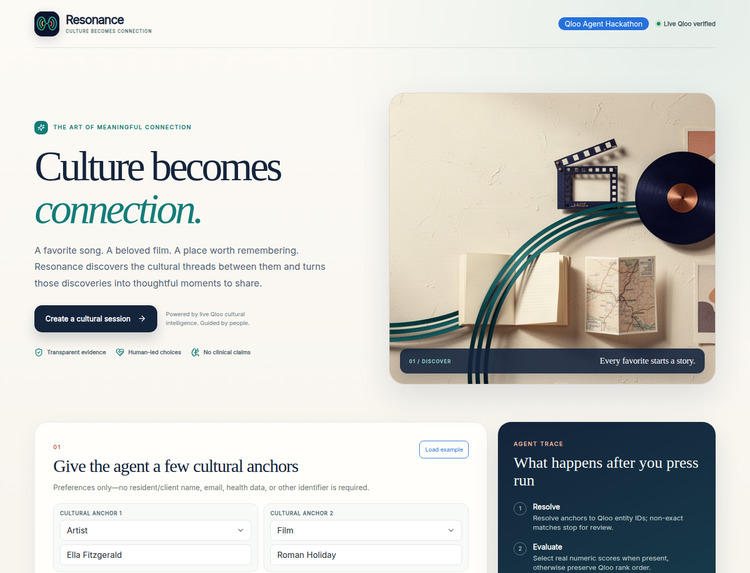
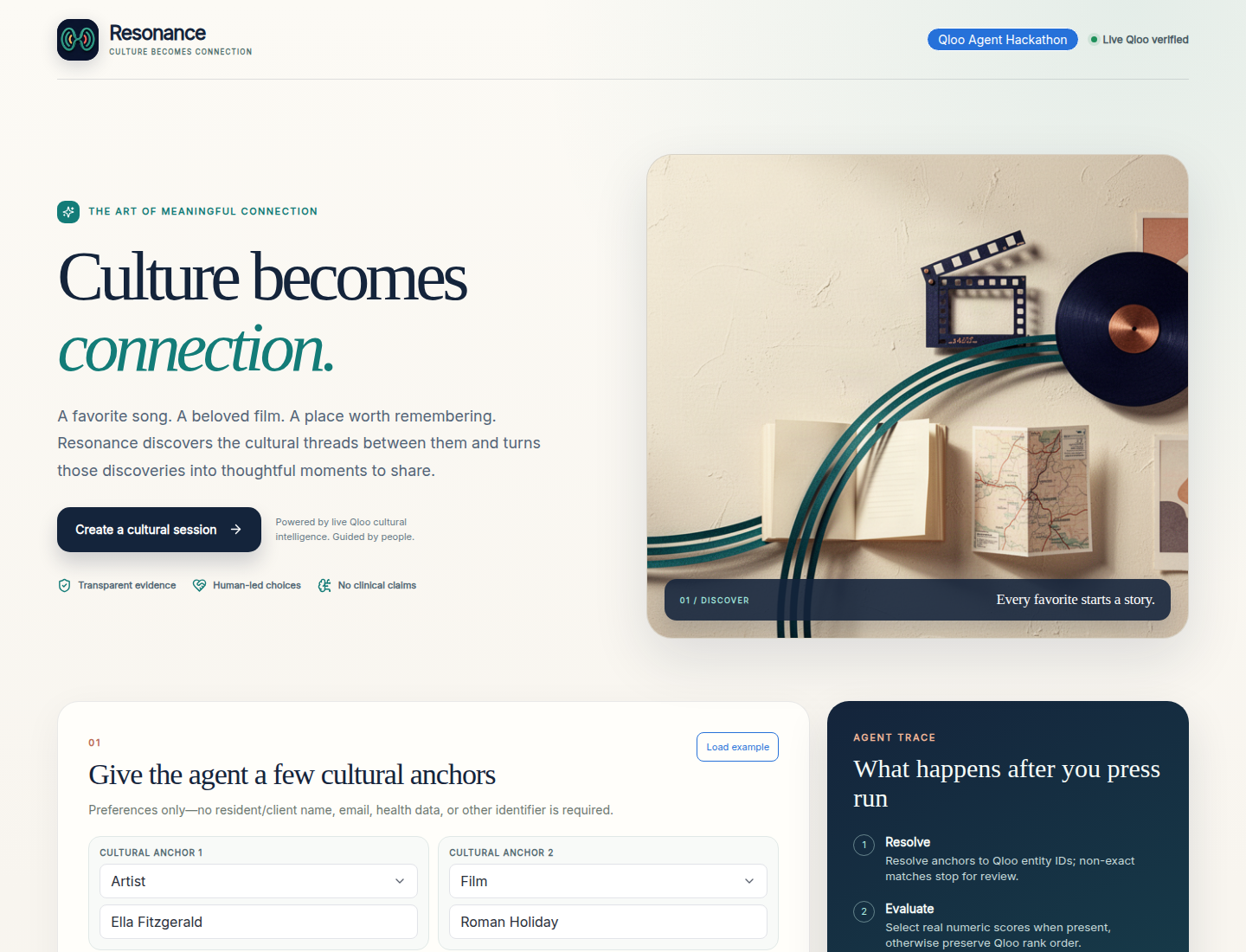
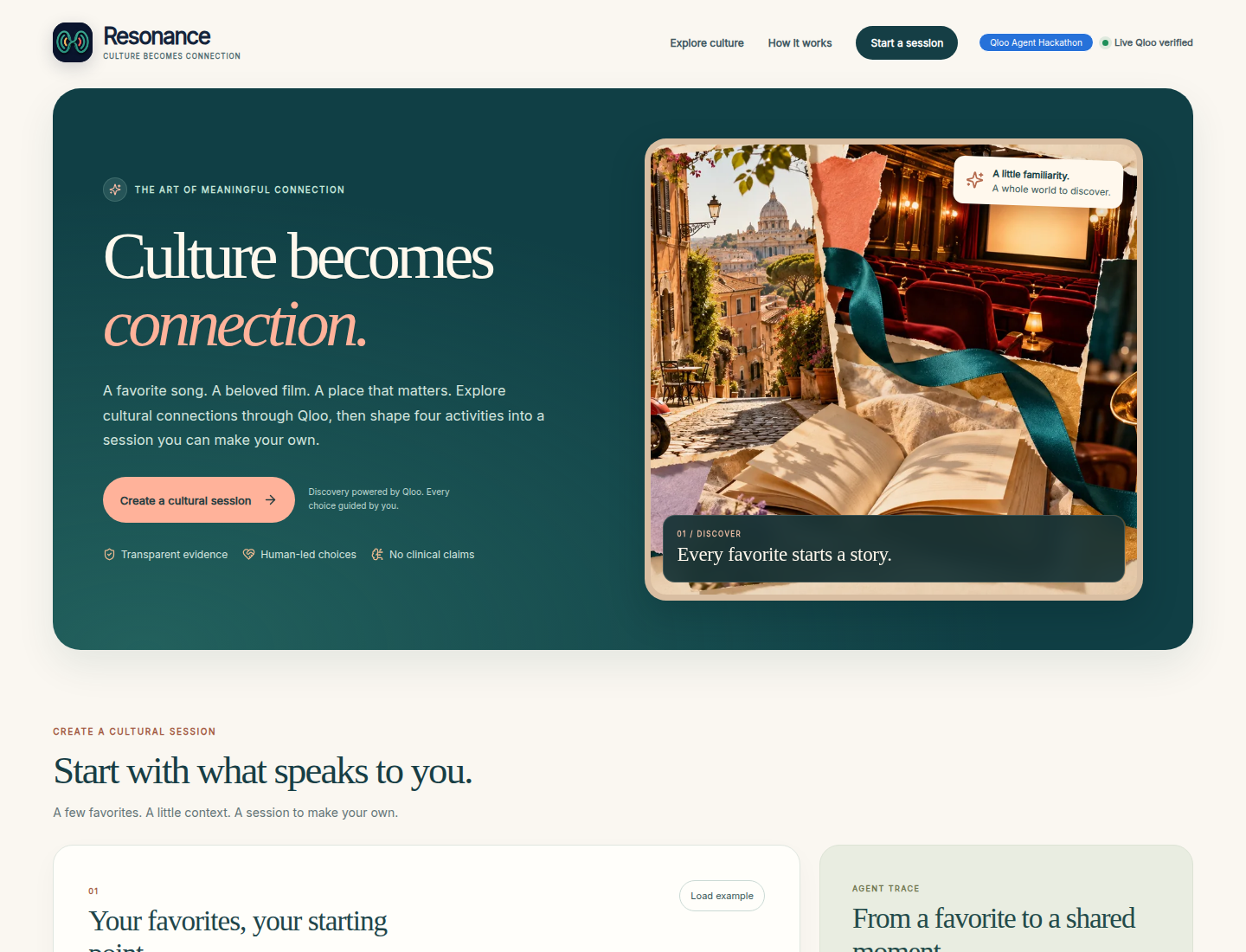
Actual product capture · Oct 8, 2026. Cultural favorites, session preferences, and the Resonance desktop experience.
-

A familiar interest can start a conversation. AI-generated concept scene; not actual participants or a testimonial.
-

Music. Films. Books. Places. A colorful world of cultural starting points. Original AI-generated editorial artwork.
-
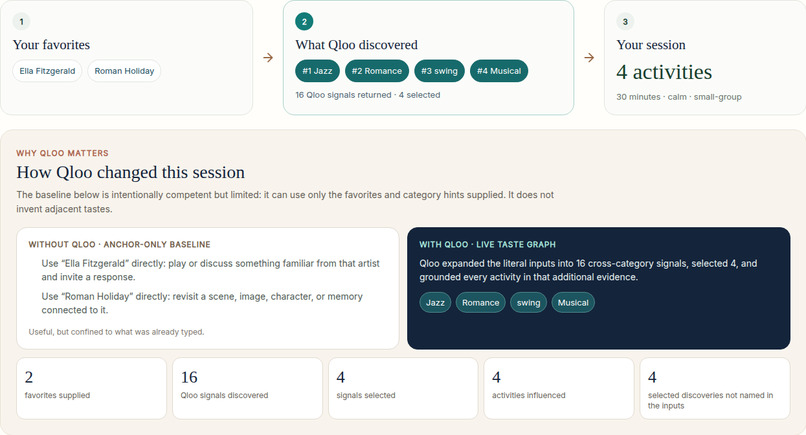
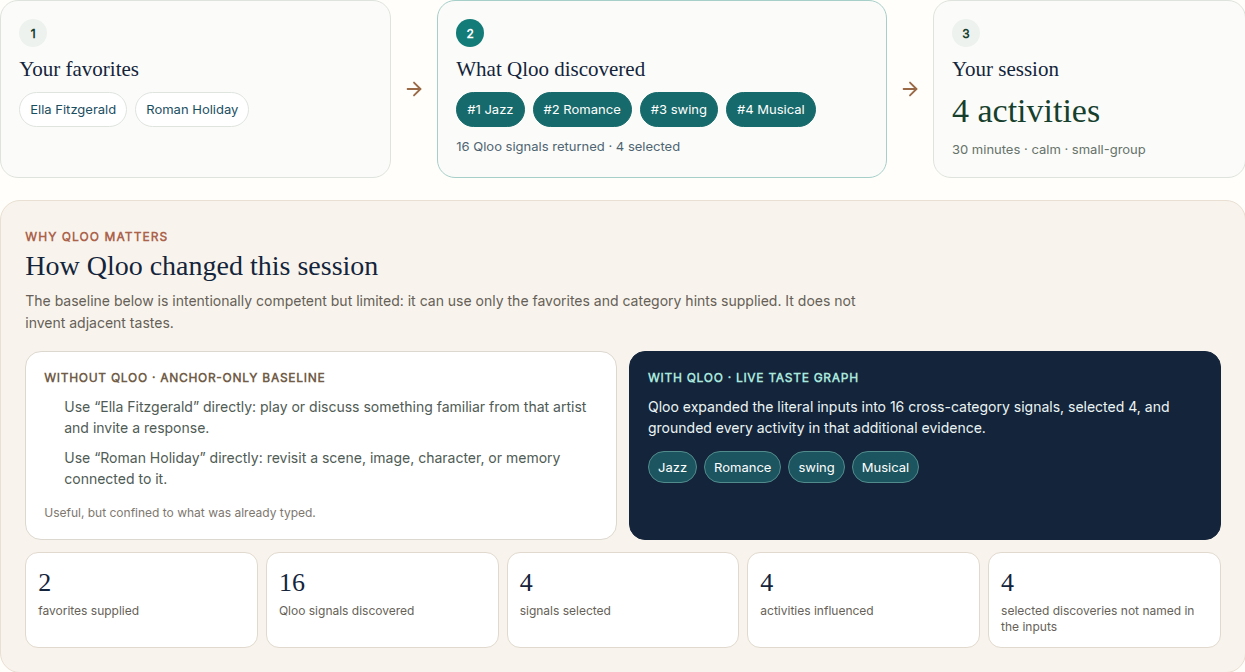
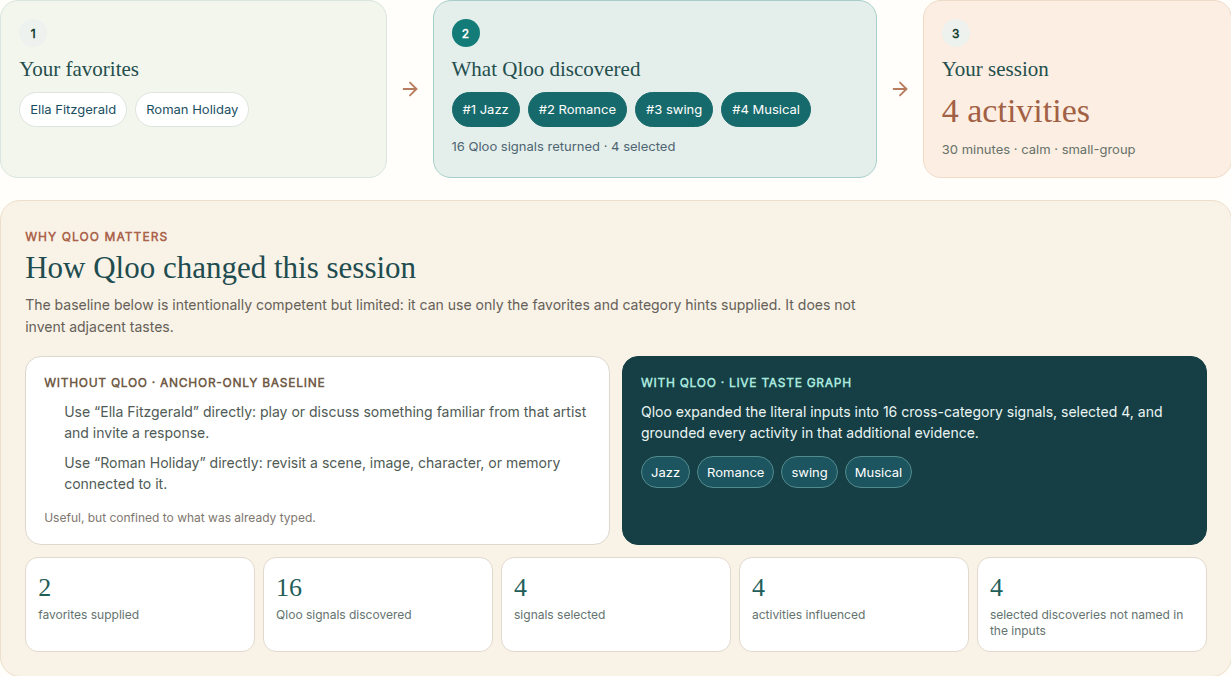
Actual product capture · Oct 8, 2026. Same favorites, anchor-only baseline, and Qloo discoveries. Live results vary.
-
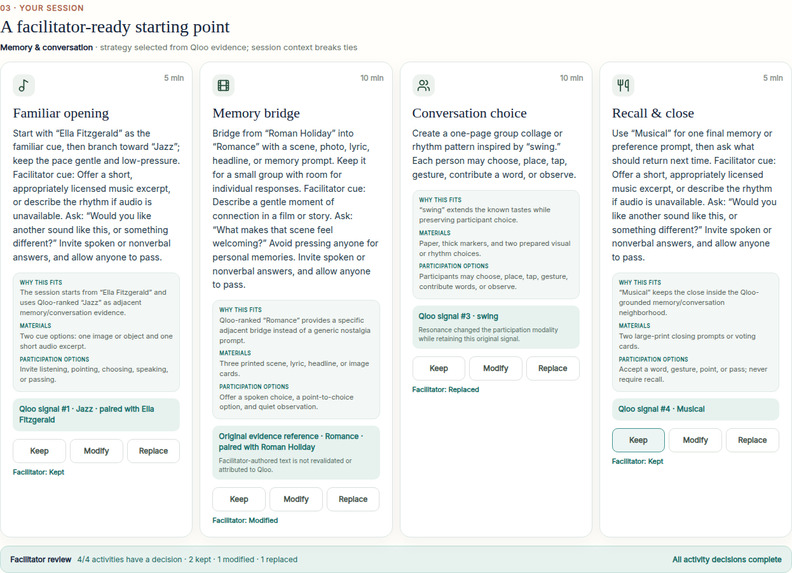
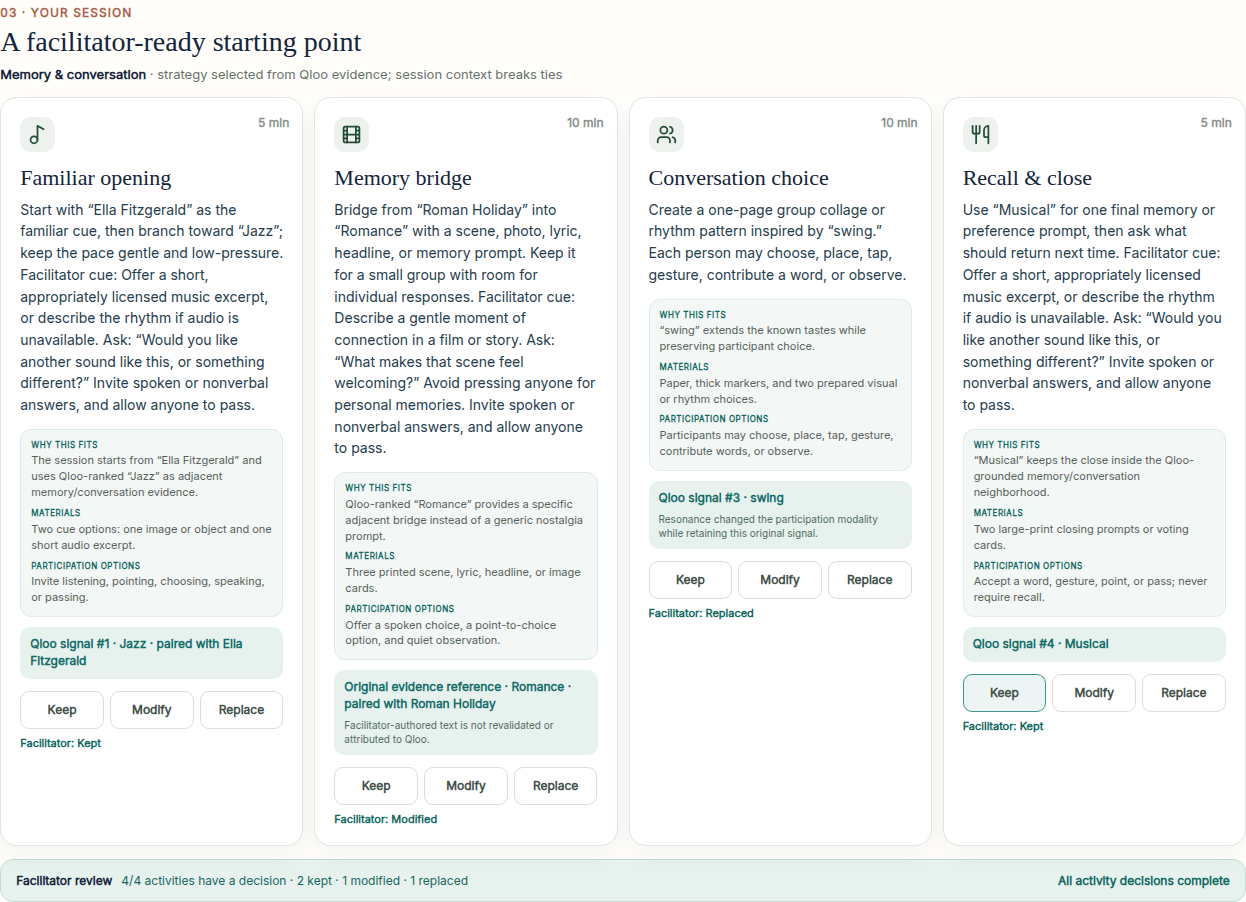
Actual product capture · Oct 8, 2026. Four activities with Keep / Modify / Replace controls and facilitator decisions.
-

A favorite song. A story waiting to be shared. Original AI-generated music artwork for Resonance.
-
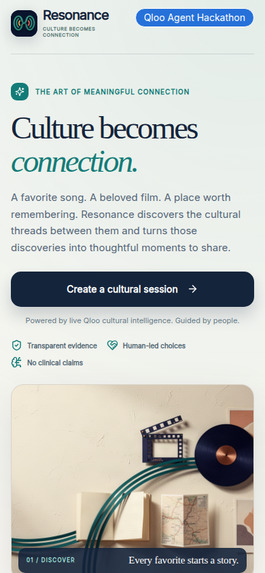
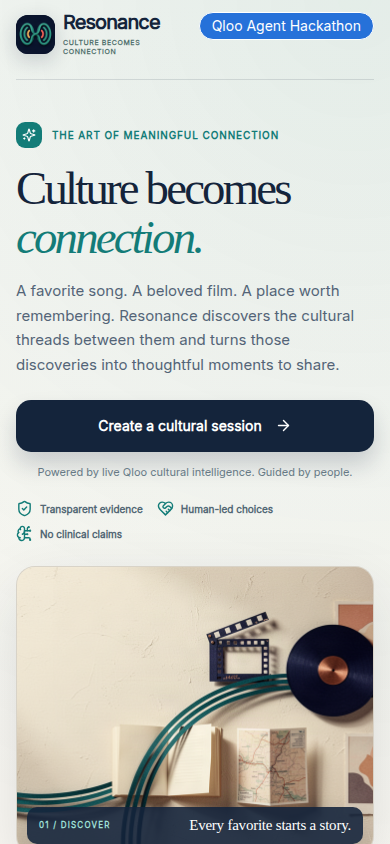
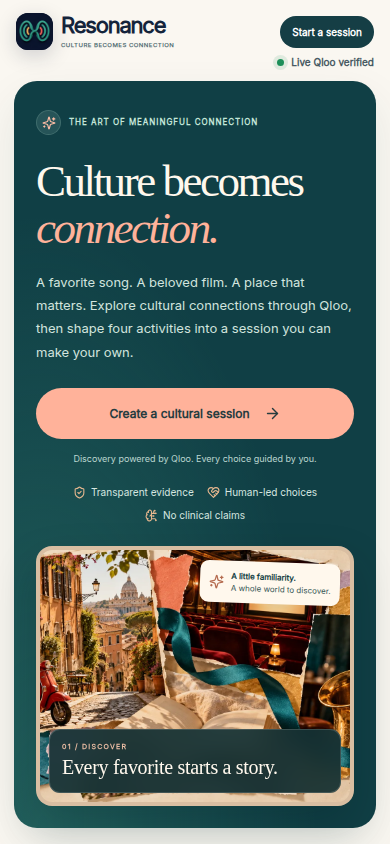
Actual product capture · Oct 8, 2026. Resonance’s responsive entry screen at an iPhone-sized width.
-
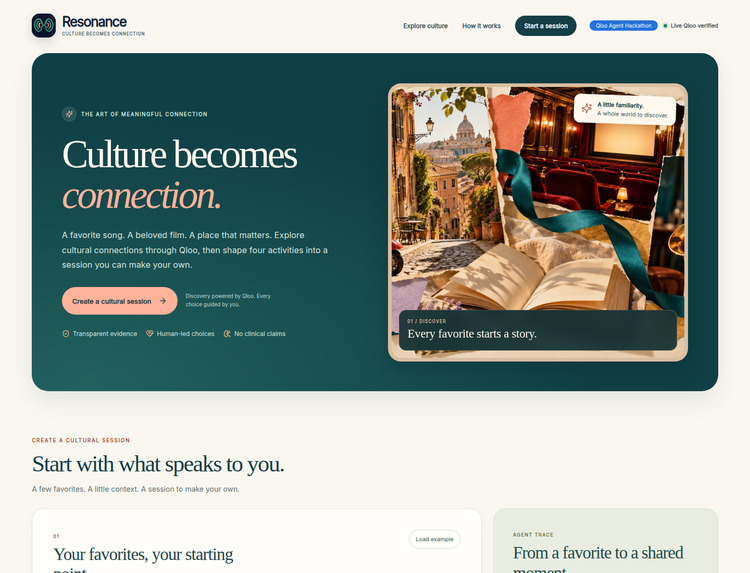
Updated October 22, 2026 — published Resonance desktop homepage and Qloo session-builder entrance.
-
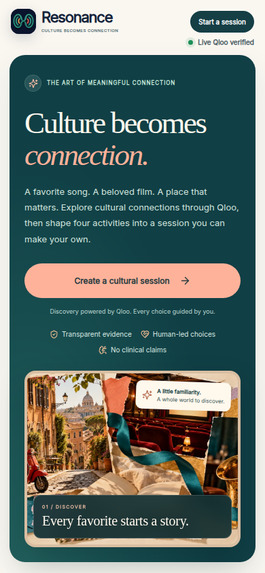
Current Resonance iPhone homepage — October 22, 2026 responsive release.
-
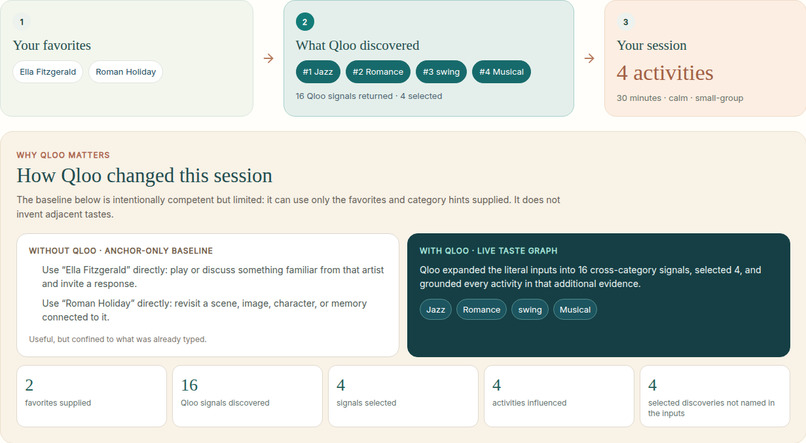
October 22 live Qloo run — cross-category signals compared with a literal anchor-only baseline.




Culture becomes connection.
A favorite song. A familiar story. A new way to connect.
Resonance starts with what someone loves—and helps a facilitator explore what comes next. It turns two to four cultural favorites into an explainable activity session, using Qloo’s cultural intelligence and keeping every decision in human hands.
Built for activity and recreation teams and family caregivers, it brings discovery, practical planning, and personal judgment together.
Explore Resonance →
Original AI-generated concept artwork. The people shown are fictional, not study participants or testimonials.
01 · Start with what they love
A singer. A beloved film. A book. A place that matters.
Activity teams may know only fragments of someone’s interests. Turning those fragments into a thoughtful group session can mean starting from a blank page. Resonance gives those familiar favorites a practical next step.
Enter two to four cultural anchors, then choose the energy, setting, and session length: 30, 45, or 60 minutes. No resident name, diagnosis, or personal identity profile is required.
A familiar song can be a starting point. Original AI-generated editorial artwork.
02 · Follow the cultural threads
Resonance resolves the favorites through Qloo’s live search and retrieves related music and media genre signals. A non-exact match pauses for explicit review before taste analysis. Returned evidence stays visible; scores are never invented.
The same inputs appear in an anchor-only baseline and a Qloo-expanded plan, so you can inspect what the cultural discoveries actually contribute. Each selected signal connects to an activity, with a trace through Resolve → Evaluate → Compose → Explain.
Music, film, books, and places. Original AI-generated artwork illustrating the project’s cultural theme.
Actual product capture, October 8, 2026. This example shows one recorded result; live Qloo responses can vary.
03 · Make the session yours
Resonance creates four timed activities, with concrete cues, approachable questions, materials, and ways to participate verbally, nonverbally, or simply pass.
Keep / Modify / Replace puts every suggestion in the facilitator’s hands:
Keep an idea that fits the group. Modify the wording or approach. Replace an activity with a more suitable choice.
Then copy or print the reviewed plan. Your edits remain your contributions, clearly separated from Qloo’s evidence.
Actual product capture, October 8, 2026. Four activities, with all four facilitator decisions recorded.
People lead. Resonance supports.
Every activity includes a rationale, practical guidance, and participation alternatives. A visible and exported safety preflight prompts staff to check relevant food, swallowing, allergy, mobility, fall, sensory, and facility requirements without entering health data.
Resonance supports cultural-engagement planning. It is not a clinical intervention or medical advice.
October 22 release — judge audit remediation
The current public app now prioritizes session creation, uses six optimized original WebP artworks, lets the four cultural cards preselect an input category, and supports TXT download, on-device saved plans, and a manual-copy fallback when clipboard permission is blocked.
The recommendation engine also refuses to attribute a Qloo session-wide genre to an incompatible individual favorite. For example, a verified public The Hobbit + Kyoto run stopped for non-exact book-title review, then built the Kyoto activity using place imagery rather than falsely linking Kyoto to Science Fiction & Fantasy. Raw returned Qloo tags remain inspectable; malformed labels are excluded from selected activities, and rank-order signals are not displayed as probabilities.
Twenty synthetic regression cases check structural safety and source attribution. They are not human-user validation or proof of improved plan usefulness. The prior unfavorable blinded synthetic comparison and zero verified target-user responses remain disclosed below.
Live release evidence: https://github.com/P00NSMASHER/resonance-qloo/blob/main/BUILD_RECEIPT.json
Warm design. Inspectable engineering.
The responsive interface combines editorial typography, Cultural Atlas artwork, midnight ink, peacock teal, warm ivory, and coral accents, with keyboard focus states and printable plans.
React, TypeScript, and Floot connect to Qloo’s /search and /v2/insights endpoints. Deterministic composition, signed entity-review receipts, server-side secrets, strict origin checks, timeouts, rate limits, bounded caching, and provenance checks protect the live path.
Live mode requires verified Qloo readiness. The separately labeled illustrative preview lets visitors explore the interface with example data. Public source, automated tests, and the build receipt document the implementation.
What we learned
Early unfiltered signals sometimes produced awkward activities. The newer workflow requests music and media genre families and pairs the returned signals with more concrete facilitation cues.
An unfavorable historical synthetic evaluation remains public: five blinded proxy evaluators preferred the anchor-only plan 4/5 times, with one tie and zero Qloo-plan wins. An earlier preregistered 12-candidate live sweep found no replacement meeting its locked 98/100 and unanimous-approval gate. The retained candidate was not declared a winner.
These were synthetic evaluations. Newer improvements have not established superiority with real participants. The published validation record contains zero validated real-user responses. We make no demonstrated time-saving, usefulness-rating, adoption, testimonial, or clinical-outcome claims.
The lesson: novelty still needs human judgment. The voluntary study is available for gathering honest feedback, including negative results.
Your favorites. New possibilities. Your call.
Open the app and check for Live Qloo verified. Try Ella Fitzgerald and Roman Holiday, with calm energy, a small group, and 30 minutes.
Select Build with live Qloo, follow Your favorites → What Qloo discovered → Your session, and compare the baseline with the Qloo-expanded result. Review the four activities, then open the audit trail to inspect the evidence.
Try Resonance →
Live app: https://resonance-qloo.floot.app Source: https://github.com/P00NSMASHER/resonance-qloo
Judge guide · Evaluation evidence · Recorded live evidence
Built specifically for the Qloo Agentic Hackathon. Development began September 30, 2026. Gallery artwork is identified as illustrative; interface screenshots are dated product captures.
Built With
- agentic-ai
- github-actions
- model-context-protocol
- node.js
- openapi
- qloo
- react
- typescript
- vite

Log in or sign up for Devpost to join the conversation.