-
-
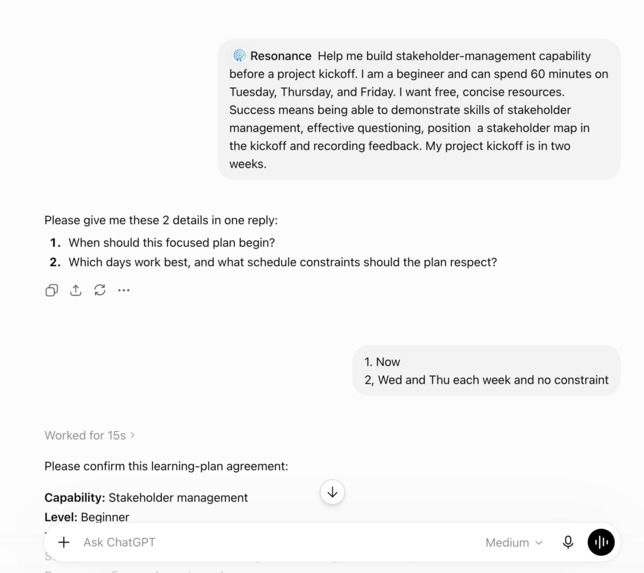
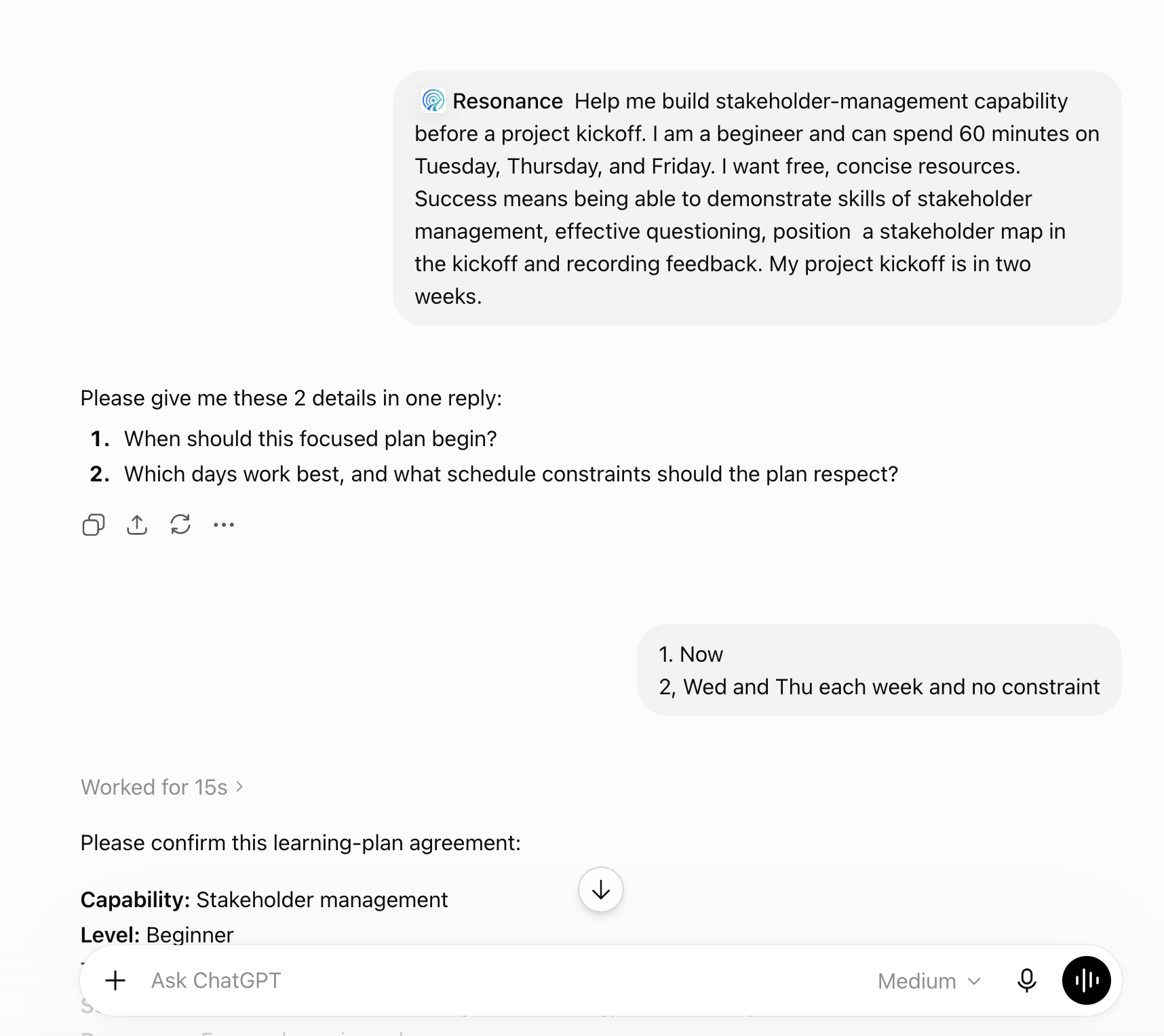
Using the plugin in a ChatGPT brainstorming conversation
-
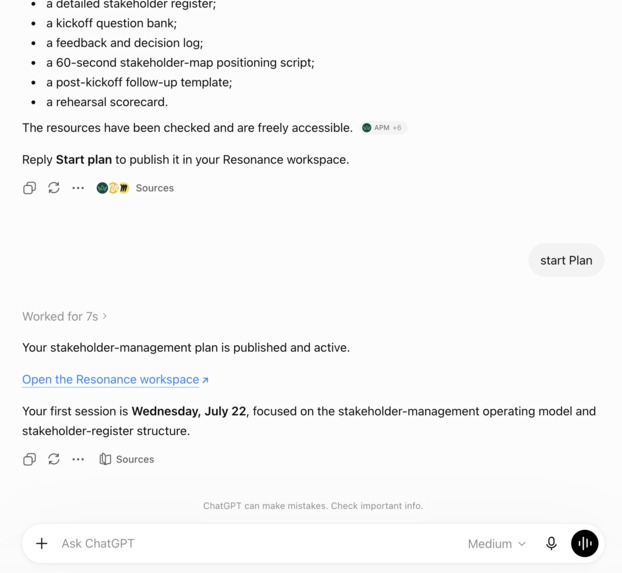
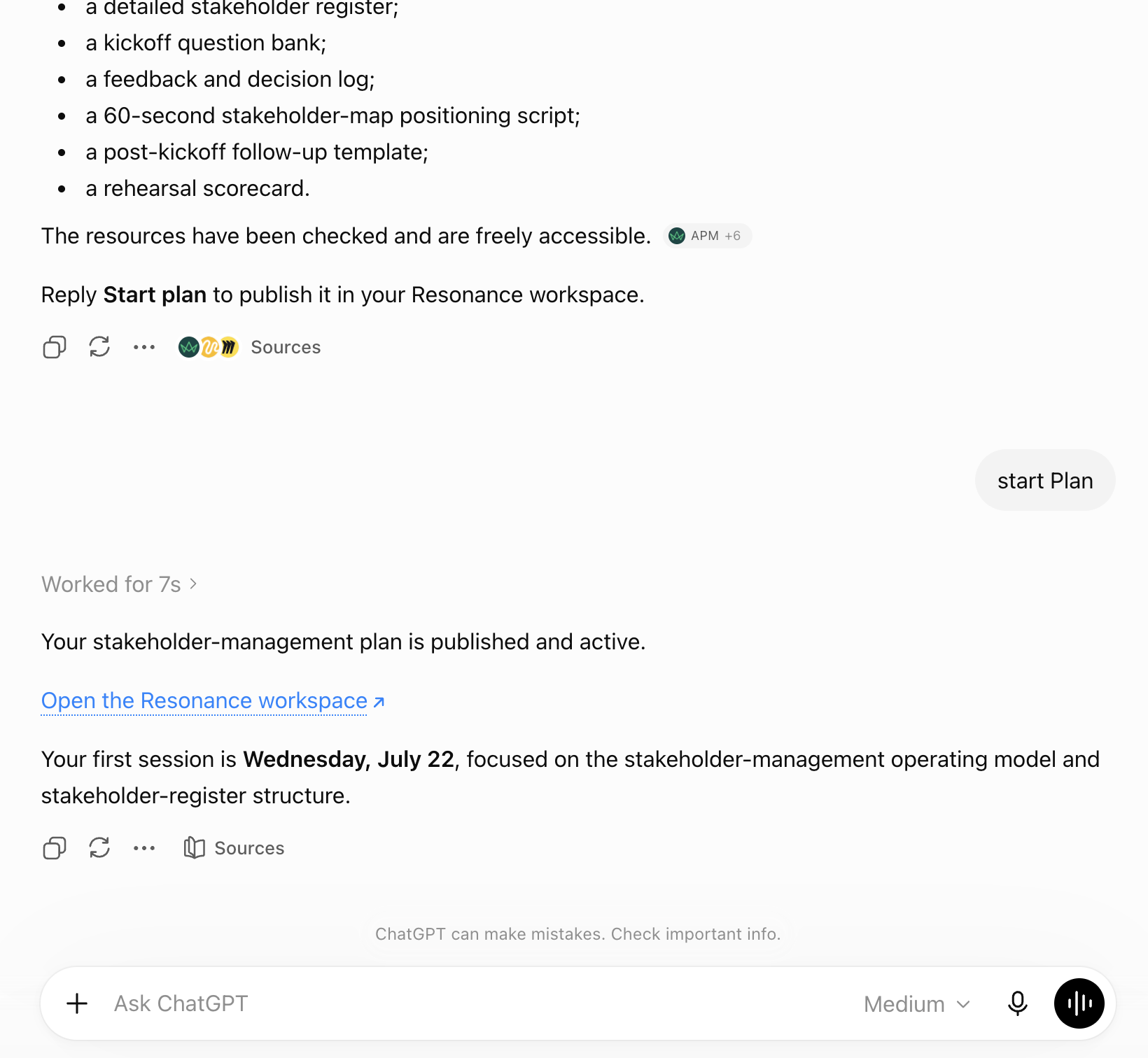
Plugin does the work, confirm the plan and deploys in a dedicated user specific workspace.
-
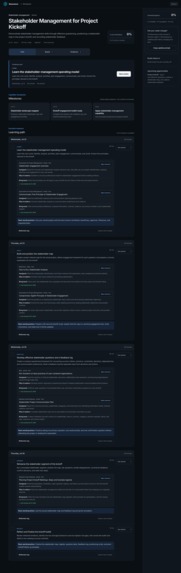
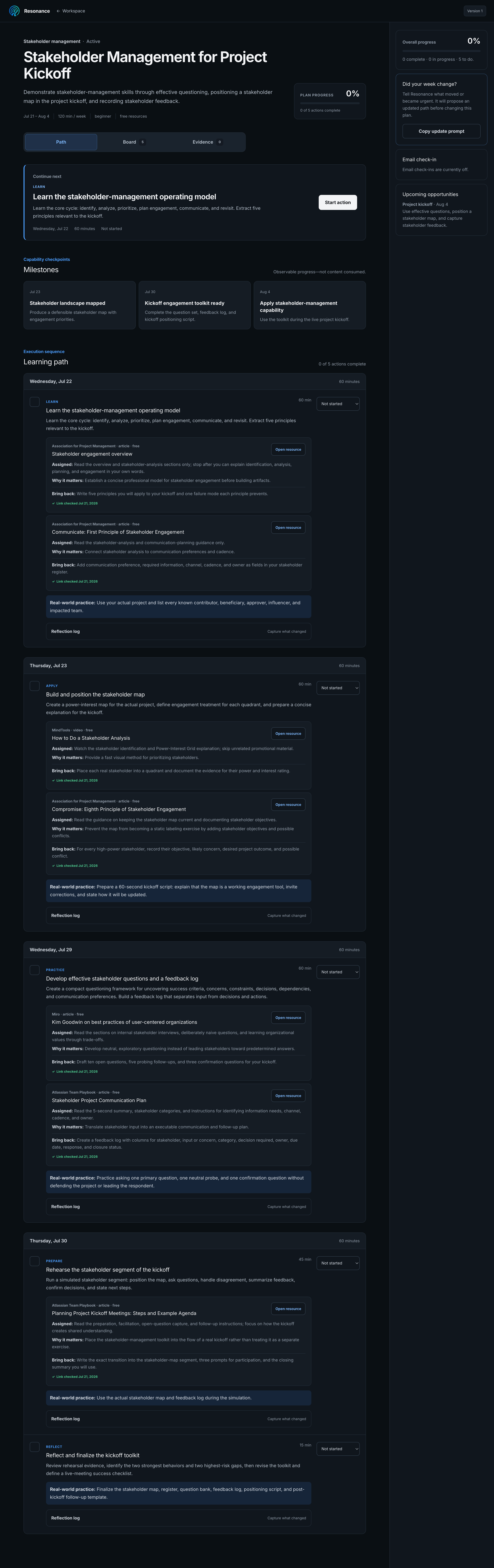
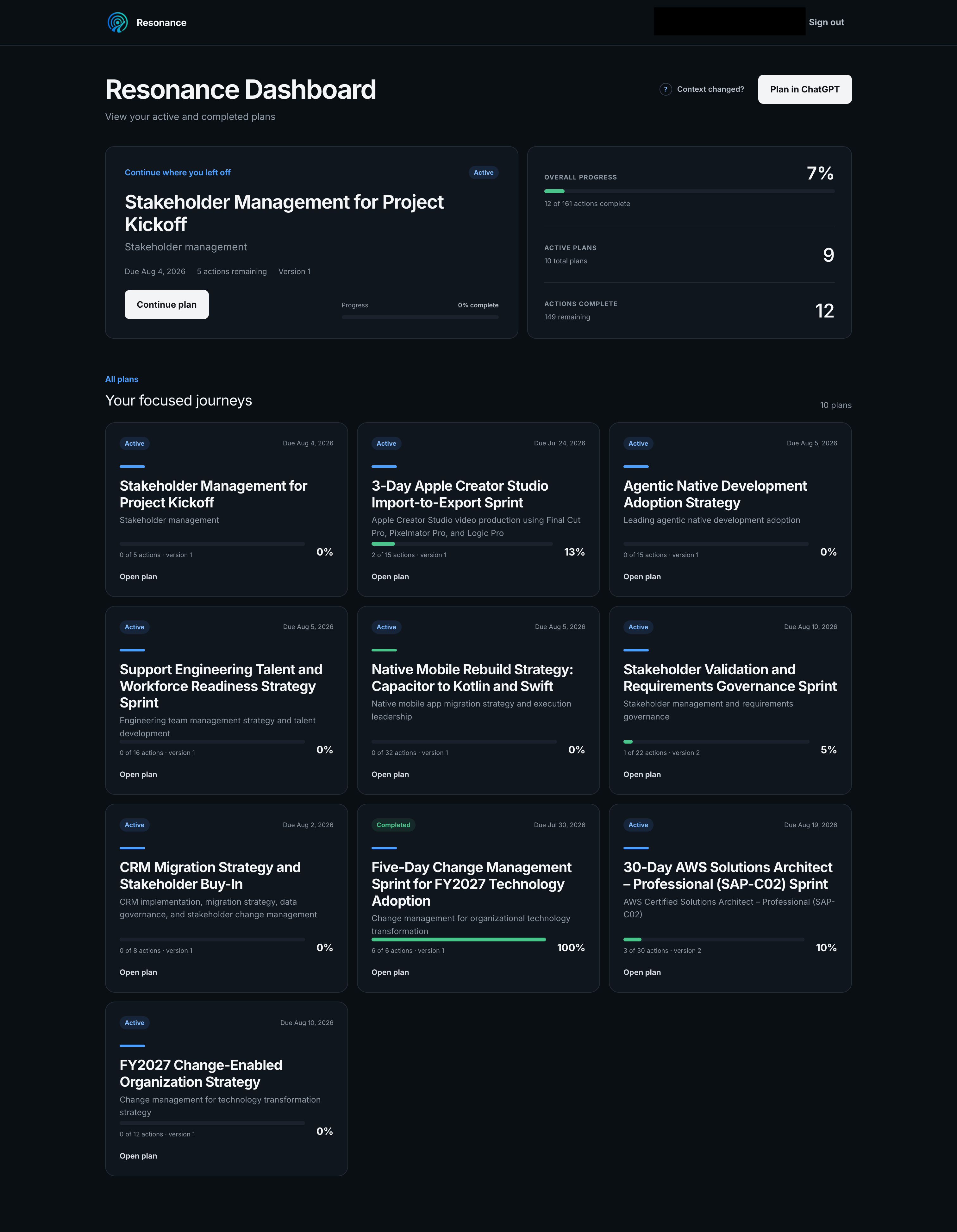
Sample deployed workspace with learning resources and trackable controls for the user
-
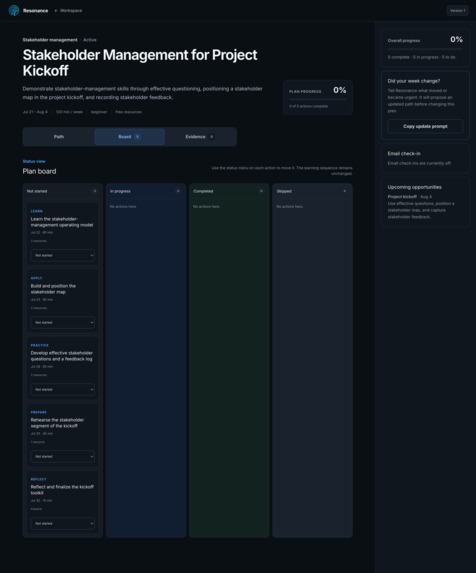
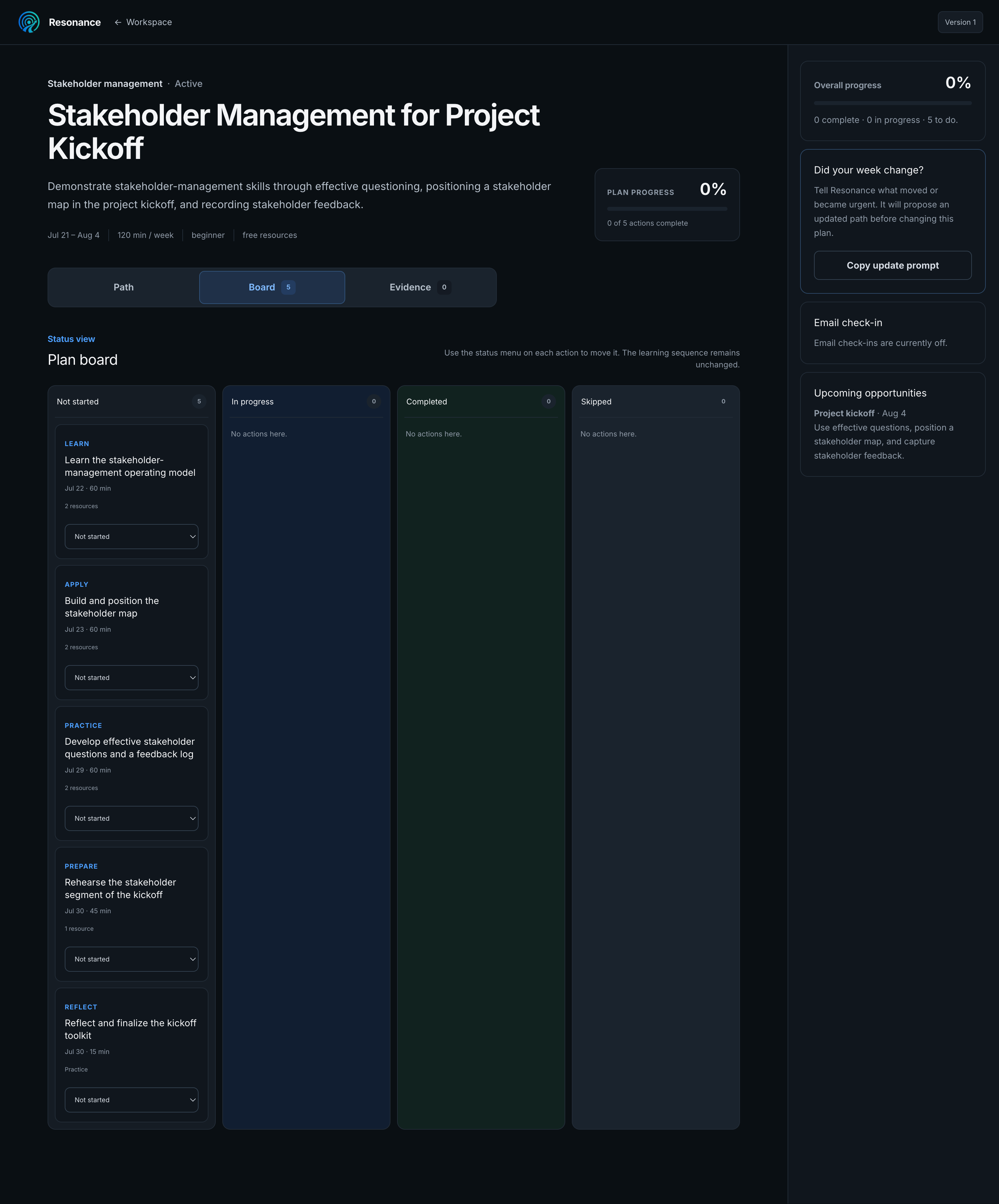
Progress tracking board
-
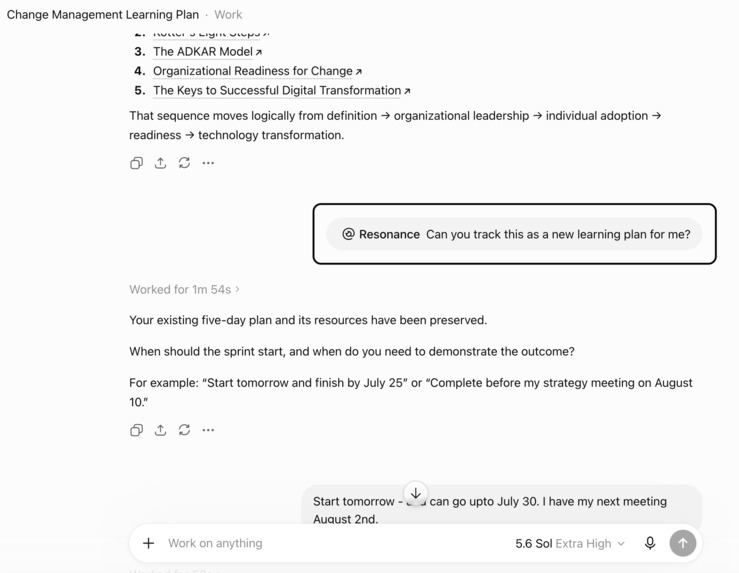
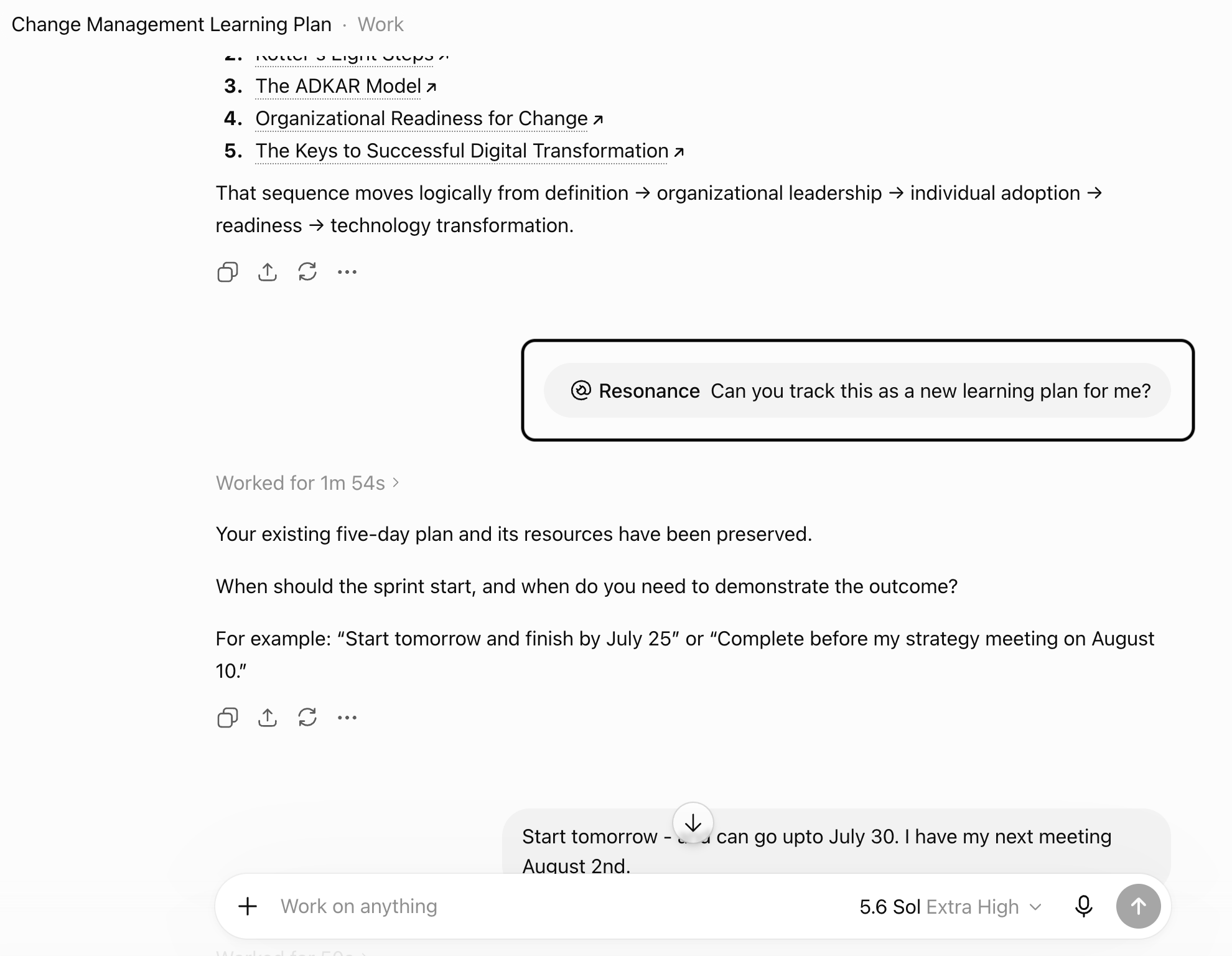
Adding plugin midway to a thread. Plugin then validate and publish the plan in the workspace
-
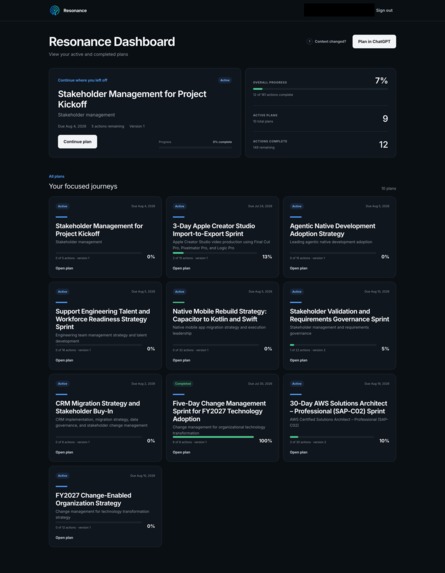
Resonance Dashboard deployed in ChatGPT Sites. Unique to the user and protected with ChatGPT account OAUTH login.
-
Inspiration
Frontier models can help us think through almost anything: a professional goal, a new project, a complex decision, a strategy, or a personal ambition.
But even an excellent conversation can lose its value if the important conclusions do not have a followup mechanism, while the user still has to organize the next steps, fit them into real life, track what happened, and decide how to respond when circumstances change.
I built Resonance around that gap.
What if the valuable outcome of a ChatGPT conversation could become a living, trackable, and measurable plan in a dedicated workspace?
Resonance gives conversational intelligence a dedicated workspace to continue. Instead of ending with an answer, the conversation can become an evolving path. The idea is to make it easy for the user to turn their intention into a guided execution.
Resonance is a product of imagination where intelligence produced in a ChatGPT conversation does not disappear when the conversation ends.
The MVP demonstrates this through professional capability development, but the underlying idea is broader: plans created through conversation should remain useful after the conversation ends.
What it does
Resonance turns a goal or an existing structured conversation into a persistent execution plan.
The user can begin with a new objective or bring in a plan they have already developed with ChatGPT. Resonance then helps clarify the intended outcome, success criteria, available time, existing context, constraints, important dates, preferred resources, and the evidence that would demonstrate meaningful progress.
Once the user confirms that understanding, Resonance creates a structured path containing milestones, actions, resources, practice, reflection, and measurable outcomes.
Before publication, the plan is checked for,
- How much time the user can spend meaningfully
- What is their timeline to achiving this goal
- Clear and actionable steps
- Does the observable outcomes resonate with the user
- What resources the user prefer, free vs paid and what form of content such as short videos, research articles, books etc.
- Adequate space for review and recovery
The user reviews the plan before it is published to a persistent ChatGPT Site.
The Site becomes the dedicated execution workspace where the user can:
- See the current objective and next action
- Follow the plan chronologically
- Review work by status
- Record progress, evidence, reflections, and blockers
- Understand whether execution remains on track
- Review recent activity
- See how the plan has changed over time
When circumstances change, Resonance creates a revision proposal, explains the impact, and activates a new version only after the user confirms it.
This results is a continuous loop:
Conversation → Structure → Validate → Execute → Observe → Adapt
How we built it
Resonance was built using ChatGPT with 5.6 Sol, Codex, TypeScript, MCP, and ChatGPT Sites.
5.6 Sol played two important roles.
First, it was the primary development engine working through Codex. It helped transform the original concept into a focused MVP, reason through architectural decisions, implement the plugin and Site, debug real platform behavior, review security boundaries, create tests, refine the interface, and prepare the project for deployment.
Second, 5.6 powers the reference reasoning experience within Resonance. It helps interpret the user’s objective, identify missing context, organize a coherent path, evaluate progress, and assess the impact of requested changes.
Codex served as the engineering environment and development collaborator throughout the build. I used it to:
- Review the original product conversations that I had in ChatGPT web (The idea was imported to Codex by referencing the thread)
- Research the available OpenAI platform capabilities
- Brainstorm and define the MVP boundary
- Design & validate the system architecture
- Organize development into reviewable implementation slices using custom skills in my Codex (I use a solutions architect skill)
- Build the TypeScript plugin and MCP server
- Implement the persistent Site
- Create the plan-versioning and confirmation model
- Build authentication and authorization controls
- Implement resource verification
- Develop automated tests
- Diagnose real ChatGPT and deployment behavior
- Review accessibility, responsive behavior, and interface quality
- Harden the system against malformed input and unauthorized access
- Prepare technical and submission documentation
The system includes a packaged Codex plugin, a TypeScript MCP server with 12 focused tools, durable Site-managed storage, Sign in with ChatGPT, owner-scoped access, one-time plan-claim links, verified resources, revision history, progress tracking, and an email transport layer for future continuity features.
A central architectural decision was to separate reasoning from authority.
The model can interpret goals, compose plans, and explain recommendations. Deterministic server logic remains responsible for scheduling, capacity calculations, authorization, resource acceptance, state transitions, and activating new plan versions.
This allows Resonance to remain conversational without allowing an uncertain model response to silently change authoritative user data.
Challenges we ran into
One of the hardest challenges was discovering that making a plugin available to ChatGPT does not automatically make the surrounding conversation follow the intended product journey.
During an early real-world test, ChatGPT selected Resonance correctly but still moved directly toward a generic answer. Codex helped trace the problem to missing server-owned intake state.
We rebuilt the workflow around a stateful, confirmation-driven process that identifies what information is still missing, recommends the next question, preserves completed intake, and prevents premature plan publication.
Another challenge was maintaining one consistent source of truth across conversation and the Site.
ChatGPT is best suited to ambiguity, reasoning, and decisions. The Site is better suited to visibility, execution, and progress recording. A canonical, versioned plan model allowed each surface to serve a distinct role while remaining synchronized.
External resources introduced a different problem. A generated link may exist but still be irrelevant, inaccessible, misleadingly described, or hidden behind an unexpected paywall. We created a server-side verification process that checks resource safety, reachability, page identity, content type, and obvious access-label mismatches.
We also had to preserve the user’s intent when adopting an existing plan. Improving structure could easily become unwanted rewriting. Resonance therefore retains recognizable source steps while clearly identifying the changes needed for scheduling, validation, and tracking.
Finally, many important issues appeared only inside the real ChatGPT and Sites environments. MCP endpoint behavior, tool discovery, authentication, deployed versions, and model-tool interaction could not be validated entirely through local testing.
Accomplishments that we're proud of
I am most proud that Resonance became a working conversation-to-execution loop.
The deployed MVP can:
- Begin with a new objective
- Adopt an existing structured ChatGPT plan
- Preserve the user’s original intent
- Identify missing context
- Create and validate an executable plan
- Verify external resources
- Publish the plan to a persistent Site
- Record progress, evidence, reflections, and blockers
- Propose changes based on progress
- Activate confirmed revisions while retaining previous versions
- Protect personal plans through authenticated, owner-scoped access
- Provide a no-sign-in demonstration using fictional data
Codex-led reviews also identified subtle problems involving task order, capacity calculations, milestone completion, paused states, demo consistency, authorization, and malformed input.
What we learned
Useful plans are not defined by how detailed they appear. A plan becomes valuable when it reflects the user’s actual capacity, contains actions that can be executed, leads toward observable outcomes, and can recover when reality differs from the original assumptions.
Conversation and execution also require different interfaces. ChatGPT is the right place to think, clarify, and reconsider. A persistent workspace is the right place to see the current state, take action, and record what happened.
Most importantly, a trustworthy AI system must know when to ask, when to recommend, and when it does not have permission to act.
What's next for Resonance
The next stage is to expand Resonance from a focused hackathon MVP into a more general bridge between conversation and execution.
Near-term priorities include:
- Get my organization verified to list the plugin in the plugin repository
- Deploy the MCP on dedicated worker compute system or continue to evaluate the feasibility of ChatGPT Sites
- Completing production OAuth and the public plugin review process
- Adding scheduled, timezone-aware check-ins
- Supporting verified updates through email
- Revising the dashboard and plan view UI for a more polished and premium user experience.
- Expanding evaluation coverage for model and plan quality
- Adding user feedback intake and user analytics
- Improving resource ranking and replacement suggestions
- Exploring selective calendar integration for confirmed commitments
- A companion Mobile App
Over time, Resonance could support more kinds of structured outcomes created through ChatGPT: professional development paths, projects, strategic initiatives, personal goals, research plans, and other multi-step commitments.
The long-term goal is to ensure that the intelligence produced in conversation does not disappear when the conversation ends.
Built With
- chatgpt
- codex
- gpt
- gpt-5.6
- mcp
- next.js
- node.js
- openai
- plugins
- react
- sites
- typescript
- vite
- wrangler

Log in or sign up for Devpost to join the conversation.