Inspiration
Resonance Field was born from a simple question: what if a Reddit post wasn't just a static page, but a living, breathing ecosystem that an entire community could shape together? We wanted to build something that leveraged Reddit's unique social dynamics — the hivemind, the daily ritual of checking in, the collective joy of optimizing toward a shared goal.
What it does
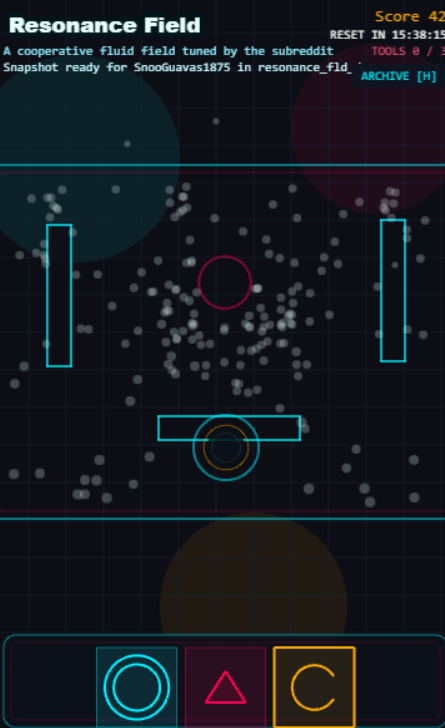
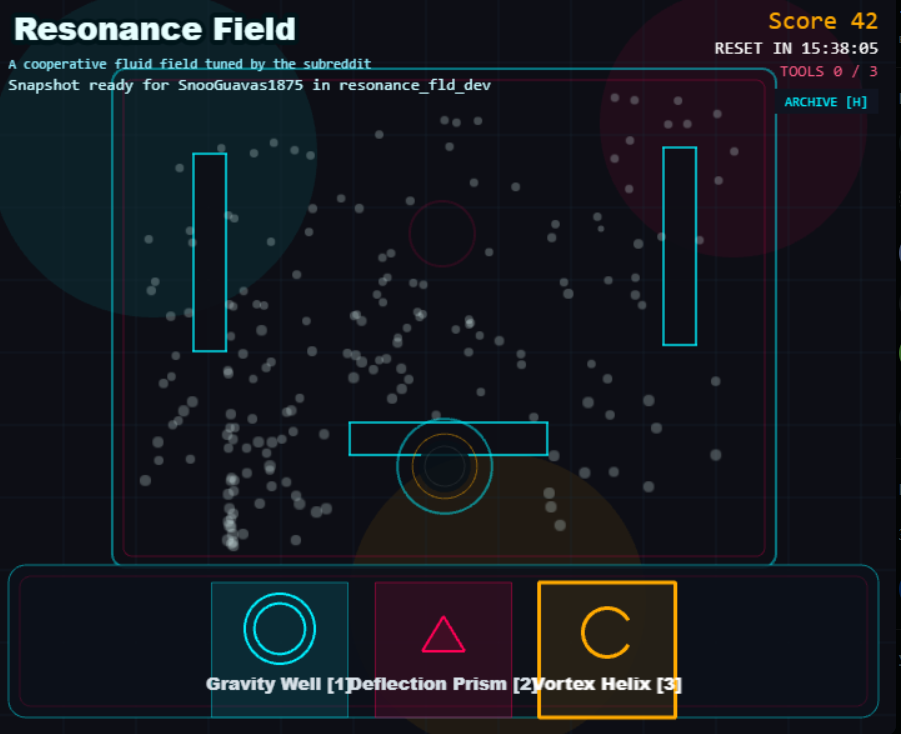
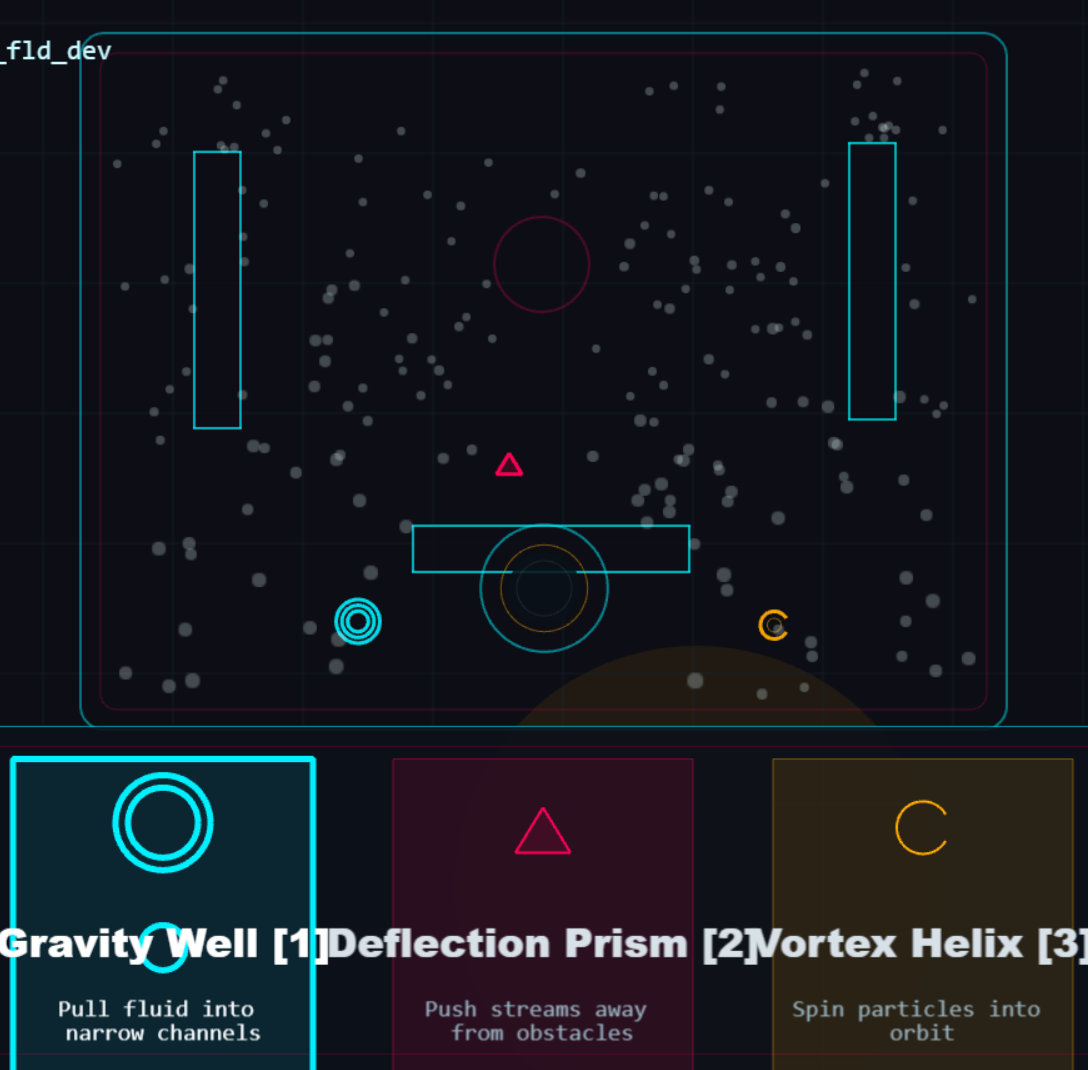
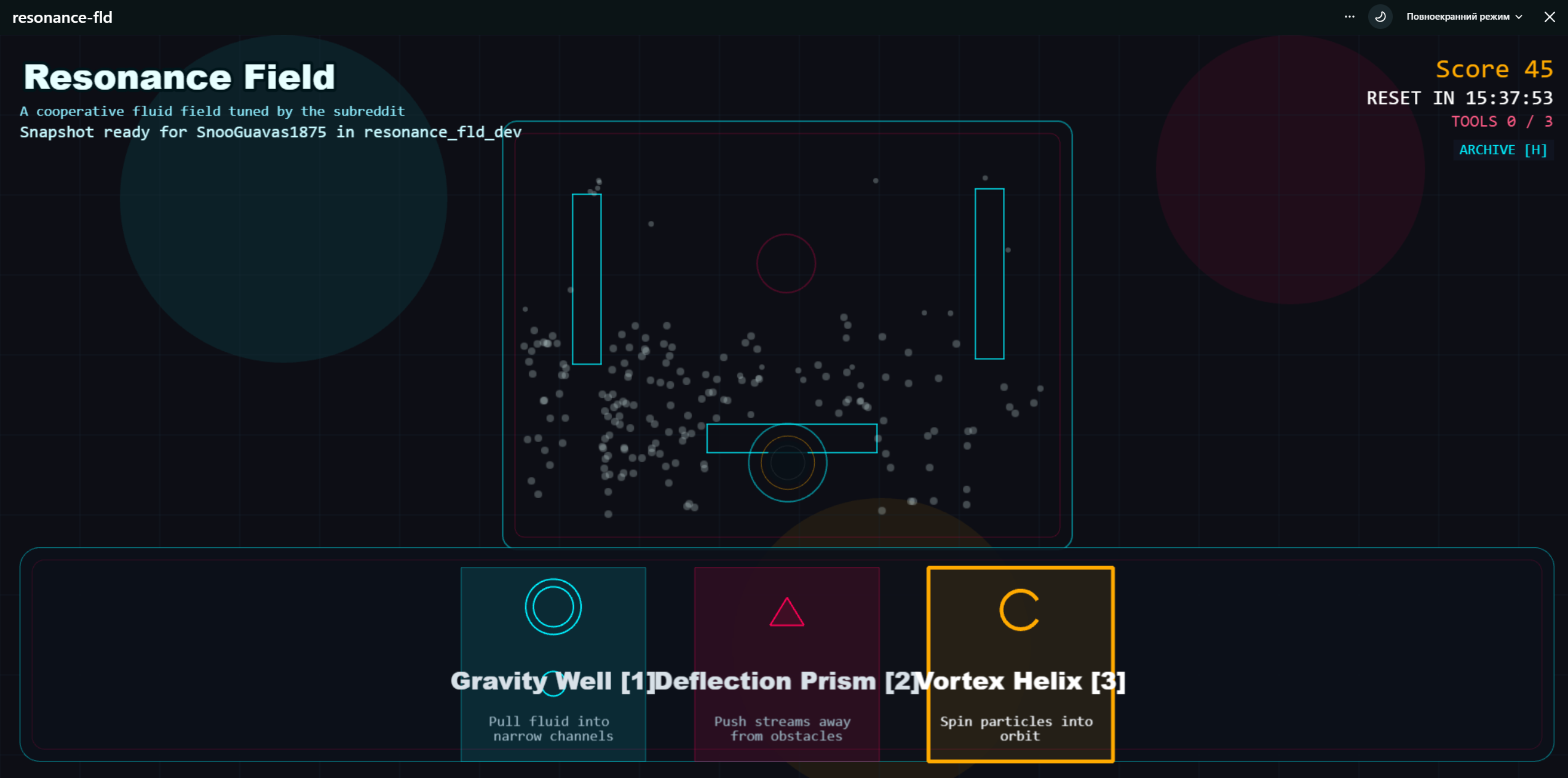
Inspired by fluid simulations, particle physics, and cooperative puzzle games, we set out to create an experience where every player's micro-action ripples across the entire community. No single player controls the outcome; instead, the community collaborates, competes, and coordinates in real-time to guide thousands of particles through procedurally generated geometric mazes.
How we built it
Resonance Field uses a decoupled client-server architecture optimized for Reddit Devvit Webviews:
- Client (Phaser 3): Runs inside an iframe and handles all rendering, particle physics, and UI. We use a custom Euler vector physics engine with WebGL blitter batch rendering to draw thousands of particles in a single GPU pass.
- Backend (Hono + Devvit): Acts as the authoritative event broker and state validator. It manages Redis for node persistence, user quota enforcement, and global score tracking.
- Realtime (Devvit Channels): Broadcasts
NODE_ADDEDandNODE_REMOVEDevents to all connected webviews, keeping the simulation synchronized across the entire community. - Communication: tRPC v11 provides end-to-end type safety between client and server. Score increments are batched every 10 seconds to protect against rate limits.
The daily reset cycle is handled by a scheduled routine that archives the final score, clears the global node database, generates a new procedural maze, and resets the score — all at midnight UTC.
Challenges we ran into
- Performance at scale: Rendering thousands of fluid particles on mobile webviews required abandoning standard physics engines in favor of raw analytical vector math mapped over flat coordinate arrays.
- Rate limit protection: Devvit's API limits meant we couldn't stream individual point actions. We solved this with a 10-second batched throughput system that aggregates local score increments before pushing to the server.
- State synchronization: Ensuring late-joining users get an accurate snapshot without disrupting active players required careful snapshot design and atomic Redis operations.
- The Trilogy Rule: Implementing FIFO queue management with client-side and server-side validation, plus 60-second temporal decay, created a natural balance between player agency and field cleanliness. ## Accomplishments that we're proud of
What we learned
Building Resonance Field taught us how to push the limits of real-time web gaming inside a sandboxed iframe. We learned to:
- Optimize particle physics for mobile: By replacing standard physics collision meshes with custom inline analytical vector math, we achieved 60 FPS on modern mobile devices while rendering thousands of particles.
- Design for constrained environments: Devvit's serverless architecture, 30-second request limits, and 4MB payload caps forced us to be creative with batching, compaction, and state synchronization.
- Build community-first mechanics: The Trilogy Rule (three active nodes per player) emerged as a design constraint that naturally fostered coordination and strategy rather than chaos.
- Implement robust realtime sync: Late-joining users must pull an accurate state snapshot instantly without causing synchronization stutters for existing players. ## What's next for Resonance field
Built With
- devvit
- devvit-realtime-channels-|-|-**persistence**-|-redis-(via-devvit)-|-|-**testing**-|-vitest
- eslint
- hono
- node.js-v22
- phaser-3
- playwright
- playwright-|-|-**tooling**-|-eslint
- prettier
- redis
- trpc
- trpc-v11-|-|-**platform**-|-reddit-devvit
- typescript
- typescript-|-|-**backend**-|-node.js-v22
- vite
- vitest
- |-category-|-technologies-|-|-|-|-|-**frontend**-|-phaser-3

Log in or sign up for Devpost to join the conversation.