-
-
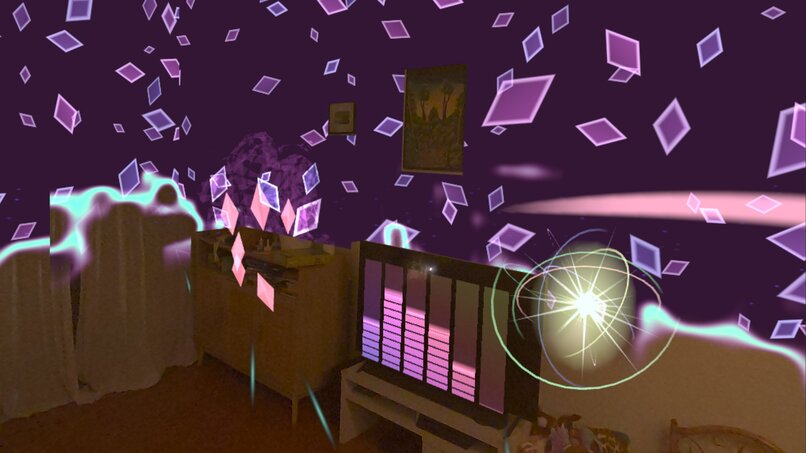
Room Transformation
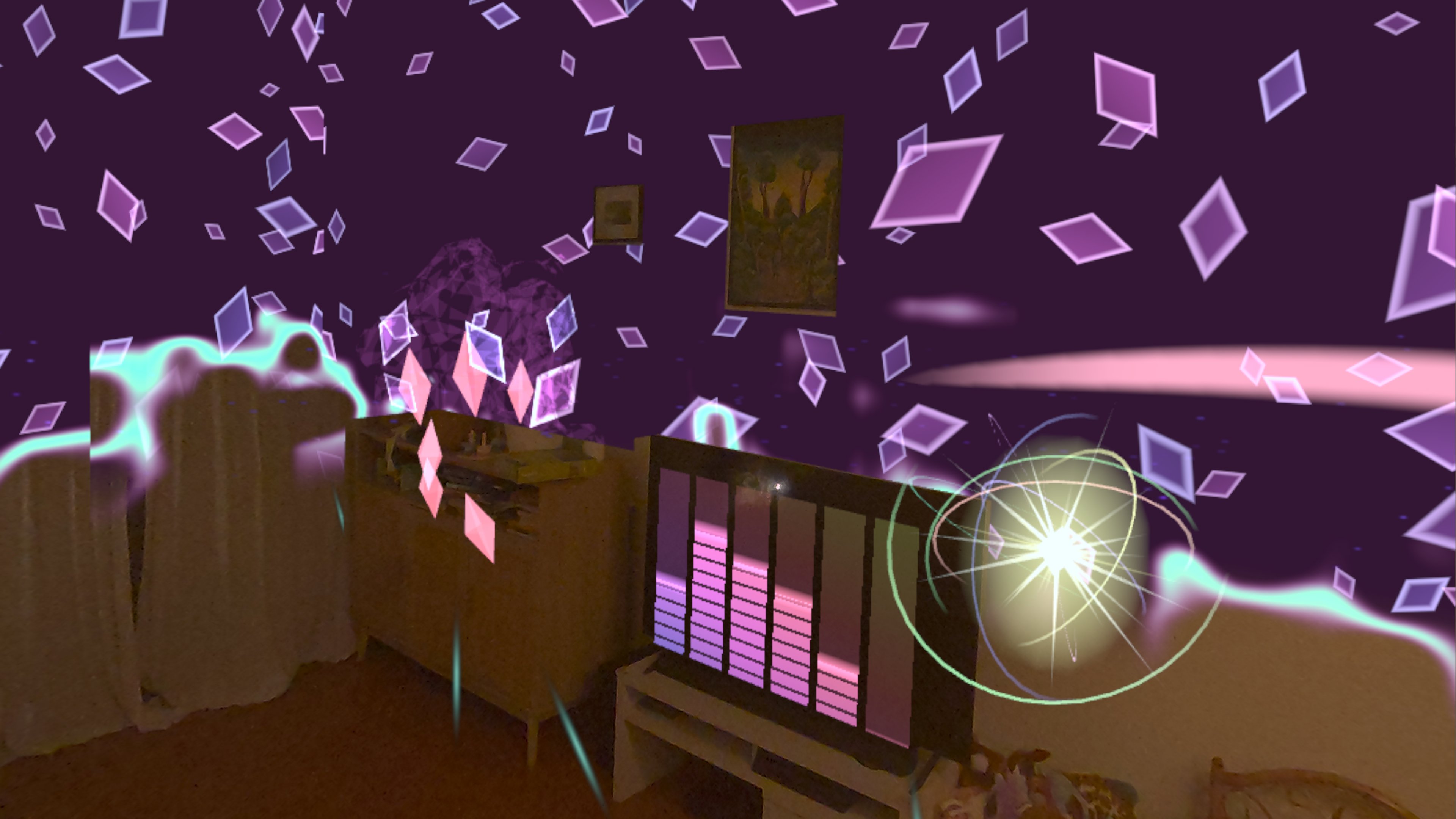
RESONANCE — Devpost Project Story
Inspiration
Music visualizers have existed for decades, but most translate volume and frequency into graphics on a screen. I wanted to explore a different question:
What if you could step inside the structure of a song?
That idea became RESONANCE, a mixed reality album for Meta Quest 3. Instead of replacing the listener's surroundings, RESONANCE uses the real room as its stage. Beats travel across the floor, voices become ribbons, instruments animate the architecture, and major musical moments open the room into a larger dreamlike world.
The RESONANCE album follows one night across six original songs and six imaginary floors, moving from the restrained tension of Streetlight Code to the sunrise resolution of Morning Keeps the Secret. Each floor changes the groove and emotional temperature while remaining part of one continuous journey.
I created all six final songs specifically for RESONANCE as original AI-generated music under the artist name Lerp. I wrote the prompts and creative directions around the needs of a spatial show: grooves that make the body respond, clear section contrasts, deliberate rests, useful tempos, distinct energy shapes and instrument stems that can drive separate visual roles. Music generation does not offer exact control, so I listened, rejected and regenerated when a result did not serve both the album and the experience. The final tracks are therefore not incidental background music; they were selected as the source material for the six-floor journey.
Every song has its own DNA
The project began with the idea that every song has a unique internal structure: its beat grid, sections, energy, key, instruments, rests and musical events. I call this description Song DNA.
Song DNA is prepared before the listener enters the experience, so the headset does not need to analyse music, use AI or connect to a network during the show. The same musical data always produces the same choreography.
The challenge is much larger than finding one tempo. This shortened summary shows what the pipeline extracted and aligned for Streetlight Code:
{
  "durationSeconds": 179.97,
  "tempoBpm": 113.9988,
  "key": "G minor",
  "beats": 342,
  "bars": 86,
  "sections": 6,
  "stems": 11,
  "storedEvents": 4264,
  "events": {
    "KICK": 177,
    "SNARE": 458,
    "HAT": 191,
    "NOTE": 3343,
    "ENERGY_RISE": 10,
    "ENERGY_PEAK": 11,
    "HARMONY_CHANGE": 17,
    "VOCAL_PHRASE_START": 28,
    "VOCAL_PHRASE_END": 48
  }
}
Detecting thousands of events is only the first step. The beats must stay aligned with the drums, vocal starts must pair with their endings, notes must retain their instrument role, and section boundaries must make musical sense. A plausible number at the wrong moment would make a ribbon, room pulse or climax feel visibly late. The real challenge was turning raw analysis into timing that feels musical to the listener.
How I built it
I built RESONANCE in Unity 6 for Meta Quest 3. The experience follows one clear path:
Song DNA
    ↓
Visual Score
    ↓
Choreography Engine
    ↓
Room, ribbons, particles, crystals, portals and sculptures
The Visual Score is a generated set of rules that describes what should happen at musical moments. The Choreography Engine reads those rules in song time and sends simple commands to independent visual systems.
Here is a shortened excerpt from the generated Streetlight Code score. The stored intensity is shown as 0.9 for readability:
{
  "on": "VOCAL_PHRASE_START",
  "stemFilter": { "kind": "ROLES", "values": ["voice"] },
  "system": "ribbon",
  "verb": "EMIT",
  "target": "SPACE",
  "intensity": 0.9
}
In plain language: when a vocal phrase begins, the show creates a voice ribbon in the room.
This separation was important. A visual effect does not need to understand the audio file, and no effect keeps time by counting frames. Audio playback supplies the song time, while Song DNA supplies the event times. That keeps the choreography repeatable after pauses, restarts and track changes.
The room is also part of the composition. RESONANCE reads its size and surfaces through one room model, then adapts effects to the available floor, walls, ceiling and furniture. At the largest moments, the familiar room can open into a luminous Dream Twin: a transformed copy of the same space.
Hands are the main input. The listener can point and pinch to choose a Song Sculpture, pause or restart a show, and directly pick up and place a sculpture in the room. During the music, surface touch and the Energy Core bring the listener's body into the artwork without turning the experience into a menu of buttons.
When a song ends, its world returns to the same Song Sculpture. The sculpture is generated from the song's data, can be placed at a local spatial anchor, and remains as a physical memory of the journey.
The challenges
The hardest challenge was making the experience feel musical instead of merely reactive. More effects did not automatically create a better show. I had to give each visual form a clear job, leave space between events, and make sections feel different through subtraction as well as addition.
Automatic music analysis was another major challenge. A tool can propose beats and sections, but a technically plausible result is not always the bar line or musical role a person hears. I combined information from the complete song and its separate instrument stems so that drums, voices and melodic parts could each shape the world in a musically meaningful way.
Mixed reality introduced a different kind of uncertainty: every listener has a different room. Effects must adapt to small and large spaces, remain readable over passthrough and avoid the wearer. I designed the choreography around the room's available surfaces and scale so the same song can still feel composed for the space around the listener.
The limits of a standalone headset also shaped the art direction. Instead of filling every moment with effects, I created a focused visual vocabulary and used contrast, timing and negative space to make the largest moments feel earned.
Accomplishments I am proud of
- I designed and built the project as a solo developer, spanning music direction, music analysis, generative choreography, mixed reality, hand interaction and visual effects.
- I built a system in which Song DNA becomes a Visual Score and then a repeatable spatial show, without needing AI or a network connection during the experience.
- I made the listener's real room part of the artwork while keeping the show adaptable to different room sizes and layouts.
- I created a hands-first museum of Song Sculptures that can be selected, moved, played and left in the listener's room after the show.
- I created a six-song original XR album with one shared identity and a clear journey from streetlight to sunrise.
- I turned a complex music-analysis process into one workflow that can transform a new song into musical data, spatial choreography and a unique Song Sculpture.
What I learned
I learned that deterministic generation does not have to produce identical-looking art. Shared rules can preserve a strong visual identity while each song still chooses its own colour, structure, accents and sculpture shape.
I also learned that mixed reality is strongest when the real world is not treated as a background. Keeping the listener's own floor, walls and furniture visible makes every transformation more personal. The contrast between the ordinary room and the impossible musical world became one of the project's most important creative tools.
Most importantly, interaction feels meaningful when it belongs to the music. A hand touching a surface, a sculpture awakening, or a world returning to an object can carry more emotional weight than a large number of unrelated effects.
What’s next for RESONANCE
There are several directions I would like to explore next:
- more expressive hand interaction, so listeners can shape and influence the music more directly;
- a richer visual identity for each song, with more dramatic room transformations and portals;
- support for a wider variety of rooms while keeping the experience comfortable and visually clear;
- creative tools that let listeners choose and edit the visual language of a song;
- a personal gallery where listeners can revisit the Song Sculptures they have collected;
- support for personal music or streaming services, if music rights, privacy and service constraints can be solved responsibly.
These are future possibilities rather than features of the current experience. RESONANCE currently presents the six original songs created for the album as one complete journey from streetlight to sunrise.
Where the project stands
RESONANCE is a playable six-song XR album for Meta Quest 3. The full journey takes the listener through six floors of one night, with each song transforming the room through its own generated spatial show. The experience supports hands-first playback and interaction, then turns each completed journey into a Song Sculpture that can be picked up and placed in the listener's space.
RESONANCE began as an attempt to animate music. It became something more specific:
Song → musical understanding → spatial choreography → interaction → memory.
Built With
- ai-generated-music
- c#
- hand-tracking
- hlsl
- meta-quest-3
- meta-xr-audio-sdk
- meta-xr-sdk
- mixed-reality
- mruk
- music-visualization
- openxr
- passthrough
- procedural-generation
- scene-api
- shaderlab
- spatial-anchors
- spatialcomputing
- suno
- unity-6
- urp
- vfxgraph
- xr


