-
-
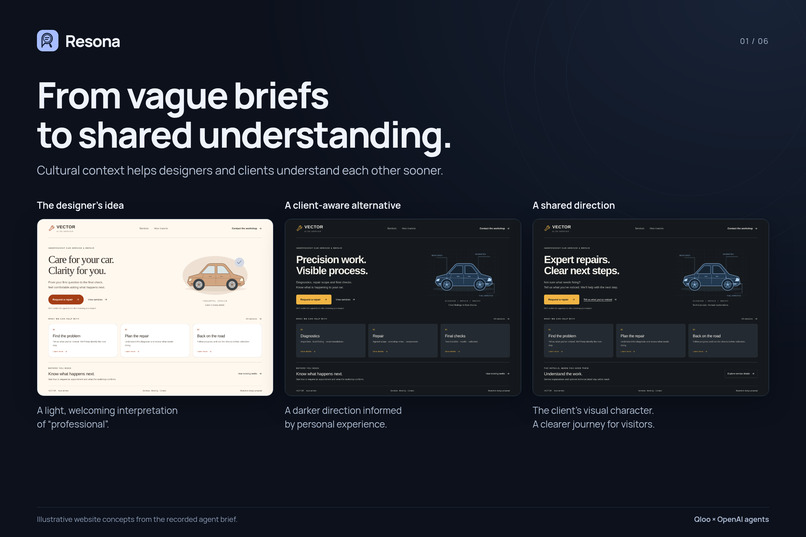
Resona uses cultural context to help designers and clients move from an ambiguous brief to a shared design direction.
-
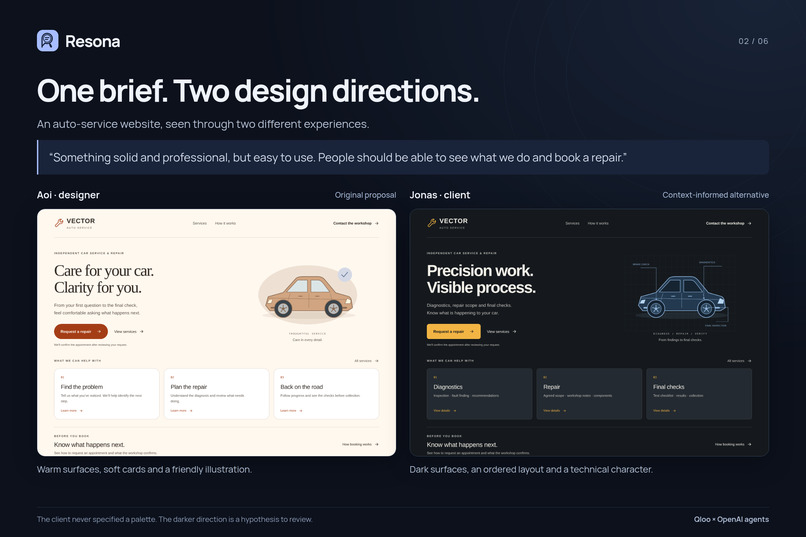
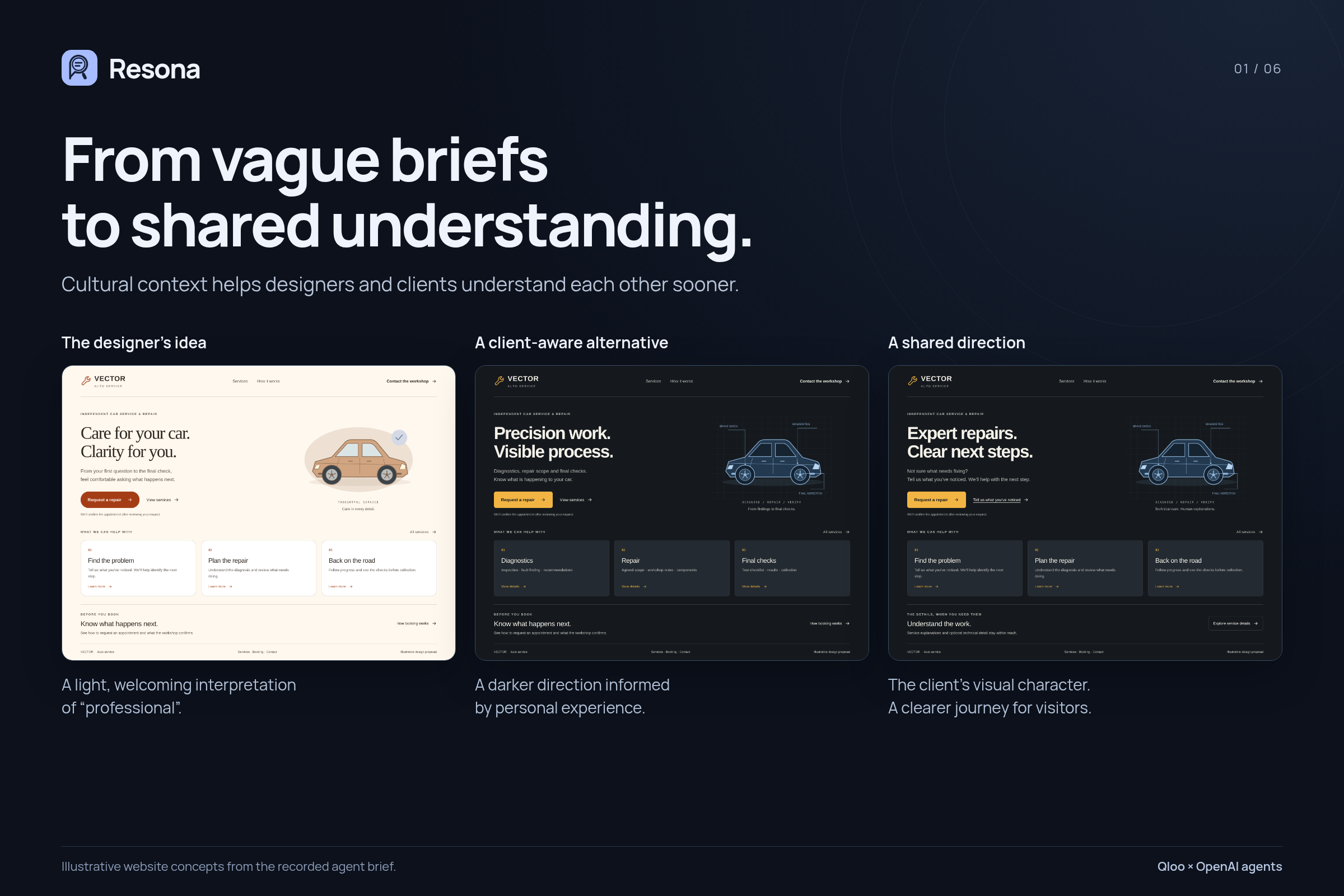
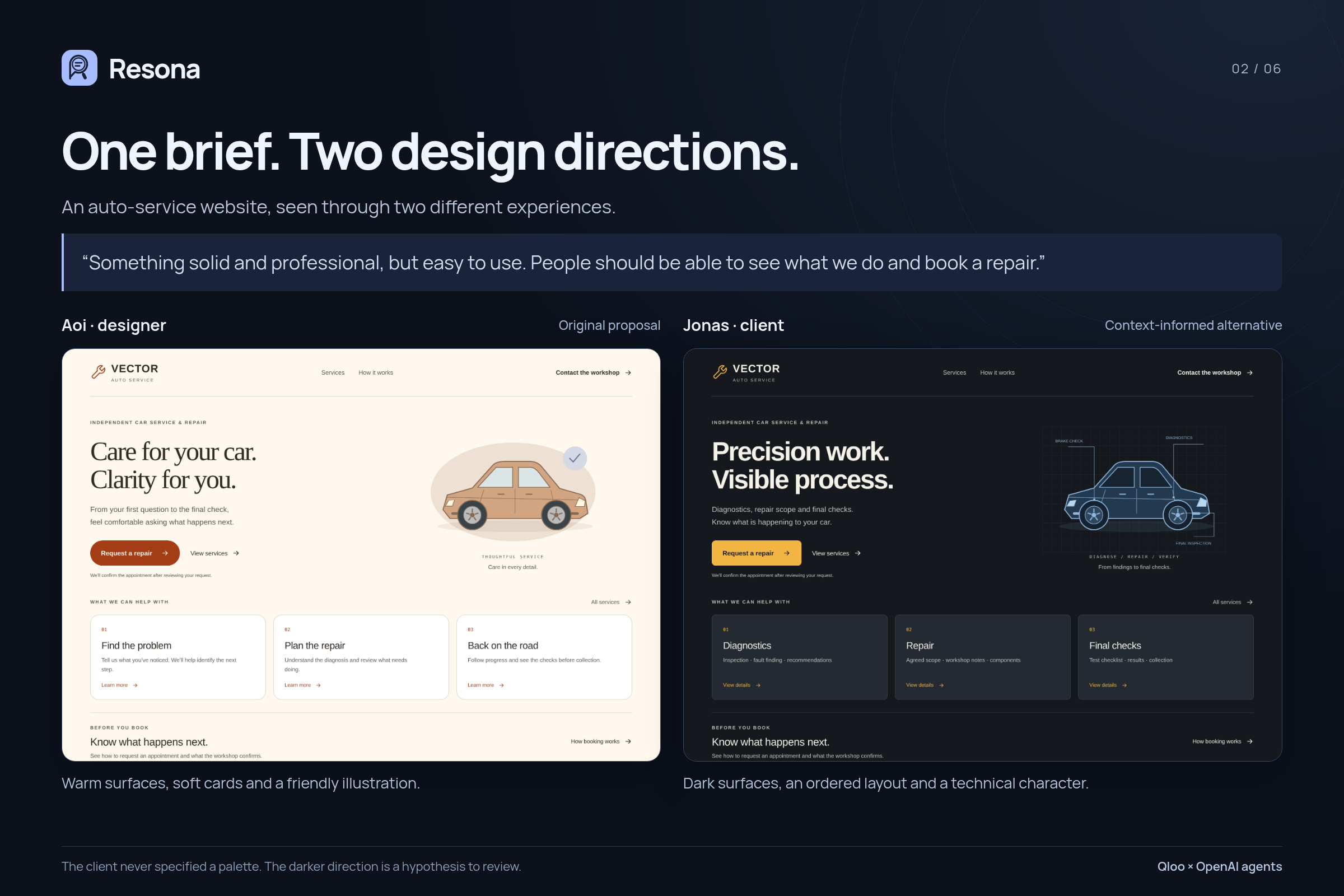
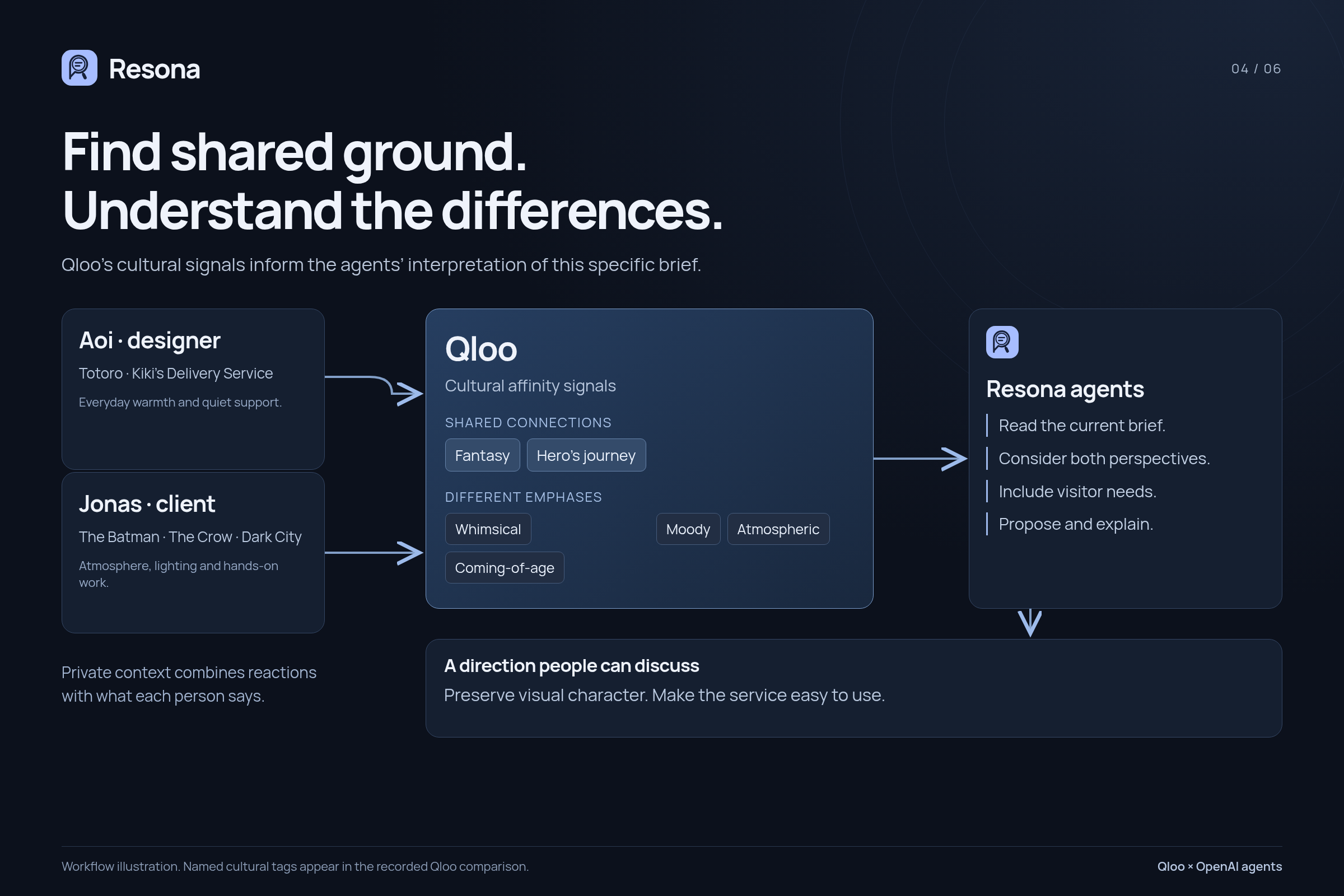
The same “professional” brief can suggest a warm design to one person and a darker, more structured design to another.
-
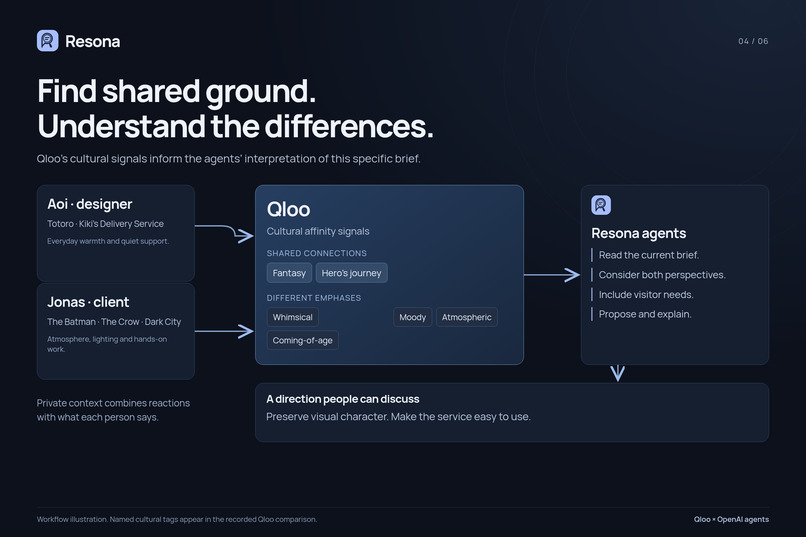
Qloo provides shared and contrasting cultural signals. Resona combines them with the brief, personal explanations and visitor needs.
-
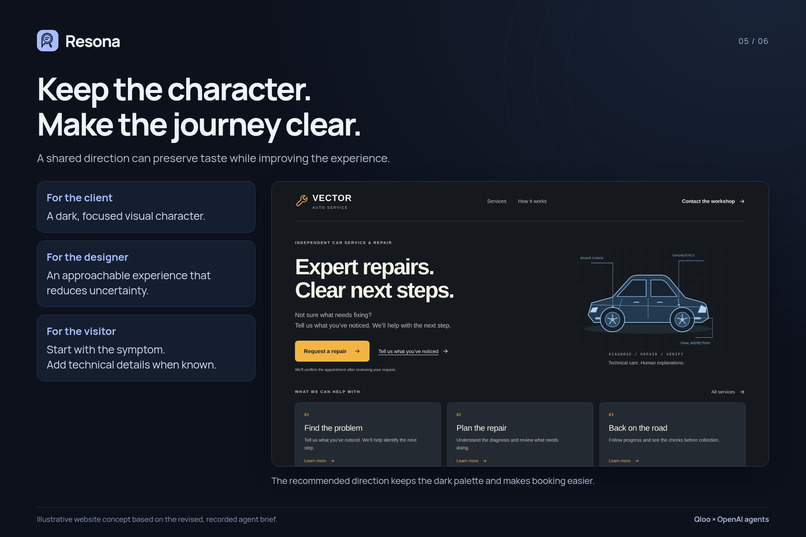
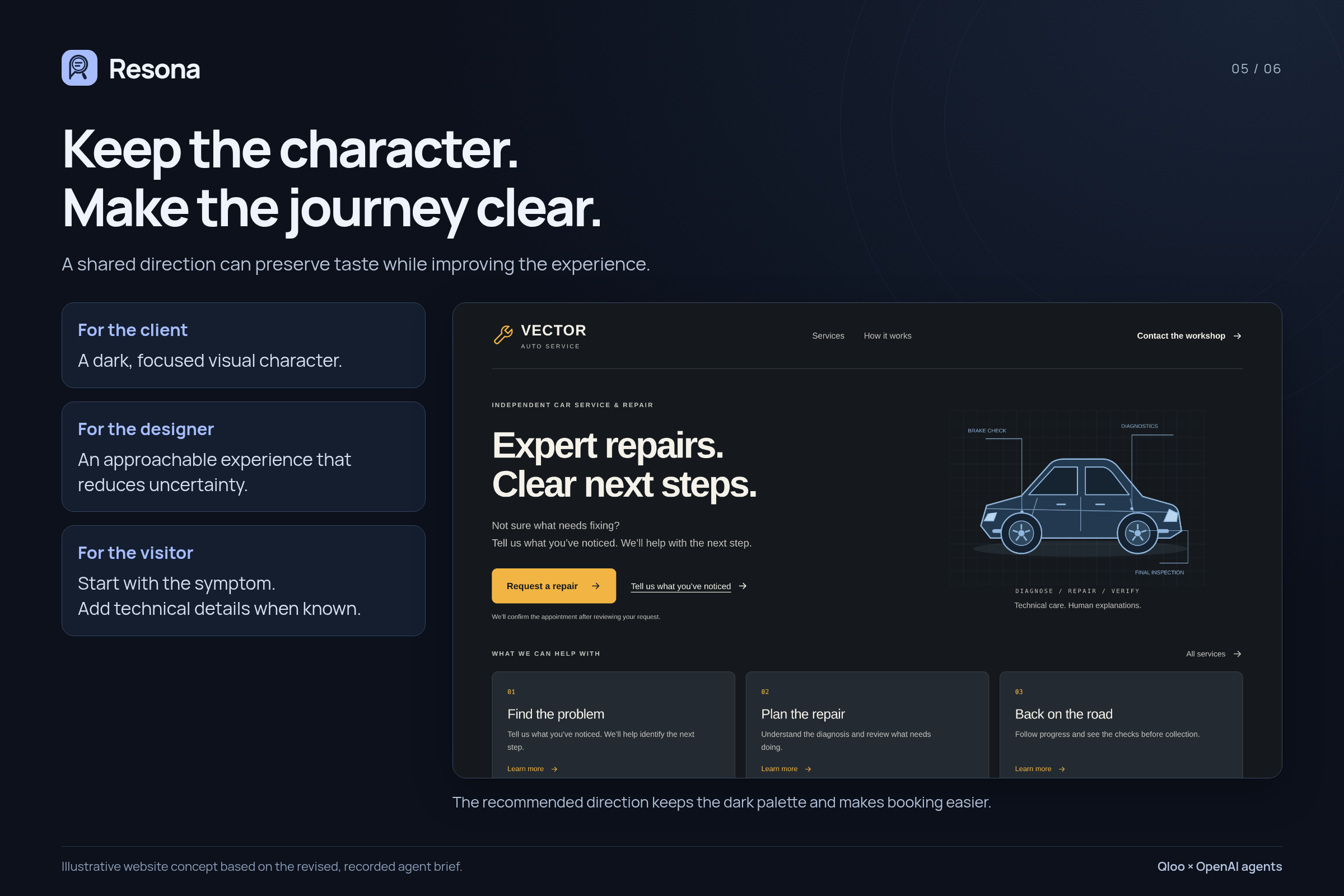
The shared direction keeps the client-aware dark style while preserving the designer’s intent and making booking approachable for visitors.
-
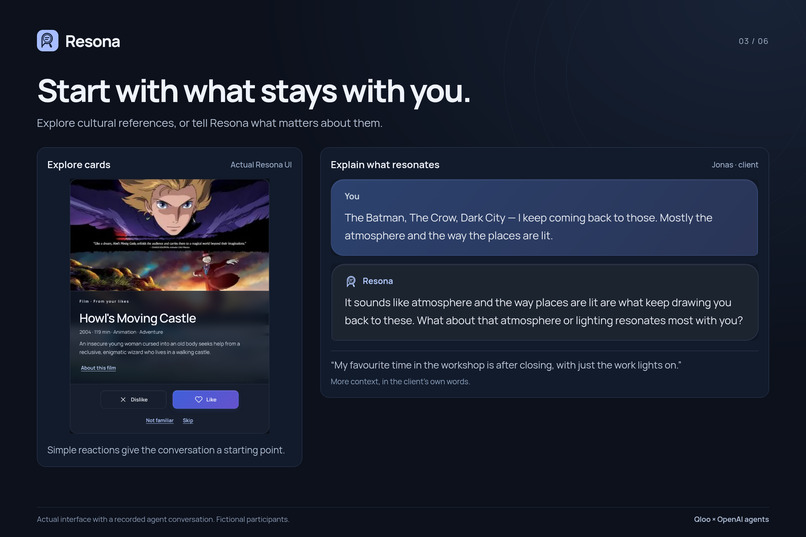
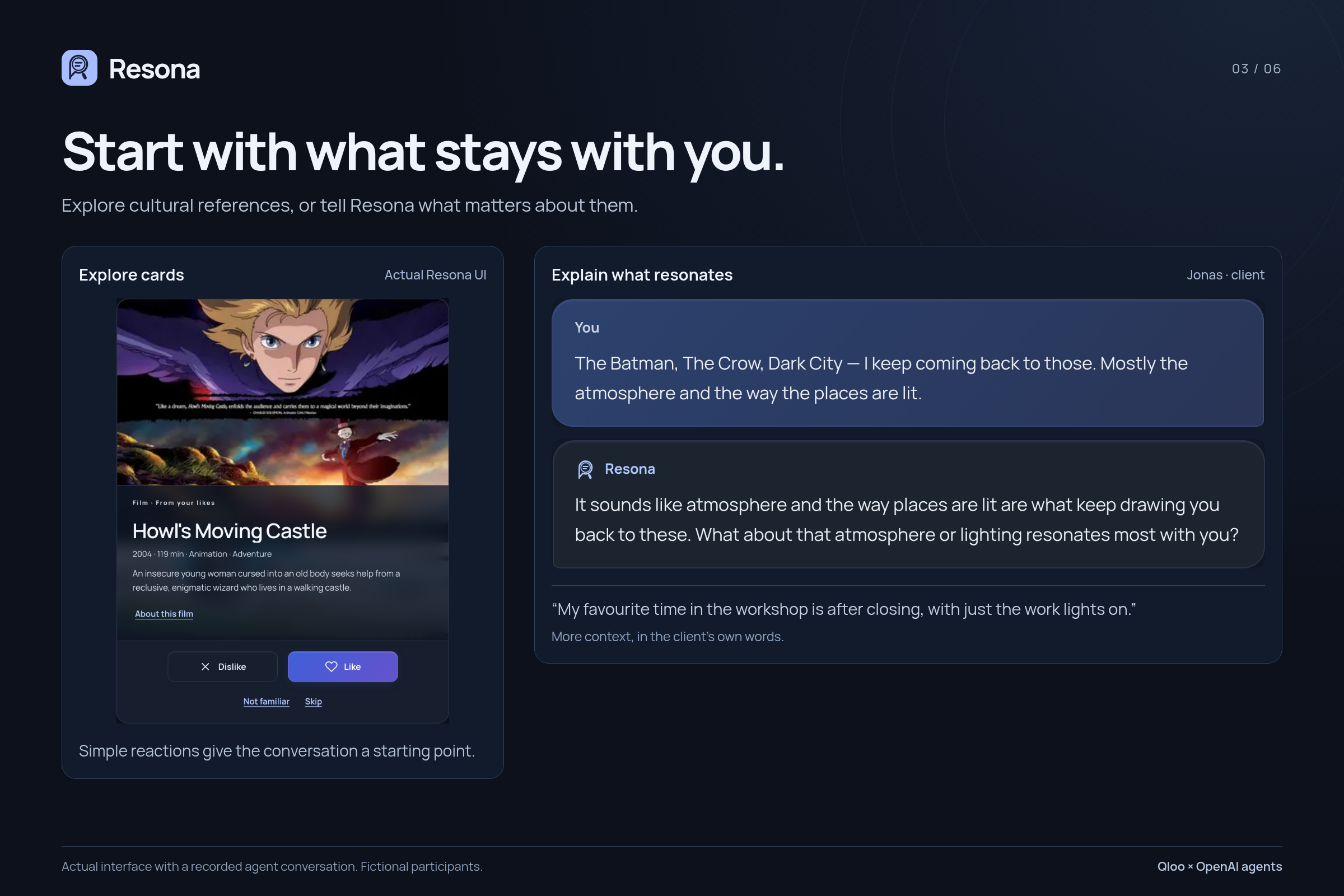
People share their experience through cards or conversation. Resona asks what a reference means to them, beyond the like itself.
-
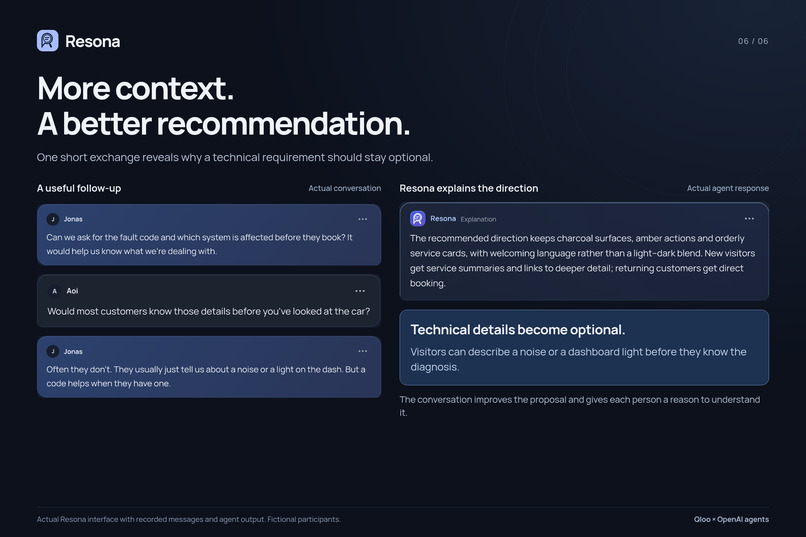
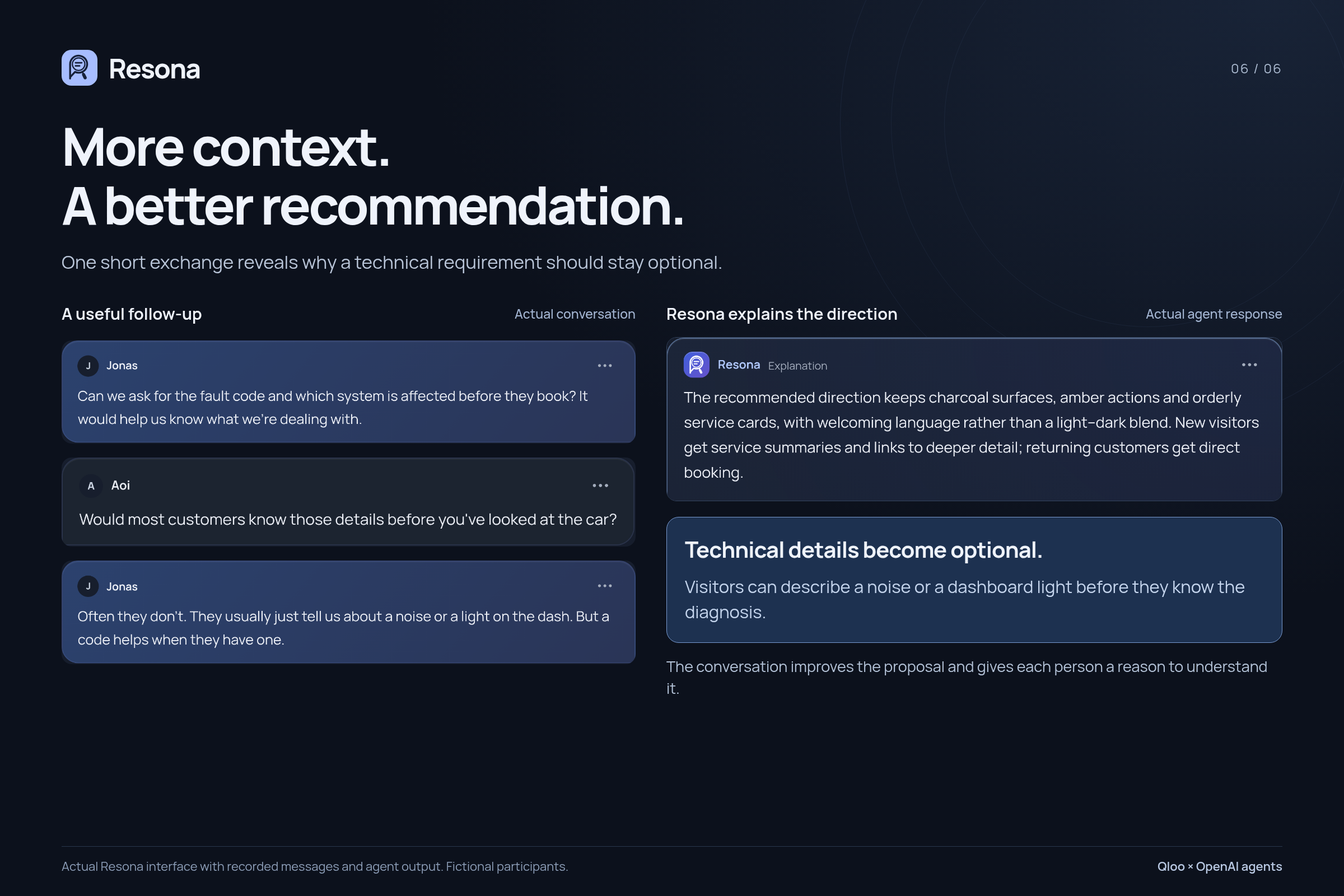
New context changes the proposal: visitors can describe symptoms first. Resona explains why technical fields should remain optional.
Inspiration
Before a designer can create something a client will love, they need to understand how that client sees it.
A request like “make it more serious” or “a little less formal” can sound clear while meaning something different to each person. A designer might imagine a bold visual identity, while the client simply wants clearer information and fewer distractions. Both people can agree on the words and still picture different results.
Resolving that gap takes conversations, examples, revisions, and time. Clients often struggle to describe what they want, and designers have to work out what is behind the request.
We wanted to explore whether cultural experience could make this process easier. The films, music, books, places, and personal experiences people connect with can offer clues about how they interpret an idea. Understanding what those references mean to someone could give a designer a better starting point.
That became the idea behind Resona: help people reach a shared creative understanding sooner.
What it does
Resona helps designers and clients interpret each other’s ideas through their cultural experiences.
Users can share their interests and memories in a private conversation, speak through voice input, or explore cards with cultural references. They can explain what they liked, what stayed with them, or why something did not resonate. Over time, Resona builds an evolving context from those interactions.
When two people discuss a creative task, that context becomes useful. A designer can describe a proposal, and Resona considers how the client might understand it. It can identify a possible mismatch, explain the different readings, suggest a focused question, and help turn the proposal into a clearer design brief.
Qloo plays a direct role in this process. It helps users discover cultural references and, during matching, compares the interests of both participants using fresh API requests. We consider both shared interests and differences in their relative strength. A difference can be just as useful as a similarity when trying to understand why two people see the same idea differently.
For example, “more detailed and imaginative” might suggest expressive visuals and a metaphorical story to the designer. The client might prefer a more balanced presentation with concrete steps and practical information. Resona can suggest an adaptation that preserves the creative idea while making it easier for the client to relate to.
These interpretations remain open to correction. Original messages stay intact, and users decide which explanations or proposals they want to share.
How we built it
Most of our time went into the research and conceptual work before implementation.
We began by exploring the communication problem: why designers and clients misunderstand each other, why preferences are difficult to explain, and how personal experience influences the meaning people attach to words and images.
We worked through different ideas, brainstormed possible approaches, and used thought experiments to test them. We explored concepts from psychology, perception, and cultural communication, asking where this information could genuinely help and where it might lead to an unsupported assumption.
From there, we developed the product concept and documented it. We defined how people would share experience, how agents would prepare context, how two perspectives would be compared, and how the results would enter a real conversation. We also worked through privacy, permissions, corrections, and the boundaries between a person’s own words and an agent’s interpretation.
Only then did we move into implementation. We used Codex to help build and refine the codebase from those documented decisions, develop the agent workflows, and test the complete journeys.
The application uses TypeScript, Next.js, PostgreSQL, a separate background worker, the OpenAI Agents SDK, and Qloo. Background agents prepare context incrementally, while task-specific agents use the relevant context to interpret a request and produce an explanation or design brief.
We tested the mechanics with controlled scenarios and real provider calls, then used the results to revise the prompts, architecture, and interaction flow.
Challenges we ran into
The hardest challenge was finding situations where cultural context could make a useful difference.
An interesting connection between two films is not enough on its own. We needed to understand how that connection could help interpret a real request and influence a practical design decision.
That led to repeated questions: What does this experience tell us about the person? What are we only assuming? How does it relate to the current task? Would the resulting explanation actually help the other participant?
Getting the agents to make that connection was another challenge. They needed to move from recognizing a reference to considering its possible meaning for an individual, while keeping the person’s own explanation in control.
We also had to make room for disagreement. The system should be able to notice a difference and work with it, without forcing every comparison toward a shared preference.
Testing these situations helped us uncover weak assumptions and improve how the agents use context.
Accomplishments that we're proud of
Our biggest achievement was turning our research into a working flow that we could put through concrete scenarios.
We started with a question: could someone’s cultural experience help explain why they interpret a creative idea differently? Seeing Resona identify possible differences in the meaning of “detailed” or “imaginative,” then carry those differences into a design brief, made that idea tangible.
We are also proud of the preparation behind the application. The research, documented concepts, and technical planning gave us a clear basis for building and improving the system.
The early results are encouraging. We now have a working foundation to take to designers and clients and find out whether it makes their everyday collaboration easier.
What we learned
We learned to pay closer attention to the relationship between someone’s experiences and the language they use.
Two people can enjoy the same film for completely different reasons. One might remember its atmosphere, another its structure, and another the way a character solves a problem. Knowing the reference helps, but understanding the person’s relationship with it matters more.
We also learned that a useful interpretation needs to stay connected to the situation. A general description of someone’s taste becomes valuable when it helps explain a particular request, question, or design choice.
This work changed how we think about understanding clients. Their interests can provide a starting point, but listening to their explanations and allowing them to correct an assumption remains essential.
What's next for Resona
Our next step is to deploy Resona and test it with real designers and clients.
We want to observe how people use it during actual projects: whether the interpretations feel relevant, which suggestions help, where the system gets things wrong, and how easily users can correct it.
We will collect feedback and examine whether Resona reduces the effort spent clarifying a brief, helps avoid unnecessary revisions, and makes it easier to reach a shared direction.
With further funding, we plan to strengthen the application for regular use, support early participants, and bring more designers and clients onto the platform.
Those real projects will guide what we improve next. We want to understand where Resona provides consistent value, refine it around those needs, and grow the product with the people who use it.
Built With
- better-auth
- codex
- docker
- google-oauth
- next.js
- node.js
- openai
- openai-agents-sdk
- playwright
- postgresql
- qloo
- react
- typescript
- vitest
- zod

Log in or sign up for Devpost to join the conversation.