Inspiration
The idea for Resona began after a late-night hospital visit with a close friend who had been injured during a casual soccer game. The care team was calm and capable, but the room moved incredibly fast: vital signs were called out, tests were ordered, updates came from different people, and new clinicians entered while treatment continued. We could hear this from outside the hospital room.
What stayed with us was how much important information existed only in the conversation. Whenever someone new arrived, the team had to quickly interpret what had already happened while still caring for the patient. We began wondering: what if documentation could follow the conversation naturally, instead of competing with it?
What it does
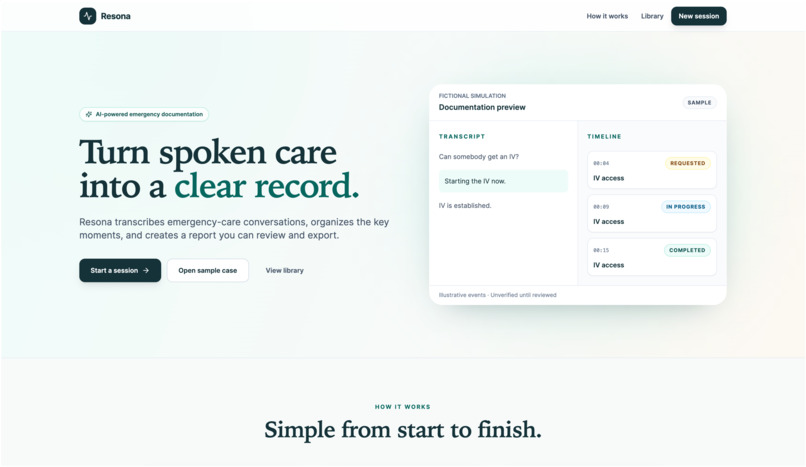
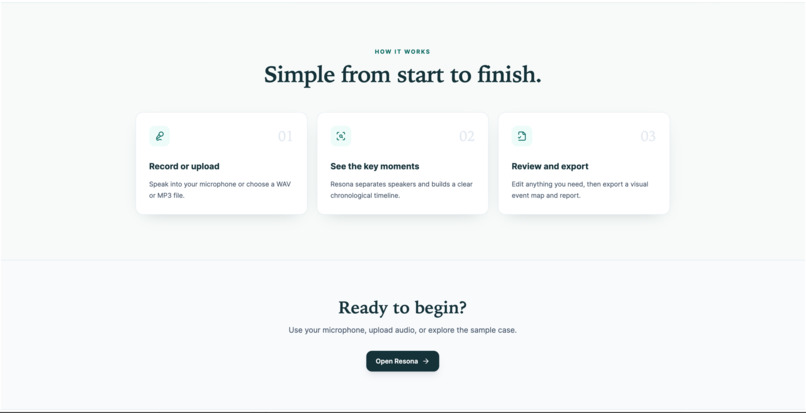
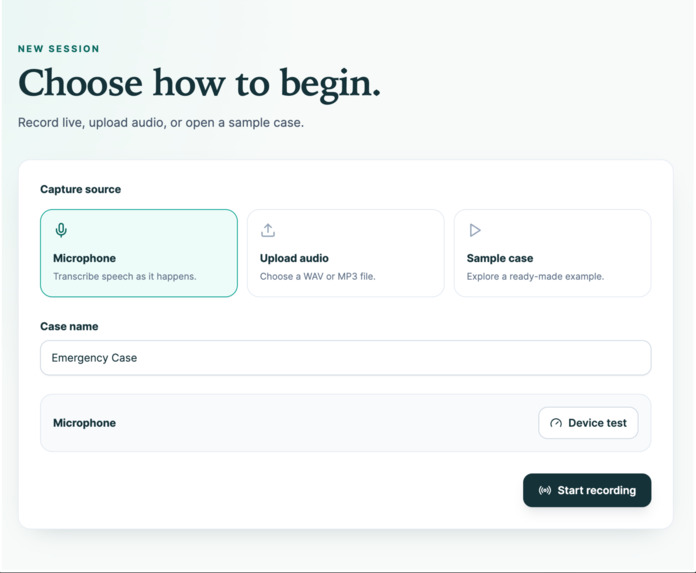
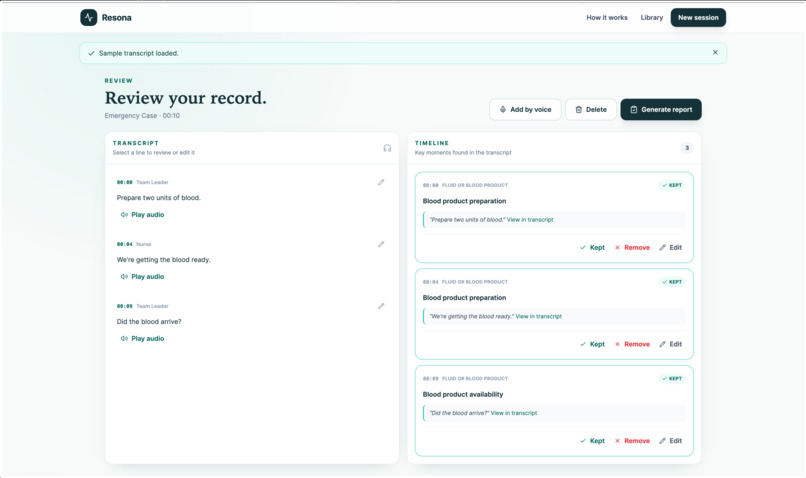
Resona transforms spoken emergency-care conversations into a clear, chronological record. A user can record through a microphone or upload an existing audio file. As the conversation is processed, Resona creates a timestamped transcript, identifies speakers, and extracts important moments such as vital signs, observations, medications, procedures, imaging results, and team communication.
Each timeline item remains connected to the exact words and timestamp that produced it. Resona also distinguishes between an action being requested, started, and completed. For example, it never treats “prepare the blood” as proof that the blood was given.
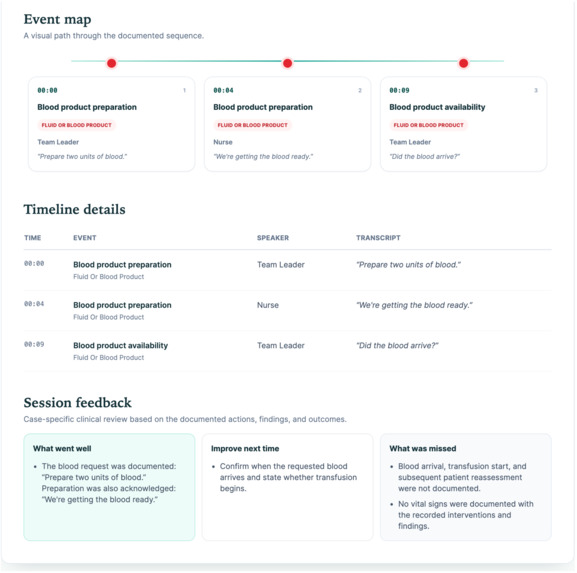
Before generating a report, users can correct the transcript, update speaker names, keep, edit, or remove events, and add an omitted detail by voice. Resona then creates:
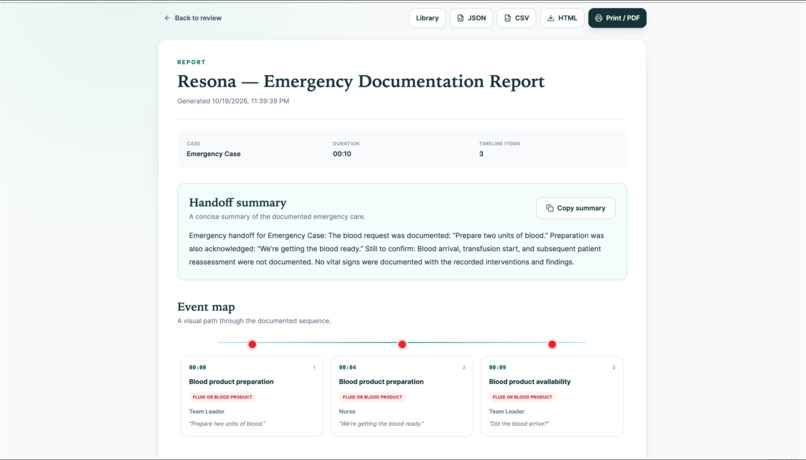
- A visual event map
- A detailed chronological timeline
- A concise, copyable handoff summary
- Case-specific feedback on what went well, what could improve, and what may have been missed
- An organized patient library containing saved cases and reports
How we built it
We designed Resona backward from one important question: Can a reviewer see exactly where every documented claim came from?
The experience begins with spoken audio. Resona converts that audio into a timestamped transcript, separates the conversation by speaker, and identifies clinically meaningful events. Those events are organized into a timeline, but the original quote is always preserved as evidence.
We made human review part of the main workflow rather than an afterthought. Users can inspect and correct the system’s work before creating a report. We also designed the experience to remain private and accessible by processing recordings locally without requiring paid AI services.
Finally, we created demonstration cases covering different emergency scenarios so the complete experience can be explored consistently, even without recording a live conversation.
Challenges we ran into
Emergency conversations are difficult by nature. People speak quickly, interrupt one another, use abbreviations, and talk over alarms or background noise. Improving transcription while keeping the experience responsive required extensive testing and refinement.
Another major challenge was understanding the difference between intention and action. Phrases such as “get an IV,” “starting the IV,” and “the IV is established” sound related, but they describe very different stages. Treating them as equivalent could create a misleading record, so we built Resona to preserve those distinctions.
We also had to resist overloading the interface. There was a temptation to display every technical detail the system produced, but that made the product harder to understand. We repeatedly simplified the experience until the transcript, timeline, evidence, and report felt like one natural workflow.
Accomplishments that we're proud of
We are proud that Resona works as a complete experience—from speaking into a microphone to reviewing a finished emergency report.
The feature we value most is evidence traceability. Every timeline event can be traced back to the original conversation, giving users a clear reason to trust, question, or correct it without a black box barrier.
We are also proud of:
- Recognizing spoken roles such as Doctor, Nurse, and Paramedic
- Preserving the difference between requested and completed actions
- Allowing users to correct omissions using their voice
- Producing concise, case-specific handoff summaries and feedback
- Turning a complicated workflow into an interface that is understandable without training
- Keeping the core experience private, local, and free to operate
What we learned
We learned that trustworthy AI is not simply AI that produces an answer. It is AI that shows its reasoning, preserves its source, admits what it does not know, and gives the user control.
We also learned that accuracy is not only a model problem—it is a product-design problem. Clear timestamps, visible evidence, editable speakers, and thoughtful review controls can be just as important as the transcript itself.
Most importantly, we learned that the most valuable AI feature is sometimes knowing when not to make a claim.
What's next for Resona
Our next step is to evaluate Resona with emergency-care professionals and medical simulation programs using increasingly realistic, noisy scenarios.
We want to improve recognition in rooms with alarms and overlapping voices, support additional languages, expand the range of emergency events Resona can organize, and make speaker identification more adaptable to different care teams.
Longer term, we envision Resona supporting secure collaboration across emergency departments, ambulances, training centers, and handoff teams. Our goal is not to replace clinical judgment—it is to preserve the context around it.
Resona listens, so care teams can stay focused on the patient.
Built With
- fastapi
- github
- next.js
- pyannote
- pydantic
- pytorch
- react
- sqlite
- tailwindcss
- typescript
- websockets
- whisper


Log in or sign up for Devpost to join the conversation.