-
-
Home page
-
Mismatch
-
Evidence
Inspiration
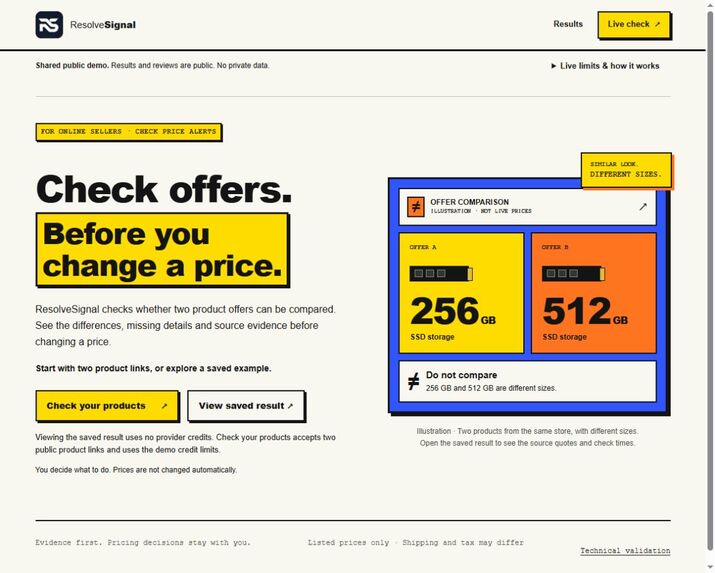
A lower price does not always mean the same offer.
For an online seller reviewing a price alert, a seemingly cheaper listing might be a different capacity, a refurbished item, a multipack or a member-only deal. Acting before checking those details can lead to a poor pricing decision.
I built ResolveSignal to answer a more useful question than “Which price is lower?”: “Can these offers actually be compared, and what evidence supports that conclusion?”
The intended users are small online sellers reviewing product offers. Customer adoption and time savings have not yet been validated.
Try it out :https://app.resolvesignal.com
What it does
Give ResolveSignal two public product-page links from US storefronts with USD prices. The agent investigates the pages and returns one of three results:
- Can compare: the required product details and offer terms match on the disclosed listed-price basis.
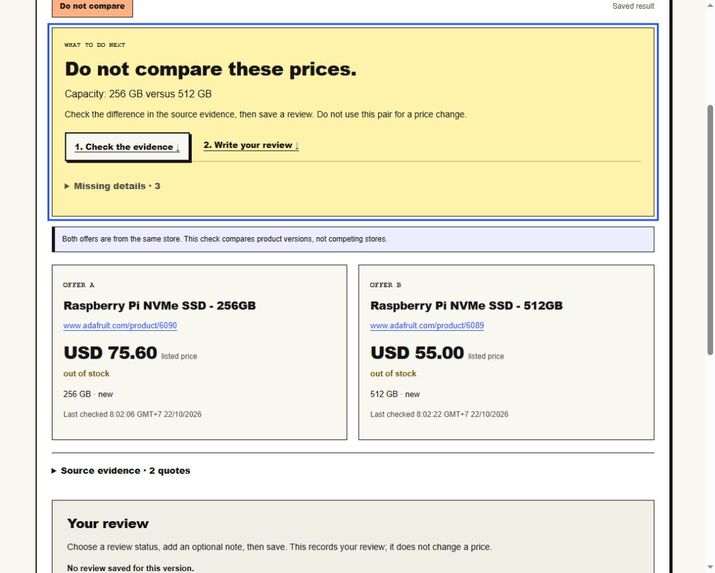
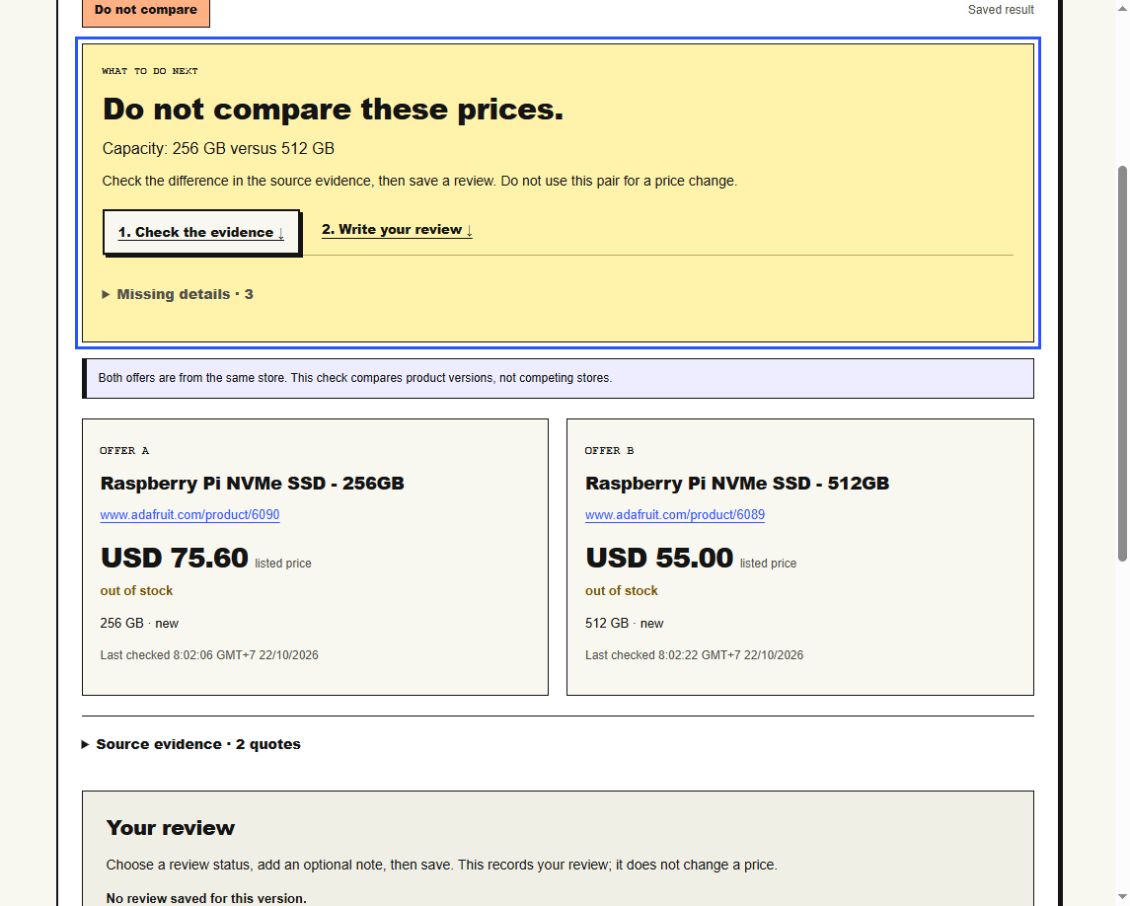
- Do not compare: evidence identifies a material difference.
- More info needed: required facts are missing, stale or inconsistent.
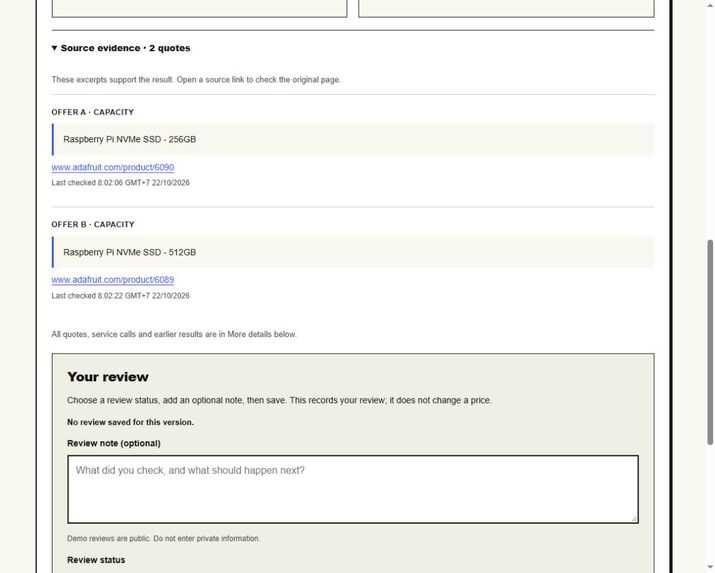
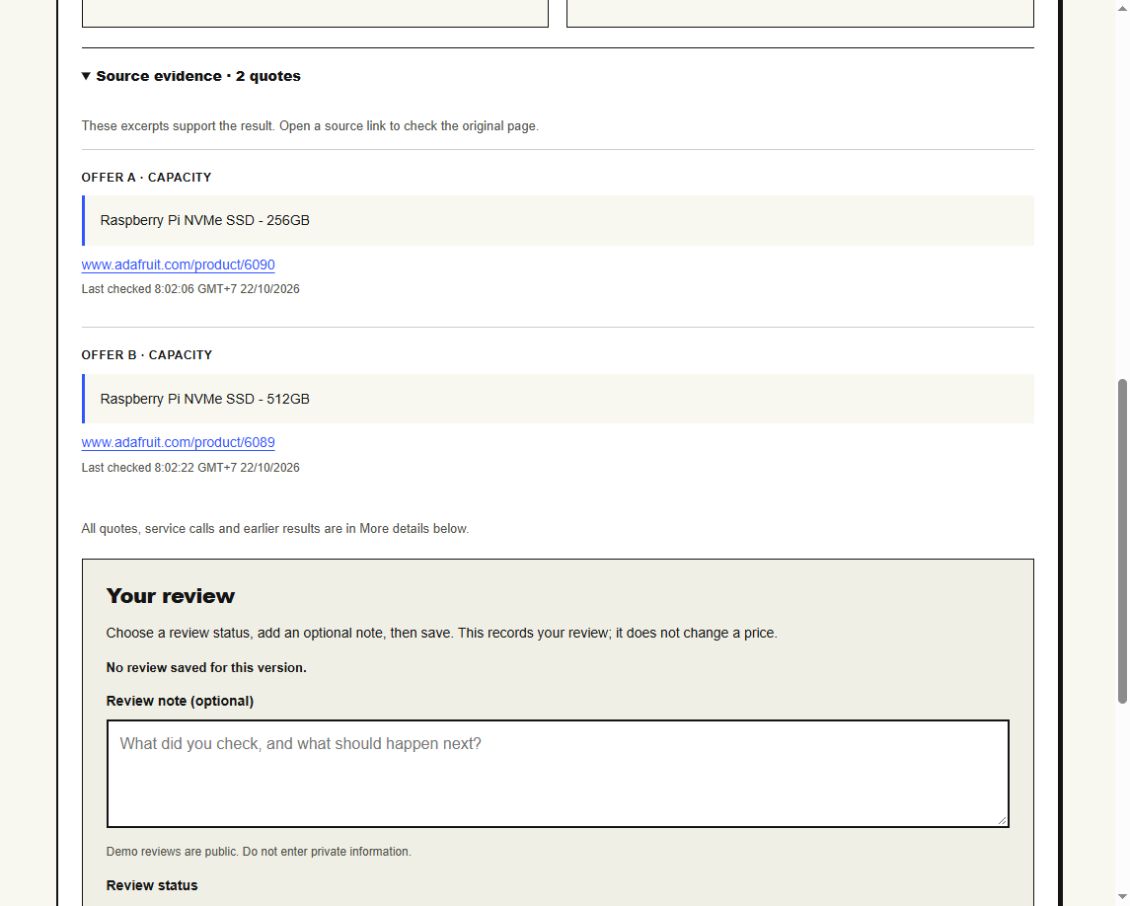
Each investigation keeps source quotes, check times, missing details and suggested next steps together. Users can save a review and export CSV, JSON or HTML. A manual recheck creates a new version while preserving earlier evidence and reviews.
ResolveSignal never changes store prices automatically.
How I built it
The application uses Python, FastAPI, Pydantic, Jinja, native JavaScript and SQLite.
NVIDIA Nemotron on Nebius Token Factory performs two reasoning steps: formulating a bounded evidence question and proposing product facts with supporting quotes. The verified runtime uses nvidia/Nemotron-3.5-Super-VL. Token Factory provided hosted inference through an OpenAI-compatible API, allowing me to build the workflow without managing GPU infrastructure.
Tavily Search and Extract supply web evidence within the agent workflow. The agent uses the model's evidence question to research relevant follow-up sources. Search snippets remain discovery leads rather than verified merchant prices.
The model does not make the final comparison unchecked. Source-validation and deterministic rules examine product identity, selected variants, condition, pack quantity, price conditions, currency, availability and freshness. Unsupported facts remain unknown.
LangSmith provides optional minimized tracing with readback verification. It records outcomes and call summaries while excluding page text, prompts, URLs, credentials and review notes.
Challenges and what I learned
The hardest problem was establishing enough trustworthy evidence.
Retailer pages can block automated reading, omit offer conditions or contain information about several variants. An exact quote also does not automatically support the model's interpretation: a product title alone cannot establish that an item is new.
I added field-specific validation, barcode checksum and ambiguity checks, selected-variant safeguards and explicit recovery guidance. I learned to separate retrieval success, supported facts and comparison decisions instead of treating them as the same achievement.
What the demo proves
A real Adafruit investigation identifies a 256 GB versus 512 GB mismatch and links the decision to source evidence. This is a same-store variant control, not a competitor savings claim.
A separate JBL/Harman recheck made actual Tavily and NVIDIA-on-Nebius calls, but both direct merchant reads returned HTTP 403. No retailer claims passed validation on that attempt, so the result correctly asks for more information.
Clearly labeled fictional examples demonstrate the remaining branches and review workflow. Verification includes 203 Python tests on Windows and Linux, 11 JavaScript tests and 37 fictional comparison scenarios. These are regression checks, not a real-world accuracy benchmark.
What's next
Test the workflow with online sellers, measure whether the evidence and recovery steps help them make decisions, and improve exact-product extraction for the stores they use most.
Current limits include US/USD listed prices, incomplete retailer access and no complete real-source positive comparison demonstrated yet. Shipping and tax may differ.
AI assistance was used during research and development. Original application code is MIT licensed, with separate third-party notices in the repository.

Log in or sign up for Devpost to join the conversation.