Inspiration
Online payments have made shopping easier, but payment-related problems still create frustration for both customers and merchants. A customer might be charged without receiving an order confirmation, encounter duplicate transactions, or struggle to get a refund.
For small businesses, resolving these issues manually takes time, requires checking multiple systems, and can negatively impact customer trust.
We wanted to build something that goes beyond simply processing payments. We envisioned an intelligent system that understands payment-related complaints, connects them with transaction information, and helps merchants make faster, evidence-based decisions.
That vision led to ResolvePay AI.
What it does
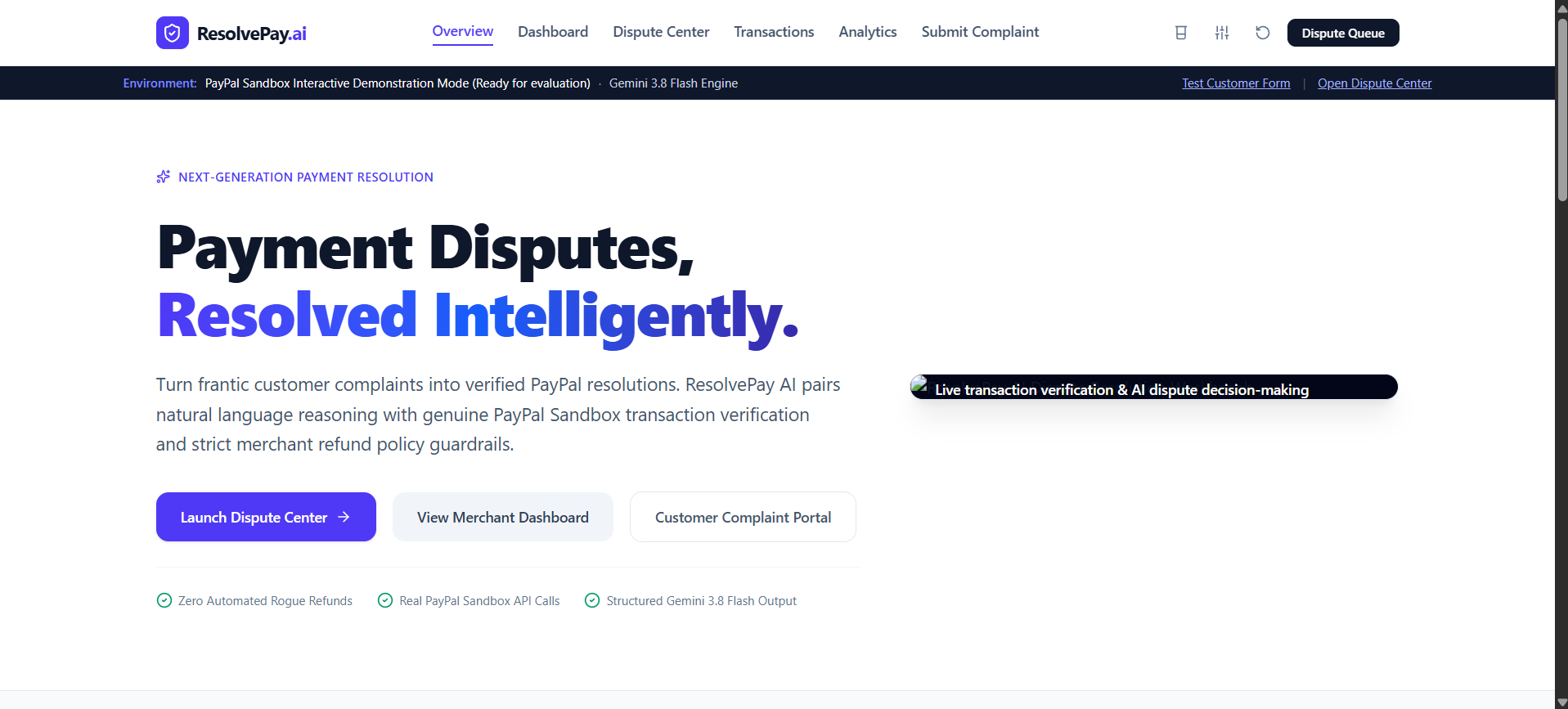
ResolvePay AI is an AI-powered payment dispute resolution platform designed to simplify how online businesses handle customer payment complaints.
It combines AI-powered complaint understanding with PayPal transaction verification to assist merchants throughout the resolution process.
Key capabilities include:
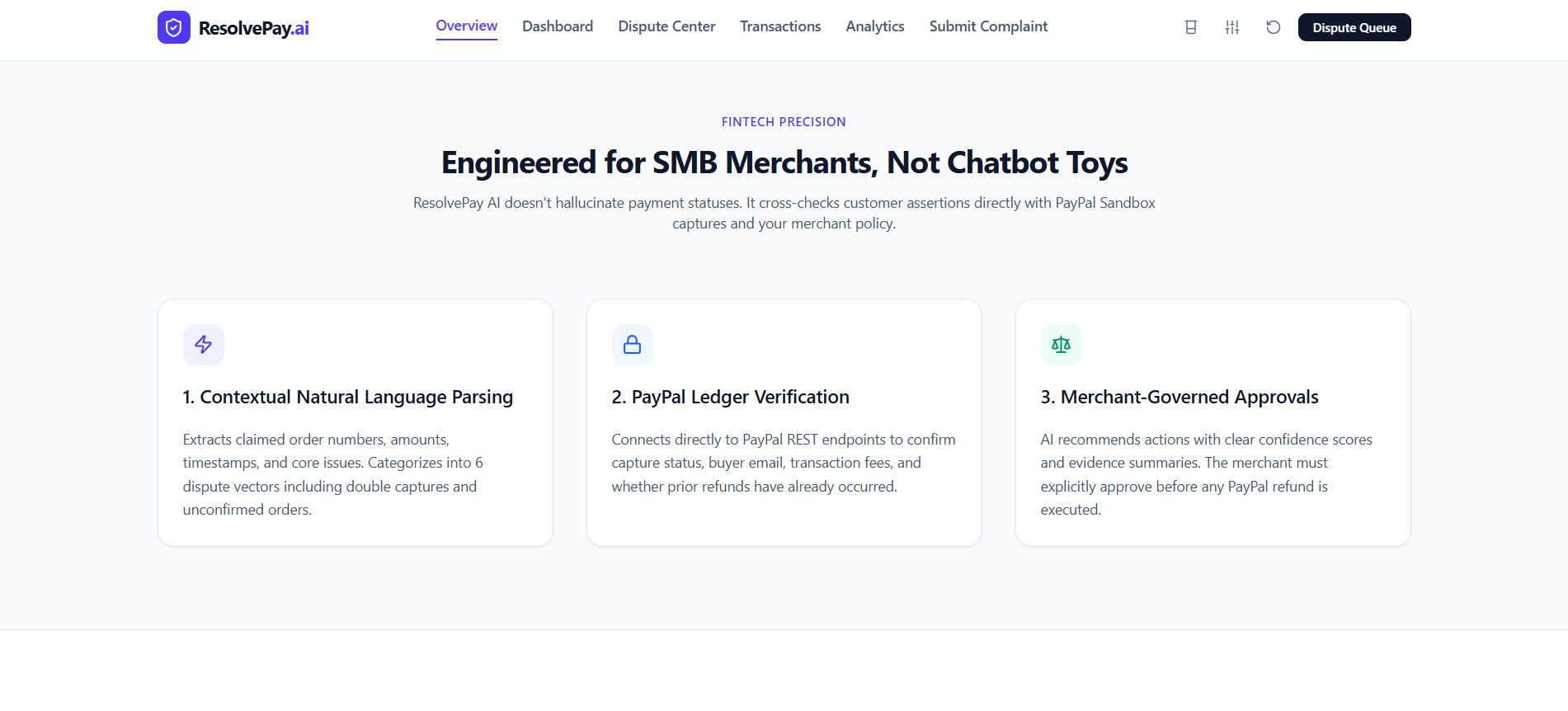
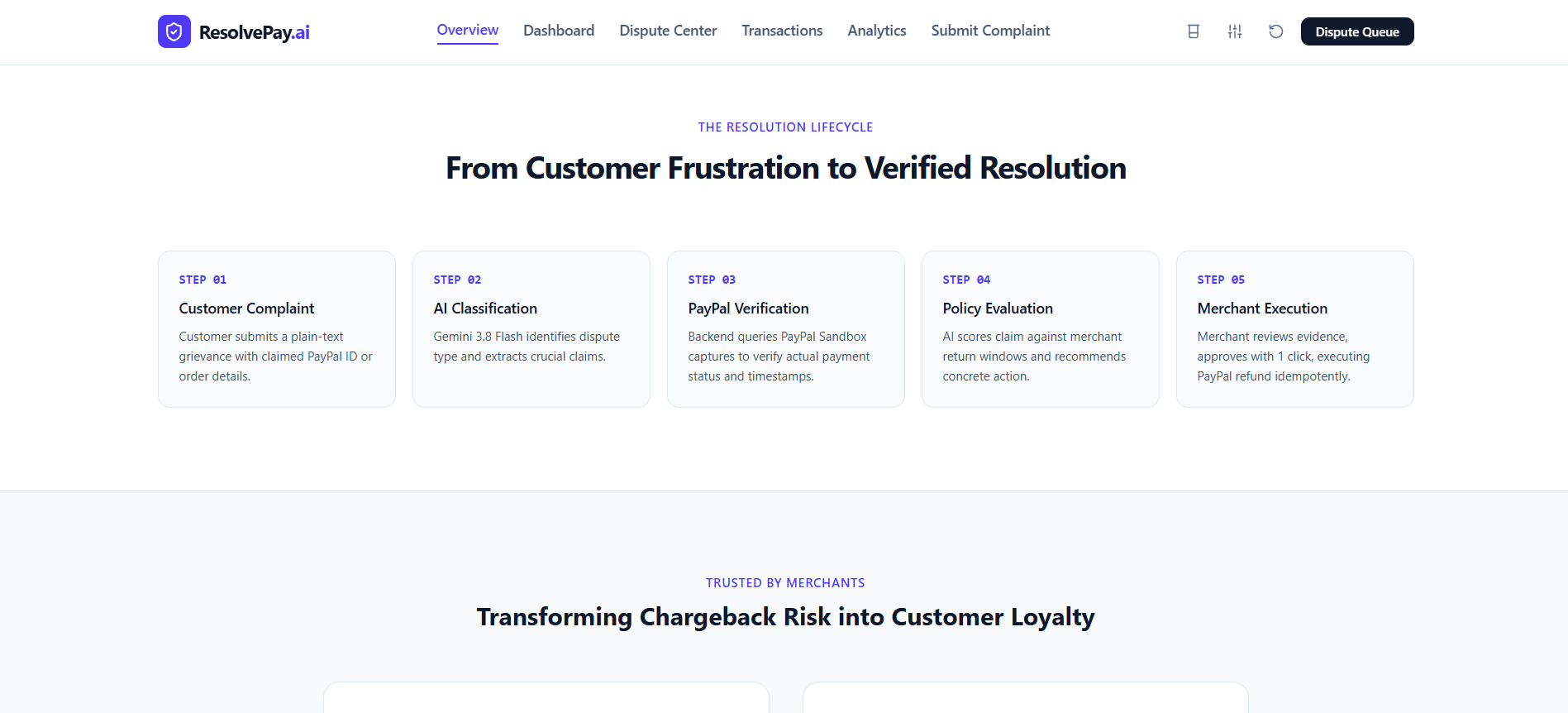
Intelligent Complaint Analysis: Understands customer complaints written in natural language and categorizes them into relevant payment issues.
Transaction Verification: Connects complaints with relevant PayPal transaction information.
AI Resolution Recommendations: Analyzes available transaction evidence and merchant policies to recommend appropriate next steps.
Merchant-Controlled Refunds: Allows merchants to review and approve refund recommendations before initiating eligible PayPal refunds.
Customer Response Generation: Generates clear, personalized responses to keep customers informed.
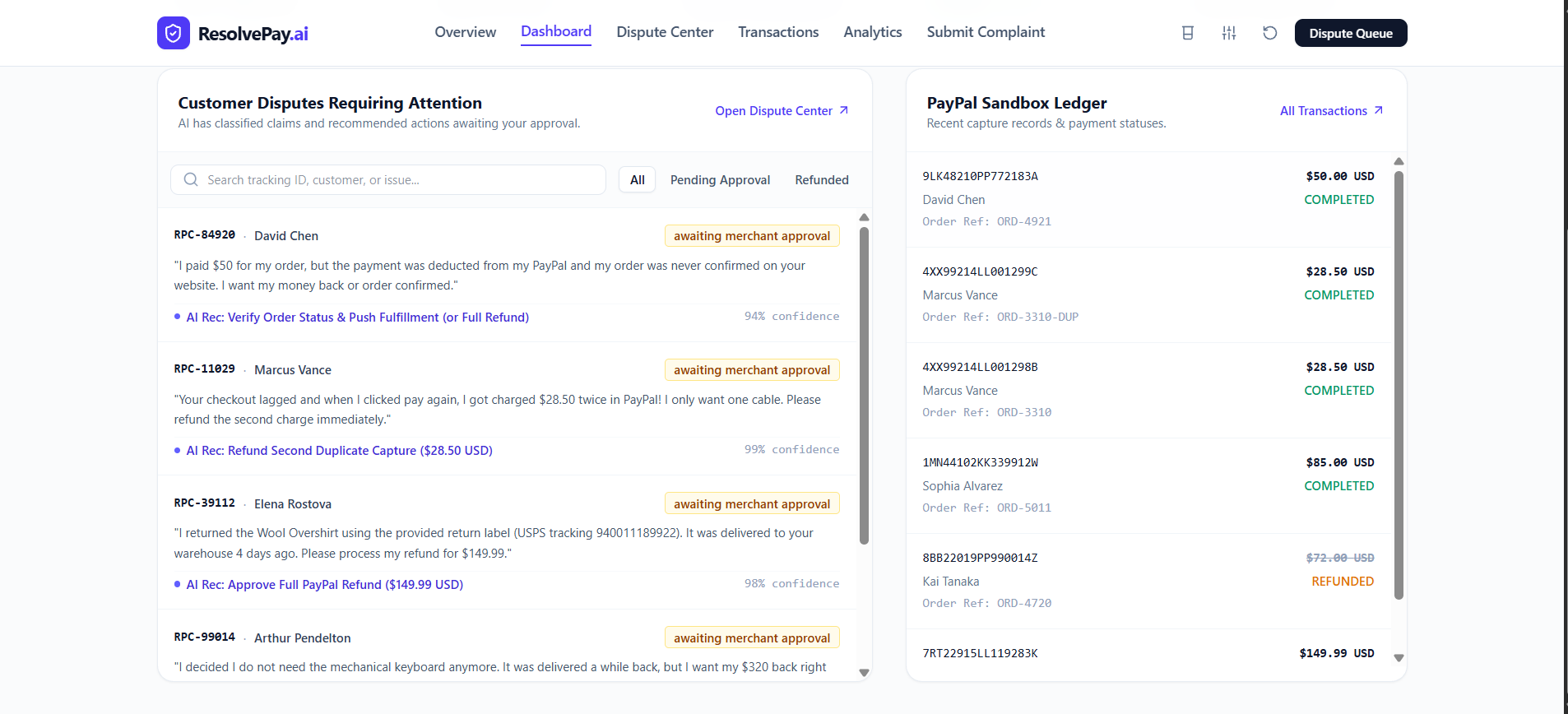
Resolution Dashboard: Provides a centralized interface to monitor complaints, transactions, refunds, and resolution statuses.
Our goal is to transform a traditionally manual process into a more intelligent, transparent, and efficient workflow.
How we built it
We designed ResolvePay AI using a modular full-stack architecture.
Frontend: React, TypeScript, and Tailwind CSS for a responsive fintech dashboard and user experience.
Backend: Python and FastAPI for handling application logic, API requests, and transaction workflows.
AI Engine: Gemini API for natural-language complaint understanding, classification, structured analysis, and resolution recommendations.
Payment Integration: PayPal REST APIs and Sandbox environment for transaction verification and refund workflows.
Database: Supabase/PostgreSQL for storing complaints, transaction references, AI analyses, and resolution records.
Visualization: Recharts for presenting transaction and dispute analytics.
The workflow connects customer complaints to transaction information, passes verified context to the AI engine, and presents recommendations to merchants for review.
We also designed a demo workflow to showcase the product without requiring real financial transactions.
Challenges we ran into
One of our biggest challenges was ensuring that AI-generated recommendations remained grounded in actual transaction information.
A language model can generate convincing explanations, but financial decisions require reliable evidence. We therefore designed the system to distinguish verified transaction facts from AI-generated suggestions.
Other challenges included:
Designing a reliable connection between AI analysis and PayPal transaction workflows.
Handling different complaint categories and ambiguous customer messages.
Preventing duplicate or unauthorized refund operations.
Maintaining a smooth user experience while handling asynchronous API requests.
Balancing advanced AI functionality with a realistic hackathon development timeline.
We focused on keeping merchants in control of financial decisions rather than allowing AI to independently execute sensitive actions.
Accomplishments that we're proud of
We are proud of developing a concept that brings AI into an actual financial workflow rather than using it as just another conversational interface.
Our key accomplishments include:
Designing an end-to-end AI-powered dispute resolution workflow.
Bringing complaint understanding, transaction verification, and refund recommendations into one platform.
Creating a merchant-focused dashboard for managing payment-related issues.
Designing a human-in-the-loop approach that keeps financial decisions under merchant control.
Building a product concept that can scale beyond individual refund requests into a broader payment-support infrastructure.
Most importantly, we are proud that ResolvePay AI focuses on a real problem faced by online businesses and their customers.
What we learned
Through building ResolvePay AI, we learned that applying AI to fintech requires much more than generating intelligent responses.
AI recommendations must be grounded in reliable data, sensitive operations require authorization, and users need transparency into why a particular action is recommended.
We also learned the importance of designing AI agents around specific tasks, integrating external APIs carefully, and building systems where automation and human decision-making complement each other.
The experience helped us understand how AI can make financial workflows more efficient without compromising trust and accountability.
What's next for ResolvePay
We envision ResolvePay AI becoming a comprehensive AI-powered payment resolution platform for online businesses.
Our future roadmap includes:
Supporting additional payment providers beyond PayPal.
Improving AI recommendations through transaction history and merchant-specific policies.
Introducing intelligent dispute prioritization based on urgency and risk.
Building automated evidence collection for payment disputes.
Adding multilingual customer support.
Developing deeper analytics to identify recurring payment issues.
Introducing integrations with popular e-commerce platforms.
Exploring proactive AI systems that detect potential payment-related problems before customers report them.
Our long-term vision is simple: Make payment resolution as seamless as making a payment
Built With
- ai
- api
- artificial
- automation
- css
- fastapi
- financial
- fintech
- gemini
- generative
- intelligence
- language
- natural
- payment
- paypal
- postgresql
- processing
- python
- react
- rest
- supabase
- tailwind
- typescript

