-
-
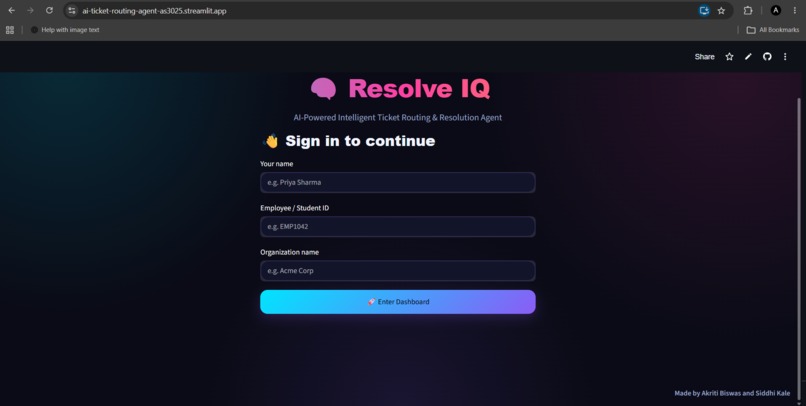
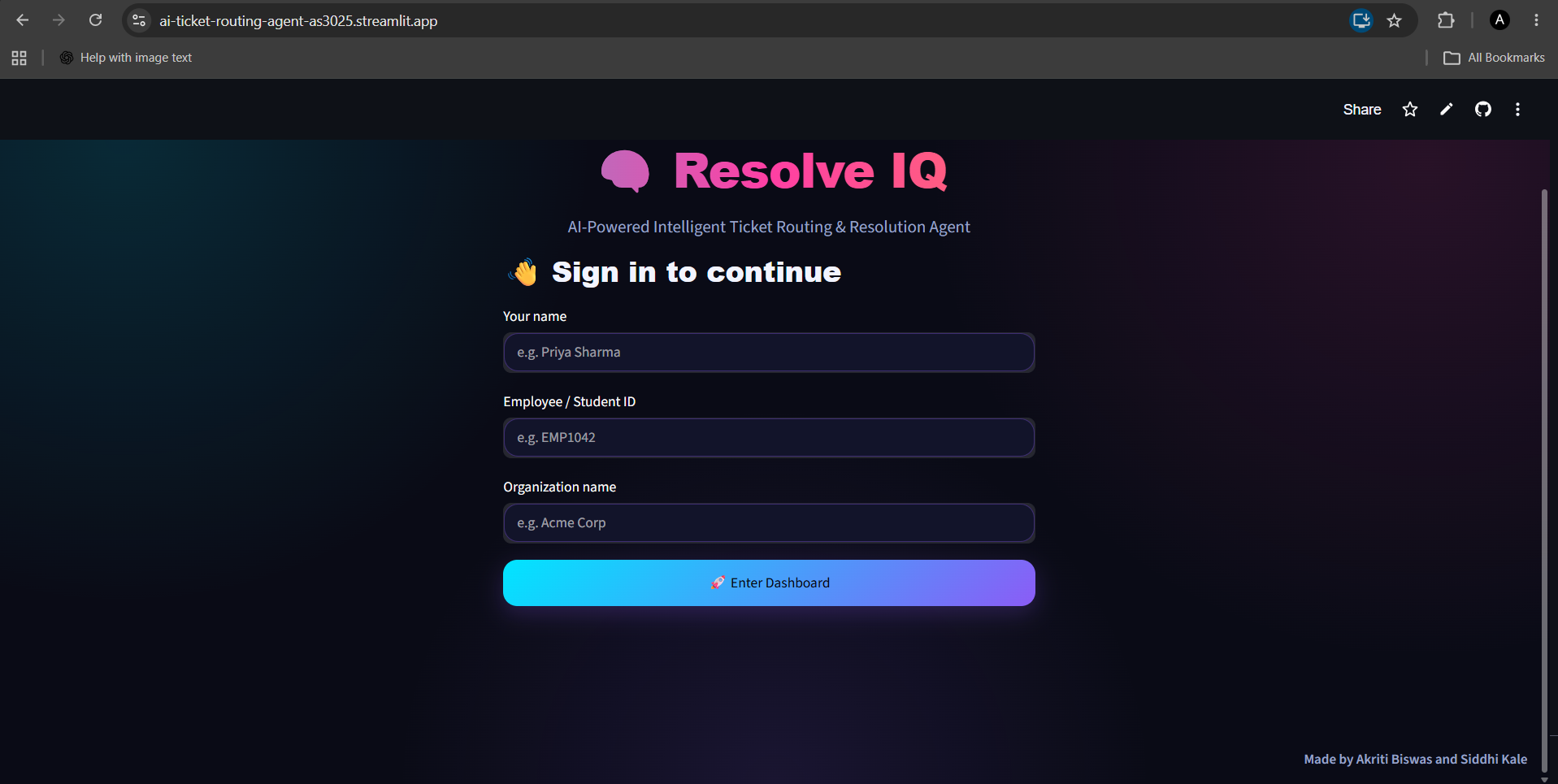
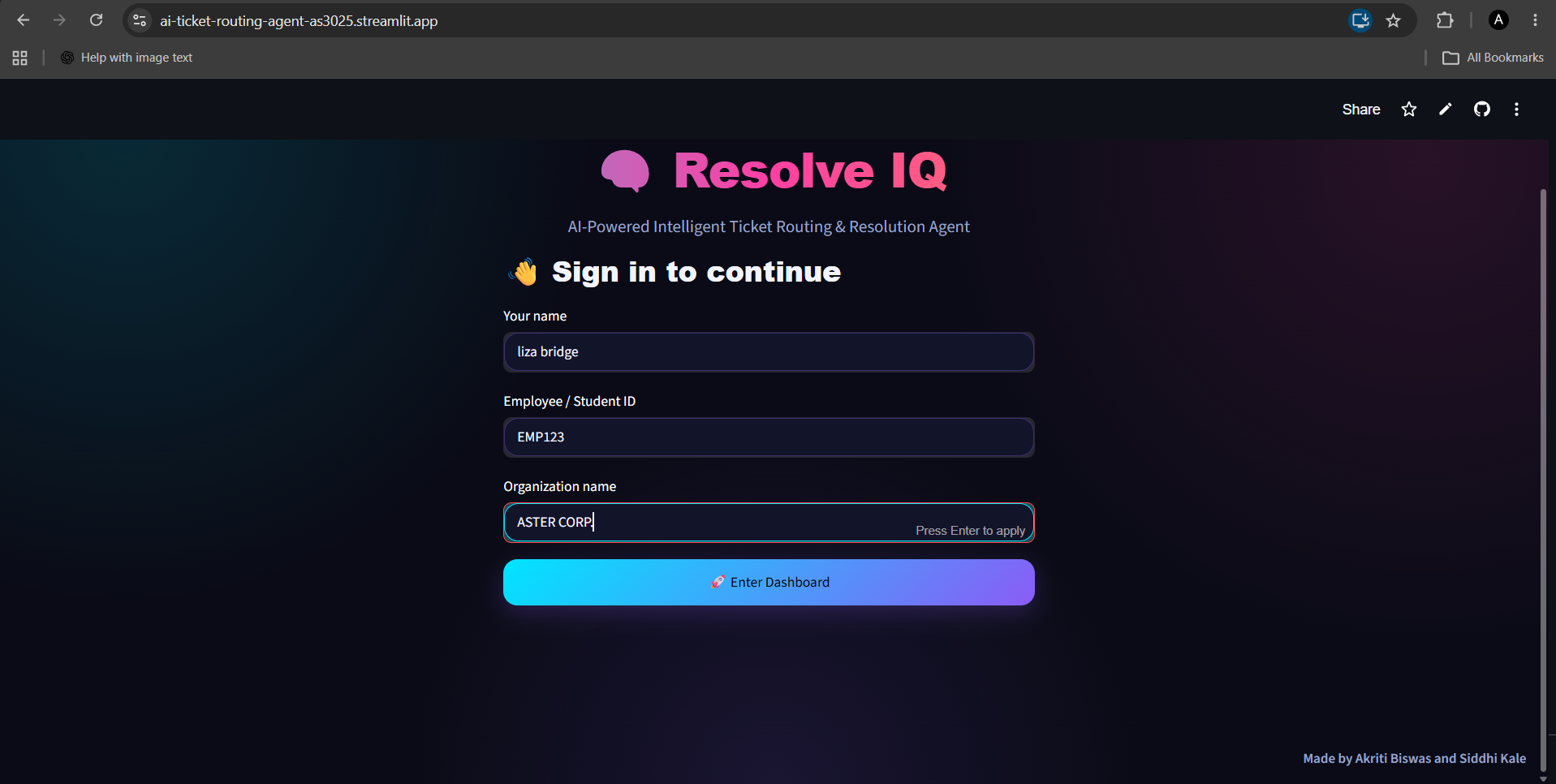
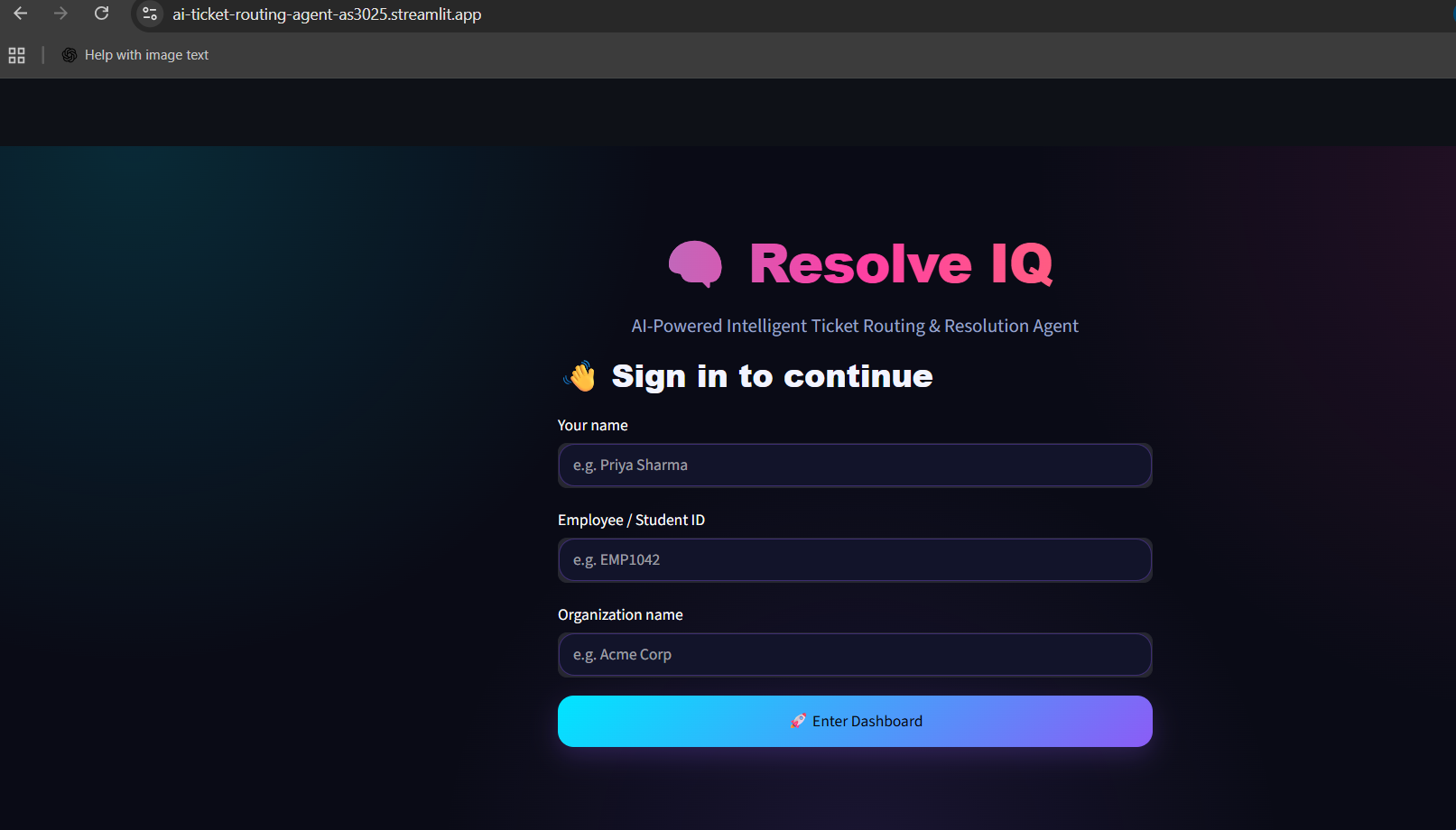
Login Page-The first UI page of Resolve IQ, where users begin by signing in to access the intelligent ticket routing and resolution system.
-
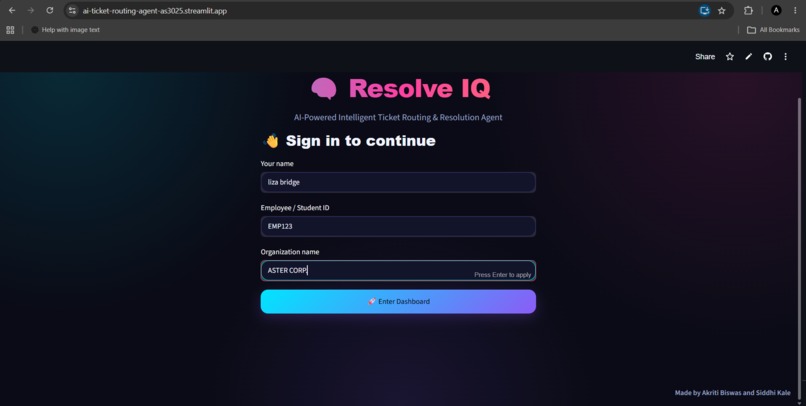
User & Organization Details - Users enter their name, Employee/Student ID, and organization name before entering the Resolve IQ dashboard.
-
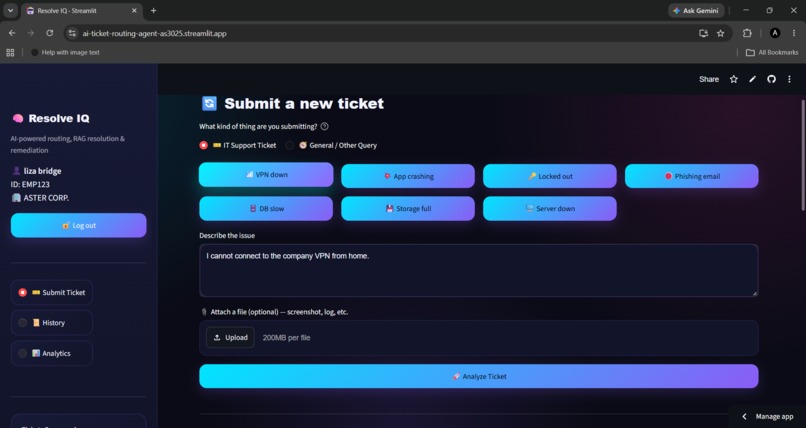
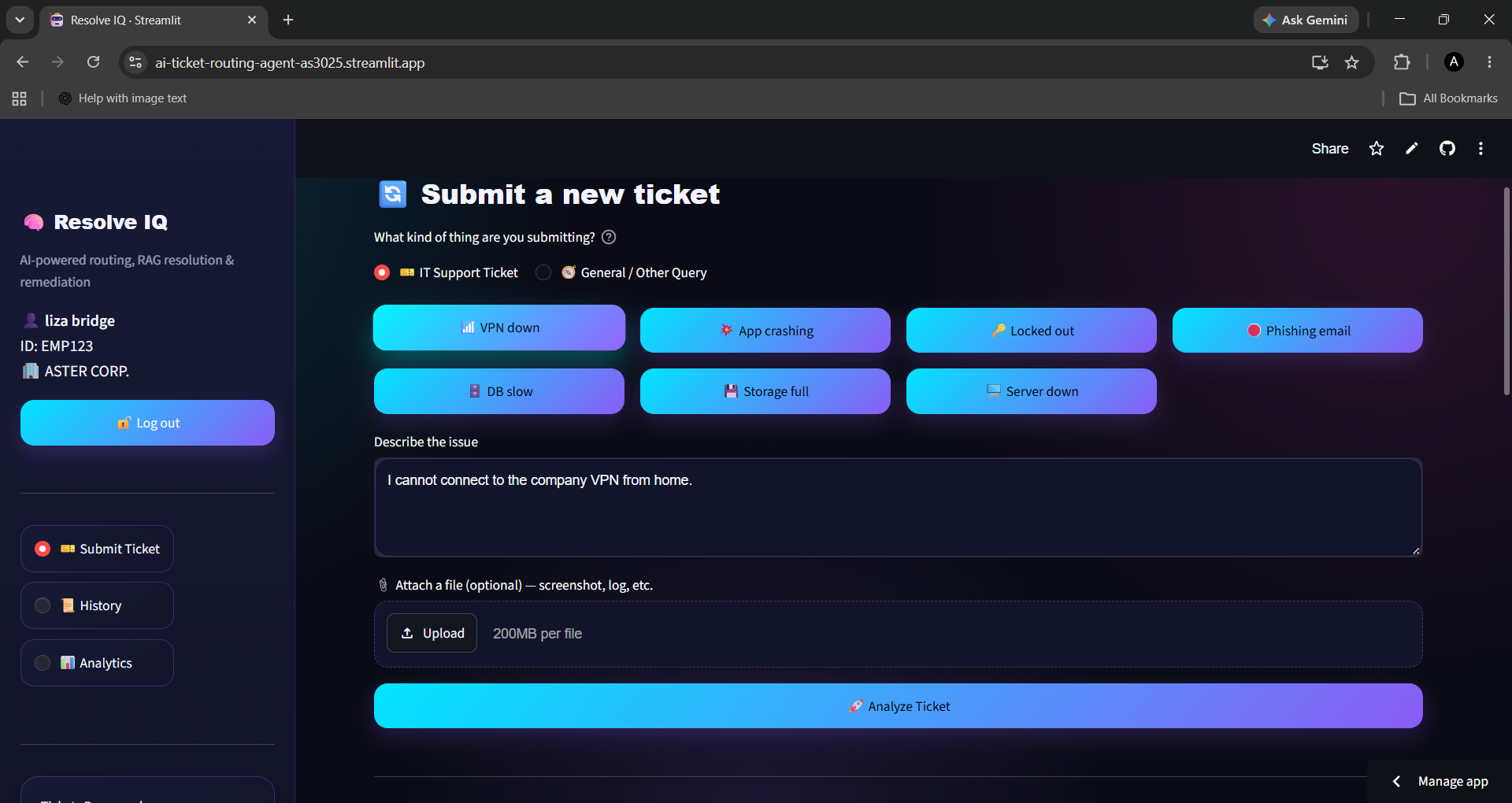
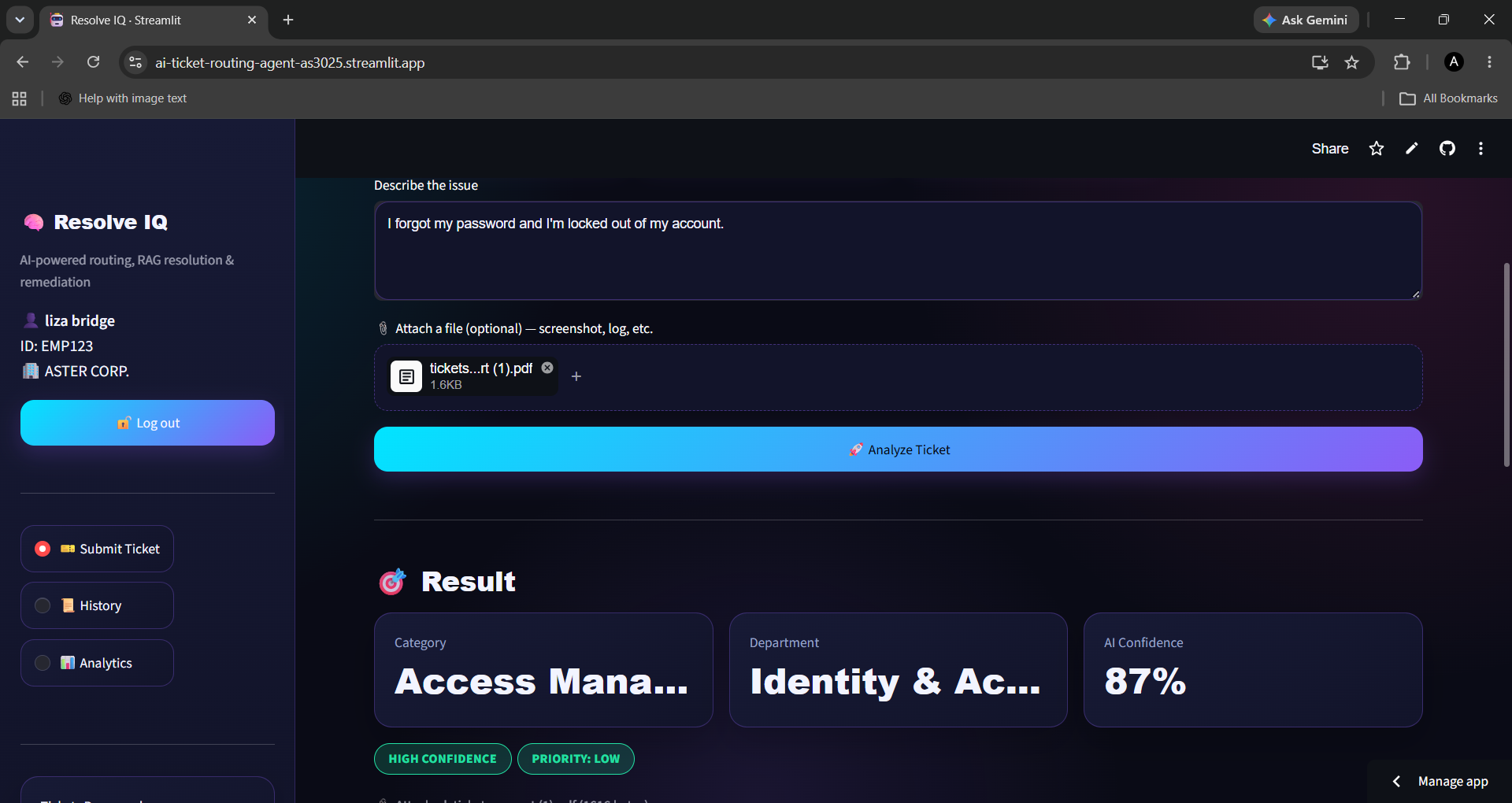
Submit Ticket – Describe the issue and attach files.
-
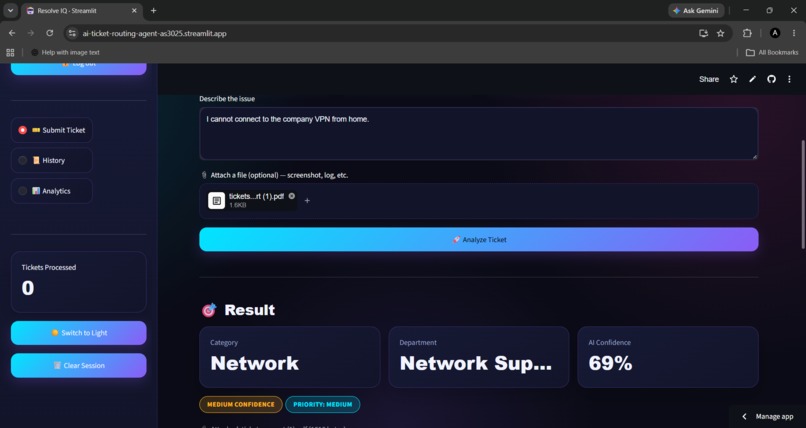
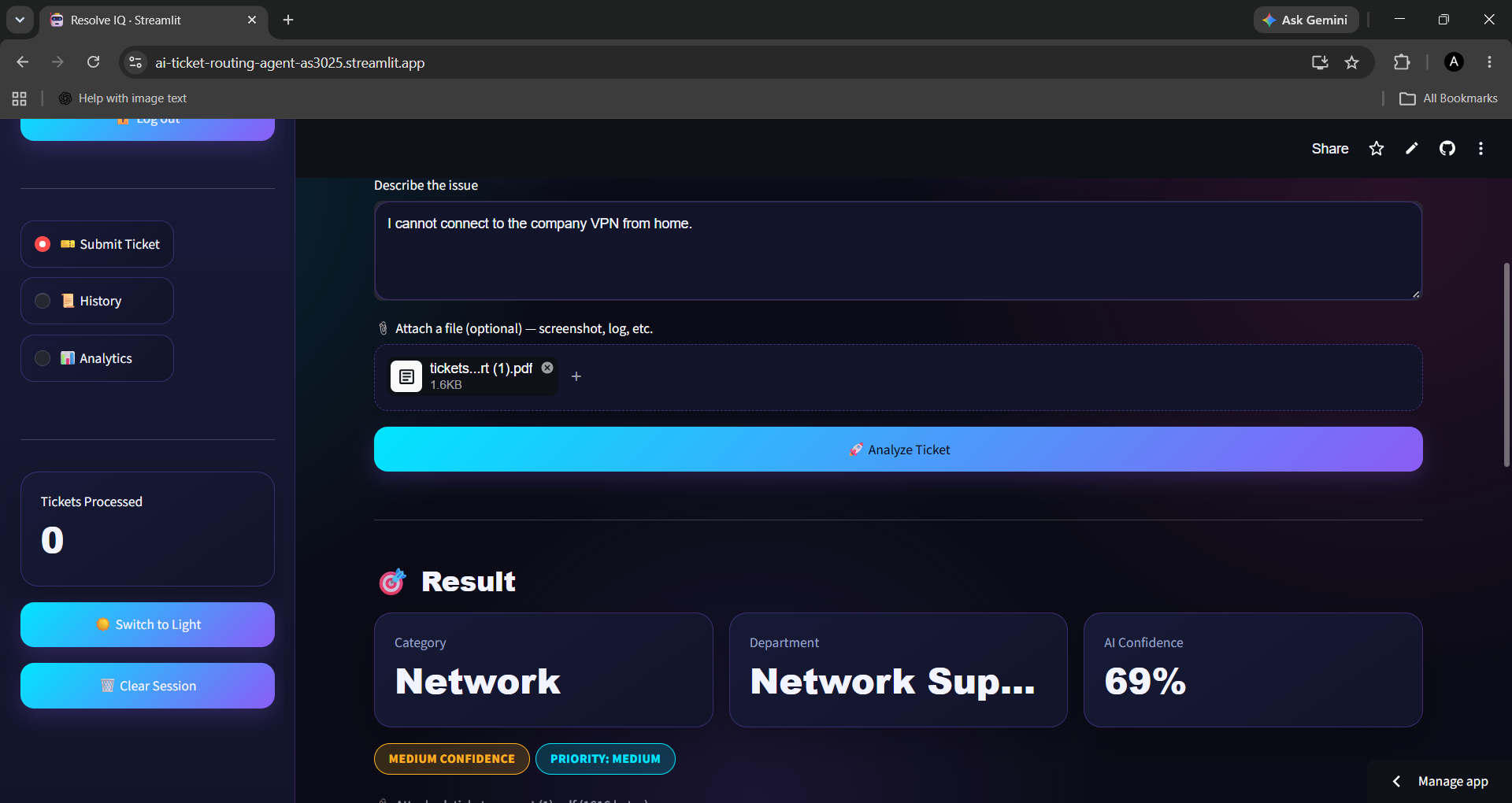
Resolve-IQ analyzes the ticket and predicts its category, responsible department, AI confidence score, and priority level.
-
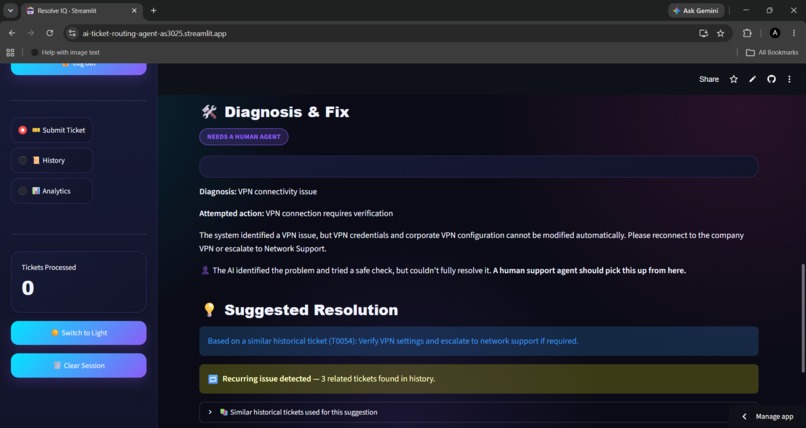
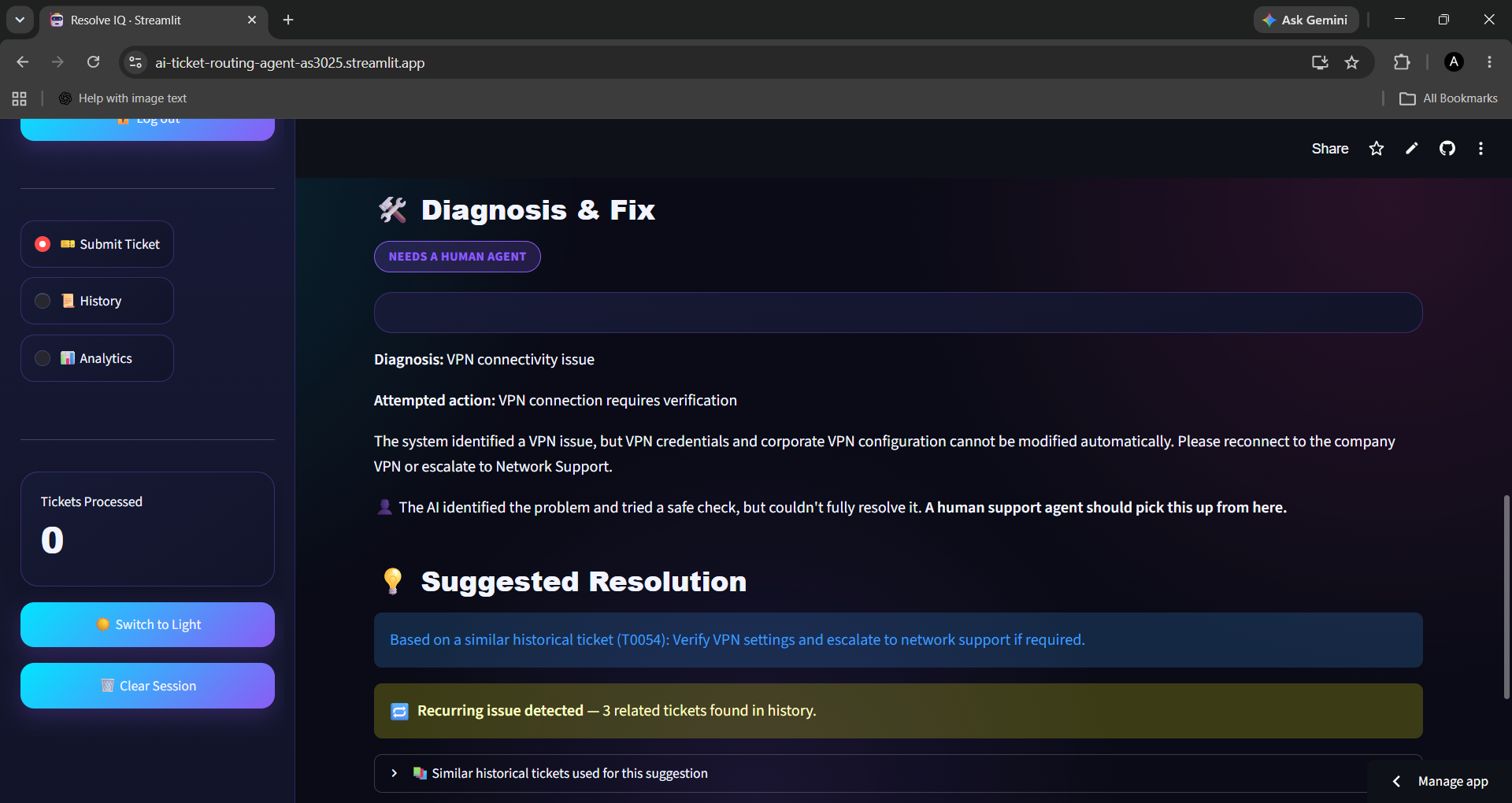
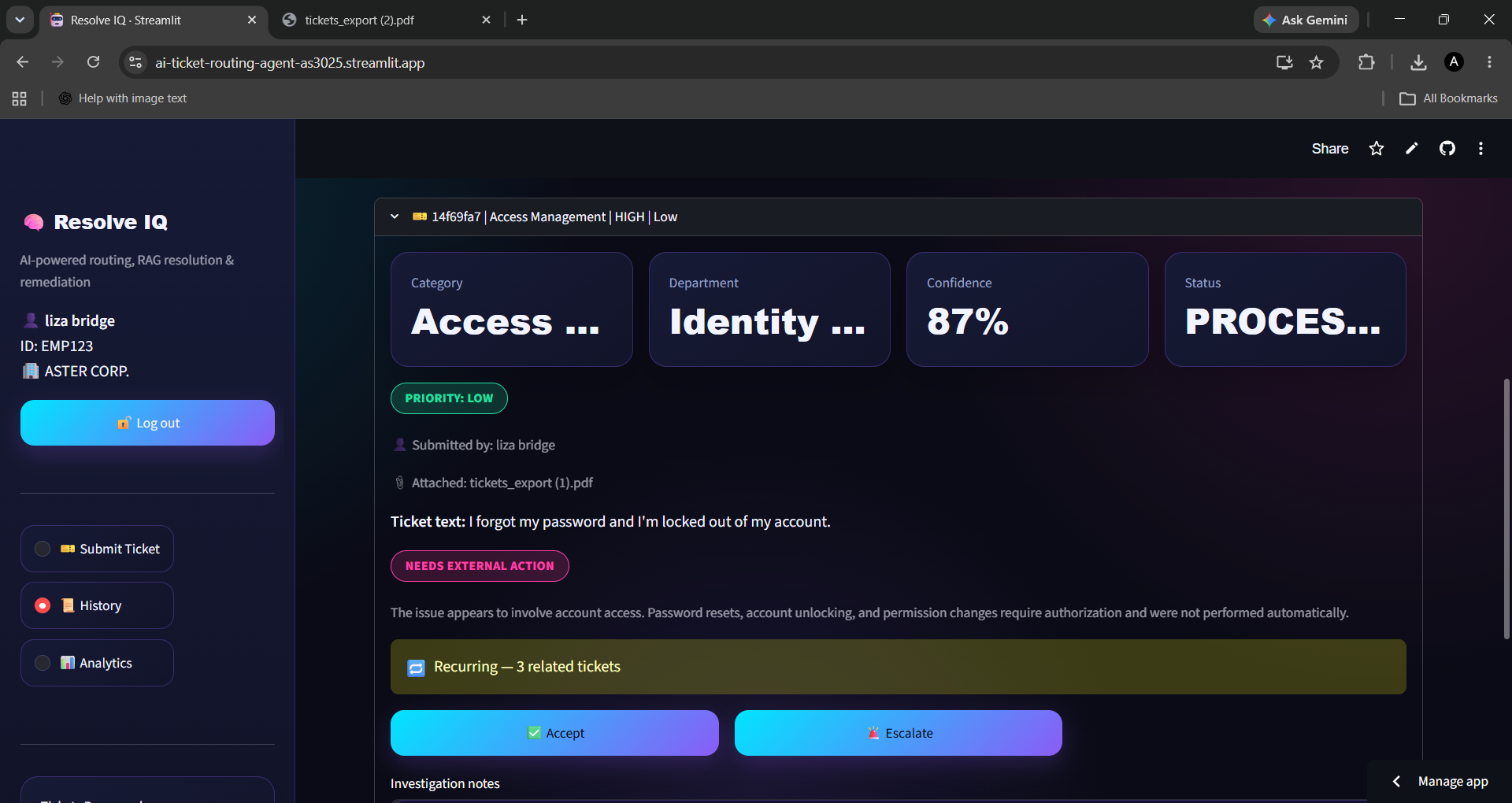
Diagnosis & Fix – Identifies the issue, explains the diagnosis and attempted action, and determines if human intervention is needed.
-
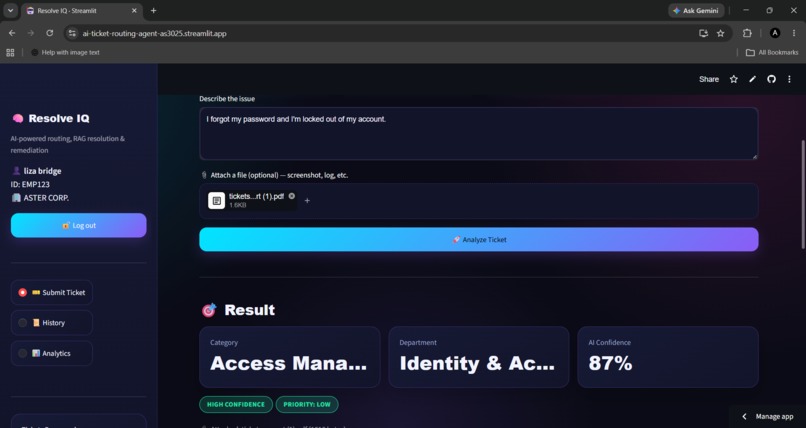
another issue raised
-
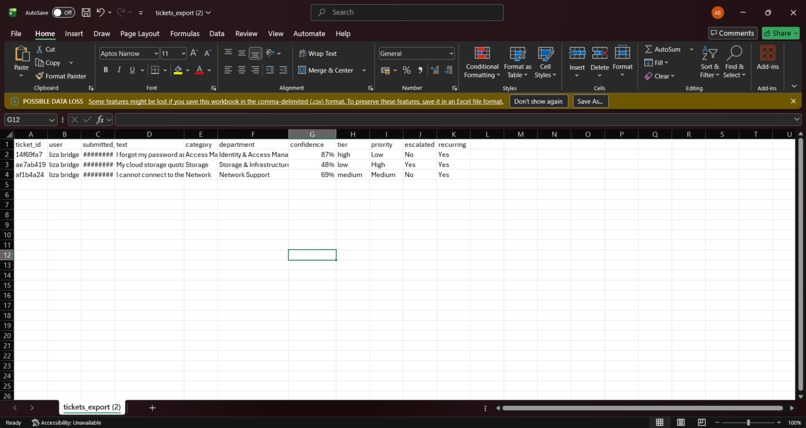
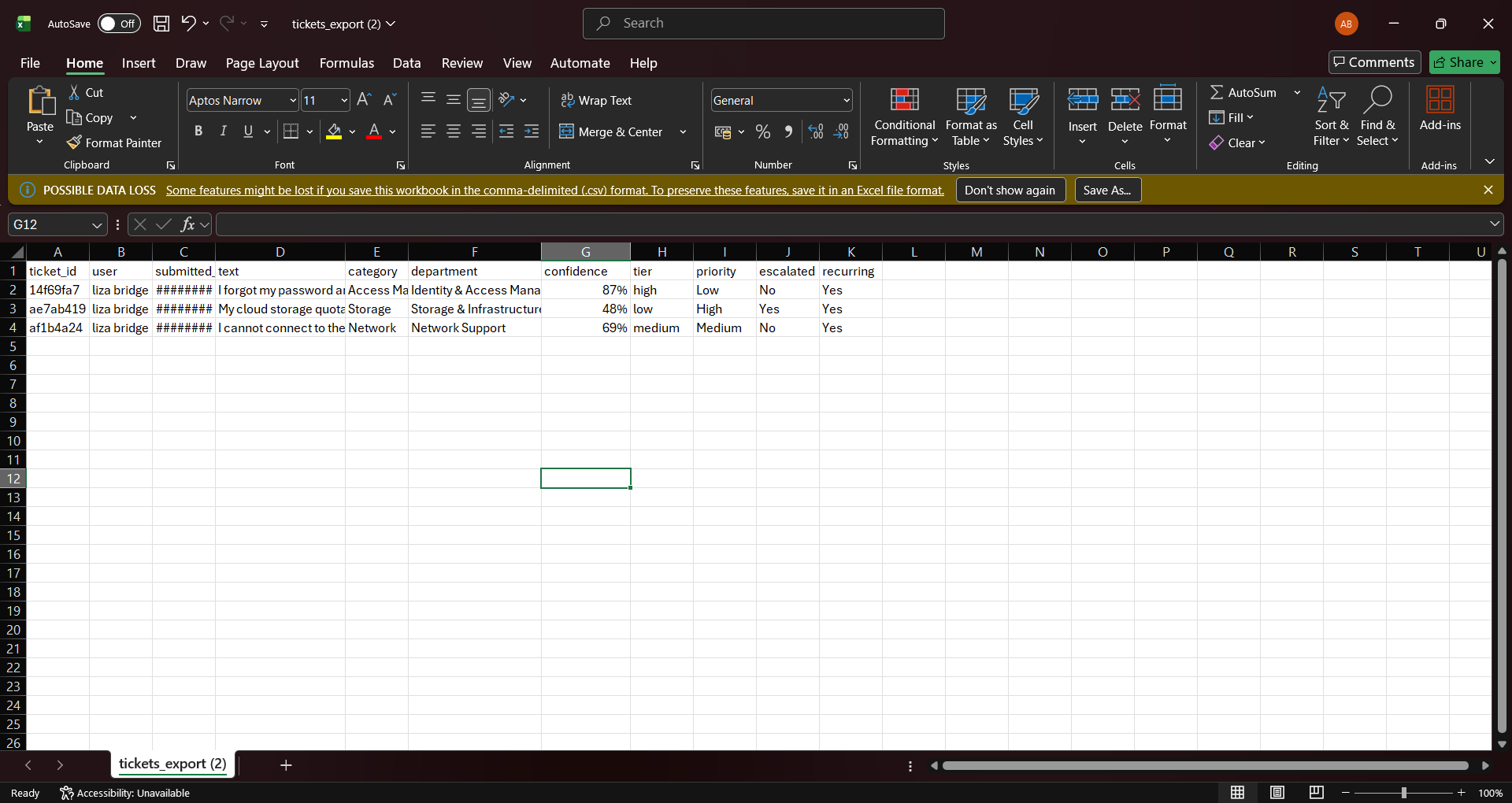
Ticket Data Export – CSV – Processed ticket information can be exported as a CSV file for analysis, tracking, and reporting.
-
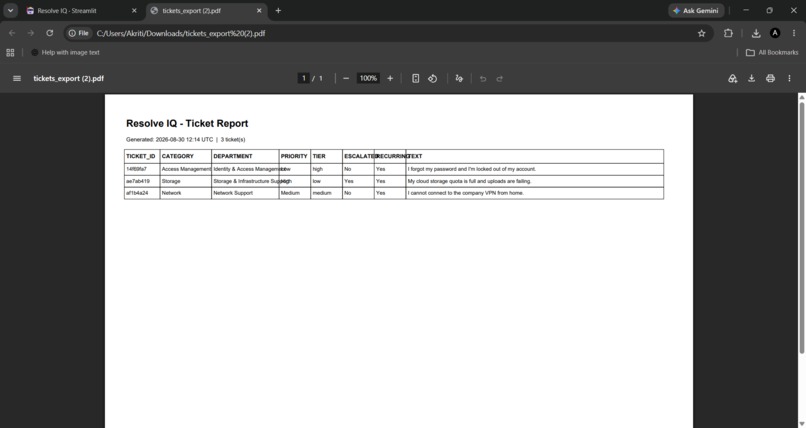
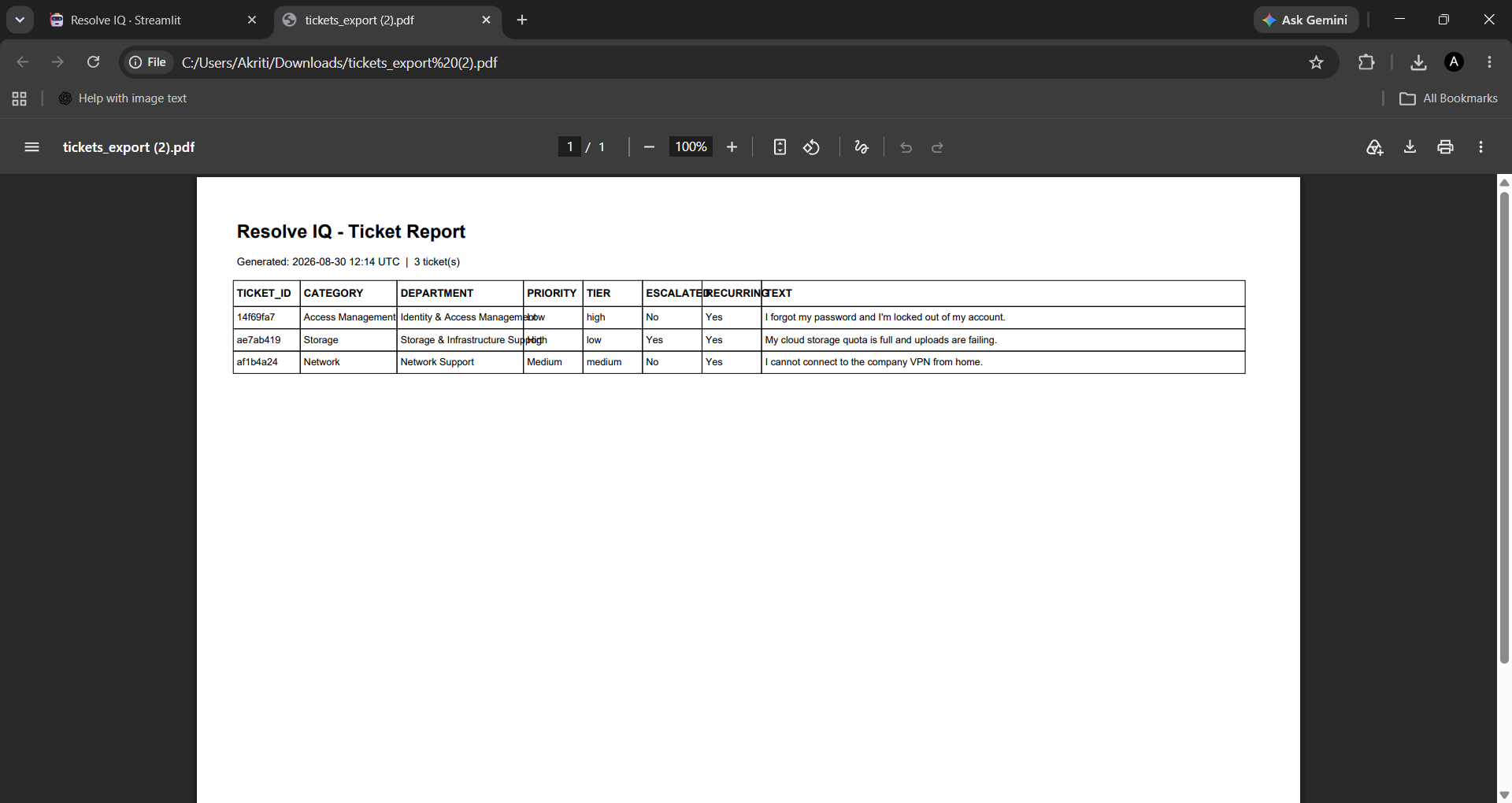
Ticket Report(PDF)–It generates a structured PDF report containing ticket categories, departments, priorities, and escalation details.
-
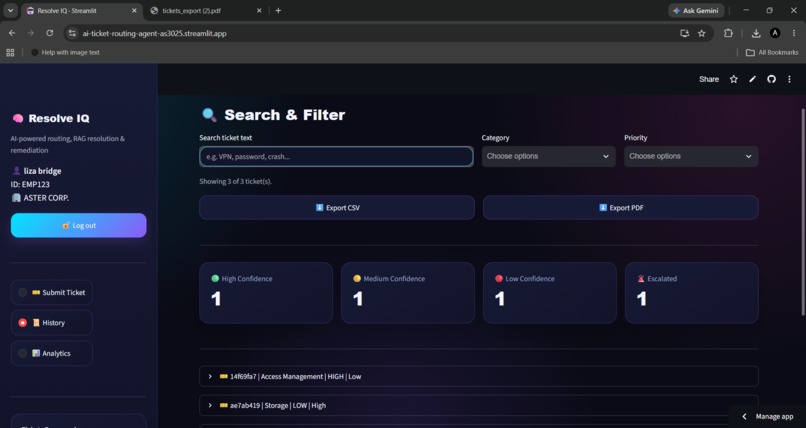
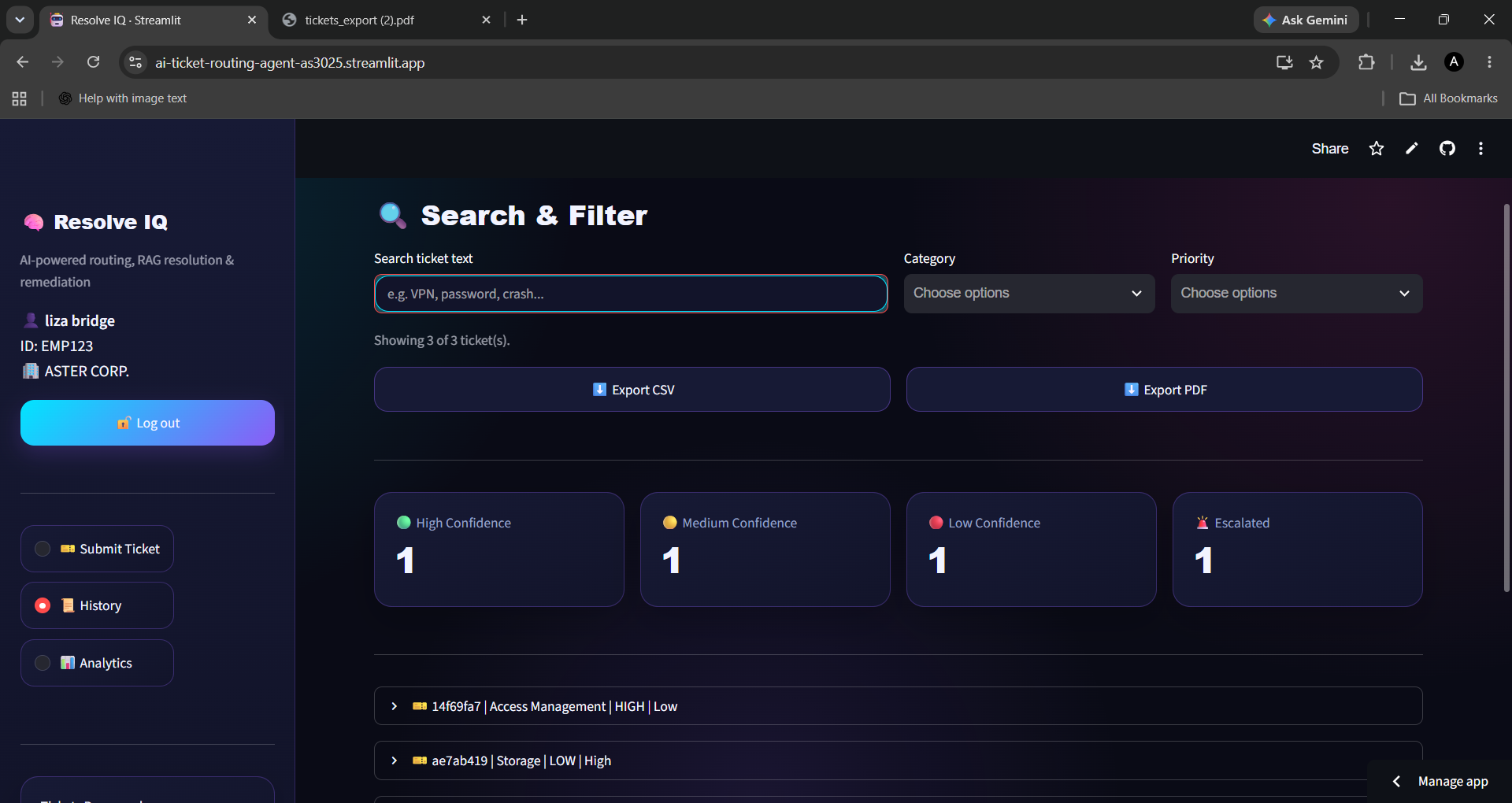
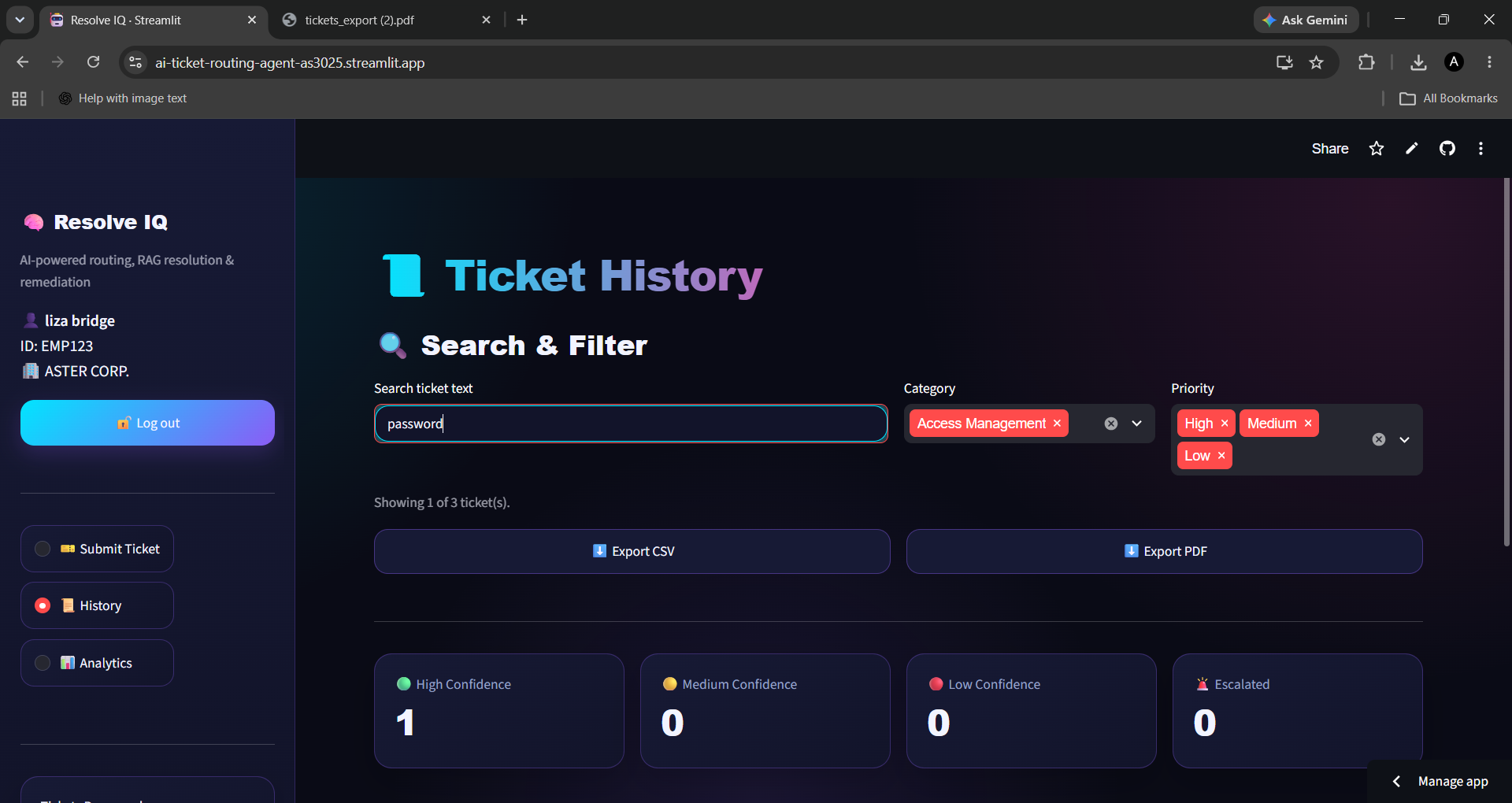
Ticket History – Search & Filter – Users can search and filter previously processed tickets using keywords, categories, and priority levels.
-
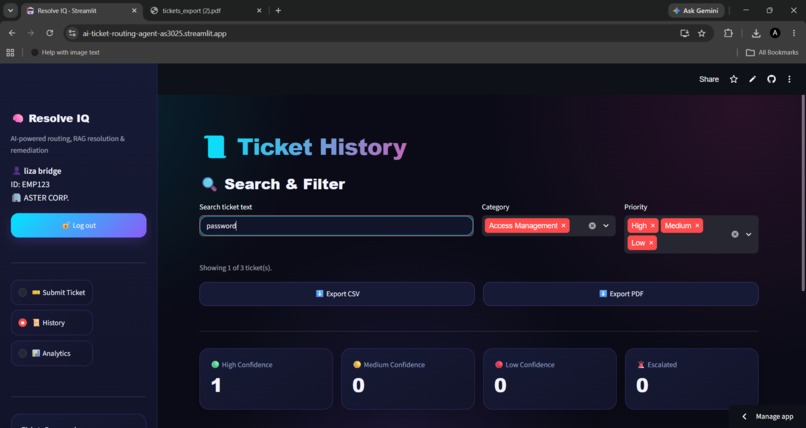
Filtered Ticket Results – System instantly displays matching tickets along with their confidence levels, priorities, and escalation status.
-
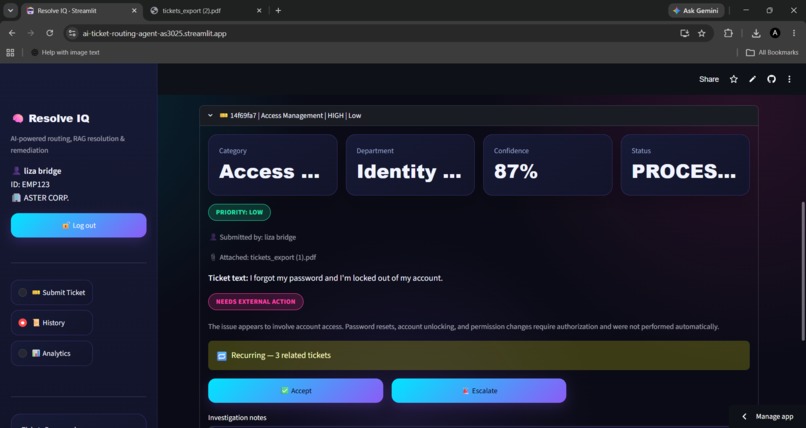
Each ticket provides detailed classification, department routing, confidence score, priority, status, and submitted information.
-
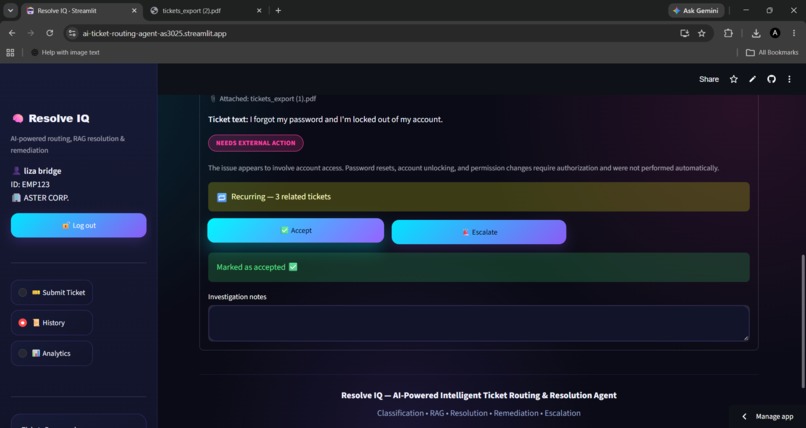
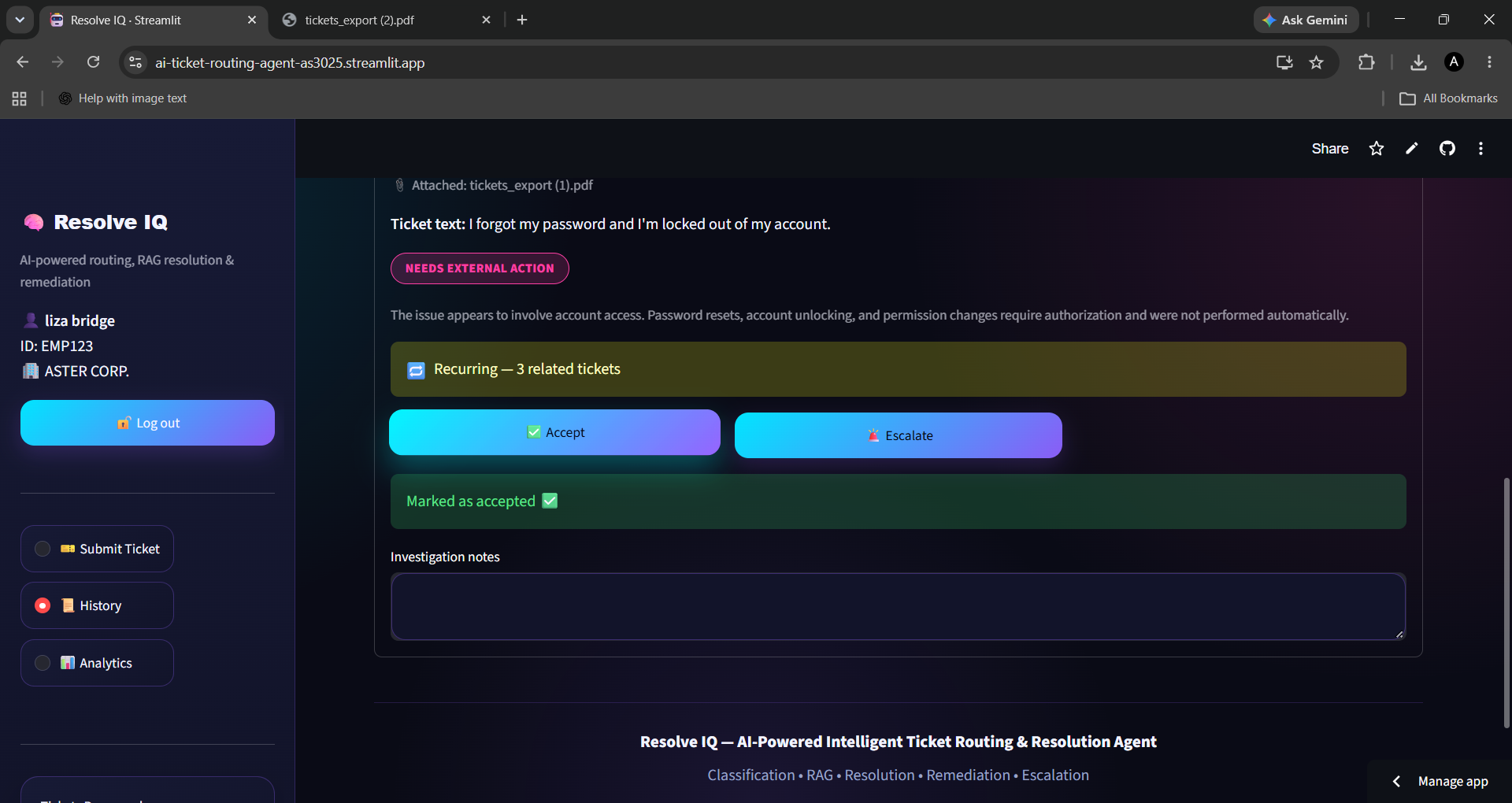
Ticket Action – Accept or escalate the AI-generated recommendation.
-
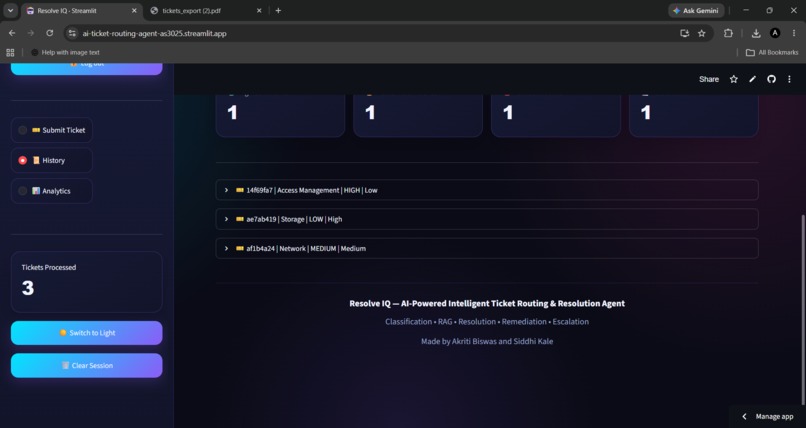
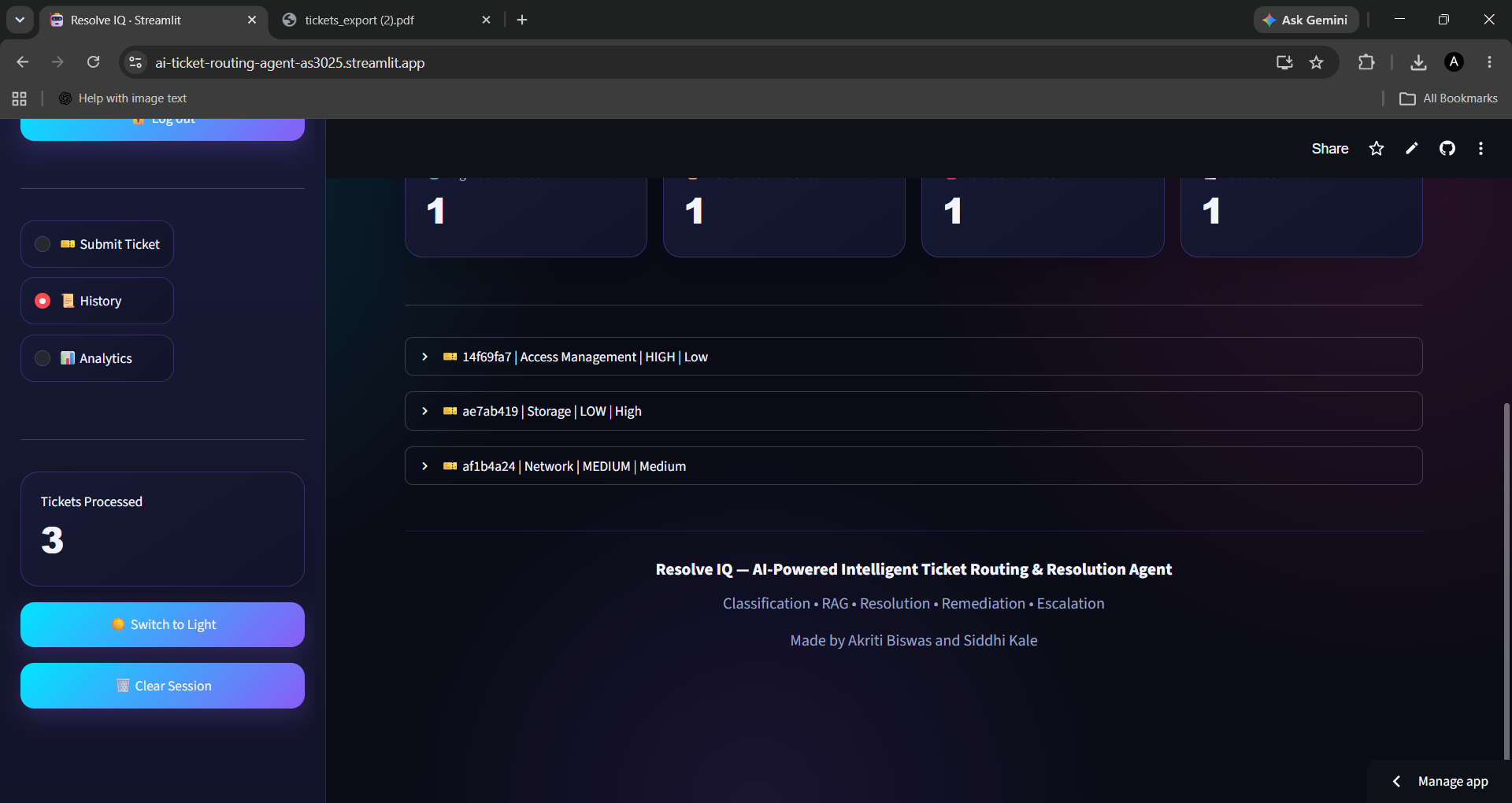
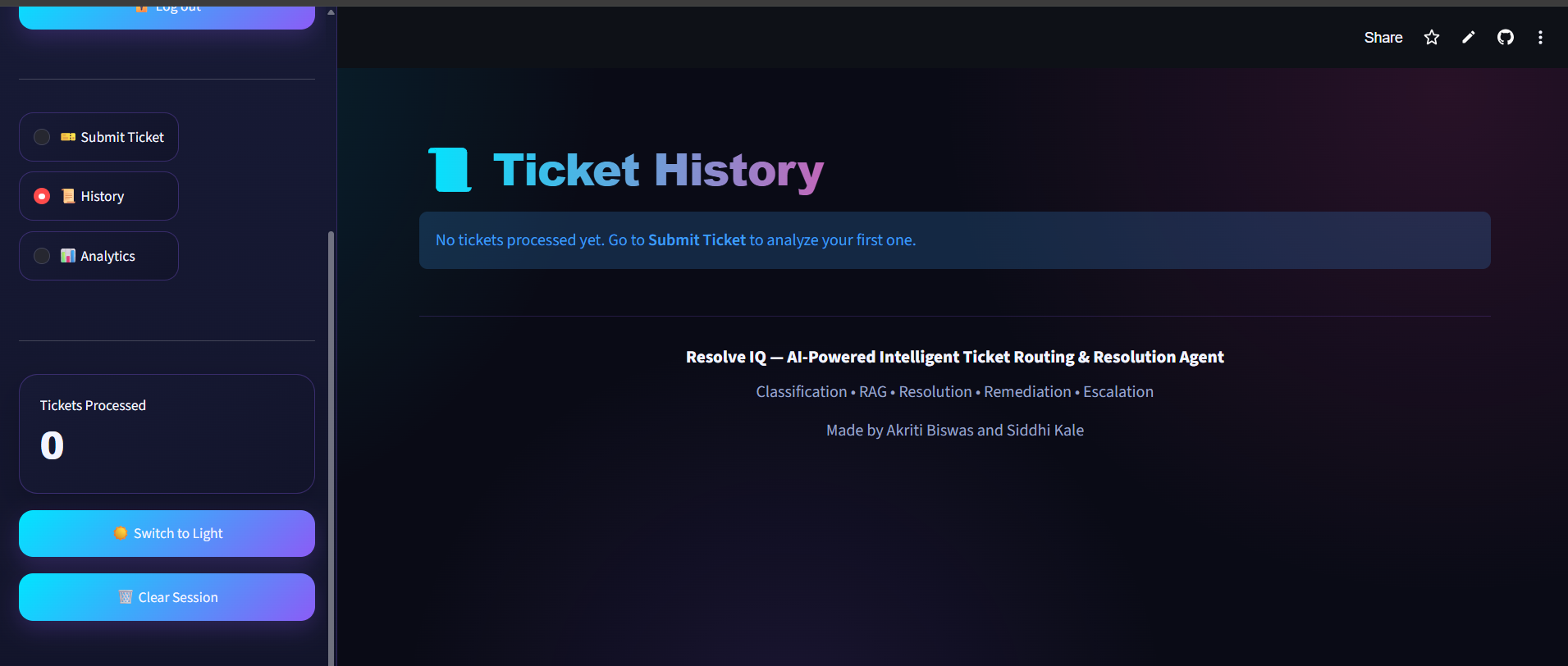
Ticket History – View all processed tickets and their status.
-
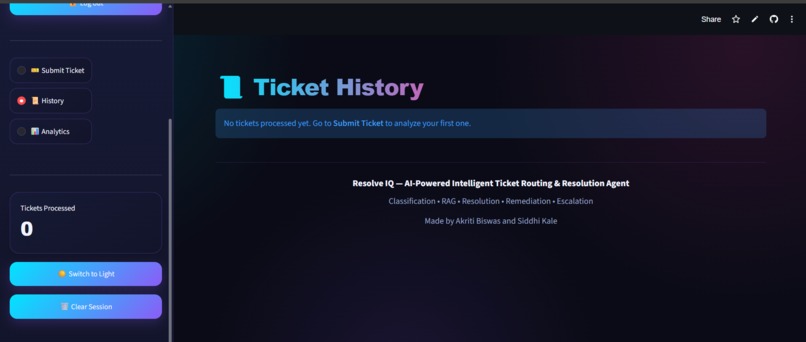
Empty Ticket History – Shows the initial state before tickets are processed.cleared session.
-
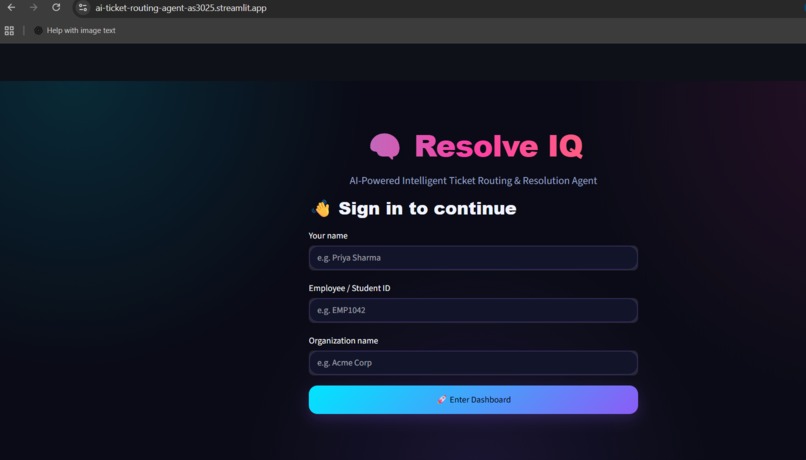
logged out
Inspiration
Support teams often receive a large number of technical tickets, but manually reading, categorizing, prioritizing, and routing every ticket can be slow and inconsistent. We wanted to build a system that could assist support teams by turning an unstructured ticket into an intelligent, actionable workflow.
This idea led us to create Resolve IQ, an AI-powered ticket routing and resolution assistant that combines machine learning, knowledge retrieval, confidence analysis, and automated escalation.
What We Built
Resolve IQ is an end-to-end intelligent ticket management system built with Python and Streamlit.
A user can log in and submit a support ticket in natural language. The system analyzes the ticket, predicts its category, estimates its priority, identifies the appropriate department, retrieves relevant knowledge, and provides a recommended resolution.
The system also evaluates its confidence in the recommendation. When confidence is lower or a case requires additional attention, it can flag the ticket for human review instead of relying completely on automation.
The application includes:
- AI-based ticket classification
- Automatic department routing
- Priority estimation
- Knowledge-base retrieval
- Resolution recommendations
- Confidence analysis and escalation
- Manual category and department correction
- Internal, External, and Needs Human diagnosis
- General / Other Query handling
- Ticket history and filtering
- Analytics dashboard
- CSV and PDF report generation
- File attachment support
- Dark and light themes
How We Built It
We built the application in Python using a modular agent-based architecture.
The ticket first passes through preprocessing and classification. A machine learning model predicts the ticket category from the submitted text. The system then estimates priority and determines the appropriate routing department.
A knowledge retrieval layer searches the available ticket knowledge base for relevant information. The resolution component uses the retrieved information and ticket context to provide a useful resolution recommendation.
A confidence and escalation layer helps determine whether the recommendation can be provided as automated assistance or should be reviewed by a human.
The complete workflow is connected through an interactive Streamlit dashboard, allowing users to submit tickets, review results, correct predictions when necessary, and analyze previous tickets.
Challenges We Faced
One of the main challenges was making sure that the different parts of the system worked together consistently.
During development, we identified a mismatch between the trained model's ticket categories and the routing logic. We corrected the category mapping so that predictions were routed to the appropriate departments.
We also improved the knowledge retrieval system so that it could use the actual ticket dataset instead of relying on a small predefined set of examples.
Another challenge was designing the system so that AI recommendations could still involve human judgment. We therefore added confidence analysis, escalation logic, and manual correction rather than treating every prediction as completely reliable.
Finally, we had to make the application practical for real users, which led us to add login, ticket history, analytics, file attachments, exports, and a responsive user interface.
What We Learned
Building Resolve IQ helped us understand how multiple AI and software components can be connected into one complete application.
We learned how to combine machine learning classification with routing logic, knowledge retrieval, confidence analysis, and a user-facing dashboard.
We also learned that a useful AI system should not only make predictions, but should communicate its confidence, provide useful recommendations, and allow humans to take control when required.
Future Scope
The long-term vision for Resolve IQ is to evolve it from a standalone ticket management application into a scalable AI-powered support platform for organizations of different sizes.
🏢 Enterprise Integration
Resolve IQ can be integrated with existing enterprise help-desk and IT service management platforms such as ServiceNow, Jira Service Management, Zendesk, and similar systems. This would allow organizations to use Resolve IQ without completely changing their existing support workflows.
🧩 Browser Extension
A future browser extension could allow employees to access Resolve IQ directly while working in internal portals, email systems, documentation platforms, or other enterprise applications. Users could highlight an issue or submit a problem without leaving their current workflow.
🤖 Built-in AI Support Assistant
Resolve IQ could evolve into an always-available AI support assistant that understands an organization's internal knowledge base, policies, documentation, previous resolved tickets, and support procedures.
Employees could interact with the assistant through a chat interface to ask questions, troubleshoot problems, create tickets, or receive guided solutions.
🔗 Enterprise Knowledge Integration
Future versions could connect securely with organizational knowledge sources such as internal documentation, FAQs, policy documents, troubleshooting guides, and previous resolved tickets. This would allow the system to provide organization-specific recommendations instead of relying only on a general knowledge base.
📈 Large-Scale Deployment
The architecture can be extended to support large organizations with thousands of employees and high volumes of support tickets. Future improvements could include scalable cloud infrastructure, distributed processing, role-based access control, organization-level dashboards, and multi-tenant support.
🧠 Continuous Learning
Resolve IQ could learn from human feedback and successfully resolved tickets over time. When support agents correct a classification, routing decision, or recommendation, that feedback could be used to improve future predictions.
This would create a human-in-the-loop learning system where automation continuously improves while keeping human oversight in critical situations.
🔐 Enterprise Security
For organizational deployment, future versions could include enterprise authentication, role-based permissions, audit logs, encrypted data handling, secure API integrations, and organization-specific data isolation.
🌍 Multi-Organization Platform
The long-term goal is to make Resolve IQ usable across multiple organizations while keeping each organization's data, users, knowledge base, models, and analytics securely separated.
🚀 Long-Term Vision
Our vision is to transform Resolve IQ into an AI-powered enterprise support layer that works alongside employees and support teams rather than simply acting as a ticket classifier.
Instead of waiting for an employee to manually create and route a ticket, Resolve IQ could proactively understand an issue, suggest a solution, create or update the appropriate ticket, route it to the right team, and involve a human whenever the AI is uncertain or the situation requires expert judgment.
Built With
- agents
- cloud
- community
- fpdf2
- github
- joblib
- knowledge
- learning
- machine
- pandas
- python
- rag
- retrieval
- scikit-learn
- streamlit


Log in or sign up for Devpost to join the conversation.