-
-
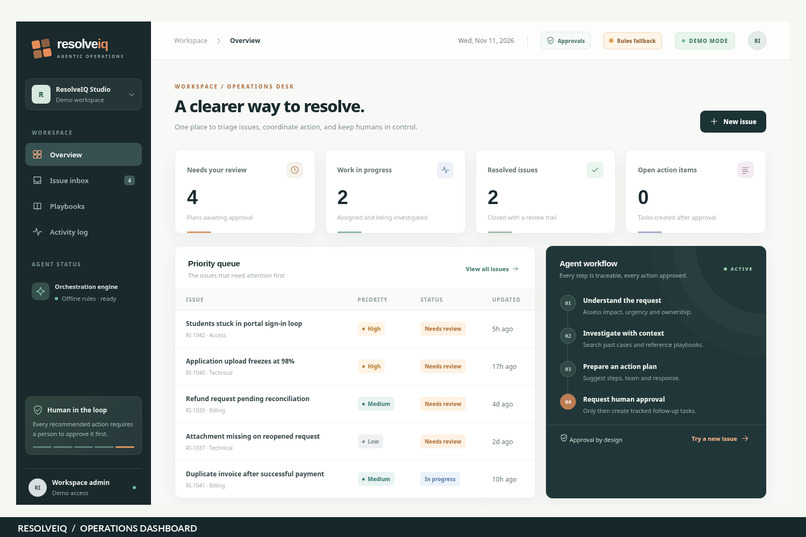
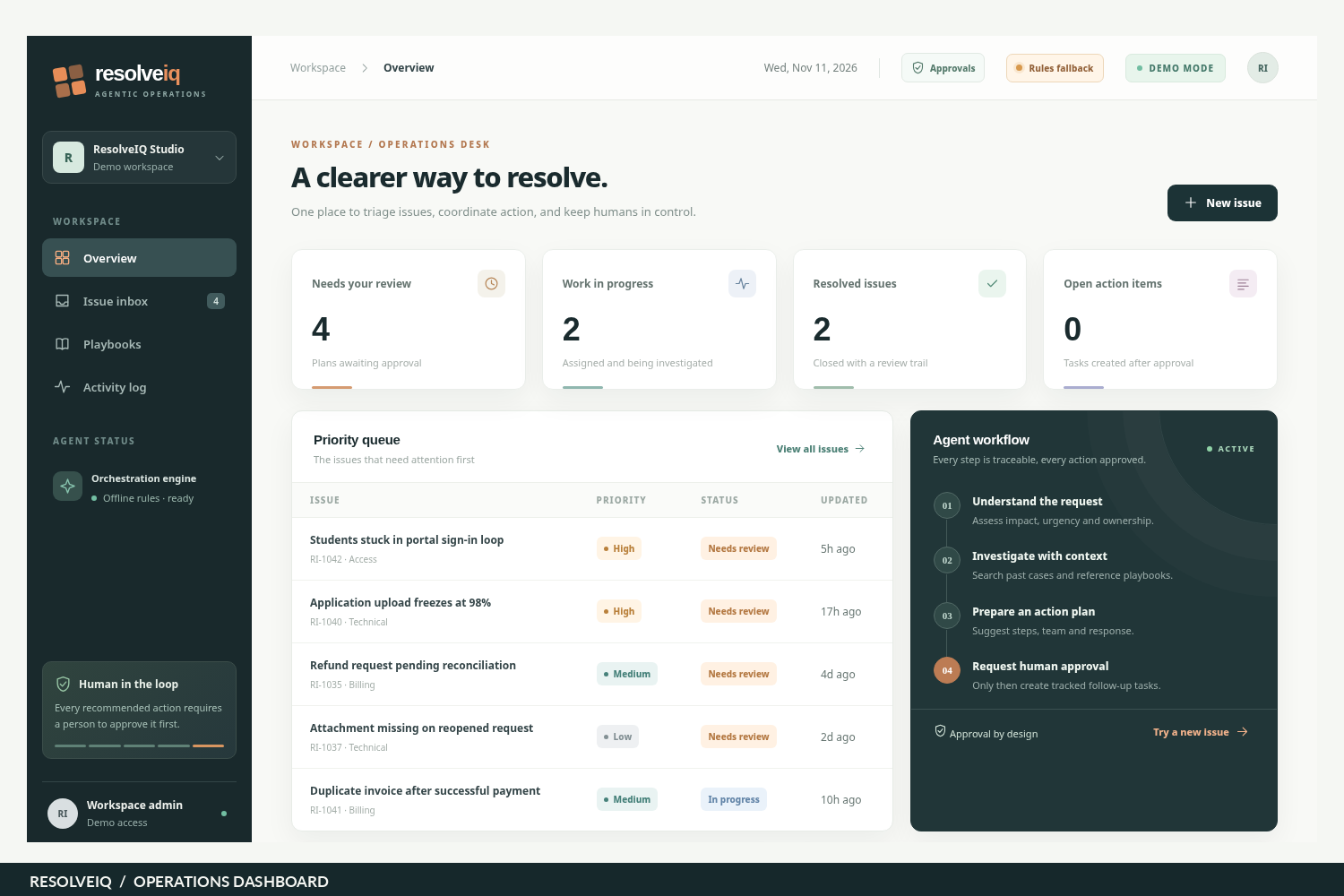
A centralized operations dashboard displaying issue priorities, pending approvals, active tasks, and the agent workflow.
-
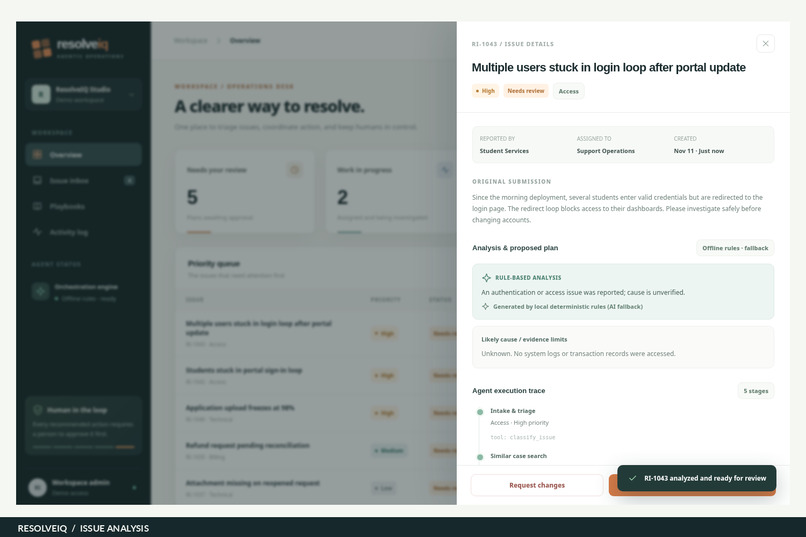
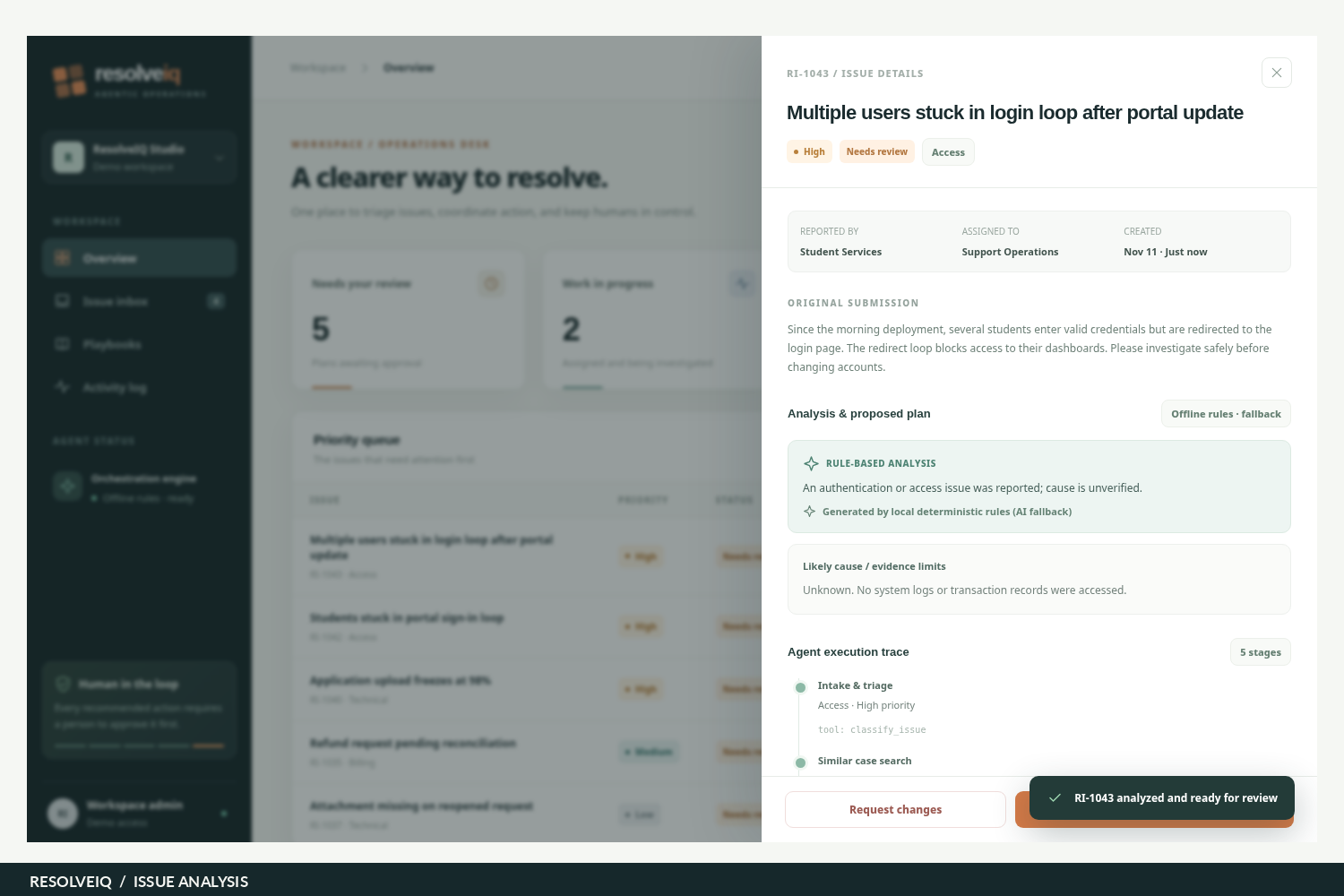
ResolveIQ analyzes incoming issues, retrieves similar cases and playbooks, and prepares actionable resolution plans for human review.
-
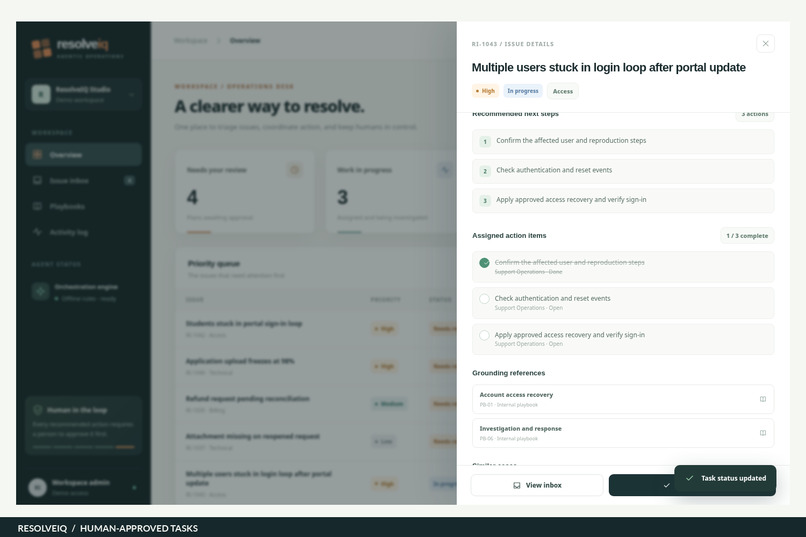
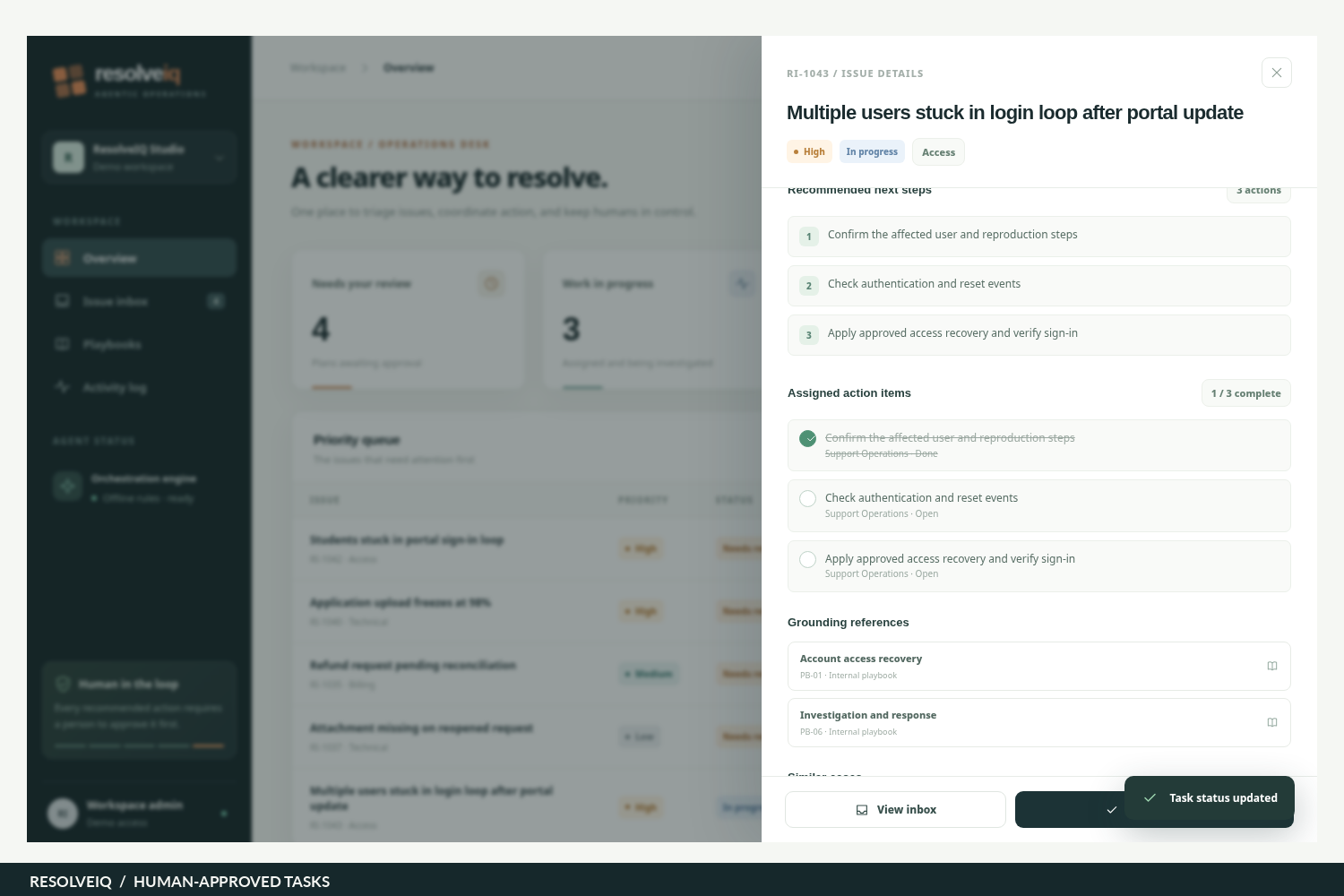
Human-approved recommendations become trackable tasks, enabling teams to monitor progress and complete resolutions.
-
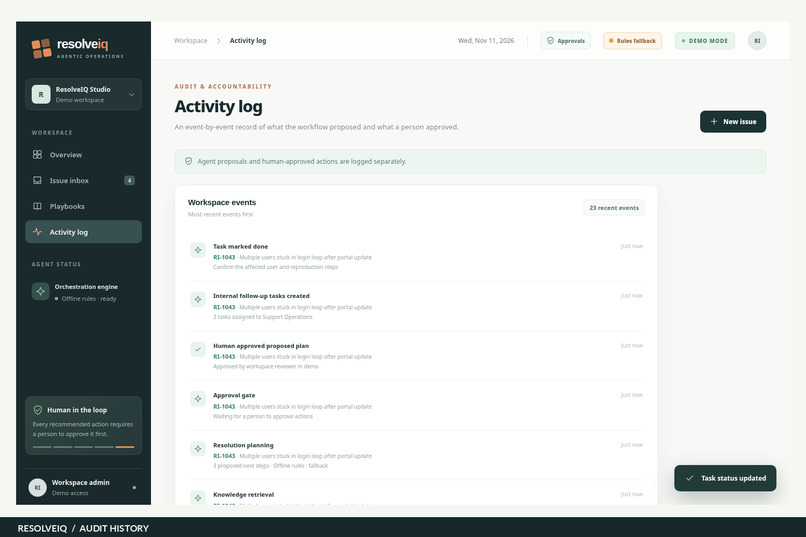
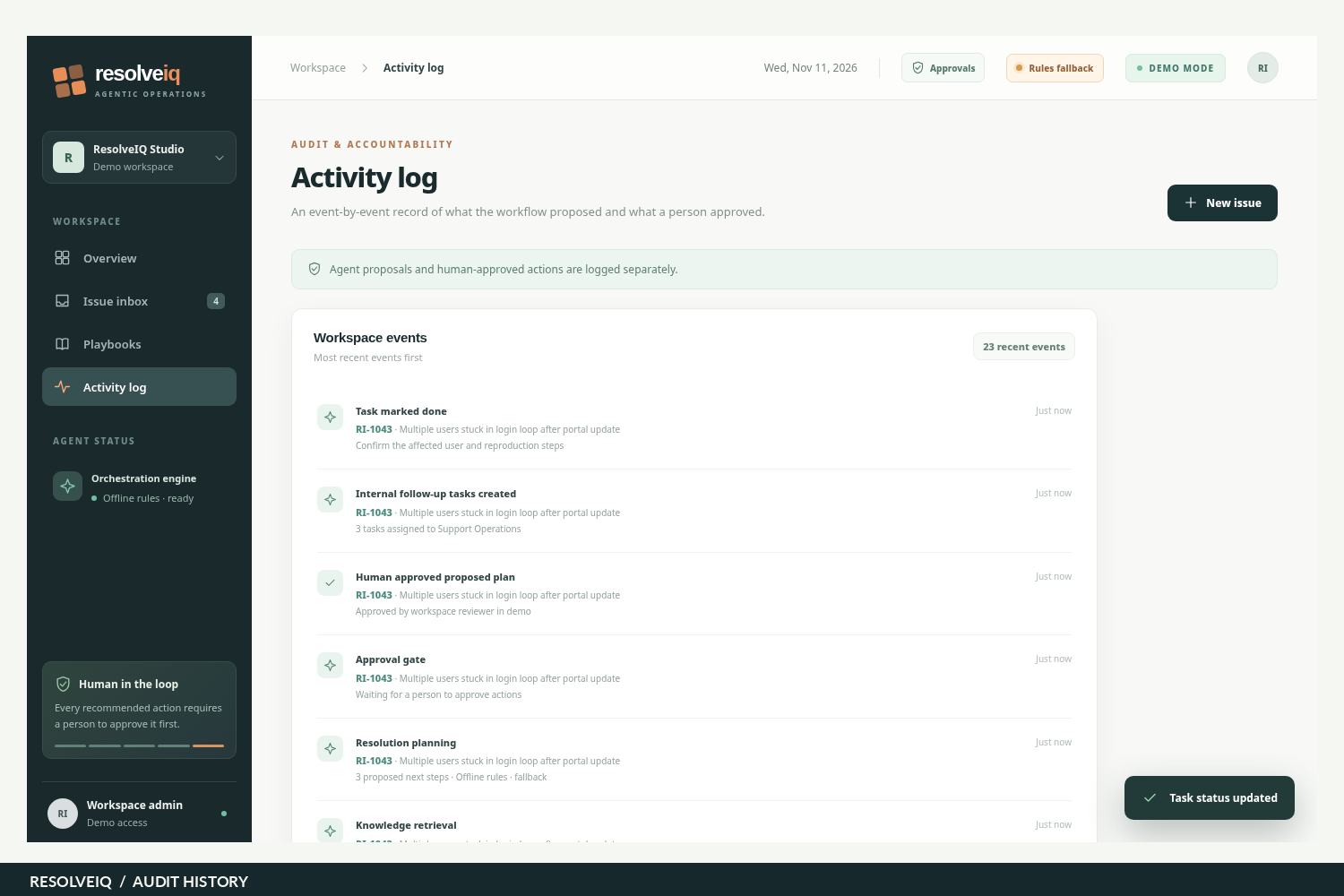
An auditable activity timeline records issue analysis, human decisions, task assignments, and resolution updates.
ResolveIQ — Agentic Issue Resolution
Inspiration
Modern organizations receive hundreds of technical issues, customer complaints, and operational requests. Yet resolving them often involves manually identifying the problem, finding the responsible department, searching for previous solutions, and coordinating follow-up actions.
I wanted to create something more useful than another AI chatbot: a system that could transform incoming issues into structured, actionable workflows while keeping people in control.
That idea became ResolveIQ, an agentic issue-resolution platform designed to make support operations faster, clearer, and more accountable.
What it does
ResolveIQ coordinates the issue-resolution process through an intelligent, multi-stage workflow.
When a user submits an issue, the system:
- Analyzes the request to identify its category, urgency, and priority.
- Searches similar incidents to find relevant previous cases.
- Retrieves operational playbooks containing potential solutions.
- Recommends the appropriate team to handle the issue.
- Creates an action plan with suggested investigation and resolution steps.
- Requests human approval before proceeding with recommended actions.
- Creates and tracks tasks following approval.
- Records activity history to make decisions and actions auditable.
The platform provides an interactive operations dashboard, issue inbox, playbook library, approval workflow, and activity log.
How I built it
I developed ResolveIQ using Python, FastAPI, SQLite, JavaScript, HTML, and CSS.
FastAPI handles the backend APIs and agent orchestration workflow, while SQLite stores issues, recommended plans, approval decisions, tasks, and activity records.
The agent workflow combines issue classification, contextual retrieval, rule-based decision logic, resolution planning, and human review.
I also implemented optional Ollama and Qwen2.5 integration for locally hosted model-powered planning. The system can detect a locally available model, request structured analysis through the Ollama API, and automatically fall back to its offline rules engine when the model is unavailable.
The Qwen API integration was tested using a simulated Ollama-compatible service. The working demonstration also shows the deterministic fallback workflow; live Qwen inference was not used in that recording.
The application includes a responsive interface designed for desktop and mobile screens, with priority indicators, workflow status, interactive navigation, and approval controls.
Challenges I faced
The biggest challenge was designing a meaningful agentic workflow rather than simply generating AI responses.
I had to connect different stages of issue resolution, maintain consistent records, and ensure that proposed actions required human approval.
Another challenge was maintaining reliability when an external or local AI service was unavailable. I addressed this by implementing automatic fallback behavior.
I also improved the interface to handle responsive layouts, navigation menus, issue notifications, and visibility into the workflow.
Accomplishments
- Built a functional end-to-end issue-resolution application.
- Implemented multi-stage issue analysis and resolution planning.
- Connected previous cases and playbooks with recommended actions.
- Added human-in-the-loop approvals and task tracking.
- Implemented optional local Qwen2.5/Ollama API integration.
- Created automatic offline fallback without requiring paid API keys.
- Developed a responsive operations dashboard.
- Added activity logging and automated backend tests.
What I learned
Building ResolveIQ taught me that agentic AI is not only about generating intelligent responses. A useful agent needs context, structured decisions, reliability, and the ability to coordinate actions safely.
I also learned how important transparency, human oversight, and graceful failure handling are when designing AI-powered software for real users.
What's next
My future plans include:
- Production authentication and team-based access controls.
- Integration with existing helpdesk platforms.
- Semantic search across historical incidents.
- Improved local LLM evaluation and deployment.
- Multi-organization support.
- Advanced workflow automation and analytics.
My long-term vision is to make ResolveIQ a reliable operational assistant for support teams, universities, software companies, and service organizations.
ResolveIQ — From incoming issues to accountable action.
Built With
- api
- css3
- fastapi
- html5
- javascript
- ollama
- python
- qwen2.5
- rest
- sqlite
