-
-
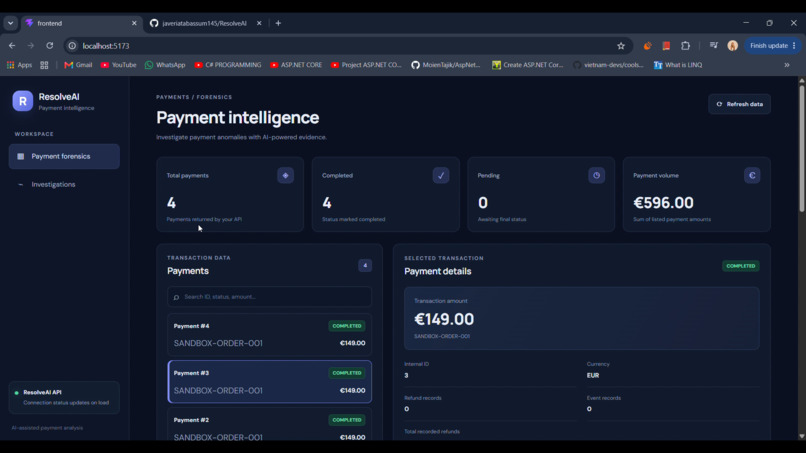
ResolveAI Dashboard
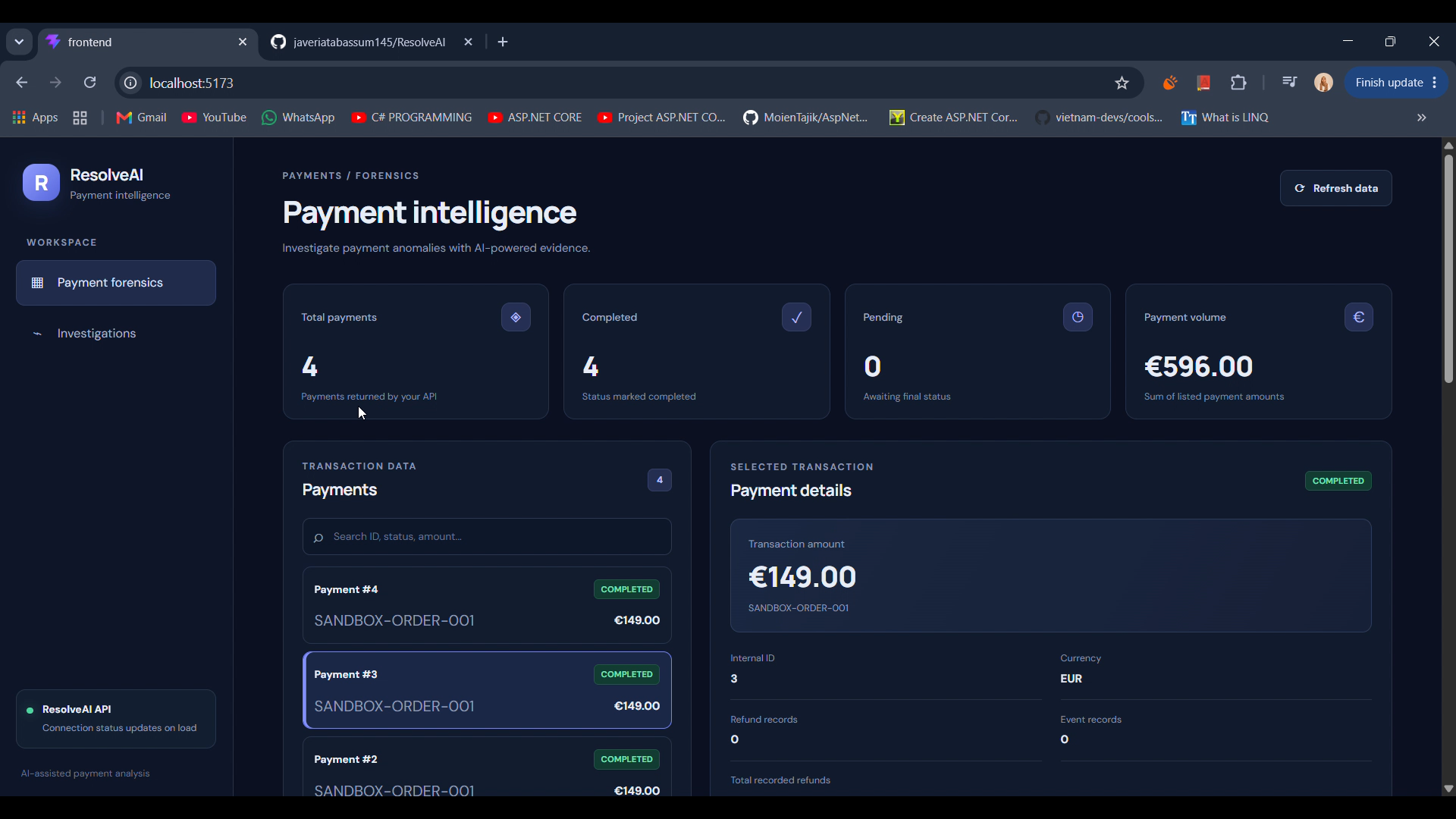
Inspiration
Payment problems can be surprisingly difficult to understand. A user may see a completed payment, a partial refund, a failed transaction, or several related events without knowing what actually happened.
We were inspired by a simple question: What if AI could investigate a confusing payment the way a human support specialist would?
Instead of giving users another generic payment chatbot, we wanted to build an AI-powered investigation layer around PayPal transactions—one that can reconstruct what happened, identify inconsistencies, and explain the result clearly.
What it does
ResolveAI — AI Payment Forensics investigates confusing payment and refund situations using PayPal transaction data.
Users can select a transaction and ask ResolveAI to investigate an issue such as:
- Why was I charged this amount?
- Why did I receive only a partial refund?
- What happened during this payment?
- Are there inconsistencies in the transaction history?
- Which payment event caused the discrepancy?
ResolveAI analyzes the available payment events, reconstructs the transaction timeline, detects discrepancies, and generates an easy-to-understand forensic report.
The result includes:
- Original payment amount
- Refund amount
- Outstanding difference
- Payment event timeline
- Detected anomalies
- AI-generated root-cause analysis
- Recommended next steps
The goal is to turn a confusing payment history into a clear explanation.
How we built it
We built ResolveAI using a full-stack architecture:
- React + TypeScript for the interactive frontend
- ASP.NET Core / .NET 8 for the backend and business logic
- PayPal Sandbox APIs for payment-related functionality
- AI model/API for investigation, reasoning, and natural-language explanations
- PostgreSQL for application and transaction data
The backend acts as the orchestration layer between PayPal and the AI system. Instead of sending unstructured information directly to an AI model, ResolveAI organizes payment events into structured data that the AI can analyze.
The investigation workflow is:
PayPal transaction → Payment events → Event analysis → AI investigation → Forensic report
This allows the AI to focus on reasoning about the payment lifecycle rather than simply acting as a conversational chatbot.
Challenges we ran into
One of the main challenges was designing an AI workflow that produces useful investigation results rather than generic responses.
Payment information contains multiple events that can be related to one another, so the system needs to preserve the sequence and context of those events. We had to think carefully about how to represent transactions, refunds, and discrepancies in a structured format that the AI could reason about reliably.
Another challenge was keeping PayPal central to the product while making the AI genuinely useful. We wanted the AI to work with real payment-related information from the PayPal sandbox rather than using PayPal only as a payment button.
We also had to balance technical complexity with the limited time available during a hackathon.
Accomplishments that we're proud of
We are proud of turning a payment transaction into an investigable timeline rather than treating it as a single payment event.
We also built ResolveAI around a clear division of responsibilities:
- PayPal handles the payment infrastructure.
- Our backend manages payment data and investigation logic.
- AI performs the reasoning and explanation.
- The frontend turns the investigation into an understandable user experience.
Most importantly, we created a working concept that demonstrates how AI can add a new intelligence layer to payment infrastructure instead of simply adding a chatbot to an existing application.
What we learned
We learned that building an effective AI application is not only about choosing a powerful model. The quality of the structured data, tools, workflow, and context provided to the model are equally important.
We also learned how important it is to design AI around a specific user problem. Rather than asking an AI model to "analyze payments," we designed a focused investigation workflow with a defined input, reasoning process, and useful output.
The project also gave us practical experience integrating PayPal's developer platform with a full-stack application and combining traditional backend engineering with AI-driven functionality.
What's next for ResolveAI - AI Payment Forensics
The current version focuses on payment and refund investigation. In the future, ResolveAI could evolve into a broader AI payment resolution agent.
Potential improvements include:
- Automated dispute preparation
- More advanced anomaly detection
- Merchant-side investigation tools
- Multi-payment investigation
- Real-time payment-event monitoring
- Automated alerts for unresolved refunds
- Integration with additional payment platforms
- AI-assisted communication with merchants
- A persistent Payment Twin representing the complete lifecycle of a transaction
Our long-term vision is for ResolveAI to move from simply explaining what happened to helping users understand what they should do next.
