Inspiration
The Story of ResolveAI: ResolveAI was born out of a critical vulnerability in modern customer support automation: traditional LLM integrations often suffer from hallucinations or autonomously execute destructive, high-stakes backend actions—such as processing unauthorized refunds or deleting user accounts—without human oversight. We were inspired to build a platform where artificial intelligence serves as a high-speed advisory engine rather than an unsupervised agent, pairing the speed of generative models with mandatory Human-in-the-Loop (HITL) safeguards for sensitive workflows.
What it does
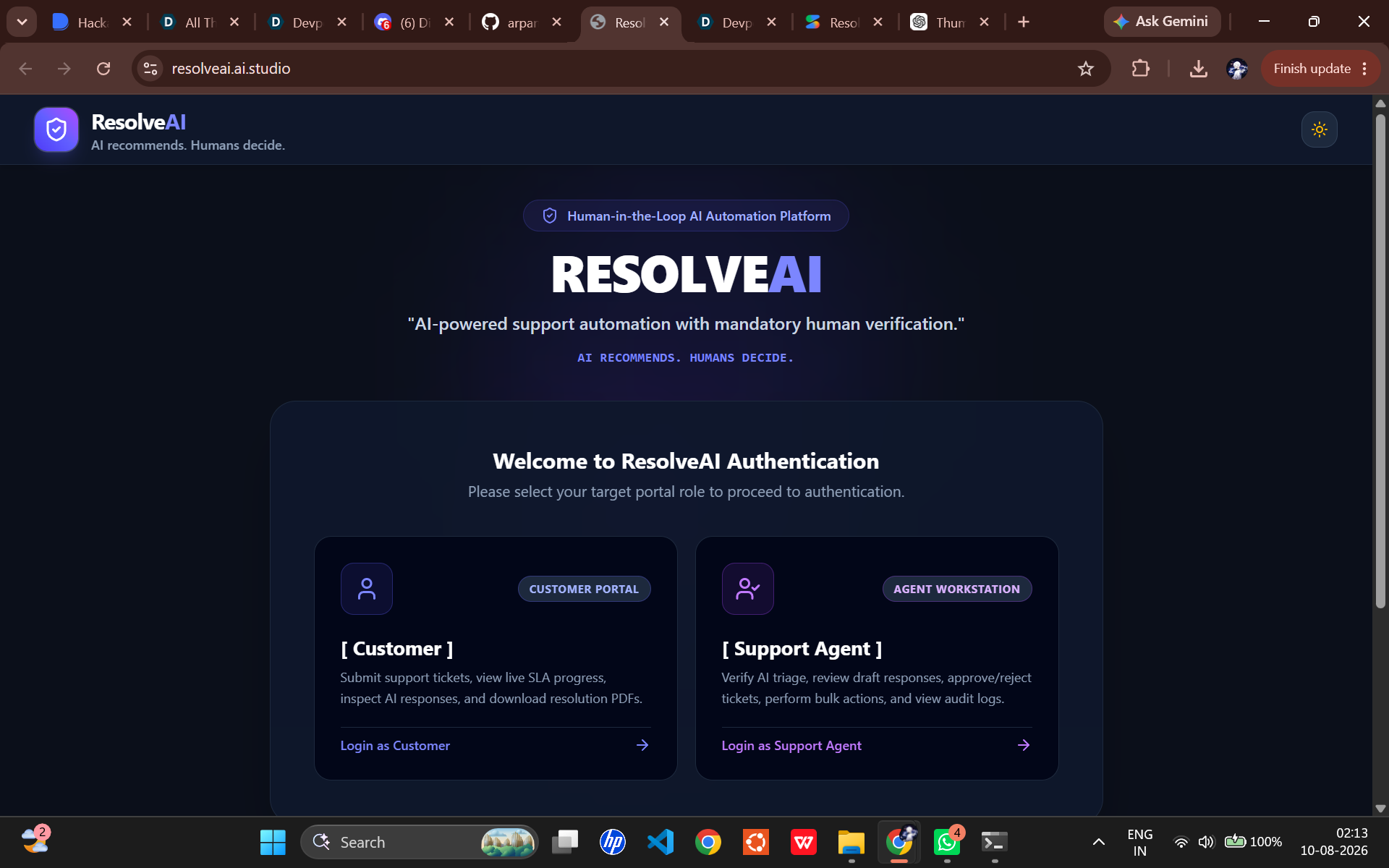
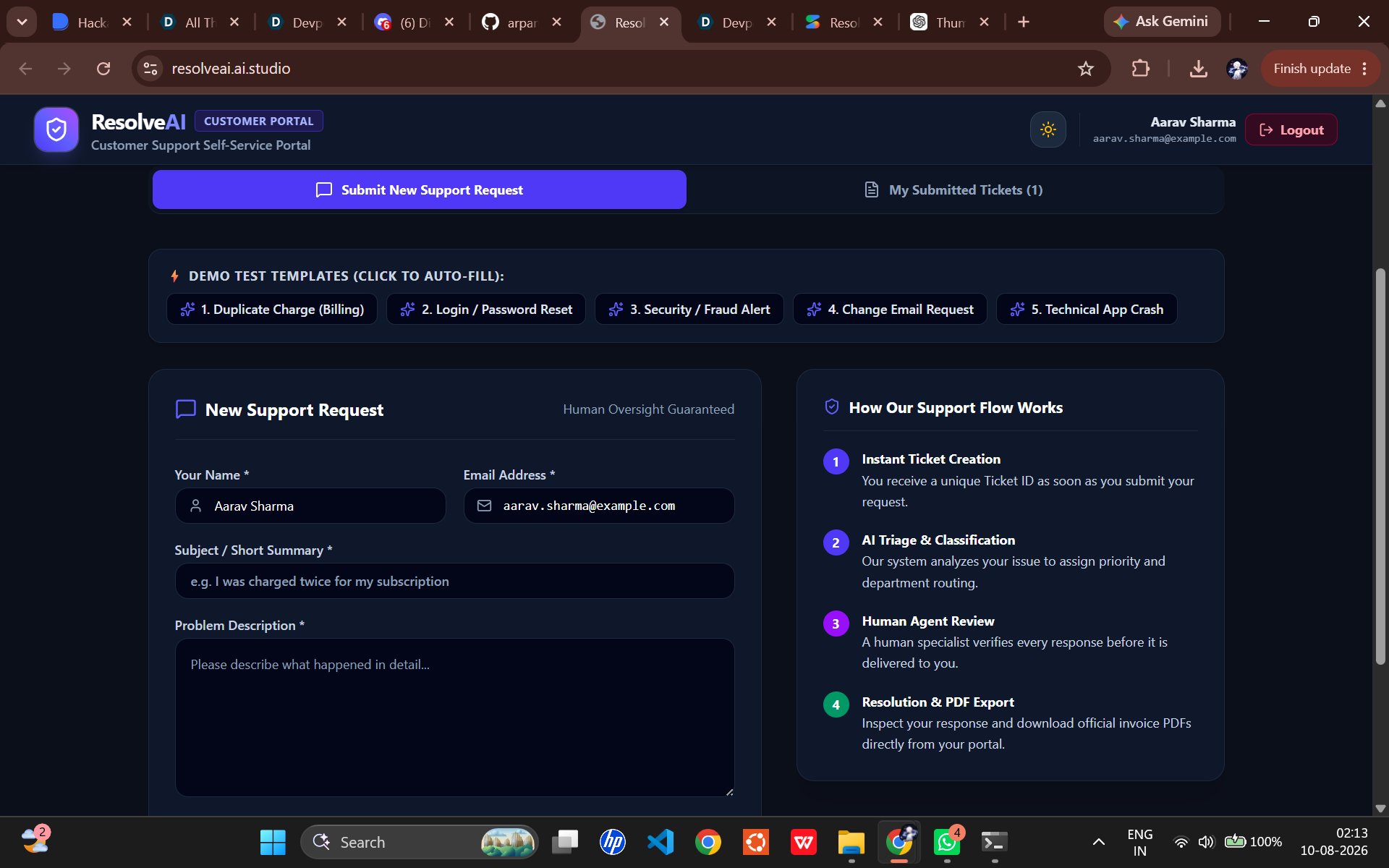
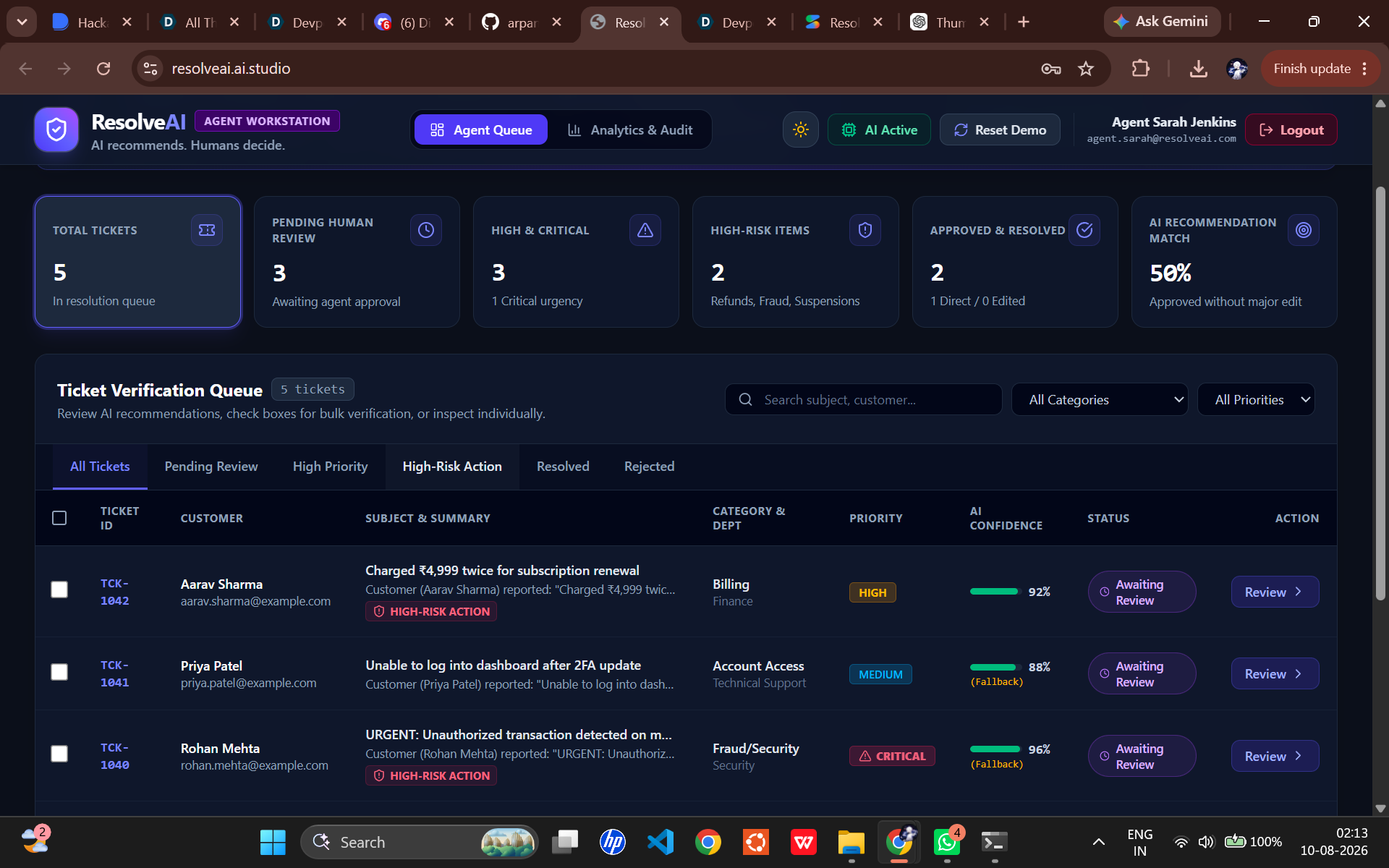
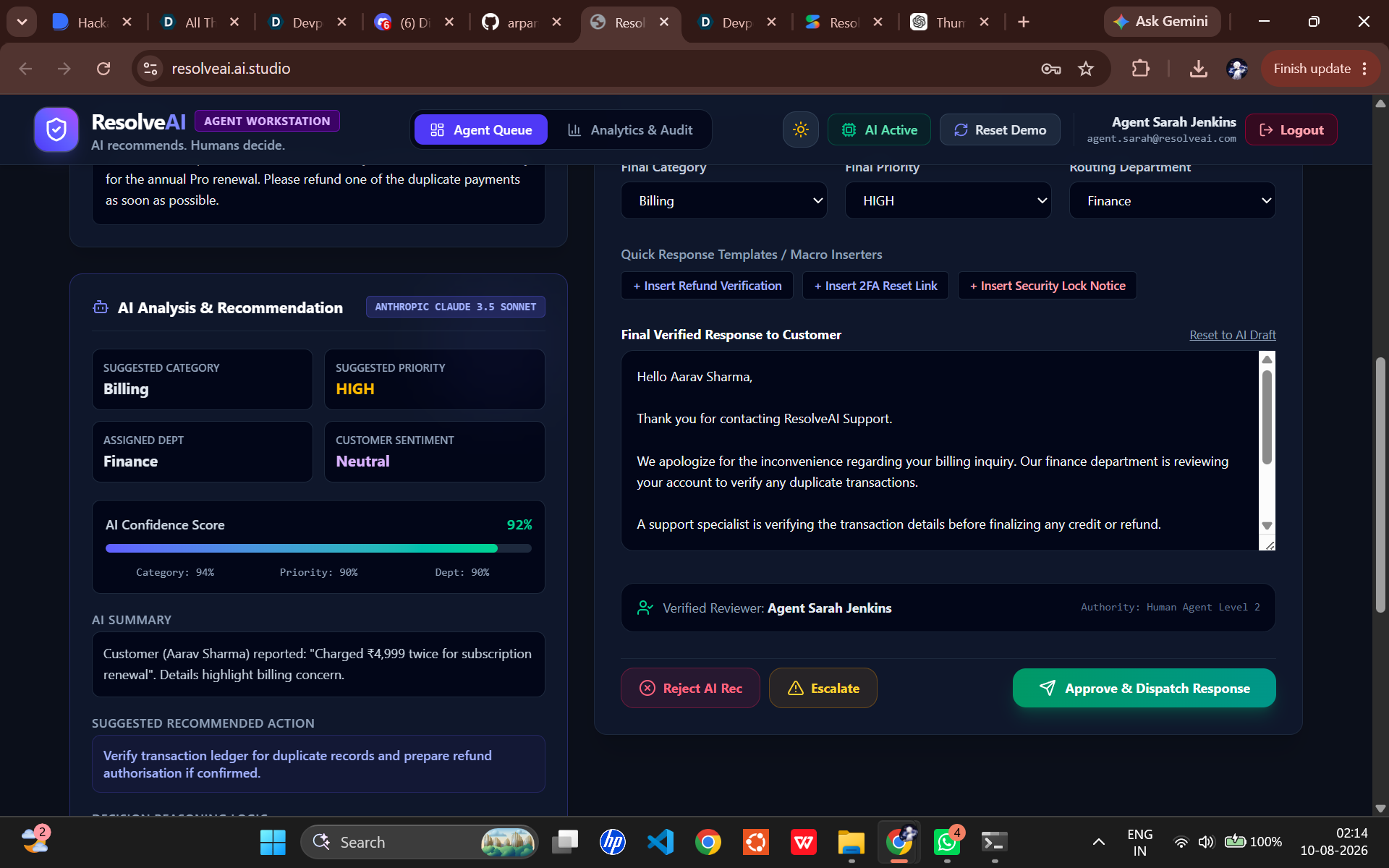
ResolveAI is an enterprise-grade Human-in-the-Loop (HITL) AI Support Ticket Triage and Resolution System. Designed to bridge the gap between autonomous AI efficiency and human oversight, ResolveAI automatically ingests, analyzes, categorizes, and drafts response solutions for incoming customer support tickets while enforcing strict safety protocols. Unlike fully autonomous support bots that risk hallucinating or accidentally processing unauthorized financial actions, ResolveAI operates under a Strict Advisory Protocol: AI as an Advisor: The AI engine performs intent extraction, priority assignment, sentiment scoring, high-risk detection, and draft response generation. Human as the Authority: Every AI decision is staged in an editable human agent workspace. Only an authenticated human agent clicking Approve or Dispatch executes the final action or customer communication.
How we built it
We engineered ResolveAI as a full-stack web application powered by React 18, TypeScript, Tailwind CSS, and a Node.js Express backend. The core intelligence utilizes Google's Gemini AI API (@google/genai) to parse incoming customer issues, auto-suggest ticket categories, assign priority levels, and draft contextual resolution emails. To satisfy our strict uptime constitution, we integrated a deterministic Fallback Engine that seamlessly takes over whenever API latency exceeds or network exceptions occur, utilizing rule-based keyword matching algorithms. The platform features dedicated dual portals for customers and support agents, anchored by an immutable audit trail system.
Challenges We ran into
Our greatest engineering hurdle was designing a robust high-risk detection engine that mathematically quantifies ticket sensitivity before execution. We evaluated ticket risk using a multi-variable classification function: where represents indicator functions for high-risk operations (such as refunds, chargebacks, or account deletions) and represents normalized customer dissatisfaction. Guaranteeing that any ticket with could never execute an automated dispatch without explicit human agent approval required strict backend session validation and state locking.
Accomplishments that we're proud of
- Multi-Provider AI Triage & Deterministic Fallback Engine Primary AI Models: Connects seamlessly with Claude 3.5 Sonnet / Google Gemini for contextual intent analysis, urgency detection, and empathetic response drafting. Zero Downtime Fallback: If AI APIs experience timeouts (>8s), rate limits, or network failures, ResolveAI seamlessly shifts to an internal Deterministic Rule Engine. This guarantees 100% operational uptime with zero unhandled exceptions.
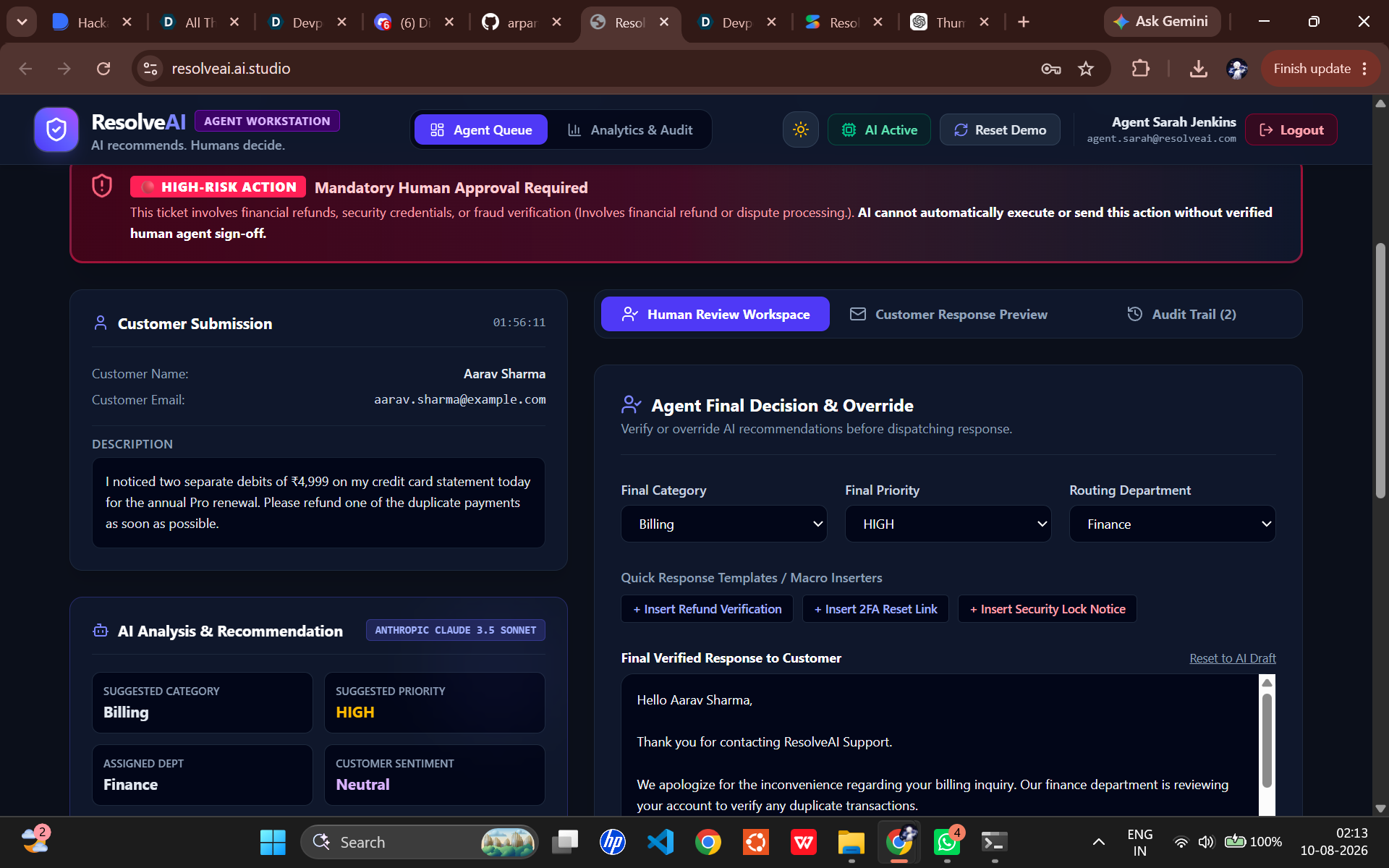
- Safeguards for High-Risk Actions High-Risk Guardrails: Automatically flags sensitive requests—such as financial refunds, credit card charge disputes, account lockouts, data deletions, and fraud reports. Visual Warnings & Forced Verification: Displays high-visibility warning banners to human agents, preventing automated execution and requiring explicit manual sign-off before dispatching sensitive resolutions.
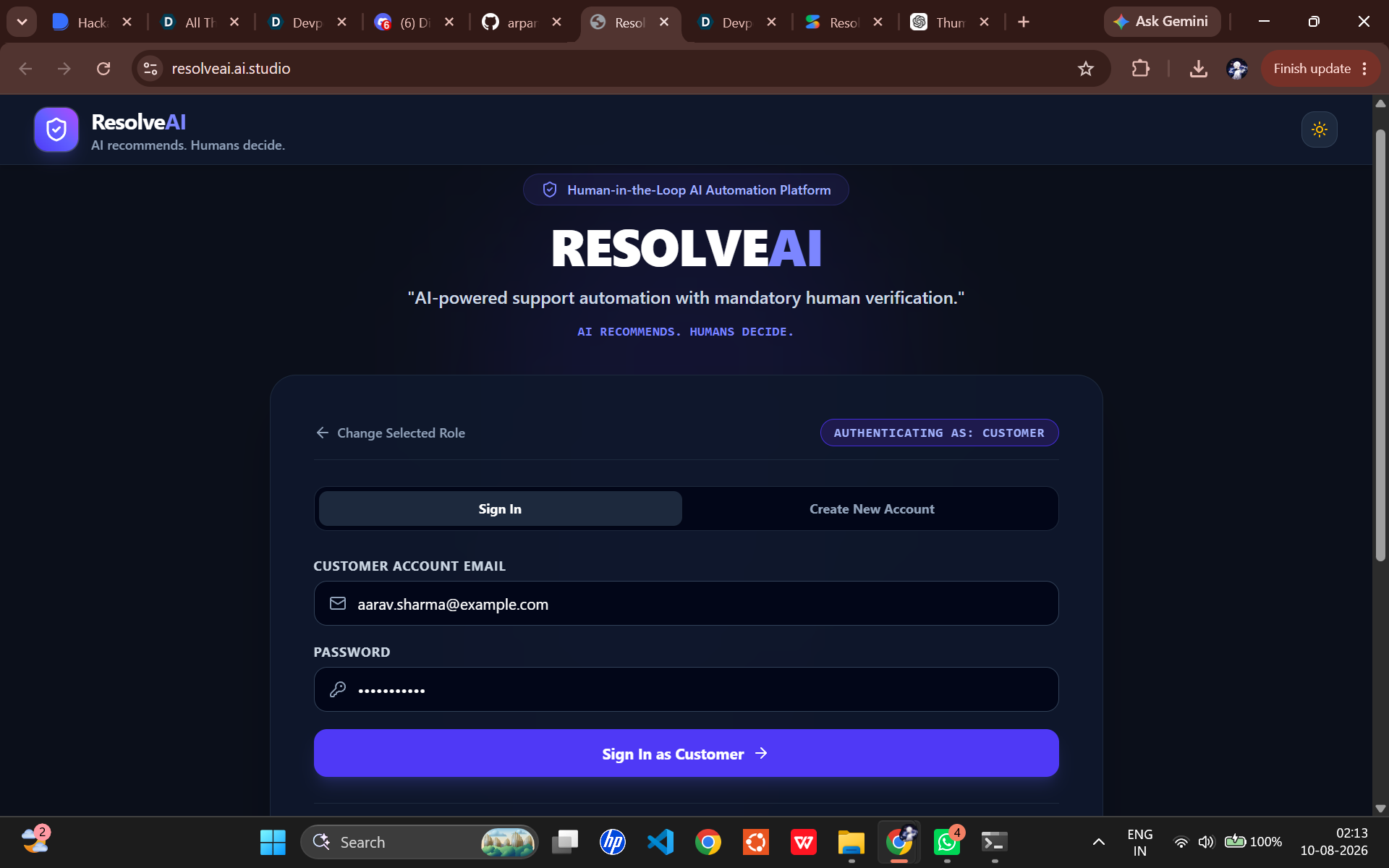
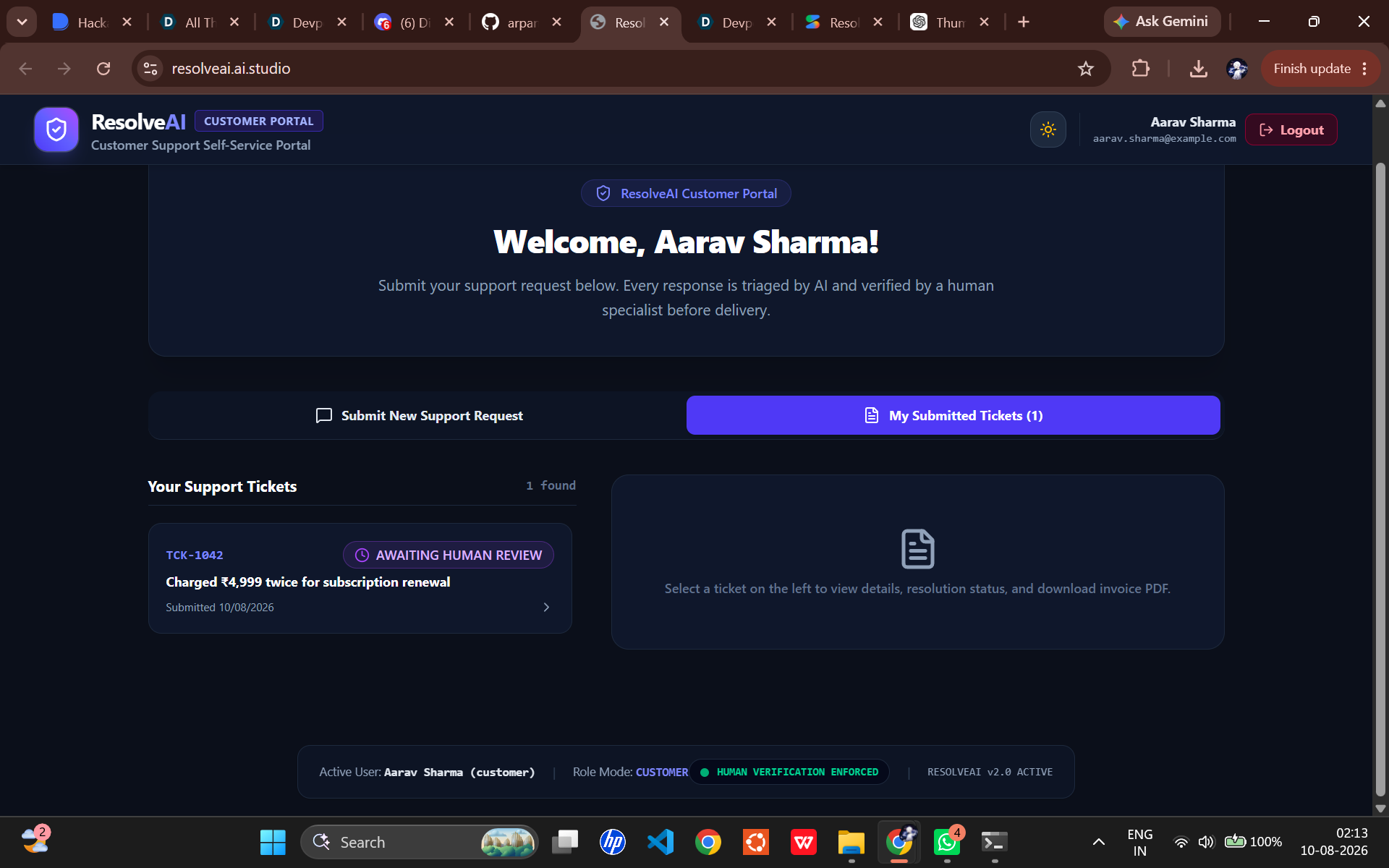
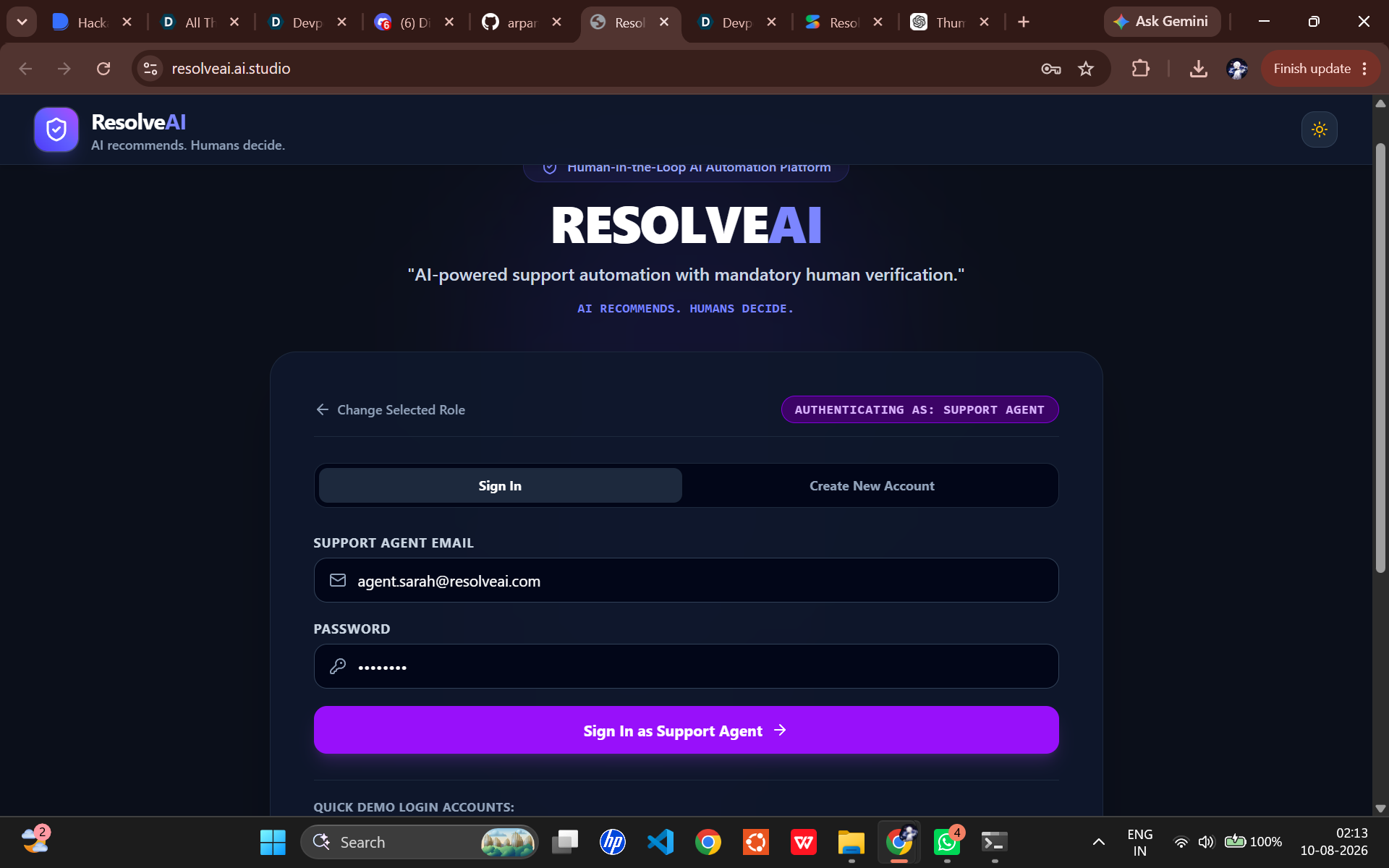
- Isolated Customer Self-Service Portal & Auth Role-Based Access Control (RBAC): Authenticates distinct user roles (Customer vs. Support Agent) with token validation and backend email isolation. Strict Data Isolation: Ensures customers can access only their own submitted tickets, preventing cross-account data leakage across sessions. Official PDF Documentation: Enables customers to instantly generate and download official Invoice PDFs (for financial transactions) or Support Resolution Records (for general tickets).
- Human Agent Decision Workspace Override Capabilities: Agents can modify AI-assigned categories, departments, priority levels, or edit draft responses directly before sending. Escalation Management: One-click escalation pathways to senior engineering or billing departments when AI confidence scores are low. Live Dispatch Simulator: Simulates real-time customer email receipt once an agent approves a response.
- Audit Logging & System Telemetry Immutable Audit Trail: Logs every interaction—ticket creation, AI classification, human edit, approval, rejection, or escalation—with precise ISO timestamps and actor signatures (CUSTOMER, AI_SYSTEM, HUMAN_AGENT). Performance Analytics: Monitors key metrics in real time, including Human Verification Rate, AI Accuracy, Average Resolution Time, and Triage Volume by Category.
- Universal Light/Dark Theme & Responsive UI Instant Theme Reactivity: Smooth, single-click toggle between Light Mode and Dark Mode with state persistence (localStorage).
What we learned
Building ResolveAI taught us that true AI reliability comes from designing deterministic safeguards around probabilistic models. We learned how to structure seamless Human-in-the-Loop approval chains, implement fail-safe multi-tier architectures, and maintain operational availability even when external cloud AI services experience downtime. Most importantly, we proved that AI achieves its highest efficiency when empowering human agents rather than replacing them.
What's next for ResolveAI
Omnichannel Ticket Ingestion Connect incoming channels beyond web webhooks: Gmail API integration, Slack Connect apps, WhatsApp Business API, and Zendesk/Freshdesk connectors. Retrieval-Augmented Generation (RAG) & Knowledge Base Integration Integrate vector search (e.g., Pinecone or Pgvector) to query private company documentation, internal SOPs, and past resolved tickets for AI response drafting. Multi-Agent Collaboration Workflows Introduce specialized sub-agents: a Billing Specialist Agent, an Infrastructure Debugger Agent, and a Fraud Detective Agent that collaboratively analyze complex tickets before presenting a merged draft to the human agent. Multi-Language Support & Sentiment Translation Real-time cross-language translation during triage, allowing support teams to handle international tickets in their native language while responding to customers in theirs. Durable Database Persistence & Cloud Hosting Transition from in-memory / demo database stores to Cloud PostgreSQL (Cloud SQL / Supabase) with real-time WebSocket updates for collaborative multi-agent queues.
Built With
- css
- esbuild
- express.js
- jspdf
- node.js
- react19
- tailwind
- typescript
- vite
- vitetest

Log in or sign up for Devpost to join the conversation.