Inspiration
A business workflow doesn't stop because software is missing a field. It stops because the next step is a phone call, and nobody has picked up the phone. Overdue supplier purchase-order acknowledgements are the first, clearest case of that: the PO, the supplier, and the missed deadline are all already in the system. What's missing is one phone call and a decision about what the answer means.
What it does
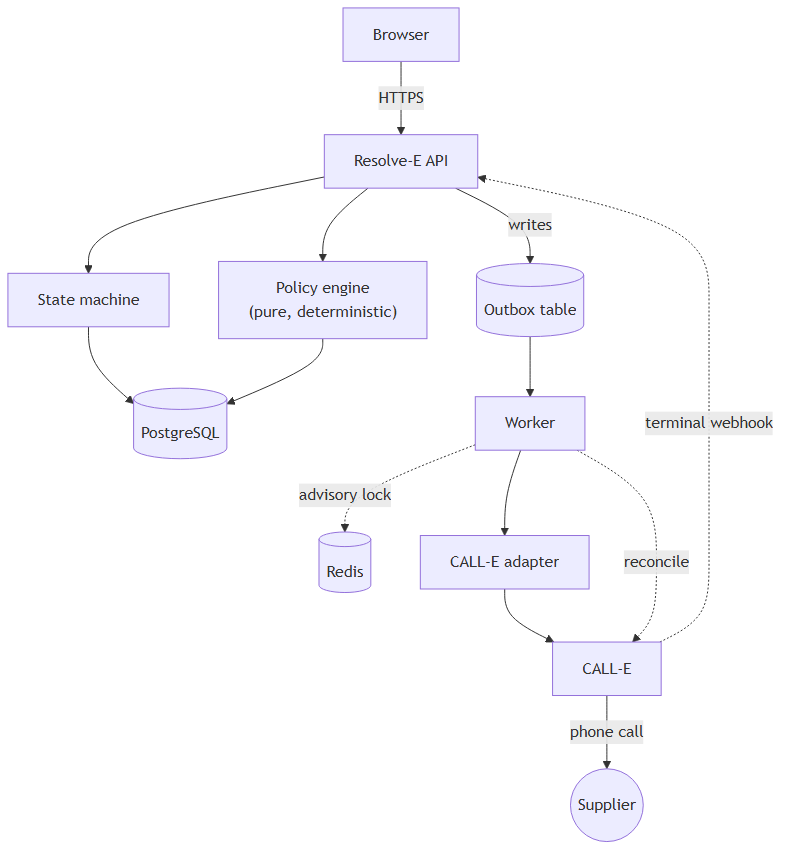
Resolve-E detects an overdue purchase-order acknowledgement, checks
that a call is permitted, dispatches one CALL-E call task (covering
several suppliers at once via recipients[] and
recipient_result_schema), and extracts a strict, per-supplier
structured result. A deterministic policy engine — not a language
model — decides whether the exception resolves, retries, or goes to a
human, and why. Every decision carries a machine-readable reason code
and an audit trail an operator can actually read.
How we built it
FastAPI + PostgreSQL backend with a pure state machine, four
deterministic policy modules, a transactional outbox, and three worker
loops (scanner, outbox, reconciliation). The official calle-ai Python
SDK is the live call transport (imported and called at runtime), with a
hand-rolled HTTP client kept as a verified-identical fallback — its
request shape was checked line-for-line against the SDK's own source.
React/TypeScript operations console on top, verified end to end by 307
tests running against real PostgreSQL, not SQLite.
Challenges we ran into
- The response schema evolved once real evidence forced it to. The
first version could represent a supplier's status but not who
actually answered the phone or why a human was needed beyond one
flag. We added
spoke_withandescalation_reasonto a v2 schema, then built a scenario to prove the gate actually holds: a supplier contact answers cleanly — "yes, on time" — but is the wrong person for POs. The exception still routes to a human, because an authorized phone number is not an authorized person. - A completion-confidence hazard, caught before it shipped. A live
call that never connected came back with
completion_confidence: 0.82,
"high"
— high confidence that the task did not complete. Treated naively as a positive signal, that number would have resolved a purchase order nobody discussed. - An undocumented daily call cap. Discovered mid-development via a live 429 response ("The 24-hour call plan limit has been reached"), not mentioned in the hackathon resources.
- We shipped a real credential leak to ourselves, and our own safety
net missed it. A live CALL-E key ended up committed to
.env.example. The pre-commit secret scanner should have caught it, but its "already committed" check usedgit ls-files, which returns nothing at all in a repository with zero commits — so the check had been silently a no-op the entire time. Found it by re-auditing the scanner itself rather than trusting a string of green checks, fixed both the leak and the scanner, and added a regression test so that class of bug can't recur silently again.
Accomplishments that we're proud of
Two real calls placed to an authorized number during development, with both terminal responses committed as regression fixtures rather than described from memory — the system is checked against what CALL-E actually returns, not only against our reading of the API contract. 307 tests passing, ruff and mypy clean, CI green on every push against real PostgreSQL with no API key present, so automated runs can never place a call.
What we learned
Building against CALL-E meant designing for an evidence-producing API rather than a synchronous one — the call doesn't just succeed or fail, it comes back with a confidence score, a transcript, and structured claims that have to be independently re-validated rather than trusted. That reframed the whole project: the hard part was never placing the call, it was deciding how much to believe the answer.
What's next for Resolve-E
- Operator authentication (currently a single-operator demo).
- The CALL-E Goals API as the production target once Goals become
creatable via API rather than only via CALL-E Chat — it publishes a
closed error taxonomy that the Calls API's
failure_codedeliberately does not.
Built With
- alembic
- call-e
- calle-ai
- docker
- docker-compose
- fastapi
- github-actions
- mypy
- postgresql
- psycopg
- pydantic
- pytest
- python
- react
- redis
- ruff
- sqlalchemy
- typescript
- vite

Log in or sign up for Devpost to join the conversation.