The Problem
When consumers face defective products, warranty issues, refund problems, or unsatisfactory customer support, the first complaint is rarely the end of the journey.
Consumers often have to repeat the same information, provide evidence, track company responses, send follow-ups, and determine whether a response actually resolves the problem.
Most AI assistants can help write a complaint, but writing the complaint is only one step.
We wanted to build something that helps consumers move from complaint to actual resolution.
What it does
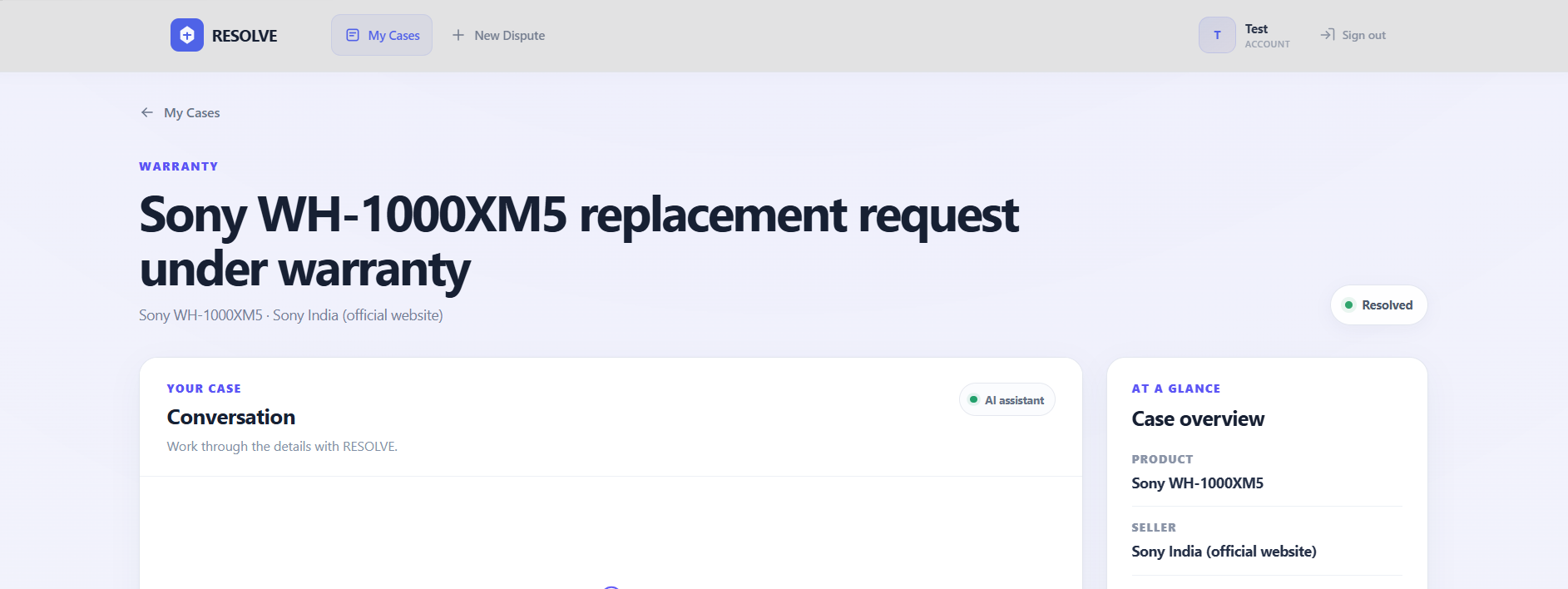
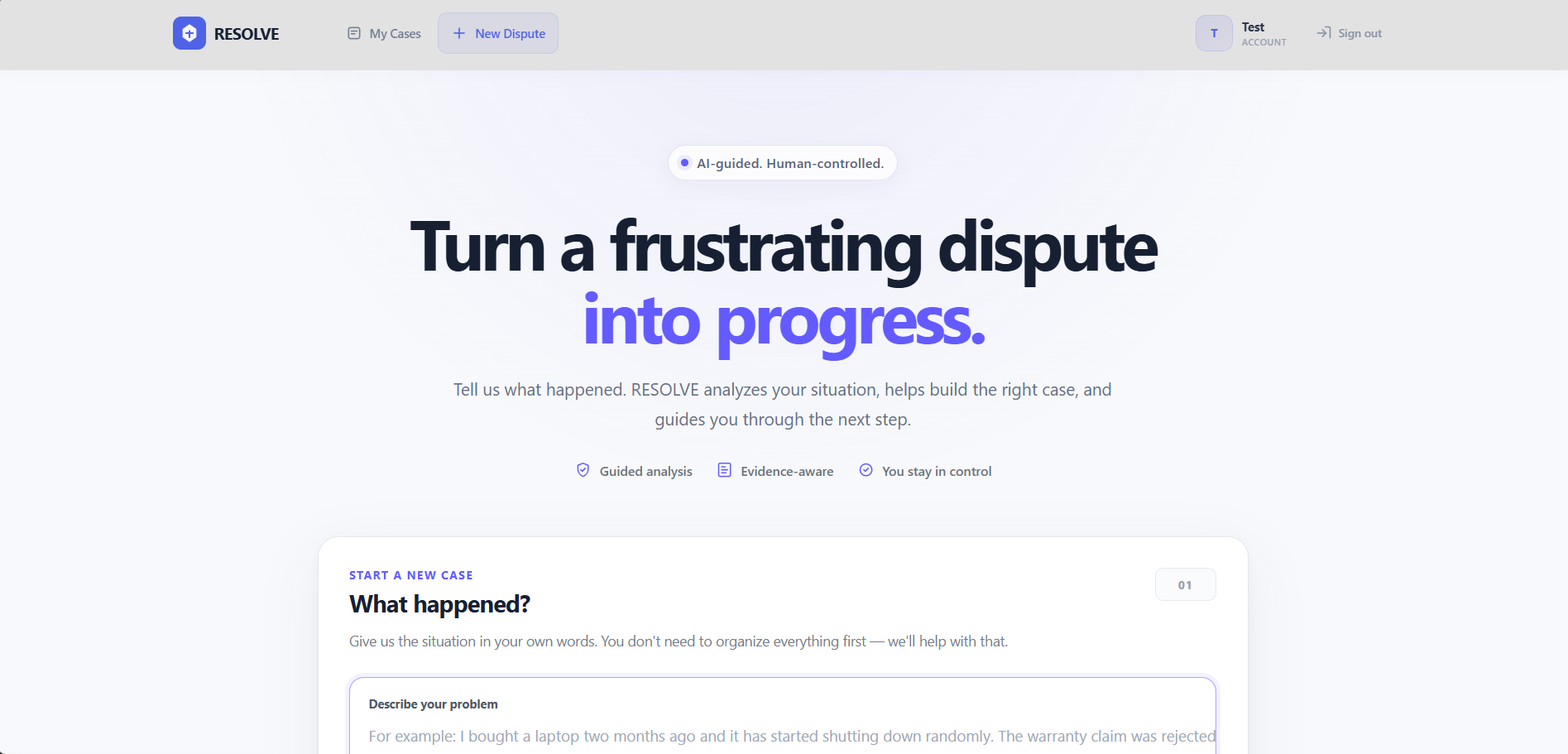
RESOLVE is an AI-powered consumer dispute resolution agent that manages the resolution journey from start to finish while keeping the human in control.
A consumer can:
- Describe their problem naturally through conversation
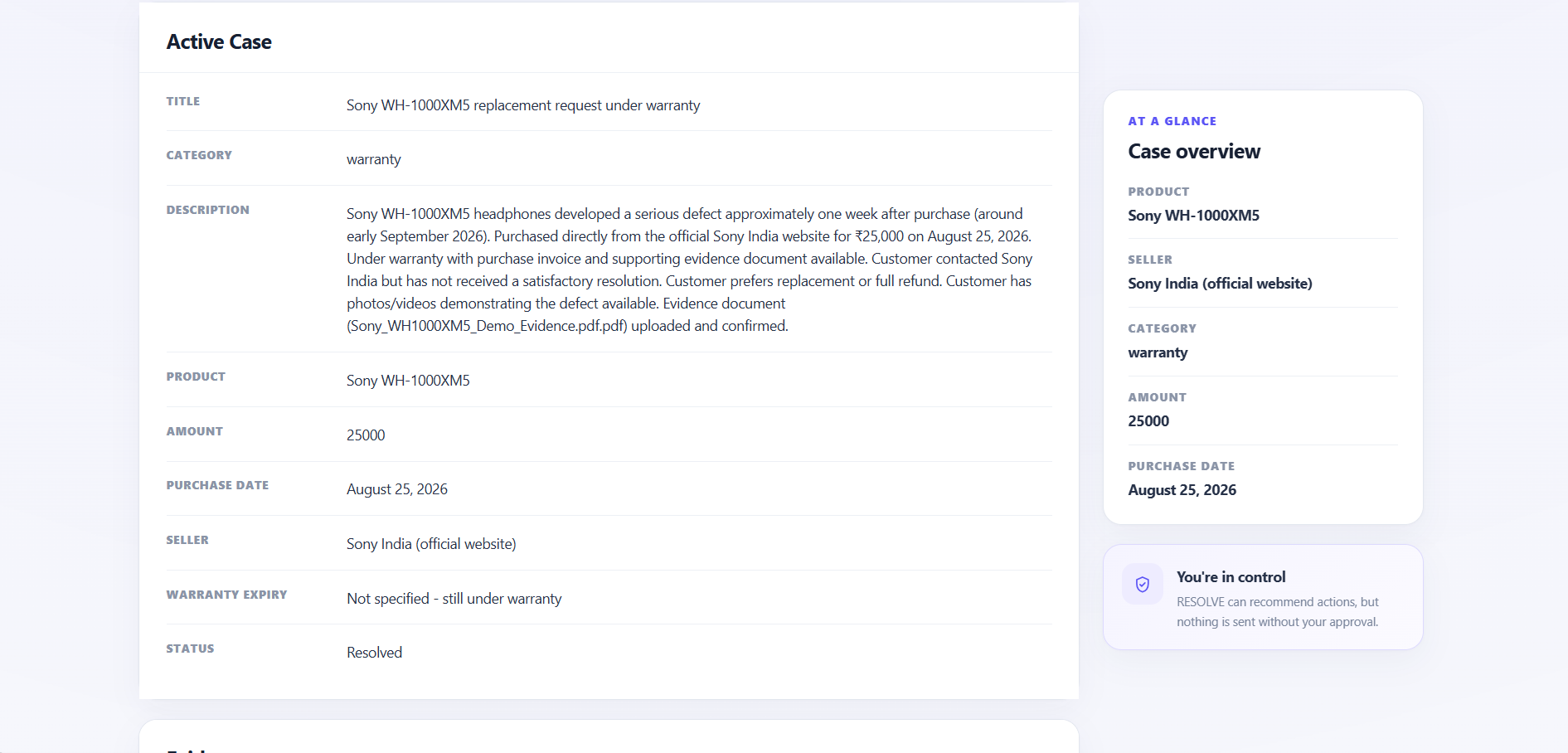
- Build a structured dispute case
- Add supporting evidence
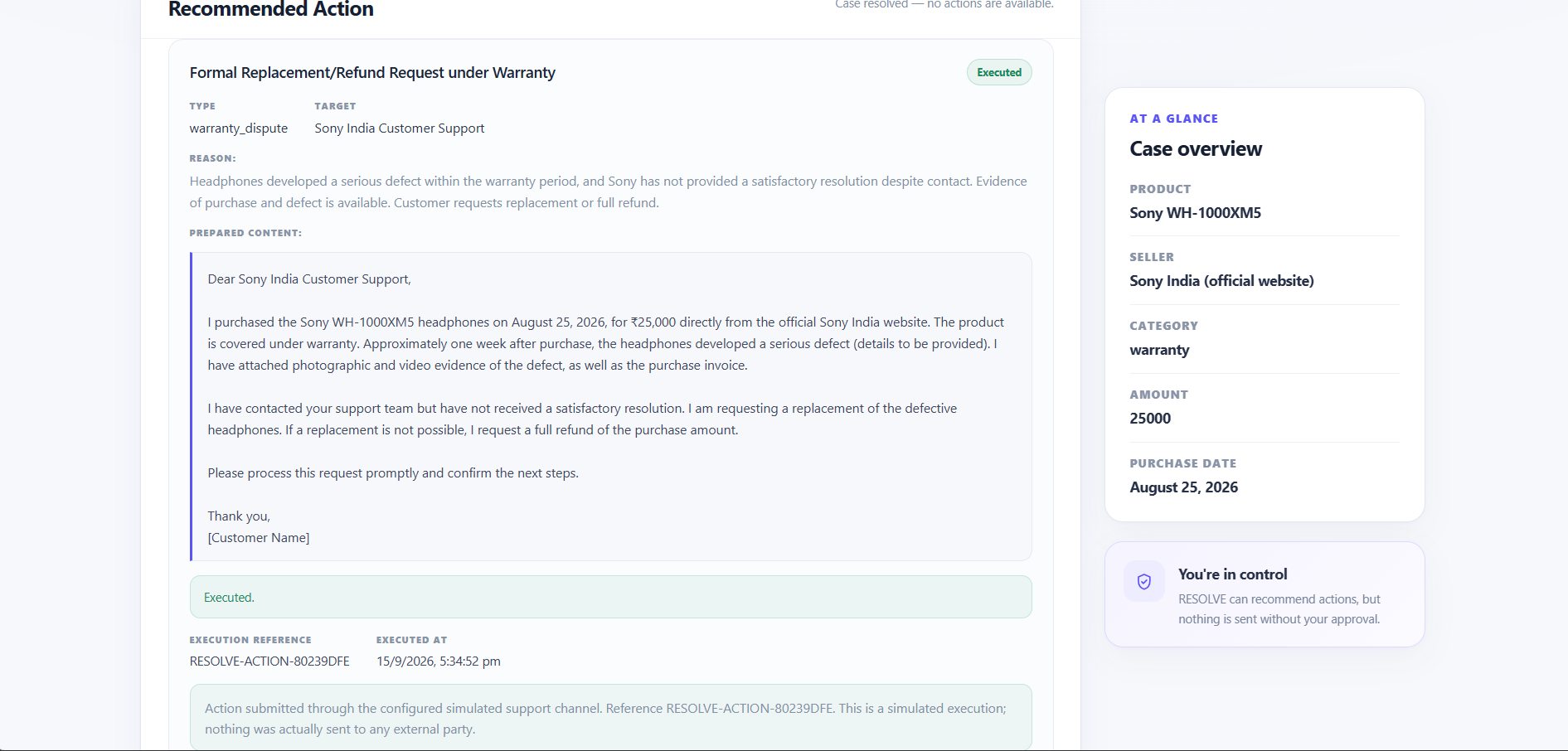
- Receive AI-recommended next actions
- Review and approve actions before they are executed
- Receive and analyze company responses
- Automatically identify when a response still requires follow-up
- Prepare the next follow-up action
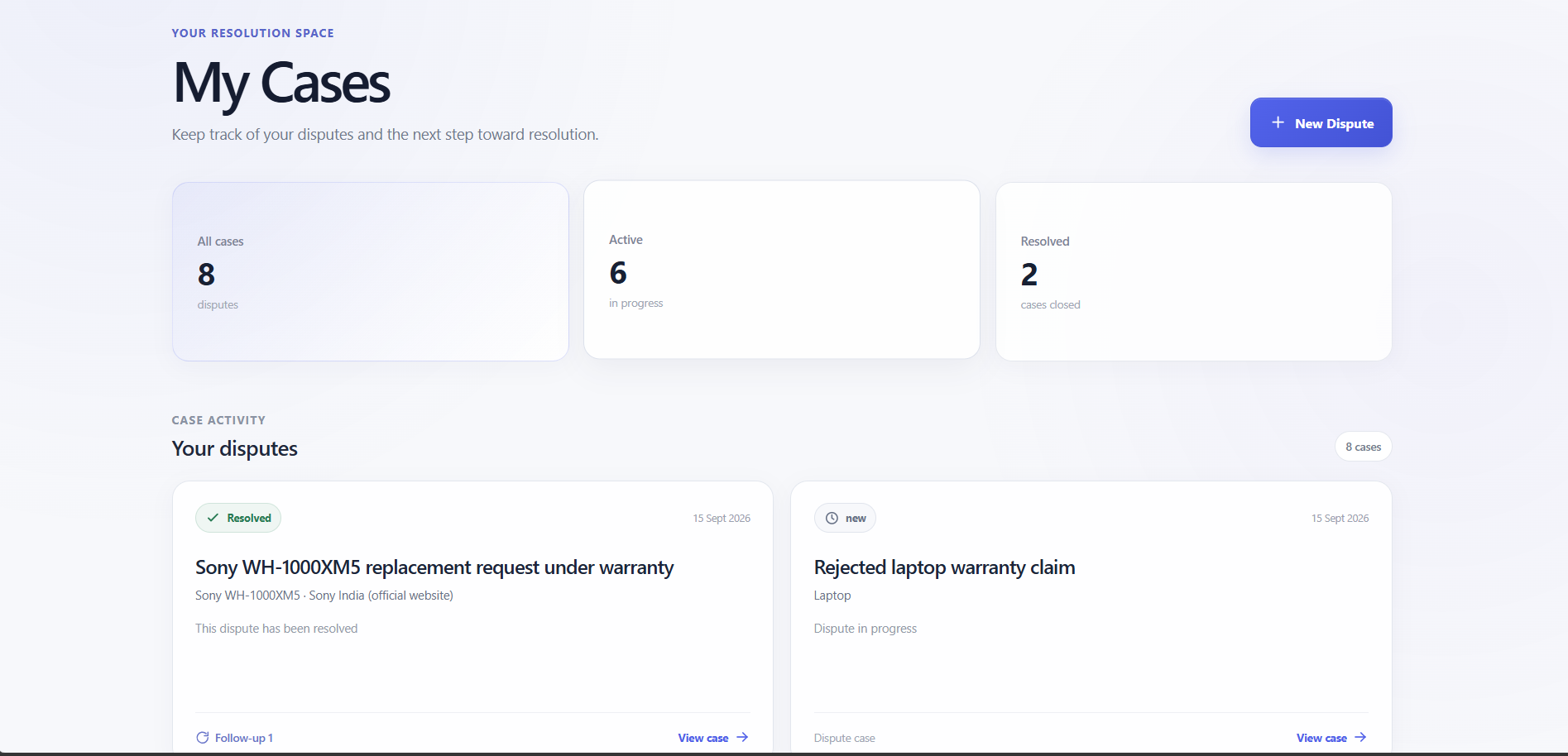
- Track the complete resolution history
- Identify when a dispute is genuinely resolved or requires human intervention
The key differentiator is that RESOLVE does not assume that a positive company response means the problem is solved.
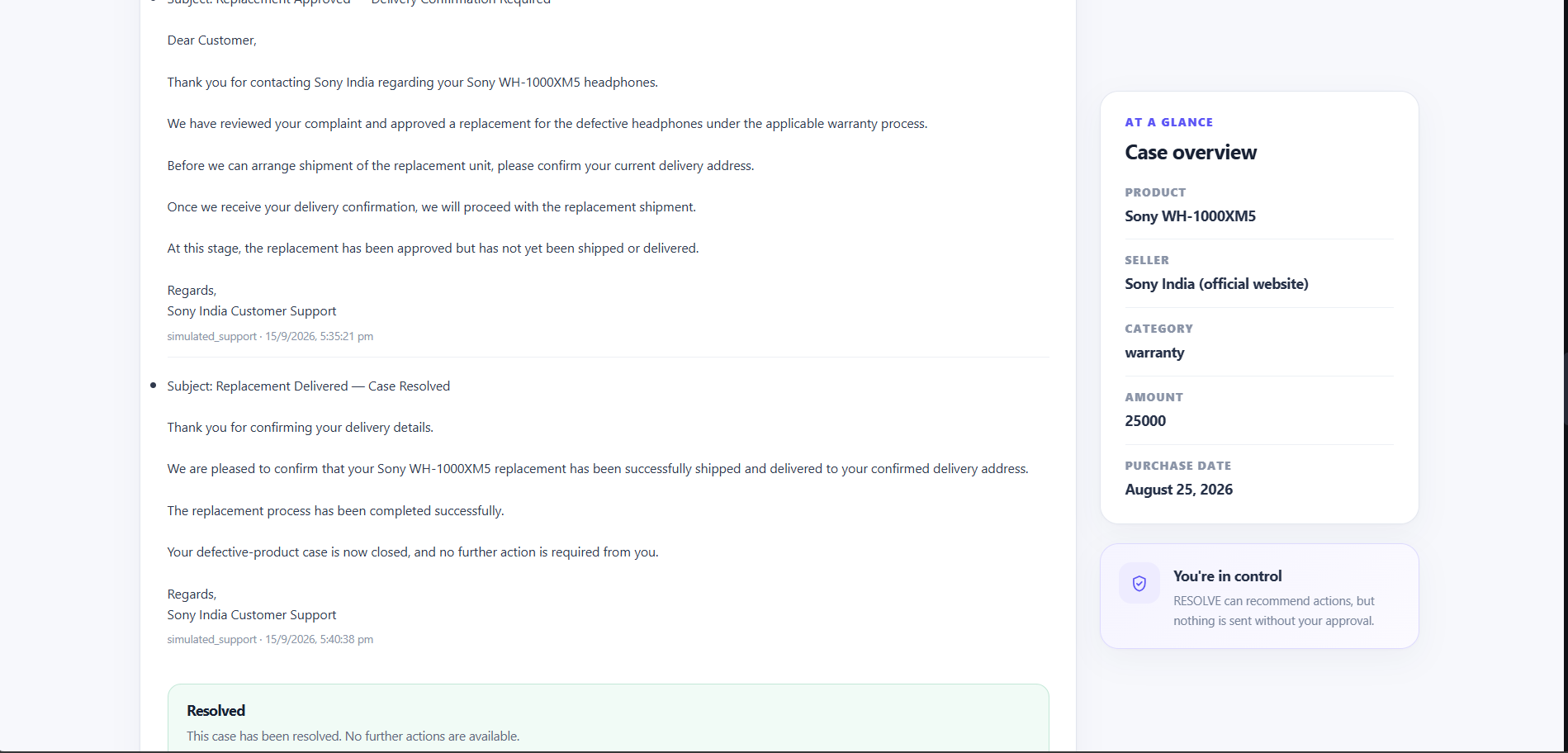
For example, in our demo, the company approves a replacement but requests delivery confirmation. RESOLVE recognizes that the replacement has been approved but not yet fulfilled, marks the case as Follow-up Needed, and prepares the next action.
After the company confirms delivery, RESOLVE evaluates the latest response and identifies the case as Resolved with 98% confidence.
This creates a continuous resolution loop, rather than a one-time chatbot interaction.
AI-guided. Human-controlled.
How we built it
RESOLVE was built as a full-stack agentic application.
Frontend
- React
- Vite
- Modern responsive UI designed as a consumer-facing product
Backend
- Python
- FastAPI
- SQLite for persistent case, action, evaluation, and history data
AI / Agentic Layer
- Strands Agents SDK
- OpenRouter / OpenAI-compatible models
- AI-driven case understanding and structured action preparation
- Separate response evaluation and follow-up planning
Evidence and Execution
- PDF evidence processing with pypdf
- Simulated and SMTP-based action execution
- Human approval before consequential actions are executed
The architecture separates AI reasoning from action execution. The AI can recommend and prepare an action, but the execution layer requires explicit human approval.
We also built authentication, case ownership, persistent workflow state, response evaluation, follow-up limits, and resolution history so the system behaves like a real product rather than a simple AI demo.
Challenges we ran into
One of our biggest challenges was making the AI workflow reliable across multiple stages.
A consumer dispute is not a single AI interaction. It can involve:
Case creation → Evidence → Recommendation → Approval → Execution → Company response → Evaluation → Follow-up → Resolution
We had to design the system to maintain state throughout this lifecycle while preventing the AI from taking uncontrolled actions.
Another important challenge appeared during testing.
We discovered that internal workflow information could become stale after a case progressed. This could cause the evaluator to incorrectly recommend another follow-up even when the latest company response indicated that the dispute was already resolved.
We redesigned the evaluation logic so that the latest company response is treated as the primary evidence, while internal workflow status is treated as bookkeeping rather than truth.
We also had to handle authentication, case ownership, duplicate actions, follow-up limits, persistence across restarts, safe execution, and human intervention.
Accomplishments that we're proud of
We are proud that RESOLVE became more than a complaint-generation chatbot.
We built a complete end-to-end resolution workflow with:
- Conversational dispute intake
- Structured case generation
- Evidence support
- AI action recommendations
- Human approval controls
- Controlled action execution
- Company response simulation
- AI response evaluation
- Follow-up planning
- Resolution confidence scoring
- Persistent case history
- Resolution timeline
- Authentication and user-owned cases
- Human intervention handling
Our strongest accomplishment is the ability to distinguish between progress and actual resolution.
In our demonstration, RESOLVE does not stop when a replacement is approved. It recognizes that fulfillment is still incomplete, requests a follow-up, and only marks the case resolved after the replacement is confirmed as delivered.
That closed-loop behavior is the core of what we wanted to build.
What we learned
We learned that building an agentic AI product is not just about getting a model to generate good responses.
The difficult part is designing everything around the model:
- Reliable state management
- Tool boundaries
- Human approval
- Persistence
- Evaluation
- Failure handling
- Security
- User experience
We also learned that more automation is not always better.
For a product dealing with real consumer disputes, the AI should be capable enough to reason and prepare actions, but the user should remain in control of consequential decisions.
The most important lesson was that an AI system needs to understand not only what a response says, but also whether that response actually completes the user's goal.
What's next for RESOLVE — AI-Guided Consumer Dispute Resolution
The next version of RESOLVE could move from a controlled prototype toward a production-ready consumer platform.
Planned directions include:
- Real email and messaging integrations
- OCR and richer document/evidence extraction
- Consumer-rights and policy knowledge
- Company-specific resolution strategies
- More advanced dispute classification
- Automated notifications and reminders
- Analytics for dispute outcomes
- Stronger escalation and human intervention workflows
- Additional communication channels
- Production-grade integrations with customer-support systems
Our long-term vision is simple:
Consumers shouldn't need to become experts in customer-support escalation just to resolve a legitimate problem.
RESOLVE is designed to help people move from frustration to progress — while keeping the human in control.
RESOLVE — AI-GUIDED. HUMAN-CONTROLLED.
Built With
- agentic
- agents
- ai
- automation
- consumer
- fastapi
- generative
- human-in-the-loop
- language
- natural
- openai
- openrouter
- processing
- python
- react
- sdk
- sqlite
- strands
- vite

Log in or sign up for Devpost to join the conversation.