-
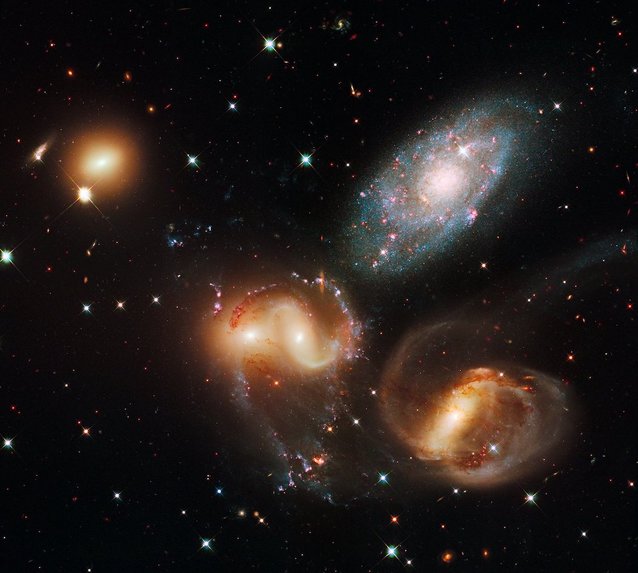
Galactic wreckage in Stephan's Quintet
Inspiration
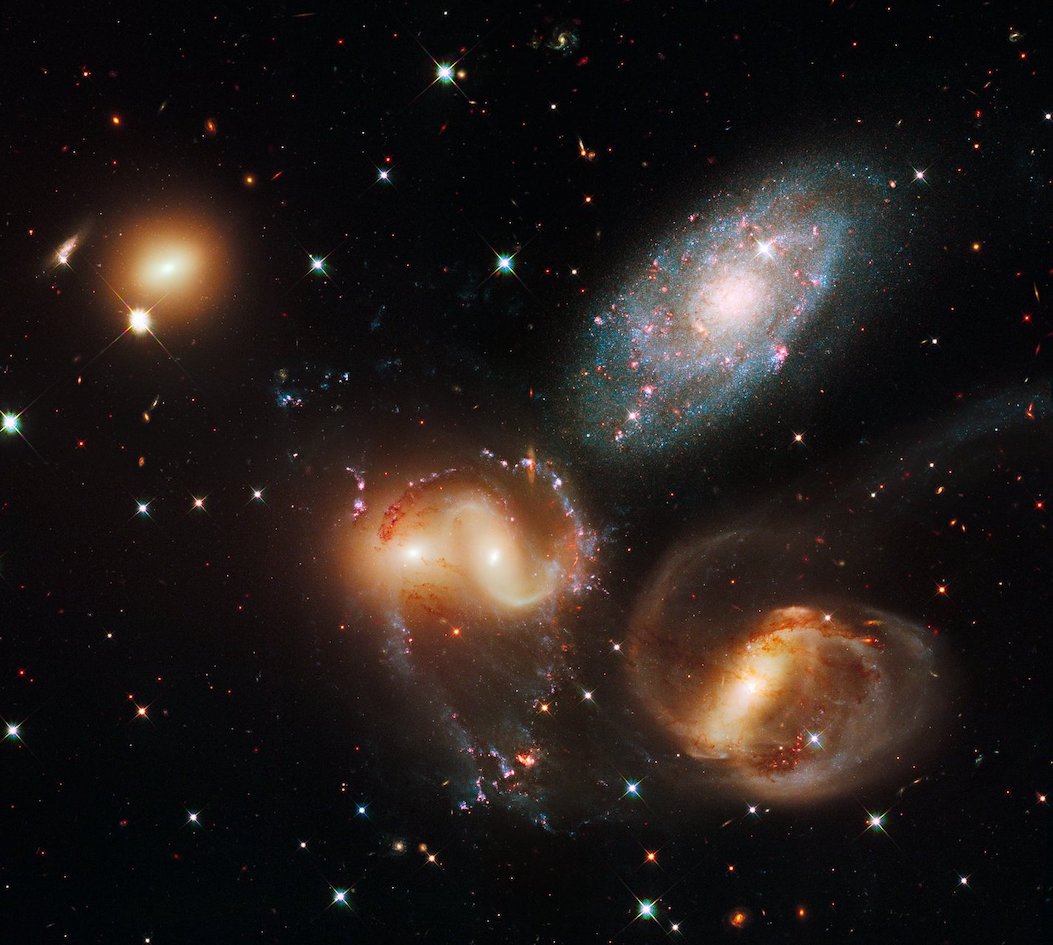
Telescopes have allowed astronomers to obtain images of objects as distant as 10 billion light-years away. For these extremely distant sources, these images are often very pixelated or low-resolution. People need to find a way to restore resolution for these blurred images.
What it does
We implement the model to get high-resolution images from low-resolution images. One method is using interpolation techniques. Another model is Super Resolution Convolutional Neural Network (SRCNN) proposed by in the paper "Image Super-Resolution Using Deep Convolutional Networks".
How we built it
For interpolation, we use the library opencv. For SRCNN, we first get astronomic image dataset on https://www.spacetelescope.org. These images are high-resolution and we get low-resolution images as training inputs by down-sampling. Then we build SRCNN model with PyTorch and train it with low-resolution batches and high-resolution labels.
Challenges we ran into
Training and fine-tuning the SRCNN model is difficult and time consuming with limited computing resources. There always exists a trade-off between training time and performance for SRCNN model. Besides, restoration for astronomic images can be more difficult because there are many pure black pixels and plenty of small, irregular, discrete particles
Accomplishments that we're proud of
We figure out the advantages of SRCNN and successfully build and feed it with astronomic datasets.
What we learned
We learned the principle of SRCNN and the process for deploying deep learning models.
What's next for Resolution restoration for astronomic images
- We can identify and leave out uniform patches since these patches cannot help the model learn better.
- With more computing time and resources, it is possible to increase the number of filters and and filter size in order to get better performance.
- Specific resolution restoration techniques for astronomic images can be then investigated.


Log in or sign up for Devpost to join the conversation.