-
-
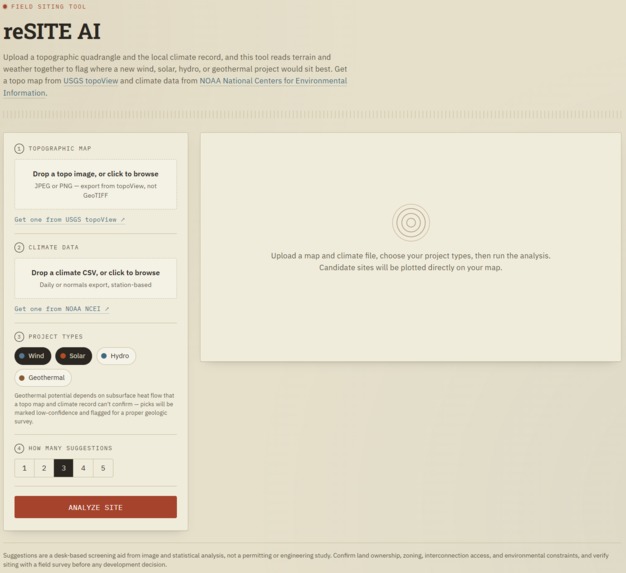
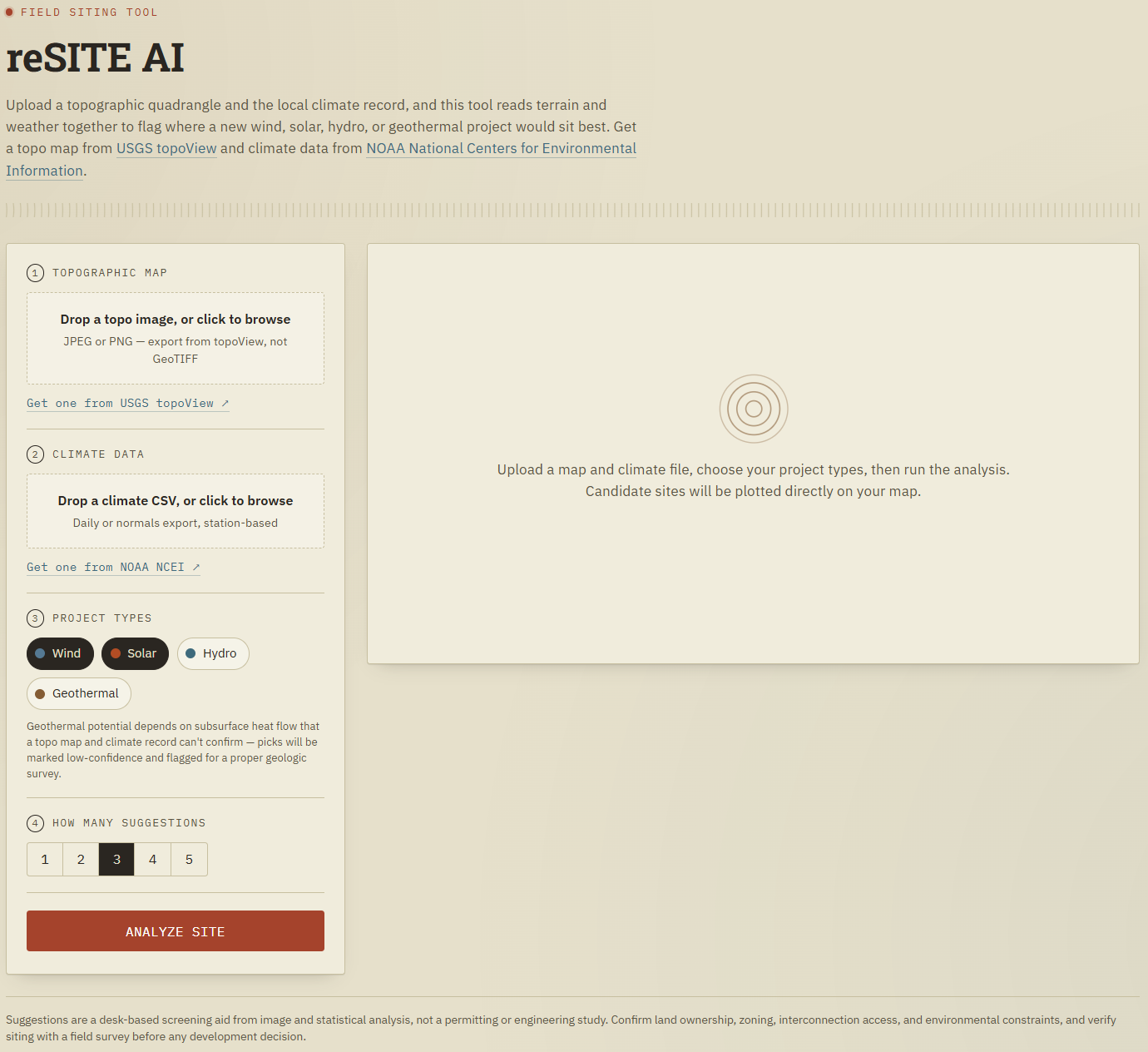
reSITE AI Dashboard
Inspiration
When taking a computational sustainability class last semester, I learned about how AI can support renewable implementation energy onto the traditional energy grid by predicting when renewables would provide power, given their potential intermittency. However, I soon realized that AI could also analyze geospatial and metrological data to support renewable energy project planning by selecting project locations that would maximize the energy that renewables could provide. From this, came my idea for reSITE AI, which references how AI can assist with identifying ideal renewable energy project sites.
What it does
reSITE AI is a user-friendly tool that provides recommendations on renewable energy project locations and types. The user uploads a topographic map, obtained from USGS topoView, based on the general location they would like their project to be, as well as a detailed climate dataset from the region, obtained from NOAA National Centers for Environmental Information Climate Data Online. The user additionally selects what renewable energy types they want to consider (wind, solar, hydro, geothermal) and how many suggestions they would like to receive. reSITE AI then calls Claude to analyze the data in combination with the user's desires. This is because I built reSITE AI as an artifact within Claude, to seamlessly be able to call and use AI analysis. Though Claude is the model used currently, other models could be used as well, including a model trained on historical renewable energy project siting decisions. Once Claude's evaluation is complete, reSITE AI will provide its suggestions for where the user should pursue each kind of renewable energy project.
Impact
reSITE AI dramatically cuts down time in the planning process of renewable energy projects, as its suggestions for where these projects should be sited can help narrow down target locations faster than manual data analysis. At the same time, it makes renewable energy projects more effective and efficient, by selecting the appropriate location for each type of renewable energy. For instance, for an open area that recieve more sunlight compared to a windy area with more uneven topography, reSITE AI would suggest solar and wind respectively. Furthermore, this tool has significant growth potential in the future. More datasets can be incorporated in its analysis to increase accuracy, while experimenting with different AI models or training a custom model can further improve results. Ultimately, reSITE AI has the potential to change how we think about renewable energy development, which is needed faster than ever to mitigate the effects of climate change.
Built With
- claude
- climate-data-online
- html
- noaa
- topoview
- usgs

Log in or sign up for Devpost to join the conversation.