Inspiration
Antimicrobial resistance (AMR) is a growing global health challenge. While surveillance systems collect valuable resistance data, turning large amounts of laboratory and regional data into timely, actionable insights can still be difficult.
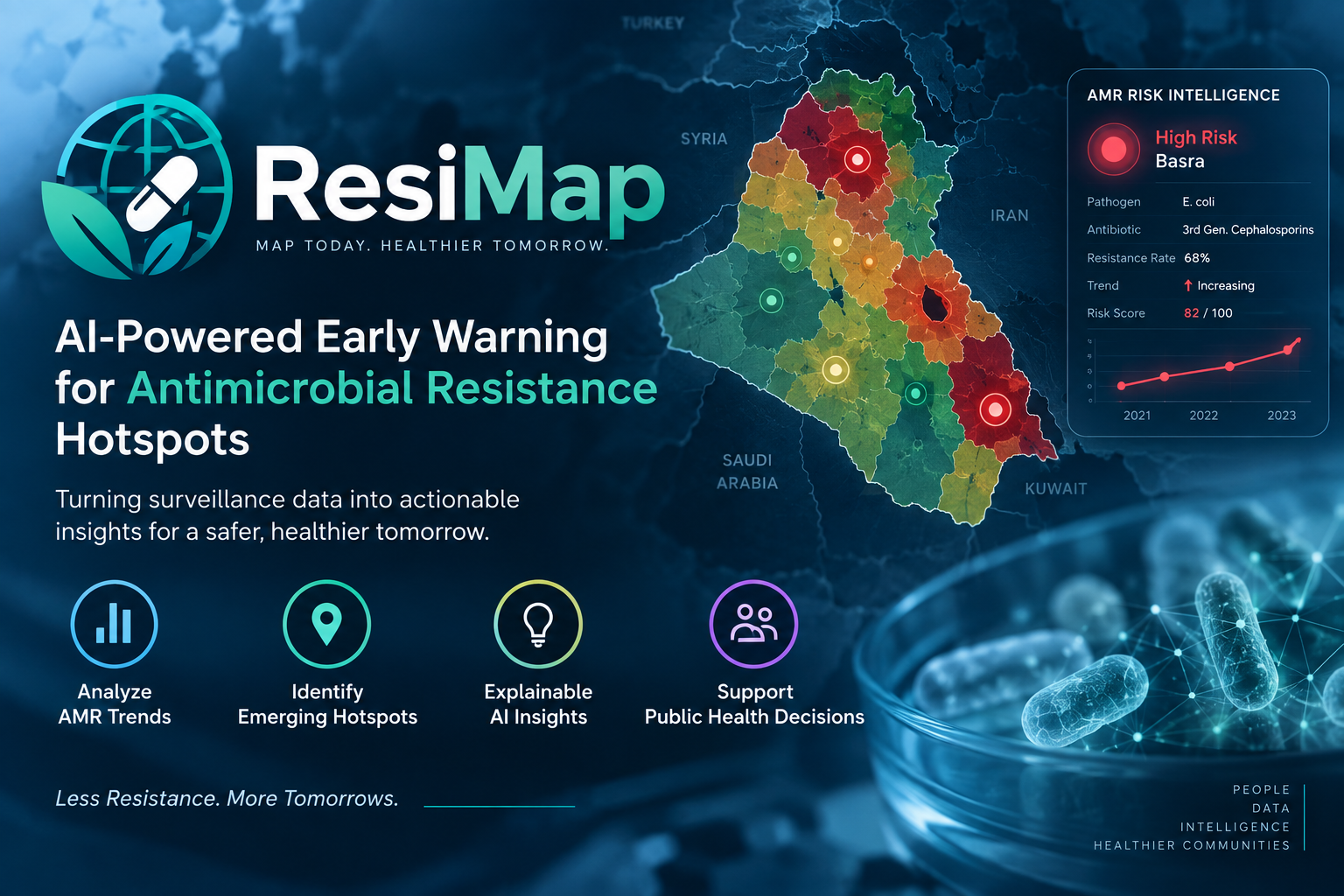
This inspired ResiMap: an AI-powered antimicrobial resistance early-warning and decision-support concept designed to help public-health teams identify where resistance is rising, understand why an area may be at risk, and prioritize locations for further investigation.
Rather than creating another static AMR dashboard, the goal is to transform surveillance data into explainable geographic risk intelligence.
What it does
ResiMap is designed to analyze antimicrobial resistance patterns across geography and time.
The proposed system combines:
- Resistance prevalence
- Changes in resistance over time
- Pathogen and antibiotic information
- Geographic patterns
- Historical surveillance trends
- Anomaly detection
- Data-quality indicators
These signals feed into an AMR Risk Intelligence Engine that can generate an interpretable regional risk score and identify unusual changes that may represent an emerging resistance hotspot.
Results are then presented through an interactive geographic interface.
For example, instead of only showing that a region has high resistance, ResiMap could generate an alert such as:
High Risk — Rising E. coli resistance to third-generation cephalosporins, with a sustained upward trend above the regional historical baseline.
The objective is not simply to answer "Where is resistance high?", but also:
"Where is resistance rising, why was the region flagged, and where should public-health teams investigate first?"
How it would work
The proposed ResiMap pipeline is:
AMR surveillance data → Data cleaning and standardization → Spatial and temporal feature engineering → Risk modeling → Anomaly detection → Explainability → Interactive risk map
The initial data foundation is designed around trusted, publicly available antimicrobial-resistance surveillance sources such as the WHO Global Antimicrobial Resistance and Use Surveillance System (GLASS).
Python and Pandas can be used for preprocessing and exploratory analysis, while Scikit-learn can support interpretable machine-learning and anomaly-detection methods. GeoPandas and interactive mapping technologies can provide the geospatial layer, with FastAPI and a web interface supporting a future prototype.
Innovation
The key innovation is the proposed AMR Risk Intelligence Engine.
Traditional visualization can show historical resistance levels. ResiMap aims to go further by combining temporal change, resistance burden, anomaly signals, and geographic context to identify locations requiring attention.
A second important component is explainability.
Instead of presenting decision-makers with an unexplained AI prediction, ResiMap is designed to communicate the factors that contributed to a risk signal.
This makes the system more transparent and potentially more useful for public-health surveillance.
Challenges
Several challenges shaped the design of ResiMap.
AMR surveillance data can vary substantially in completeness, geographic coverage, reporting frequency, and laboratory capacity. A region with limited observations should not automatically be compared with a region with extensive surveillance.
For this reason, ResiMap is designed to include data-quality and confidence indicators and to treat AI-generated risk signals as prompts for further investigation rather than confirmed outbreaks.
Another challenge is ensuring responsible use of AI in healthcare. ResiMap is therefore explicitly designed as a surveillance and decision-support tool, not a diagnostic system and not an antibiotic-prescription system.
What I learned
Designing ResiMap highlighted that applying AI to healthcare is not only about maximizing predictive performance.
Data quality, interpretability, epidemiological context, uncertainty, and responsible communication are equally important.
It also showed the potential of combining data science, geospatial analytics, and public-health surveillance to make complex health data easier to act upon.
What's next
If selected for further development, the next stage will focus on building and validating a working prototype using public AMR surveillance data.
The development roadmap includes:
- Preparing and standardizing AMR surveillance data.
- Performing spatial and temporal exploratory analysis.
- Developing and validating the AMR Risk Intelligence Engine.
- Implementing anomaly detection for emerging hotspots.
- Adding explainable risk signals and data-quality indicators.
- Building an interactive geographic prototype.
- Evaluating the system using temporal validation and false-alert analysis.
The long-term vision is for ResiMap to become a modular AMR intelligence layer that could be adapted to national, regional, hospital-network, and eventually One Health surveillance environments.
ResiMap's vision is simple: turn antimicrobial-resistance surveillance from passive reporting into explainable early-warning intelligence.
Built With
- ai
- anomaly
- detection
- explainable
- fastapi
- geopandas
- geospatial
- glass
- leaflet.js
- learning
- machine
- pandas
- plotly
- python
- scikit-learn
- who


Log in or sign up for Devpost to join the conversation.