-
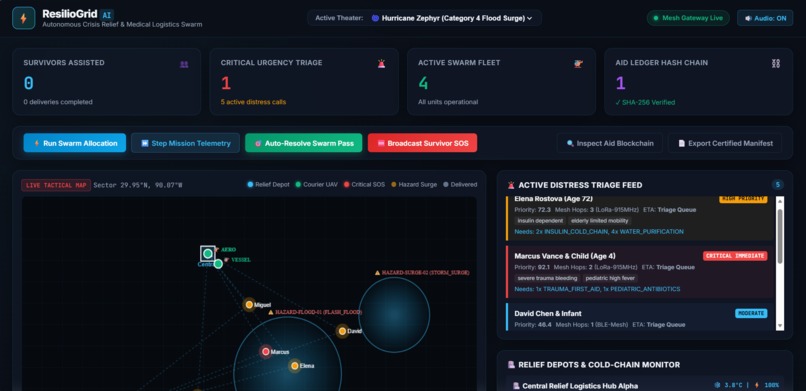
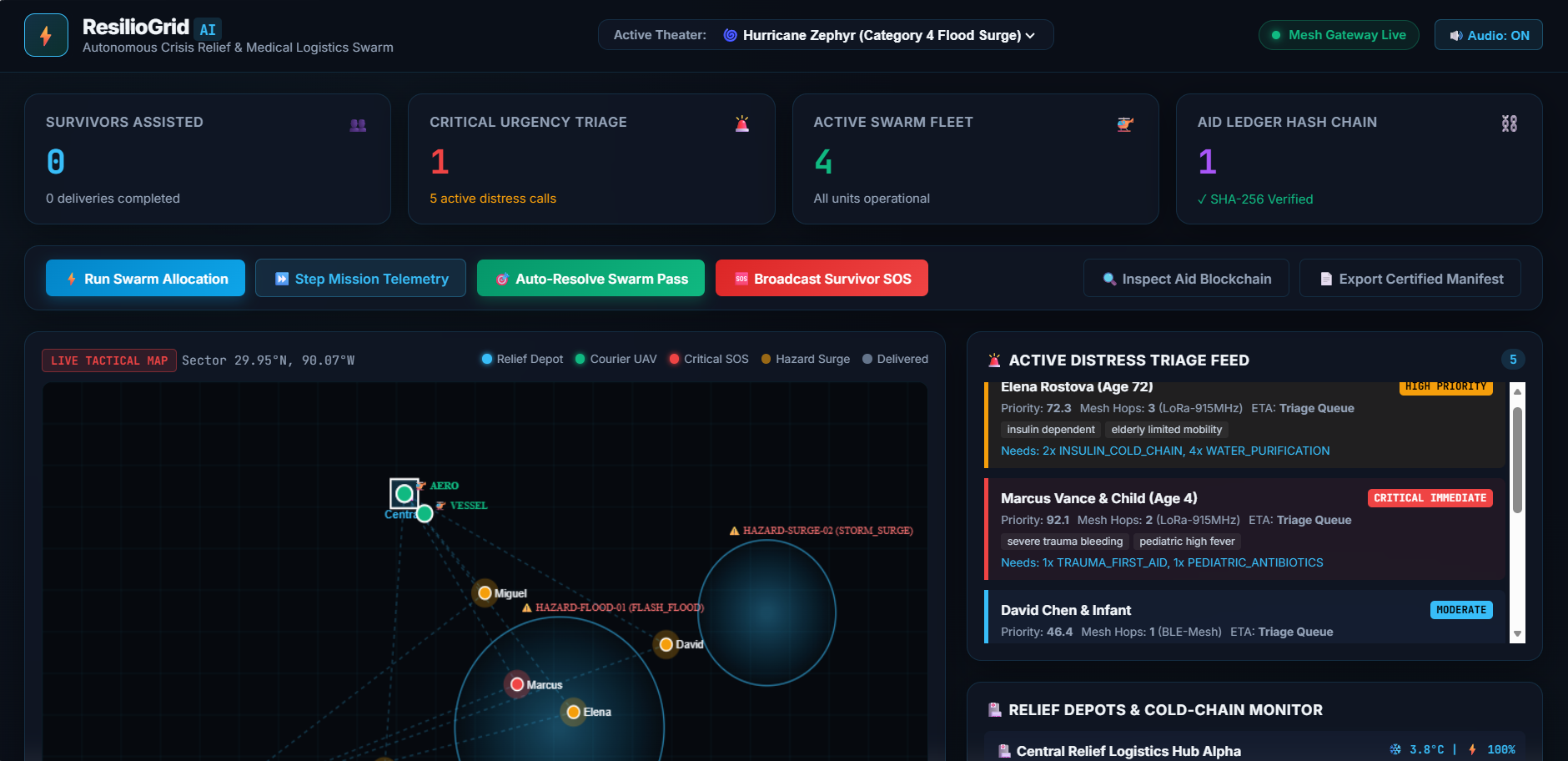
ResilioGrid AI Tactical Operations Center — Real-time geospatial hazard tracking, autonomous drone fleet dispatch
💡 Inspiration
Every major natural disaster—from severe hurricanes and flash floods to coastal wildfires—shares a tragic pattern: telecommunications collapse within the first 6 hours, plunging entire communities into critical "data deserts."
In these blackouts, the "Last-Mile Misallocation Paradox" emerges: central relief warehouses are overwhelmed with generic donations, yet the most vulnerable individuals—seniors requiring cold-chain insulin, infants needing clean formula, dialysis patients losing battery power, and trauma victims—remain completely invisible to emergency responders. We built ResilioGrid AI to forge an autonomous, offline-first lifeline that detects, prioritizes, and delivers life-saving medical supplies to those who need them most without requiring cellular connectivity or central power.
🛠️ What It Does
ResilioGrid AI is a full-stack, autonomous disaster response and medical resource orchestration swarm:
- Offline Delay-Tolerant Mesh Bridge: Stranded civilians broadcast emergency SOS beacons over LoRa (915MHz) or BLE Mesh without cellular data, WiFi, or power grid infrastructure.
- Bayesian Risk & Vulnerability Quantifier: Combines non-linear demographic vulnerabilities (insulin dependency, elderly mobility, infant care) with advancing environmental hazard wavefronts to dynamically compute survival priority indices ($0-100$).
- Multi-Objective Swarm Allocator: Autonomously assigns optimal dispatch units (refrigerated cold-chain UAVs, amphibious rescue vessels, and all-terrain 4x4s) while respecting payload limits, battery ranges, temperature safety ($4^\circ\text{C}$), and hazard obstacle avoidance.
- Cryptographic SHA-256 Humanitarian Ledger: Mints an immutable blockchain block for every delivered aid package, providing verifiable proof of work and eliminating aid theft or diversion.
- Tactical Operations Command Console: A glassmorphic dark-mode interface featuring a live 2D tactical canvas map, animated drone trajectories, real-time audio dispatch notifications, offline survivor SOS simulator, and one-click certified relief manifest exports.
⚙️ How We Built It
- Backend & Simulation: Python 3.11, FastAPI, WebSockets, and NumPy for geospatial distance matrices and Bayesian probability propagation.
- Algorithms: Multi-objective bipartite matching, log-distance LoRa RF path loss modeling, dynamic waypoint hazard deflection geometry, and SHA-256 cryptographic hash-chains.
- Frontend & Visualization: Modern HTML5 Canvas tactical radar, CSS3 Glassmorphism with cyber-dark aesthetics, Web Audio API sound synthesizer, and vanilla ES6 JavaScript.
- Testing & Verification: 16 comprehensive Pytest unit and integration tests covering allocation logic, RF mesh multi-hop routing, blockchain verification, and REST APIs (100% pass rate in 0.4s).
🚧 Challenges We Ran Into
- Modeling Multi-Hazard Dynamics: Accounting for how different vehicles react to hazards—all-terrain vehicles get immobilized in flash floods where amphibious vessels thrive, while drones can fly over water but must deflect around wildfire thermal convection plumes.
- Preventing LoRa Broadcast Storms: Implementing stateful deduplication and hop-count limits so ad-hoc mesh networks don't collapse under repeated distress broadcasts.
- Real-Time Synchronous Telemetry: Creating a seamless WebSockets bi-directional streaming loop that reflects physical flight steps, battery degradation, and blockchain minting simultaneously on the tactical UI.
🏆 Accomplishments That We're Proud Of
- 100% Passing Automated Test Suite (16/16 Tests) validating every core algorithm in under 0.5 seconds.
- True Offline-First Architecture: Simulating both survivor-side mesh broadcasting and responder-side tactical management without external cloud dependencies.
- Zero-Config One-Click Launcher: Launchable via a single
python run.pycommand with automatic browser opening.
📚 What We Learned
We learned how crucial cold-chain guarantees ($4^\circ\text{C}$) are in disaster logistics—delivering warm insulin or degraded blood plasma is as dangerous as delivering nothing. Engineering active temperature monitoring into the allocation objective function made the system significantly more realistic and clinically viable.
🔮 What's Next for ResilioGrid AI
- Integrating real physical LoRa Meshtastic hardware transceivers via serial/USB bridges.
- Connecting live OpenStreetMap and NOAA disaster weather satellite API feeds.
- Expanding autonomous drone payload drop confirmations using on-device computer vision QR-code scanning.
Built With
- autonomous-agents
- bayesian-inference
- blockchain
- css3
- disaster-response
- fastapi
- html5
- humanitarian-aid
- javascript
- lora
- mesh-networking
- numpy
- pydantic
- pytest
- python
- sha-256
- websockets

Log in or sign up for Devpost to join the conversation.