Inspiration
A deadline does not move just because your day did.
Most planning tools answer, “Where can this task go?” Reset asks a harder question: “What can still be delivered, what must change, and what evidence is actually ready?”
A plausible timetable is not enough if the minimum work cannot fit. Equally, a task labelled “finish the demo” is not proof that a usable video exists. Reset connects recovery planning with delivery evidence instead of hiding those uncertainties.
What it does
Reset is an Alexa+ simulated web experience, using the hackathon’s permitted browser-simulation route. It is not a production Alexa integration or an Echo-connected skill.
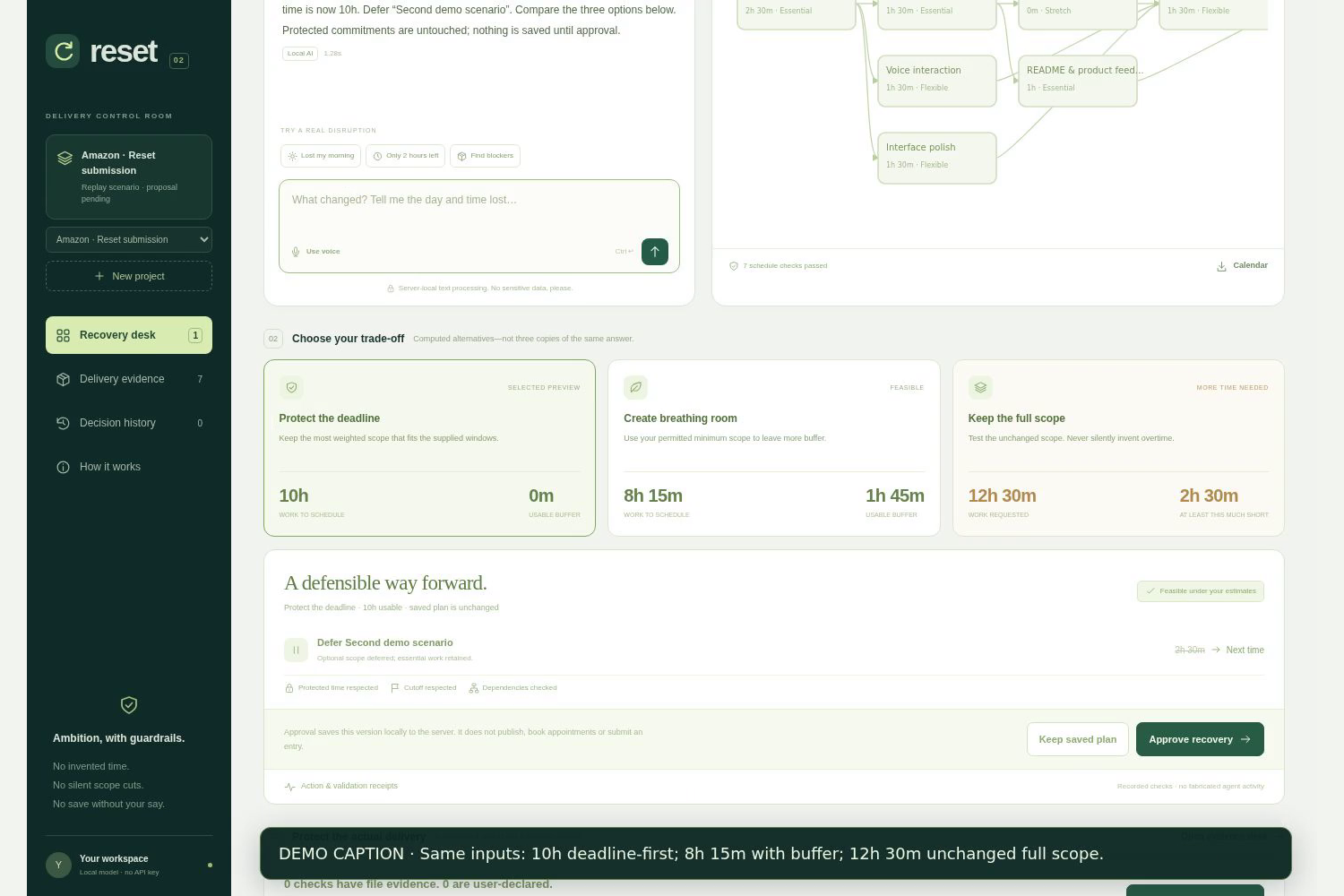
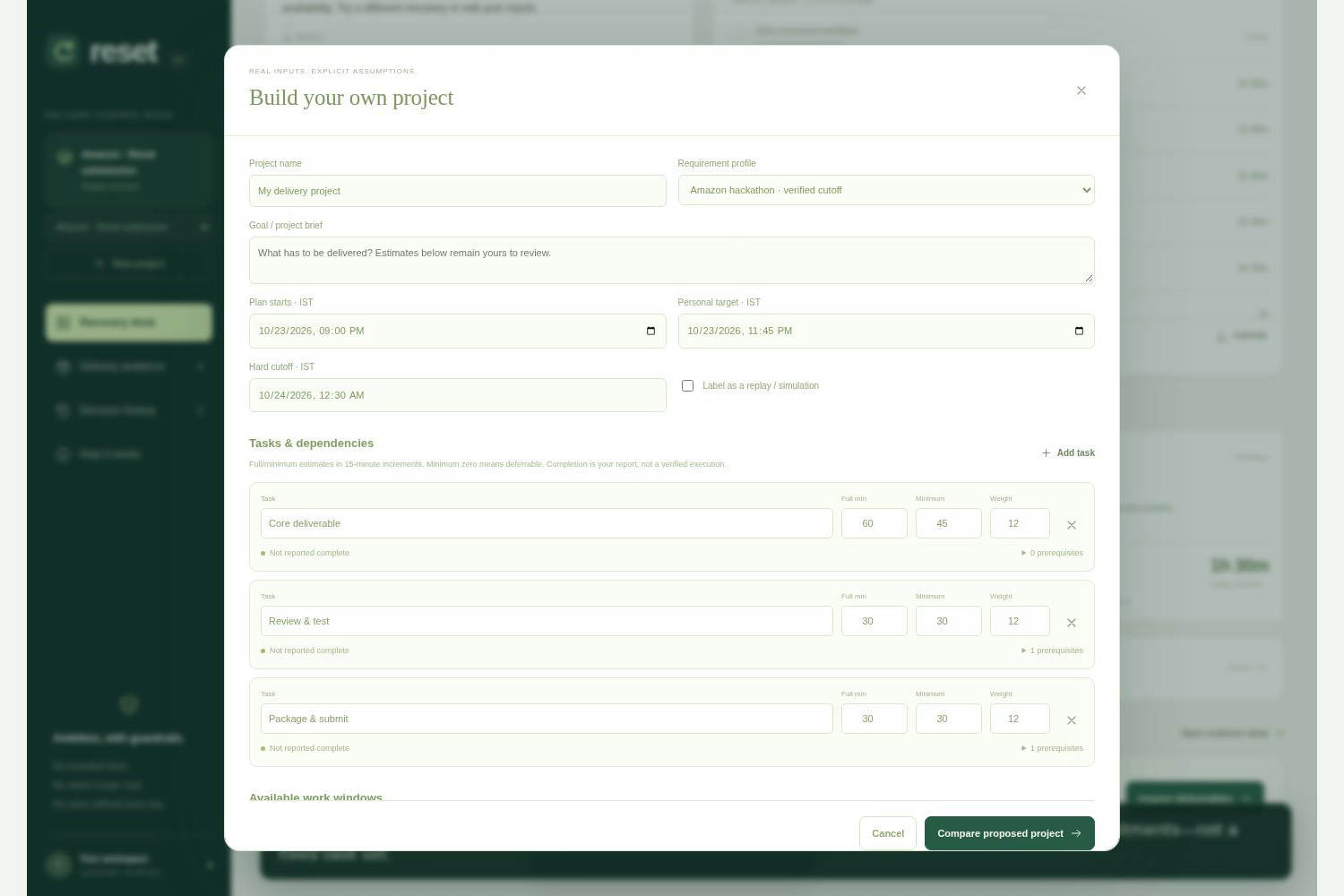
Users configure tasks, dependencies, full/minimum estimates, available windows and protected commitments. After a disruption, Reset computes three policies:
- Protect the deadline: retain weighted scope that fits the available time.
- Create breathing room: use permitted minimum scope to leave more buffer.
- Keep full scope: test the unchanged workload—and refuse approval when it cannot fit.
In the labelled replay, losing a morning reduces capacity from 14 hours to 10. The options are a 10-hour plan, an 8h 15m plan with 1h 45m buffer, or unchanged 12h 30m scope that needs another 2h 30m. No extra hours are invented.
Proposals require approval, persist after reload and can be undone. Reporting completion advances the planning clock so spent time cannot be reused.
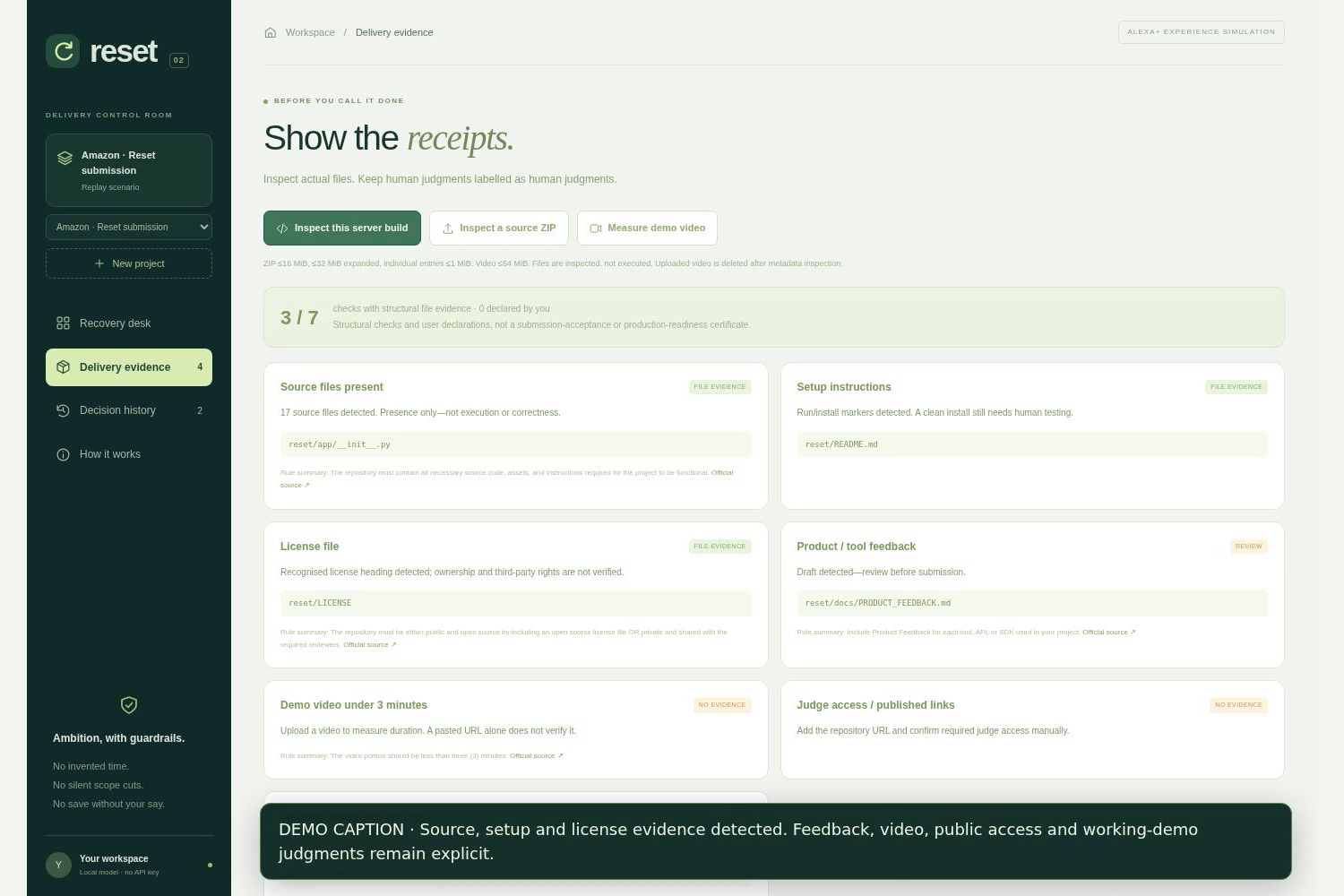
A delivery-evidence desk inspects actual source ZIPs and measures video duration. File evidence, user declarations and unresolved questions remain separate. Uploaded code is not executed; finding a file does not certify its quality or acceptance.
How it was built
The application uses Python, FastAPI, Pydantic and SQLite, with an HTML/CSS/JavaScript frontend. Qwen2.5-0.5B-Instruct runs locally through llama-cpp-python to extract bounded availability facts. Deterministic Python code—not the language model—performs scope search, dependency scheduling and constraint checks.
ffprobe measures video metadata. Pytest and Playwright support automated software and browser checks. Development was substantially AI-assisted using Arena.ai Agent Mode.
Challenges
The early interpreter sometimes confused a remaining-time request with a status query. Reducing model output to availability facts, validating quantities and direction, and retaining a labelled fallback made the boundary clearer.
Another challenge was avoiding false confidence: a scheduled task is not completed work, and a detected README is not proof of a successful installation. The interface keeps those distinctions visible.
Accomplishments and lessons
The last verified run passed 102 automated software tests, alongside desktop/mobile Chromium integration checks covering strategy selection, approval, undo, elapsed-time accounting, artifact inspection and export.
The central technical lesson is simple: AI can interpret intent without owning the invariants—or permission to act. Evidence also needs a source and a limit, not merely a green tick. These software checks are not a model-accuracy or real-world productivity benchmark.
What’s next
Evaluate consenting users’ real short-project workflows, improve language coverage, add production authentication and assess a genuine Alexa+ integration separately. The current replay uses synthetic data, and optional browser microphone behaviour still needs testing on the user’s device.

Log in or sign up for Devpost to join the conversation.