RESERVE: Evidence-Ready Routing for Circular Materials
Inspiration
Circular supply chains depend on more than finding the nearest destination. Recovered materials must reach processors that can accept the material, meet quality requirements, accommodate the shipment, and satisfy delivery constraints. A facility that looks optimal geographically may not be a feasible destination operationally.
That observation inspired RESERVE — Climate-Aware Resource Routing. I wanted to explore how a transparent decision-support system could combine operational feasibility with transport-emissions estimates to help make recovered-material routing decisions more informed and explainable.
The goal was to move beyond a conceptual proposal and build an interactive prototype that demonstrates the decision process, makes its assumptions visible, and creates a foundation for future evidence-based evaluation.
What it does
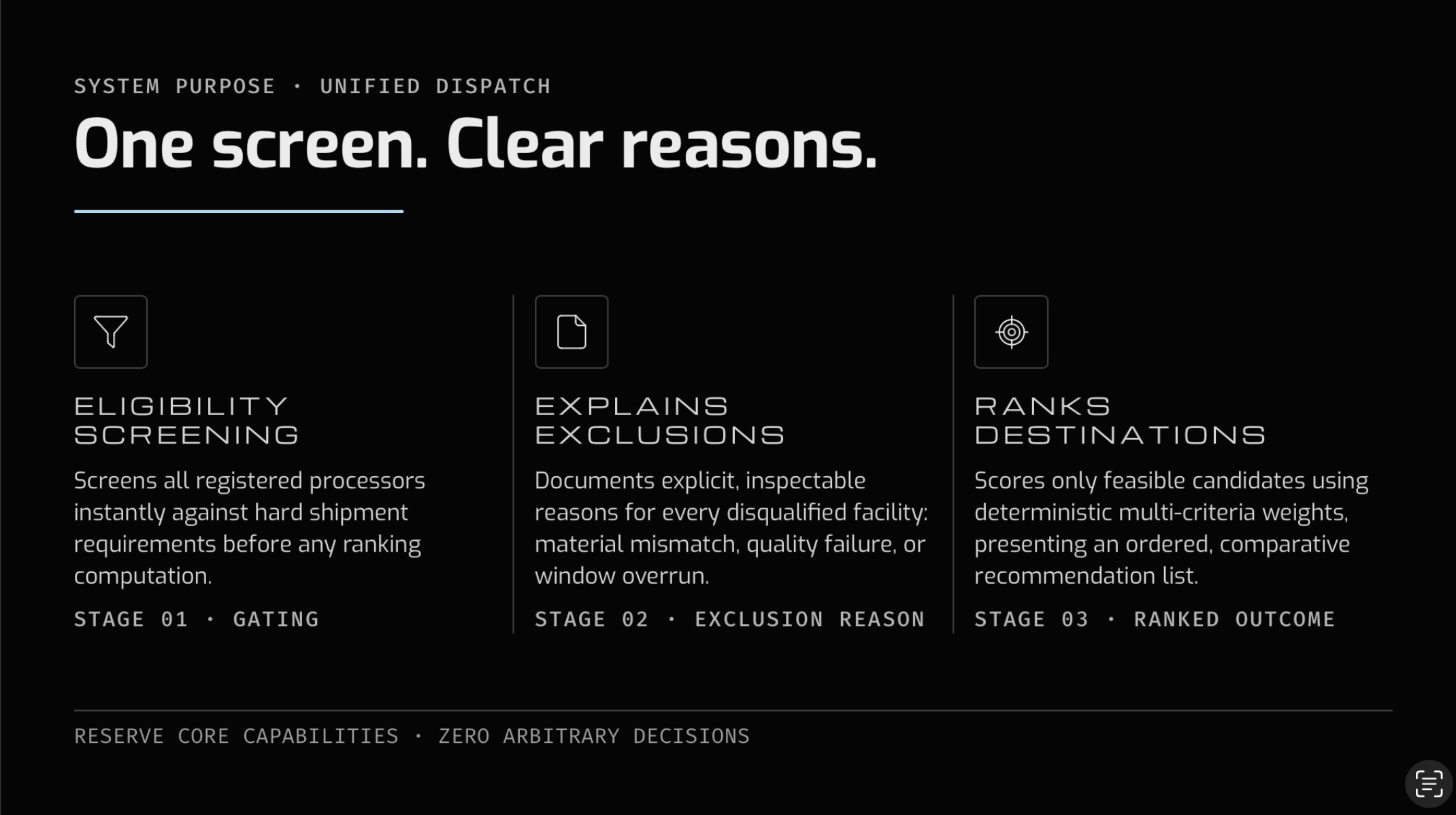
RESERVE evaluates potential destinations for recovered materials through an eligibility-first routing workflow.
The prototype checks four key operational requirements:
- Material compatibility: Can the processor accept the shipment's material?
- Available capacity: Can it accommodate the required quantity?
- Quality requirements: Does the shipment meet the specified quality threshold?
- Delivery constraints: Can the destination satisfy the required delivery window?
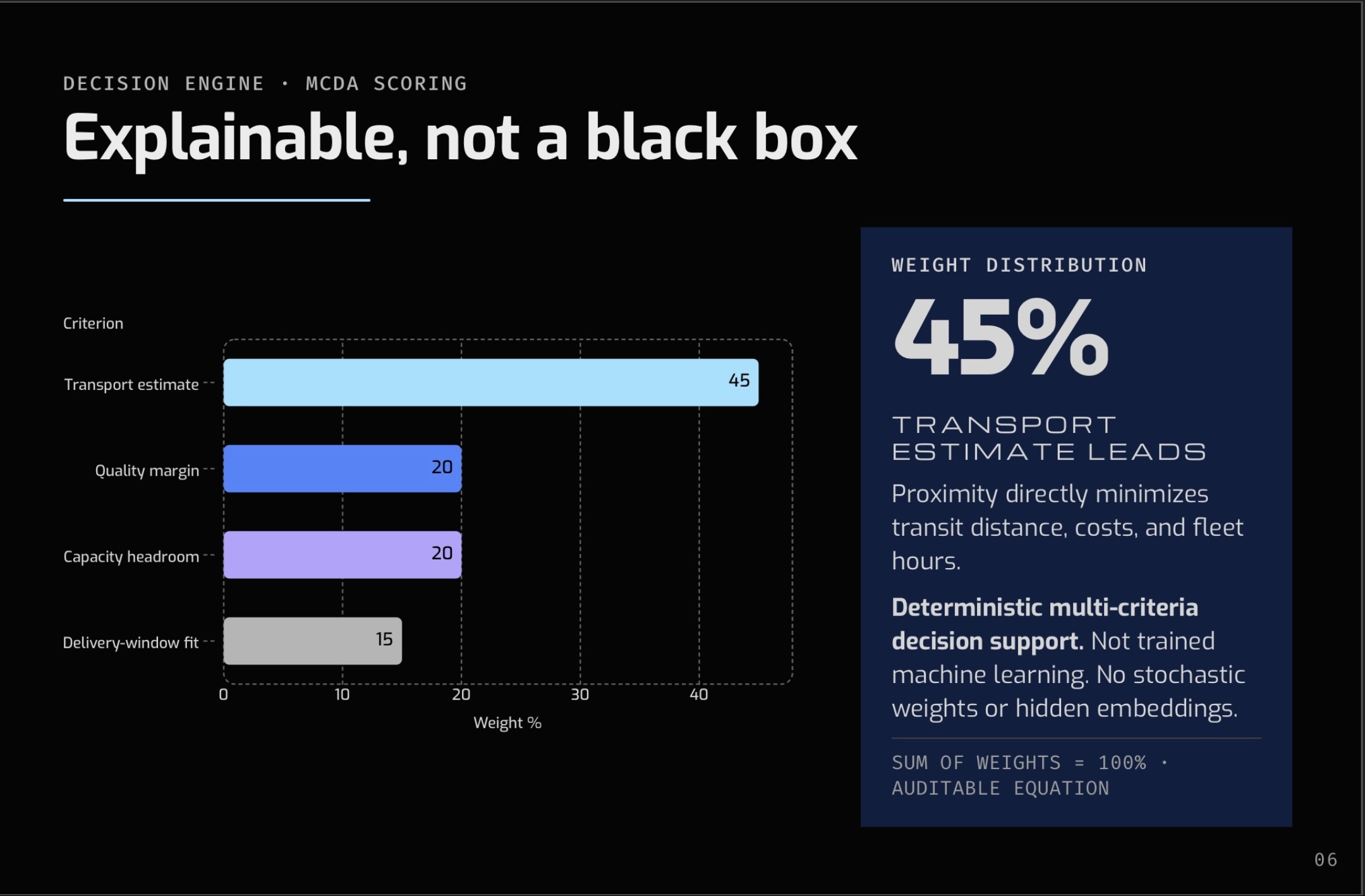
Processors that fail the eligibility checks are excluded before the remaining candidates are ranked. The application also provides an explainable, multi-criteria decision-support model that considers estimated transport emissions, quality margin, capacity headroom, and delivery-window fit.
The prototype compares the selected destination with a nearest-eligible baseline, helping distinguish geographic proximity from operational feasibility.
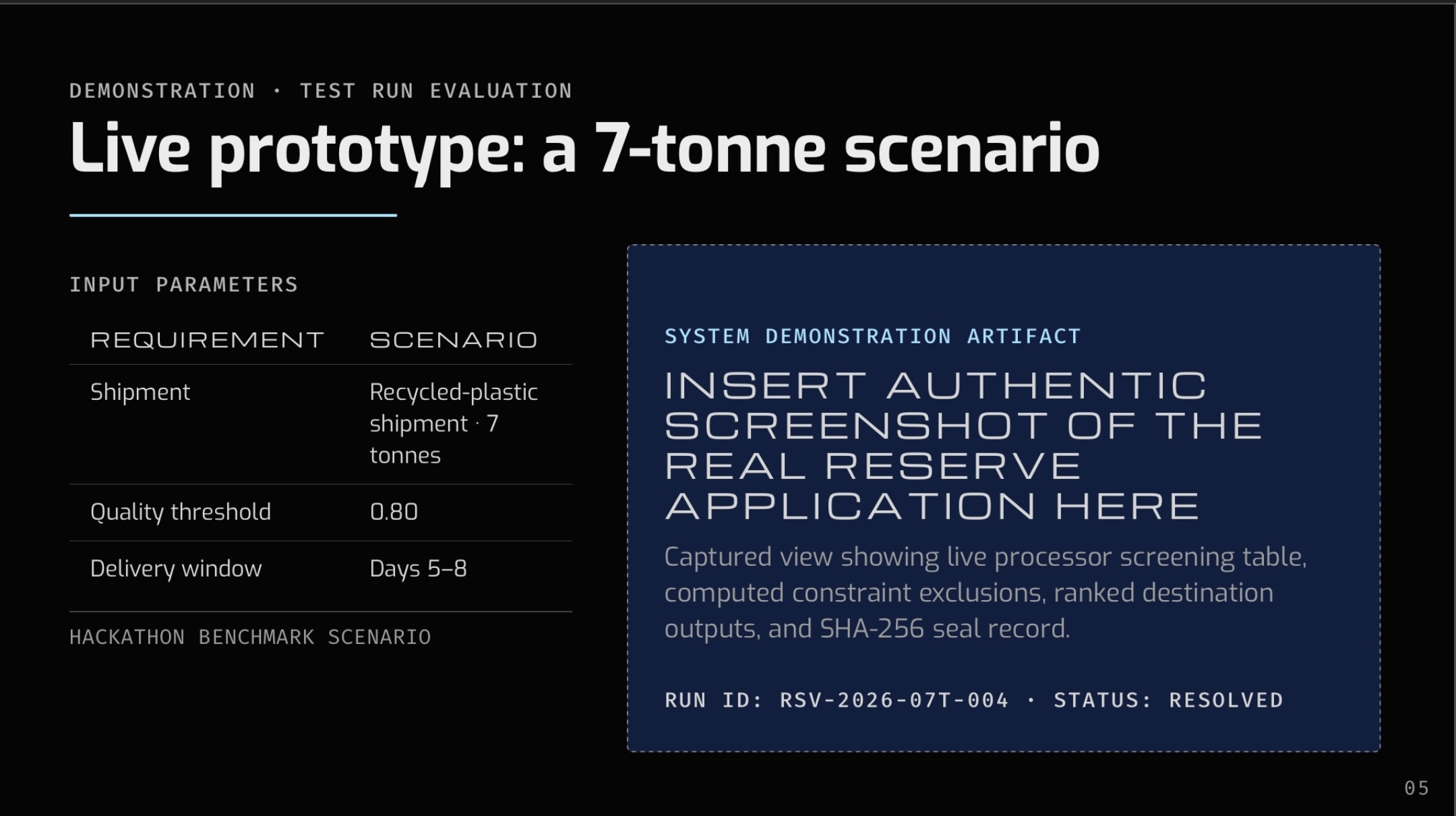
In the demonstration scenario, a seven-tonne recycled-plastic shipment is evaluated against fictional processor profiles. The nearest processor is excluded because it lacks sufficient capacity, while a farther eligible processor becomes the recommended option. This illustrates why feasibility should be established before optimization.
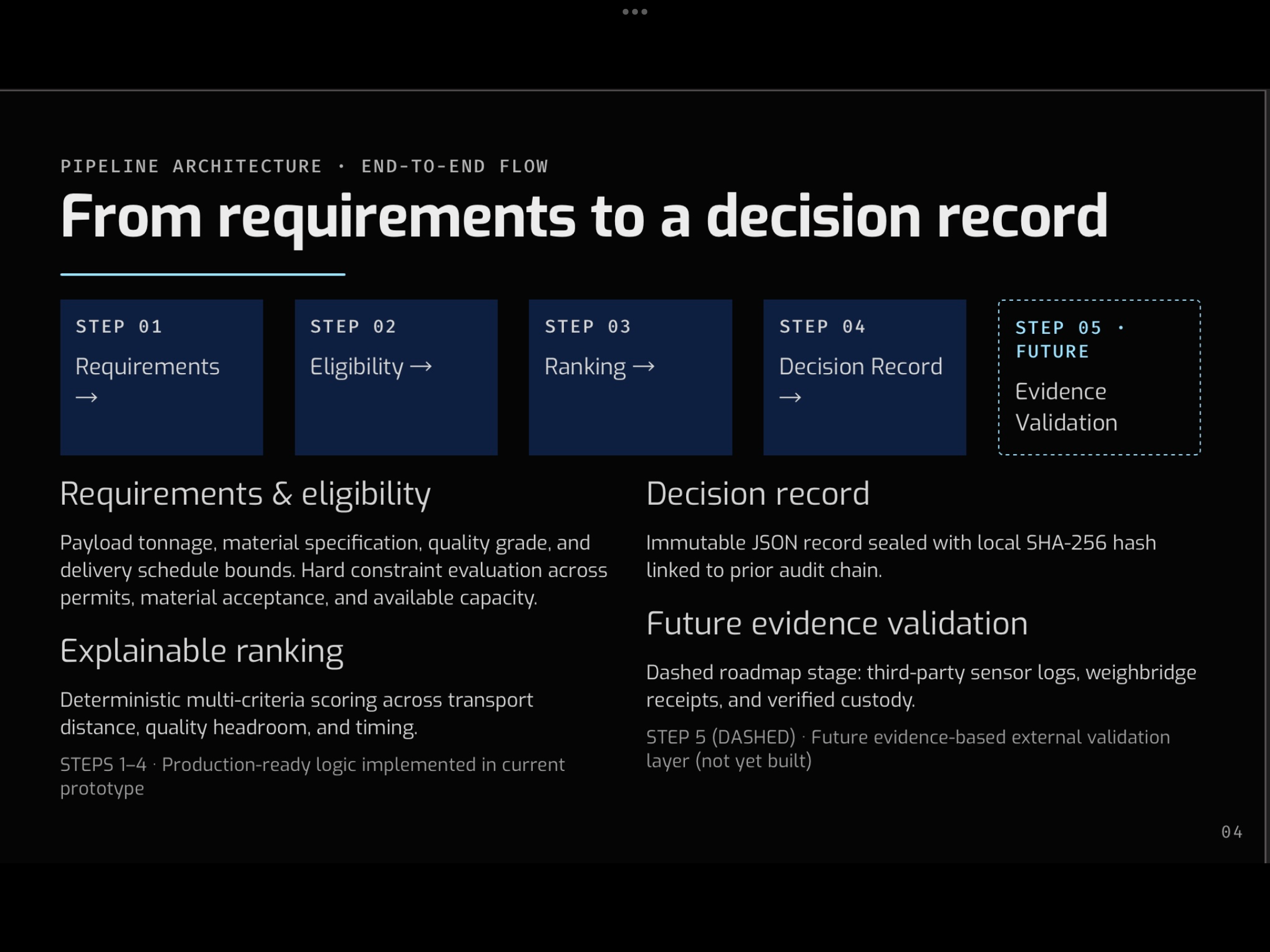
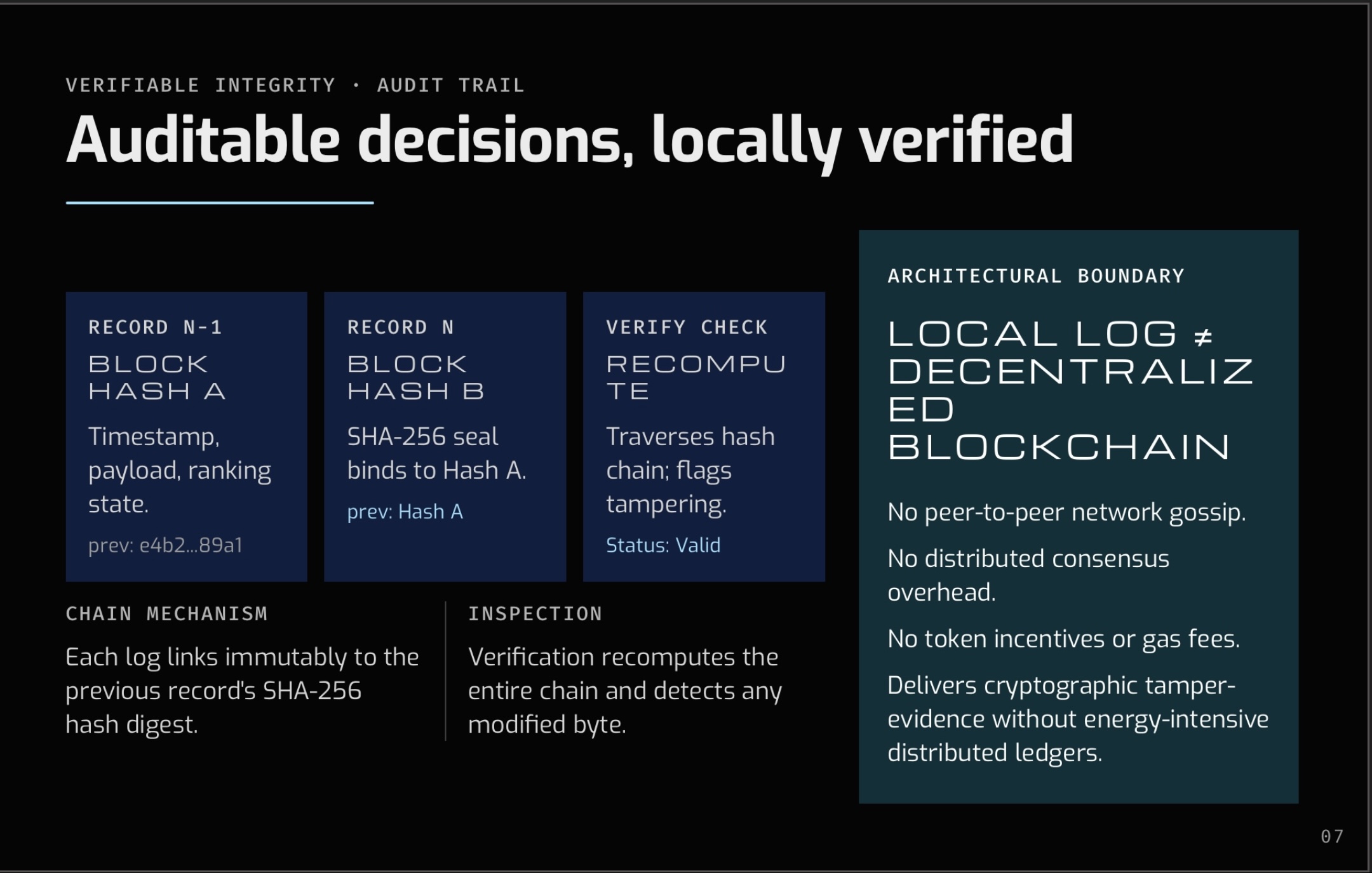
RESERVE also includes a SHA-256 hash-chained audit log and a verification workflow designed to help detect changes to recorded decision events. A Solidity smart-contract registry prototype explores how decision evidence could be anchored on-chain in a future implementation.
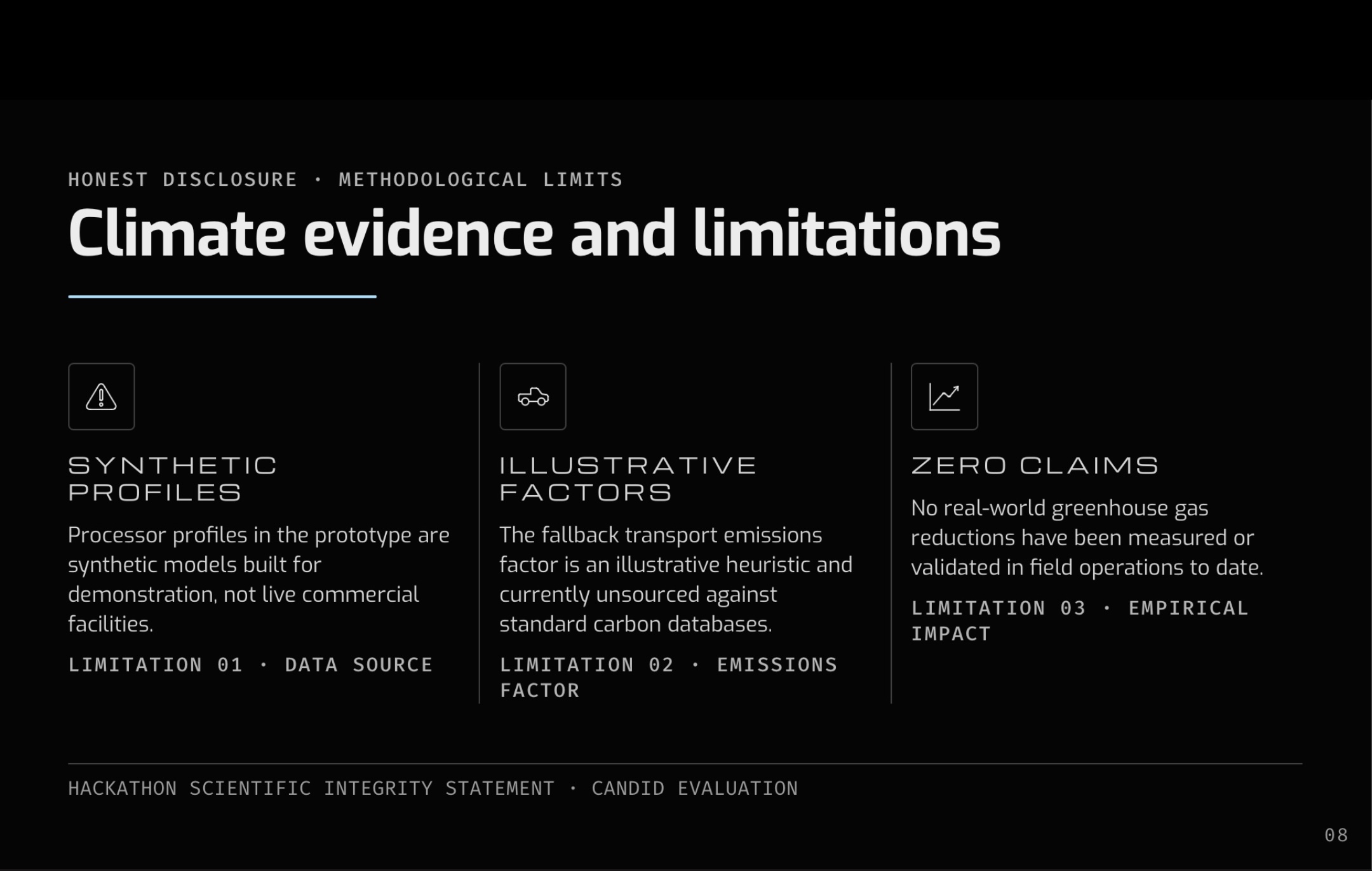
The current application is a proof of concept, not a validated operational routing service. Its processor profiles are fictional, its fallback transport-emissions factor is illustrative and unsourced, and its emissions estimates do not demonstrate measured or verified climate savings.
How we built it
RESERVE was developed as a web application using Python, Flask, JavaScript, HTML, and CSS. The backend applies eligibility rules, evaluates candidate processors, calculates illustrative transport-emissions estimates, and produces structured decision results. The frontend presents these results through an interactive simulator, including processor exclusions, ranking explanations, and the assumptions underlying the recommendation.
The project incorporates a deterministic multi-criteria decision-support model with visible weights for transport-emissions estimates (45%), quality margin (20%), capacity headroom (20%), and delivery-window fit (15%). These weights are configurable decision parameters, not learned model coefficients. The system does not currently use a trained machine-learning model.
To support auditability, I implemented a local SHA-256 hash-chained event log with a verification endpoint. The repository also contains a Solidity smart-contract registry prototype and Foundry tests. The local audit log is not a decentralized blockchain, and the smart contract has not been deployed to a public or test network or integrated with live on-chain transactions.
The application is publicly deployed, allowing reviewers to explore the prototype without installing it locally. The public repository includes automated Python and Solidity testing workflows, documentation of the emissions methodology and factor provenance requirements, a pilot data dictionary, and a proposed evaluation protocol.
The emphasis throughout development has been on making the system's reasoning inspectable and separating implemented functionality from capabilities that still require deployment, data, or validation.
Challenges we ran into
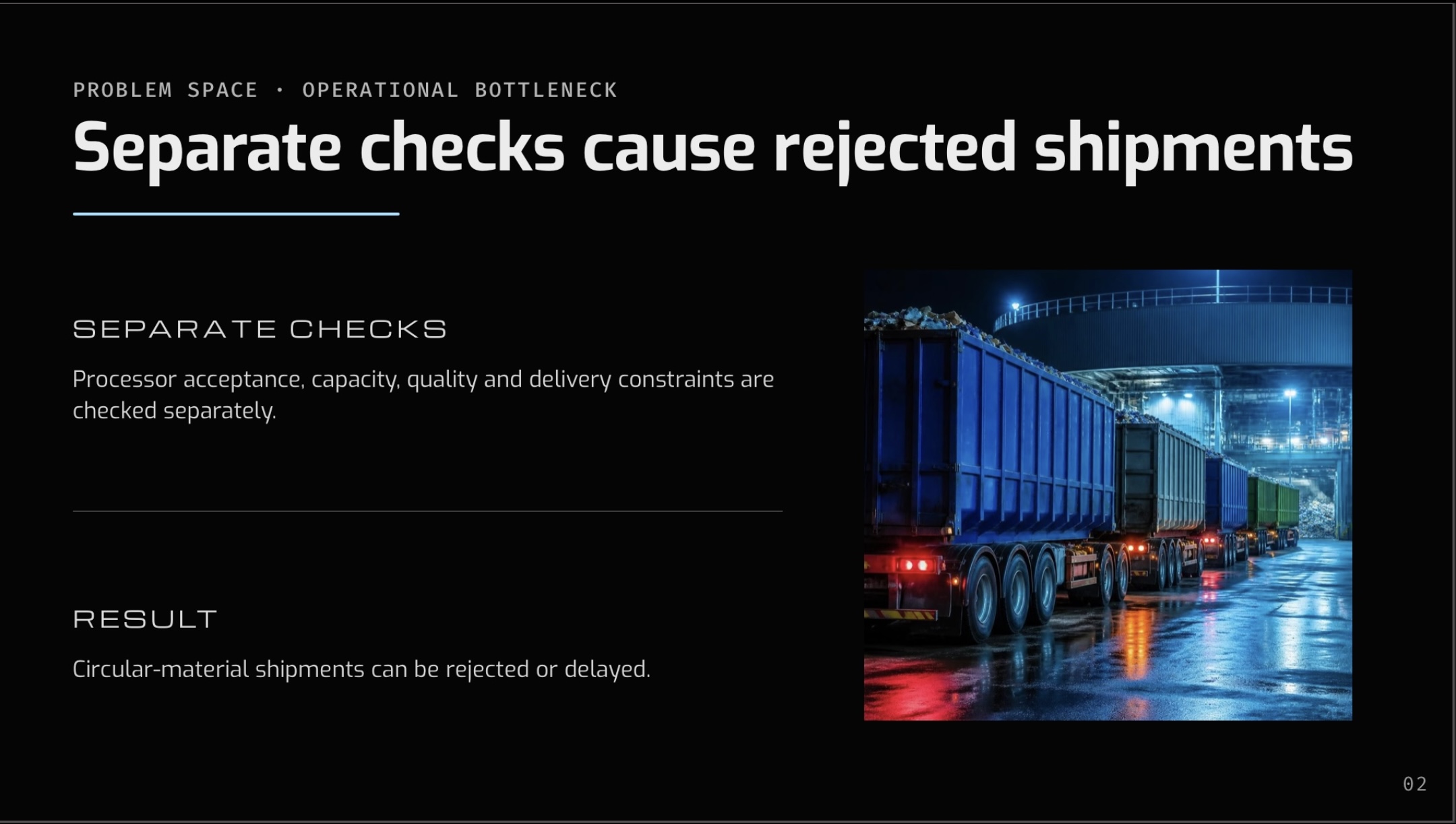
One major challenge was designing a decision process that was more useful than simple distance-based routing without making the system unnecessarily complicated. Distance alone cannot establish whether a processor can accept a shipment or meet its operational requirements. RESERVE therefore separates eligibility screening from the ranking of feasible alternatives.
A second challenge was making the recommendation explainable. A ranked list by itself does not tell a user why an apparently attractive destination was rejected. Showing exclusion reasons and decision criteria makes the result easier to inspect and challenge.
Deployment and reliability were also important. The project needed to be accessible as a working application rather than remain a local prototype or a set of presentation screenshots. Automated testing and public deployment helped establish a reproducible starting point for further development.
The most significant remaining challenge is data quality. Reliable routing requires current processor acceptance rules, available capacity, shipment requirements, transport activity, and emissions factors with traceable sources. Without those inputs, a system can demonstrate its logic but cannot establish real-world environmental performance.
Accomplishments that we're proud of
I'm proud that RESERVE has progressed from an initial idea to a publicly accessible, interactive prototype with a documented technical architecture.
The project demonstrates an end-to-end workflow: evaluate a shipment, screen candidate processors, explain exclusions, rank eligible alternatives, and record decision evidence. Its example scenario makes the practical value of eligibility-first decision-making understandable without requiring a complex explanation.
I'm also proud of the project's evidence-first approach. The repository includes automated tests for the Python application and Solidity registry, alongside documentation covering emissions assumptions, factor provenance, pilot data requirements, and evaluation methodology.
Equally important, RESERVE explicitly distinguishes its current capabilities from its future ambitions. It does not present fictional data as operational evidence, an illustrative emissions estimate as verified climate impact, or a local audit log as decentralized blockchain infrastructure.
That distinction is central to building a tool that could eventually be evaluated responsibly in real supply chains.
What we learned
Building RESERVE reinforced three important lessons.
First, feasibility must come before optimization. A destination cannot be the best operational choice if it cannot accept or process the shipment, regardless of how close it is.
Second, explainability is part of useful decision support. Showing why a processor was excluded can be as important as identifying the highest-ranked eligible option, especially when decisions affect costs, delivery commitments, and material recovery.
Third, climate-aware decision-making requires evidence, not just estimates. A credible assessment needs traceable transport activity, appropriate emissions factors, a defensible baseline, and an evaluation that accounts for uncertainty. A modeled difference is not equivalent to a measured reduction.
These lessons have shaped both the current prototype and the proposed path toward real-world evaluation.
What's next for RESERVE — Climate-Aware Resource Routing
The next phase is to move from a synthetic demonstration toward controlled evaluation using realistic operational data.
Priorities include:
- Data validation: Obtain permission to use real processor acceptance criteria, available capacity, shipment records, and delivery outcomes.
- Emissions methodology: Replace the illustrative fallback factor with traceable, scenario-appropriate emissions factors and document the assumptions, boundaries, and uncertainty.
- Baseline comparison: Define a fair baseline and compare RESERVE recommendations with existing routing practices using consistent constraints.
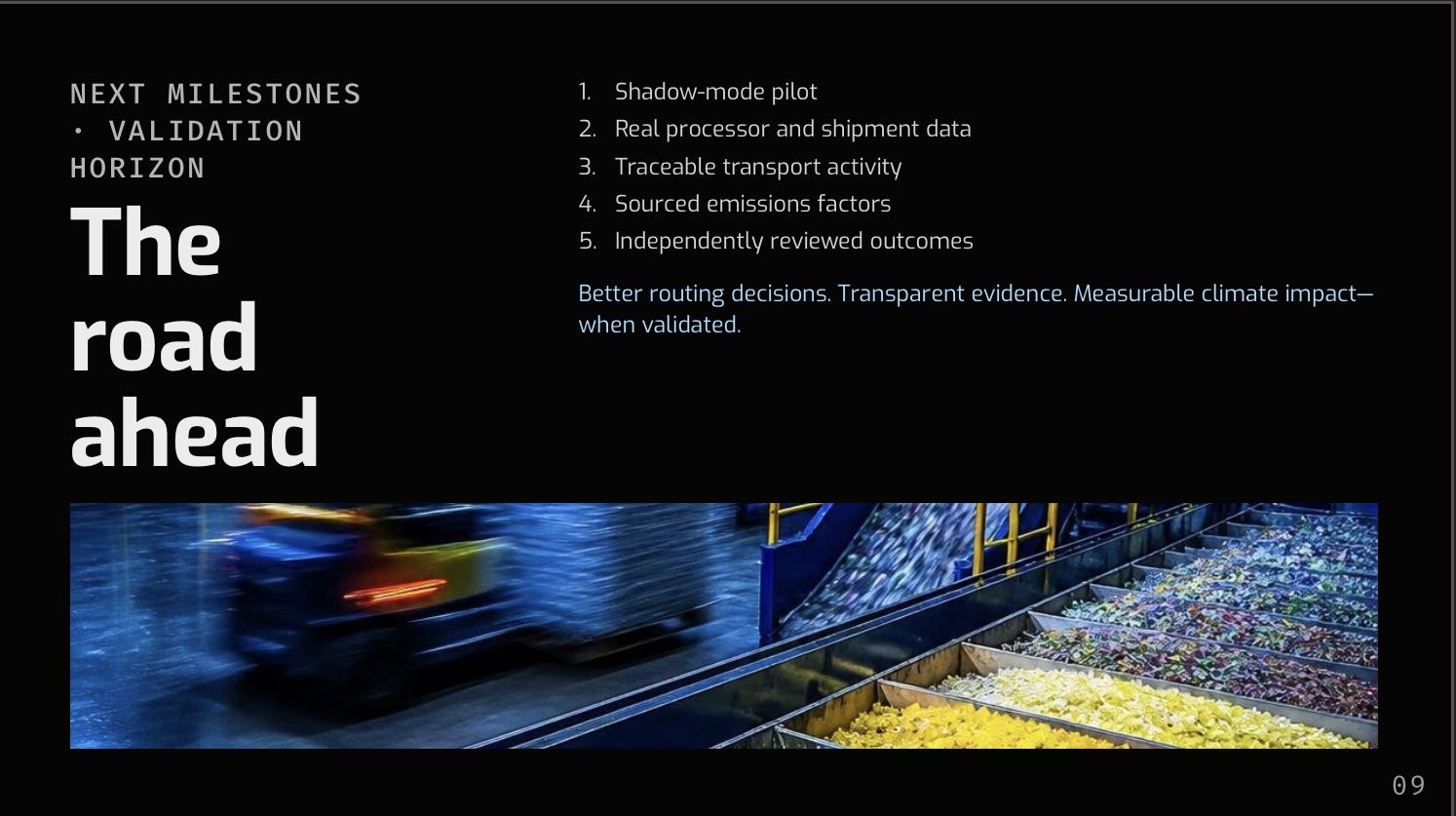
- Shadow-mode pilot: Generate recommendations alongside normal operations without controlling dispatch, then evaluate feasibility, rejection rates, delivery performance, and estimated emissions.
- Audit and ledger development: Strengthen the evidence workflow and assess whether deploying and integrating the smart-contract registry provides a meaningful benefit beyond the existing local audit log.
- Independent evaluation: Review the methodology and results before making claims about operational improvements or emissions reductions.
The longer-term objective is to determine whether eligibility-first, explainable routing can support more reliable circular-material logistics and improve the quality of evidence behind climate-related decisions.
RESERVE is a starting point, not a claim of proven environmental impact. Its next milestone is to test the approach against real constraints and trustworthy data, then report what the evidence actually supports.
Better routing decisions. Transparent evidence. Measurable climate impact—when validated.
Built With
- api
- circular
- climate
- css
- decision
- economy
- flask
- html
- javascript
- python
- rest
- sustainability
- tech

Log in or sign up for Devpost to join the conversation.