-
-
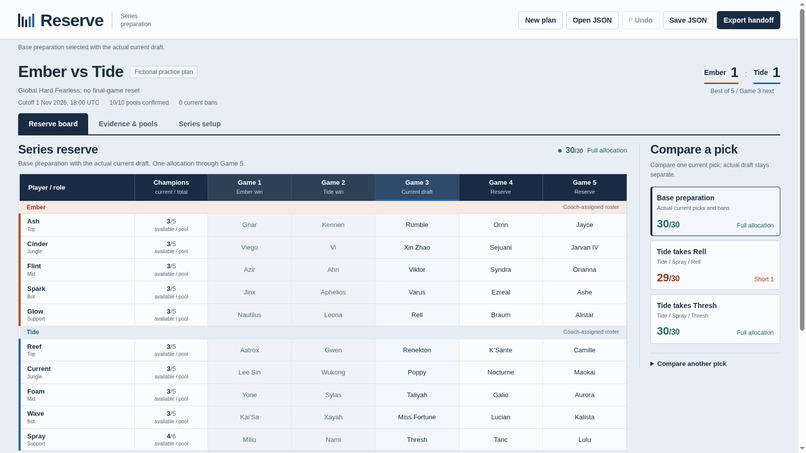
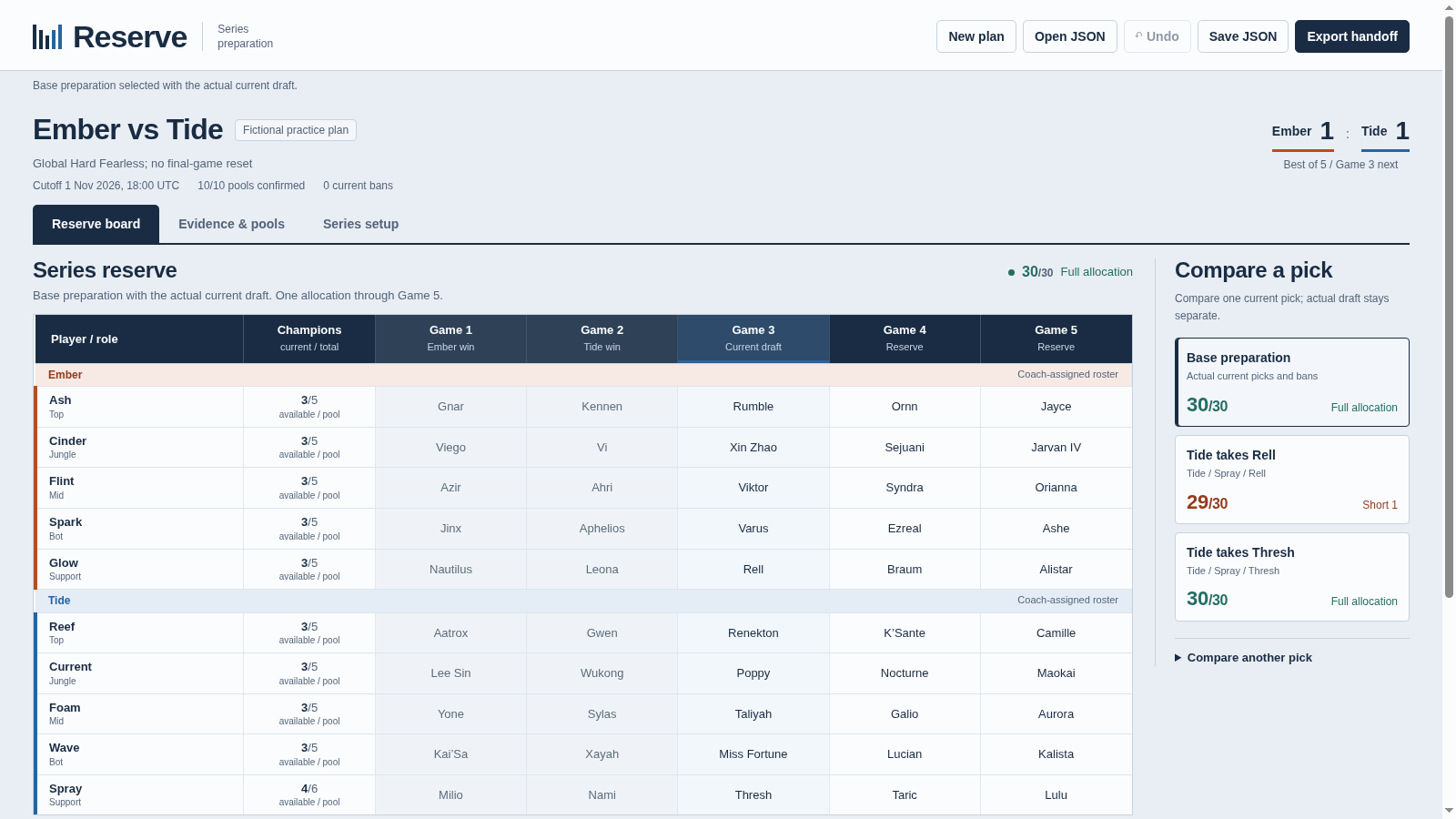
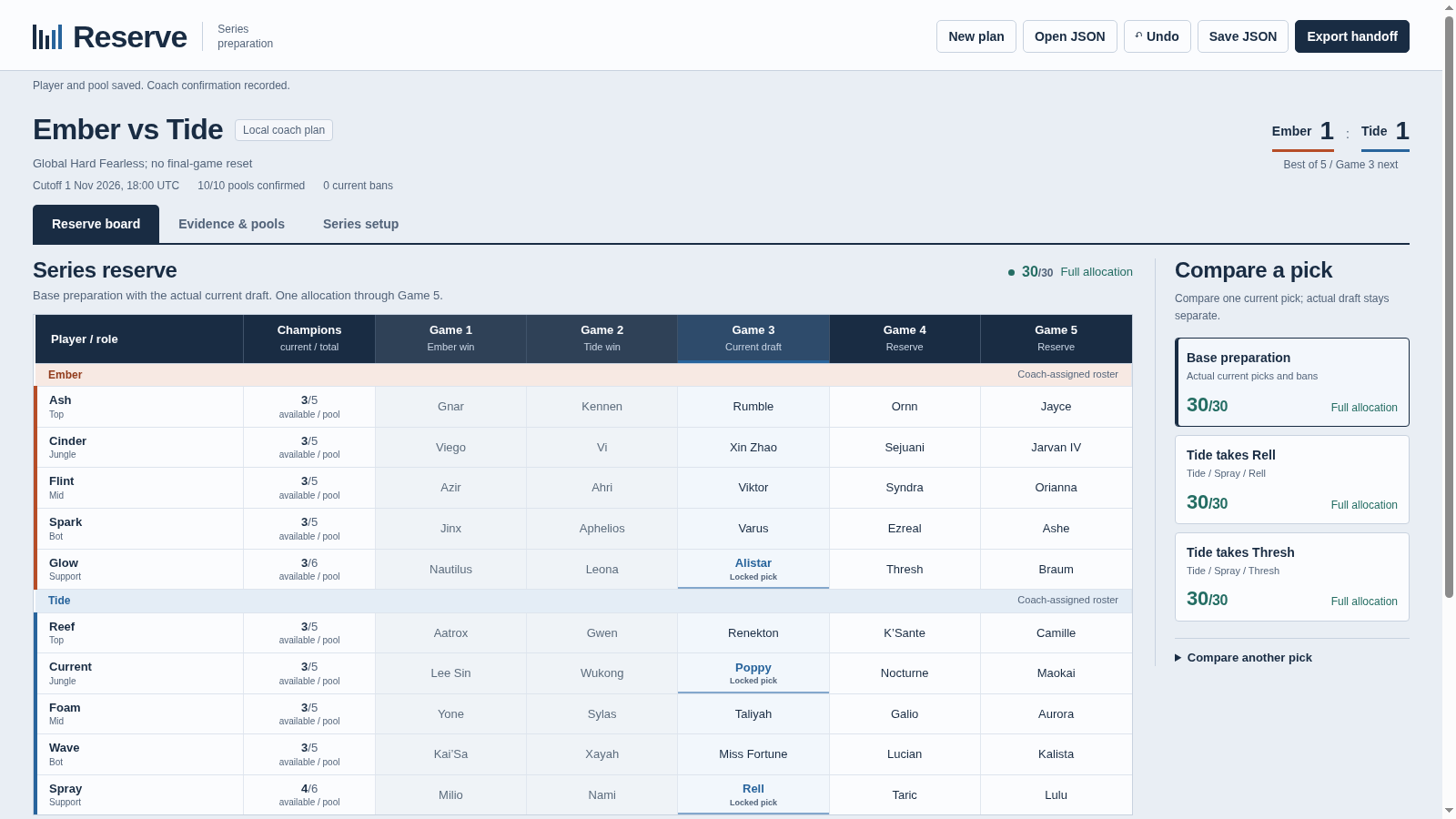
Fictional full-series preparation: confirmed pools, recorded games and Rell 29/30 versus Thresh 30/30.
-
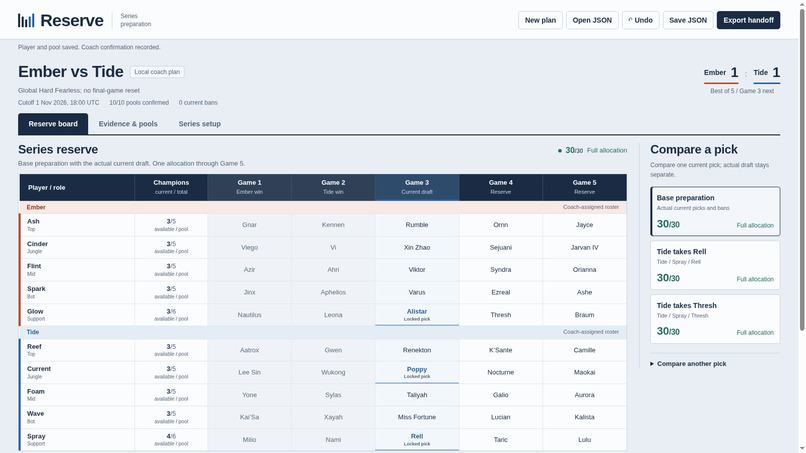
Same three fictional locks; assumed-approved Thresh extra restores joint 30/30.
-
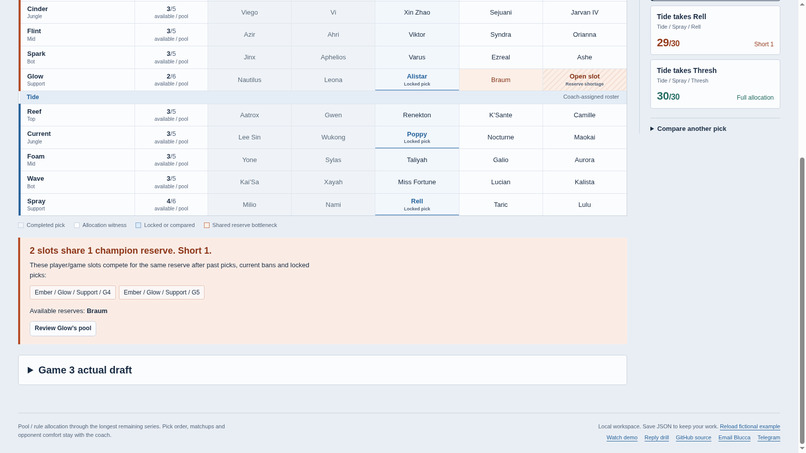
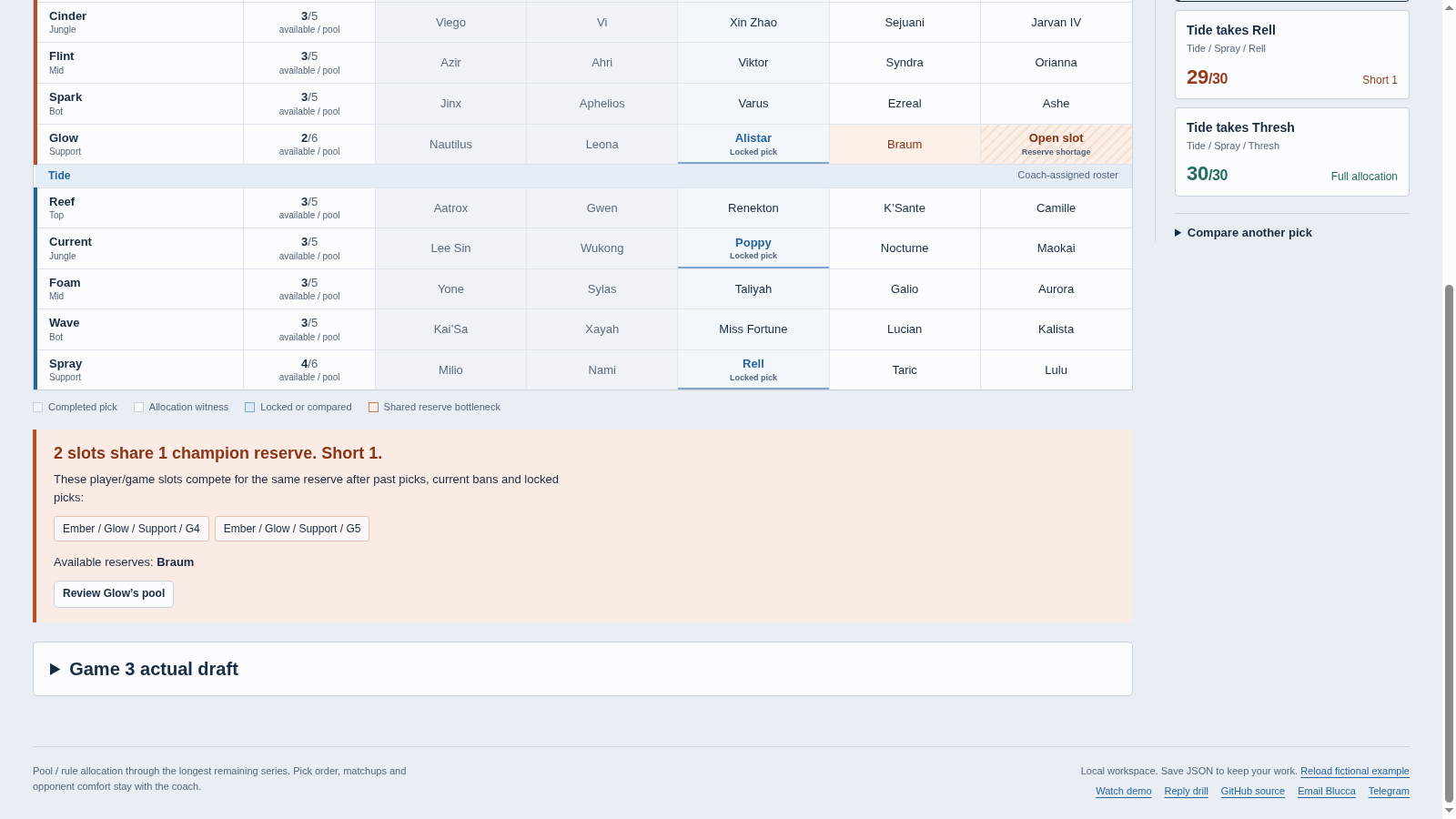
Fictional complete reply turn: Alistar + Rell + Poppy locked; assumed-approved Poppy extra leaves Glow's two future slots sharing Braum.
Inspiration
What it does
How we built it
Challenges we ran into
Accomplishments that we're proud of
What we learned
What's next for Reserve
Inspiration
Plan the whole series. Competitive League of Legends coaches need to connect scouting evidence, playable champion pools and the current draft before Fearless shrinks their options in Games 3–5. A spreadsheet can show enough champions for every player while the two teams share too few options to finish the series. Reserve makes that shared bottleneck visible and keeps the complete preparation ready for a teammate.
What it does
Open the complete free workspace — no installation or account. Start with the fictional practice plan, or import your own permitted evidence. Review observations, confirm playable pools and the league rule, record completed games and current picks/bans, compare specific choices, and inspect an allocation or the exact shortage. Save JSON to resume the complete preparation; export Markdown to hand it to a teammate. Files and calculations stay in the browser.
Watch the complete real-run demo (2:36). The current recording includes the full preparation and a second fictional drill: the same three current locks stay fixed while changing an assumed-approved pool extra from Poppy to Thresh changes 29/30 to 30/30.
Methodology
https://github.com/blucca/series-reserve/blob/main/docs/method.md
Reserve connects earlier evidence to coach-confirmed pools, records the series and current draft, and checks whether all ten players can fill the longest remaining series under global Hard Fearless. A compared pick fills its current slot and consumes its champion across the shared reserve. Exact matching returns one checkable allocation; a shortfall identifies the specific player/game slots sharing too few options. Current bans stay local to that game. JSON preserves the complete preparation and evidence; Markdown provides a readable teammate handoff.
The existing lock-and-compare workflow also prepares our current pick against the opponent’s first single reply and complete immediate two-pick turn. A complete fictional drill compares two first picks that initially both fill 30/30: taking the shared reserve first preserves 15/15 own-team capacity through the available first replies and complete two-pick turn; the other pick permits a reply leaving 14/15 and identifies the two affected future support slots. The original runnable comparison and browser walkthrough retain the declared fictional pools: https://github.com/blucca/series-reserve/blob/main/docs/first-reply.md. Tactical candidates and player bindings stay explicit coach choices. The public demo page includes two ready-to-open fictional preparations for that complete turn, with saved current locks and explanatory notes: https://blucca.github.io/series-reserve/demo.html#reply-drill. Open JSON restores the recorded actual draft on Base preparation.
Keeping Glow’s Alistar first, the same engine compares the original pool with one extra assumed coach-approved and stage-ready for the fictional exercise. Each fixed declared pool condition has 102 legal complete immediate consecutive two-pick states: the original has 12 Ember shortages; Thresh gives joint 30/30 throughout; Poppy leaves one Ember shortage and 11 other states with Ember 15/15 and joint 29/30. Poppy’s single Rell reply has a mixed five-slot/four-reserve Hall certificate; Rell plus Poppy leaves Glow’s two future slots sharing Braum. Counts are unweighted, and the independent Ember bound relaxes Tide’s free future demands. Existing pool confirmation and current-draft locks reproduce these states; coaches update the preparation for later games, actions and bans.
The public practice plan is fictional. One registered-participant experiment on Cloud9 vs LYON (3 October 2026, LCS Split 3 Playoffs) uses the public adapter and engine, the official 2026 league rule, stated observation-derived pools, and only the known Game-3 draft prefix. It produces 29/30 for a shared-champion choice versus 30/30 for the control. Licensed records remain outside the public repository. Long-term users bring their own permitted data and playable-pool judgment.
Full method and validation. The allocation answers distinct champion capacity under the recorded rules and pools. Coaches supply playable-pool judgment, player bindings, draft order, matchup quality and future ban scenarios.
How it was built
Original MIT source: github.com/blucca/series-reserve. The local workspace uses native JavaScript modules, HTML and CSS with no backend or build dependencies. A Python core and GRID adapter support separately permitted inputs.
JetBrains PyCharm 2026.3.0.1 performed project inspection of reserve.py, grid_plan.py and check.py using the project's Python 3.12 interpreter and a saved correctness profile. Its optional-value, dictionary-member and naming findings were reviewed alongside independent matching controls and the complete native preparation task. The IDE completed inspection and exported diagnostic XML. Codex implemented the source and browser workflow; the public repository retains runnable checks.
Challenges and checks
The native starter leaves roles empty, and current draft events identify a team rather than the final player. The adapter keeps current player binding and roles as explicit coach choices and uses a strict historical cutoff. Pool observations and coach confirmation remain separate. The official LCS rule consumes both teams' prior picks through Game 5 and keeps ordinary bans local to their game.
Independent Python and JavaScript checks compare all 64 small three-slot graphs with a separate exhaustive oracle, validate every allocation edge and complete Hall-neighbor set, and cover forced choices, shared pools and per-game bans. A complete Chromium task imports CSV, confirms pools, records games, compares and locks picks, downloads JSON/Markdown, and restores an equal saved preparation. A first-use handoff test surfaced the wrong comparison on Open JSON; the single entry point now restores the recorded actual draft on Base preparation.
Accomplishments and what was learned
The complete public workspace, runnable checks, current real-run film, methodology and saved fictional reply drills are finished. The immediate-turn study made a useful distinction visible: a joint allocation can remain full before an opponent reply yet leave one team's future slots short after it. Reusing the same engine and explicit pool choices makes the next preparation decision checkable.
AI-powered workflow story
Building Reserve with Codex and PyCharm explains AI-assisted implementation, schema decisions, independent checking, IDE inspection and the handoff fix. The demo uses real browser actions with fictional inputs and synthesized narration.
Current status and next steps
Built and publicly accessible. Professional external pool approval, own Run, repeat use and orders are currently zero. Next is a coach's own permitted pools and actual preparation: check whether the reserve witness changes a pick, a pool decision or verification time, then improve the workflow around that concrete task.
Built With
- css3
- html5
- javascript
- playwright
- pycharm
- python
