-
AI
Inspiration
ResearchPilot AI was inspired by the everyday struggles of students, researchers, educators, startups, and innovators who spend countless hours searching for reliable research papers, understanding complex technical content, organizing references, and identifying meaningful research gaps. Traditional research workflows are often fragmented across multiple tools, making the process slow, repetitive, and inefficient. We envisioned a single AI-powered platform that could simplify the entire research journey—from discovering relevant literature to generating summaries, finding citations, analyzing trends, and suggesting innovative project ideas. Our goal is to reduce the time spent on manual tasks so users can focus on creativity, experimentation, and impactful innovation. By combining modern AI technologies with an intuitive interface, ResearchPilot AI empowers anyone to conduct smarter, faster, and more efficient research regardless of their experience level.
What it does
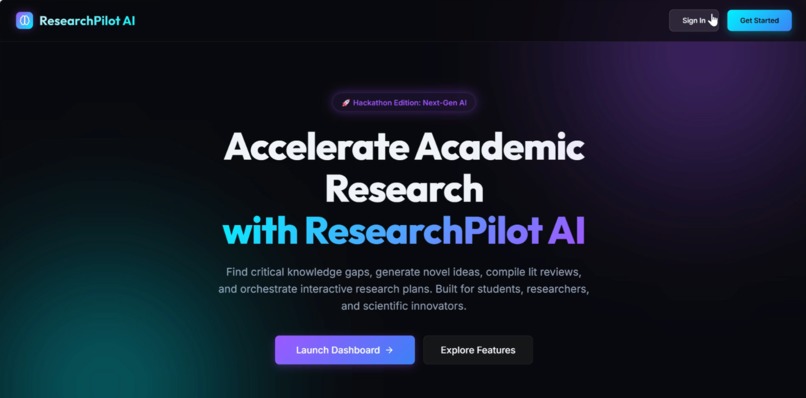
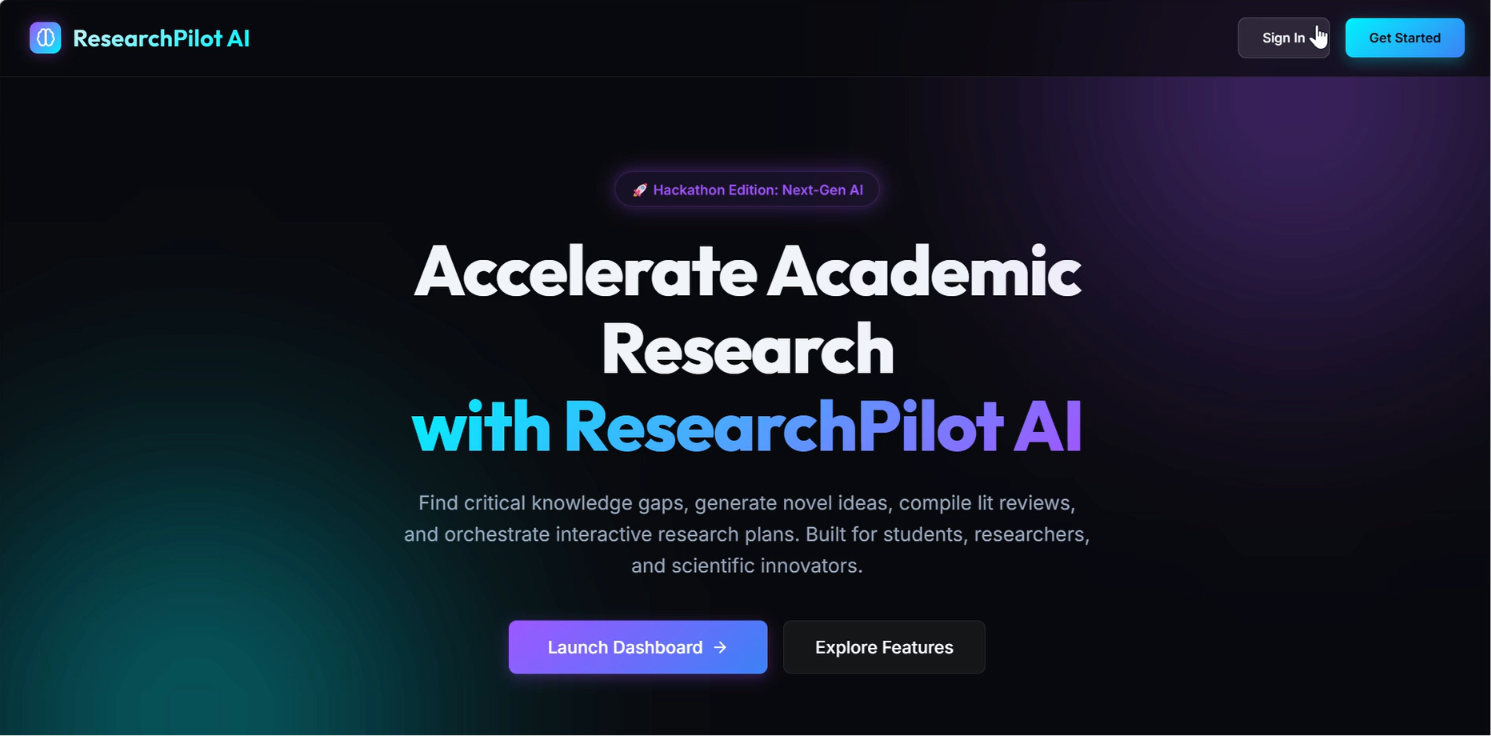
ResearchPilot AI is an intelligent research assistant that streamlines every stage of the research process. Users can search for research papers using natural language, receive AI-generated summaries, generate literature reviews, discover related publications, identify research gaps, and receive credible citation recommendations in multiple formats such as APA, MLA, and IEEE. The platform also provides AI-powered project idea generation based on current research trends and emerging technologies. Users can organize bookmarks, save research history, compare papers, and generate structured reports for academic or professional use. Whether preparing a thesis, building a startup idea, writing a technical report, or exploring a new field, ResearchPilot AI acts as a comprehensive companion that increases productivity while maintaining research quality.
How we built it
We built ResearchPilot AI using a modern full-stack architecture designed for scalability and performance. The frontend was developed with React.js, Tailwind CSS, and responsive UI components to deliver a clean and intuitive user experience. The backend was built using Node.js and Express.js, while MongoDB was used to securely manage user data and research history. AI capabilities were integrated using advanced Large Language Models for summarization, literature review generation, research gap analysis, and intelligent recommendations. APIs were connected to retrieve academic research content, while vector search and semantic search techniques improved result relevance. Authentication, cloud deployment, and optimized API communication ensured secure, fast, and reliable performance throughout the platform.
Challenges we ran into
One of our biggest challenges was delivering accurate and relevant research results without overwhelming users with excessive information. Integrating AI responses with authentic academic sources while reducing hallucinations required careful prompt engineering and validation techniques. Handling long research papers efficiently within token limits and generating concise yet informative summaries was another technical challenge. We also focused on creating a user-friendly interface capable of displaying complex research data in a simple and interactive manner. Optimizing API performance, managing response latency, ensuring scalability, and maintaining citation accuracy required multiple iterations, testing cycles, and continuous refinement throughout the development process.
Accomplishments that we're proud of
We successfully developed a working AI-powered research assistant capable of automating multiple stages of the research workflow within a single platform. We are proud of creating features such as intelligent paper summarization, literature review generation, research gap identification, citation recommendations, semantic search, and AI-based project idea generation. The platform significantly reduces manual effort while improving research efficiency and accessibility. We also designed an intuitive interface that enables users with different technical backgrounds to benefit from advanced AI capabilities. Most importantly, we built a solution with real-world value that has the potential to support students, universities, researchers, startups, and innovation teams globally.
What we learned
Building ResearchPilot AI taught us how Artificial Intelligence can meaningfully transform research when combined with thoughtful user experience design. We gained hands-on experience integrating Large Language Models into production workflows, designing scalable APIs, implementing semantic search, and improving AI reliability through prompt engineering and response validation. We also learned the importance of balancing automation with transparency by providing trustworthy citations and explainable outputs. Working as a team strengthened our collaboration, problem-solving, and rapid prototyping skills while reinforcing the value of continuous testing, user feedback, and iterative product development in building impactful AI applications.
What's next for ResearchPilot AI
Our future roadmap focuses on making ResearchPilot AI a complete AI research ecosystem. We plan to integrate live academic databases such as IEEE Xplore, arXiv, PubMed, Springer, and Google Scholar for real-time research discovery. Upcoming features include collaborative research workspaces, multilingual support, PDF-based question answering, AI-powered plagiarism detection, automated research proposal generation, personalized research recommendations, knowledge graphs, voice-based interaction, and offline document analysis. We also aim to introduce citation verification, experiment planning assistance, dataset recommendations, and AI-powered peer review support. Our long-term vision is to become the most trusted AI platform for accelerating scientific research, innovation, and knowledge discovery worldwide.

Log in or sign up for Devpost to join the conversation.