-
-
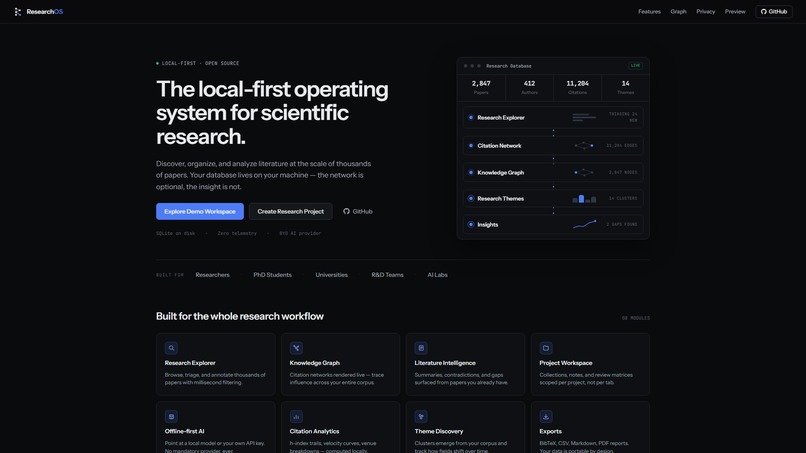
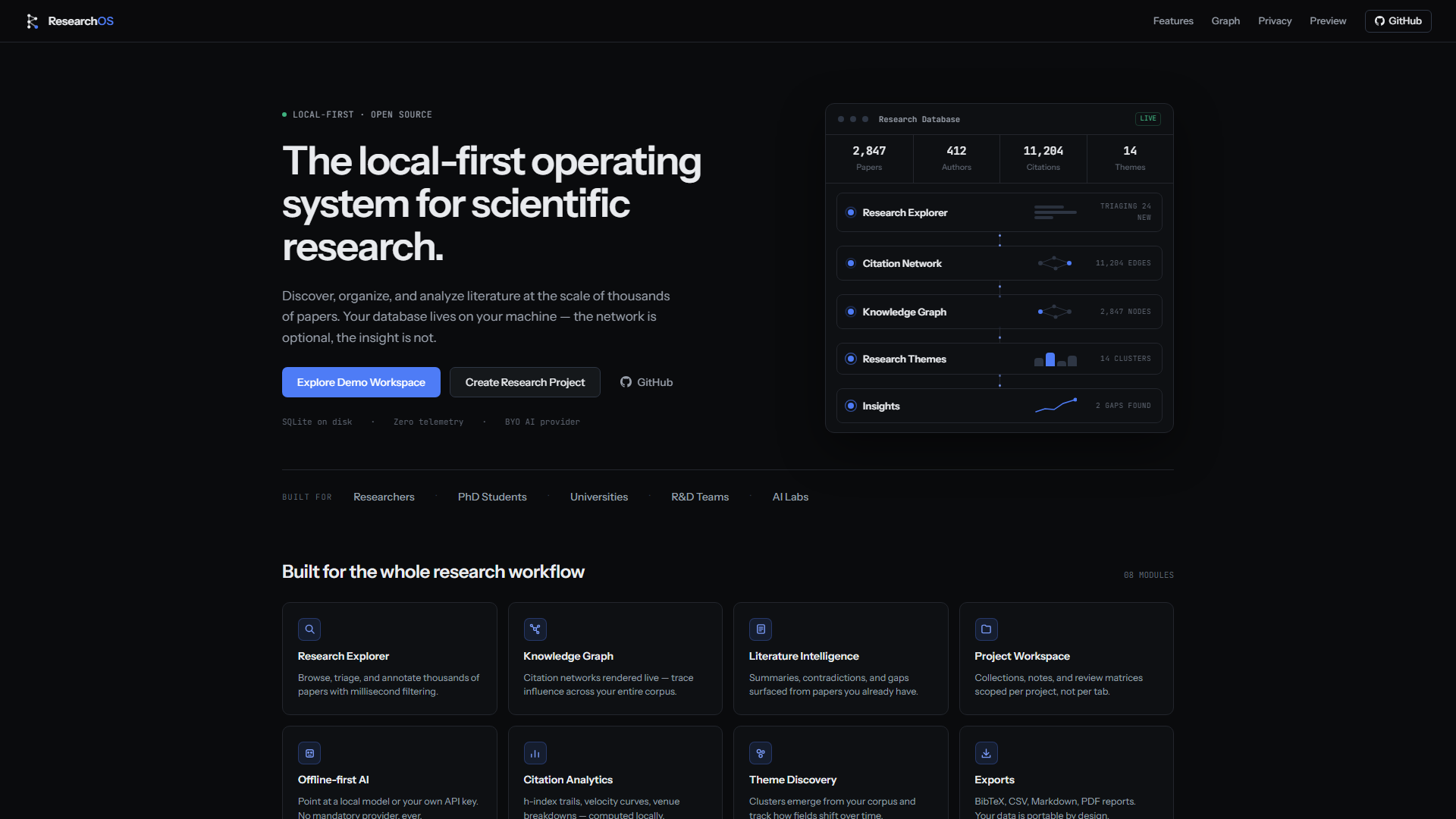
ResearchOS landing page showcasing the local-first AI research workspace.
-
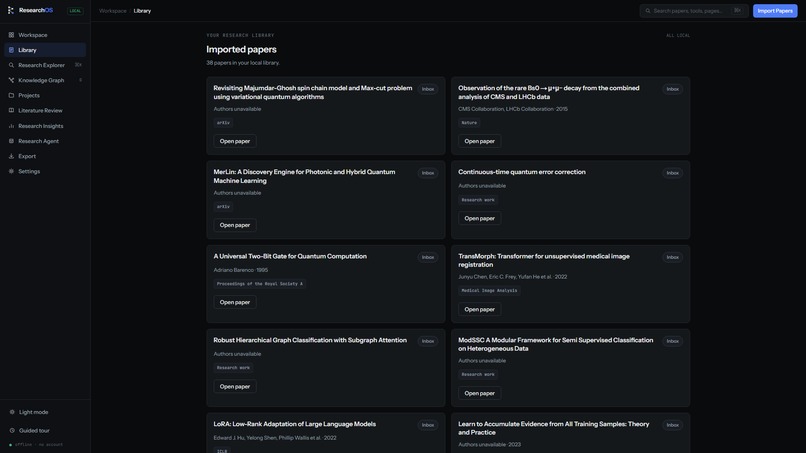
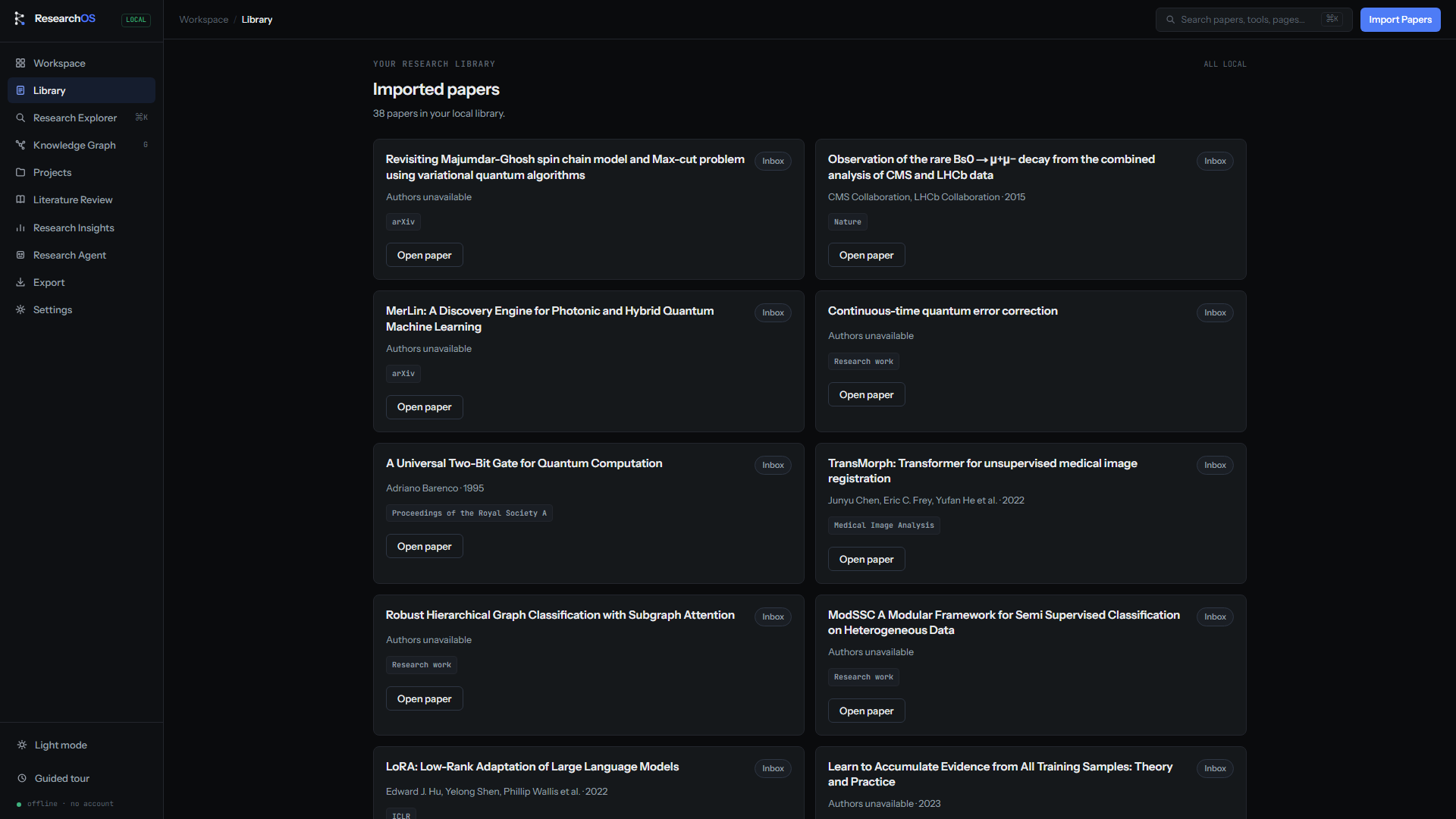
Import, organize, and browse thousands of research papers in a unified local library.
-
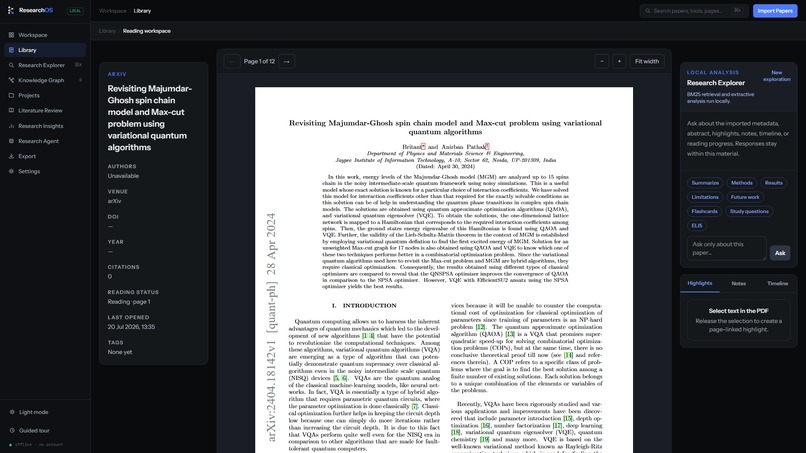
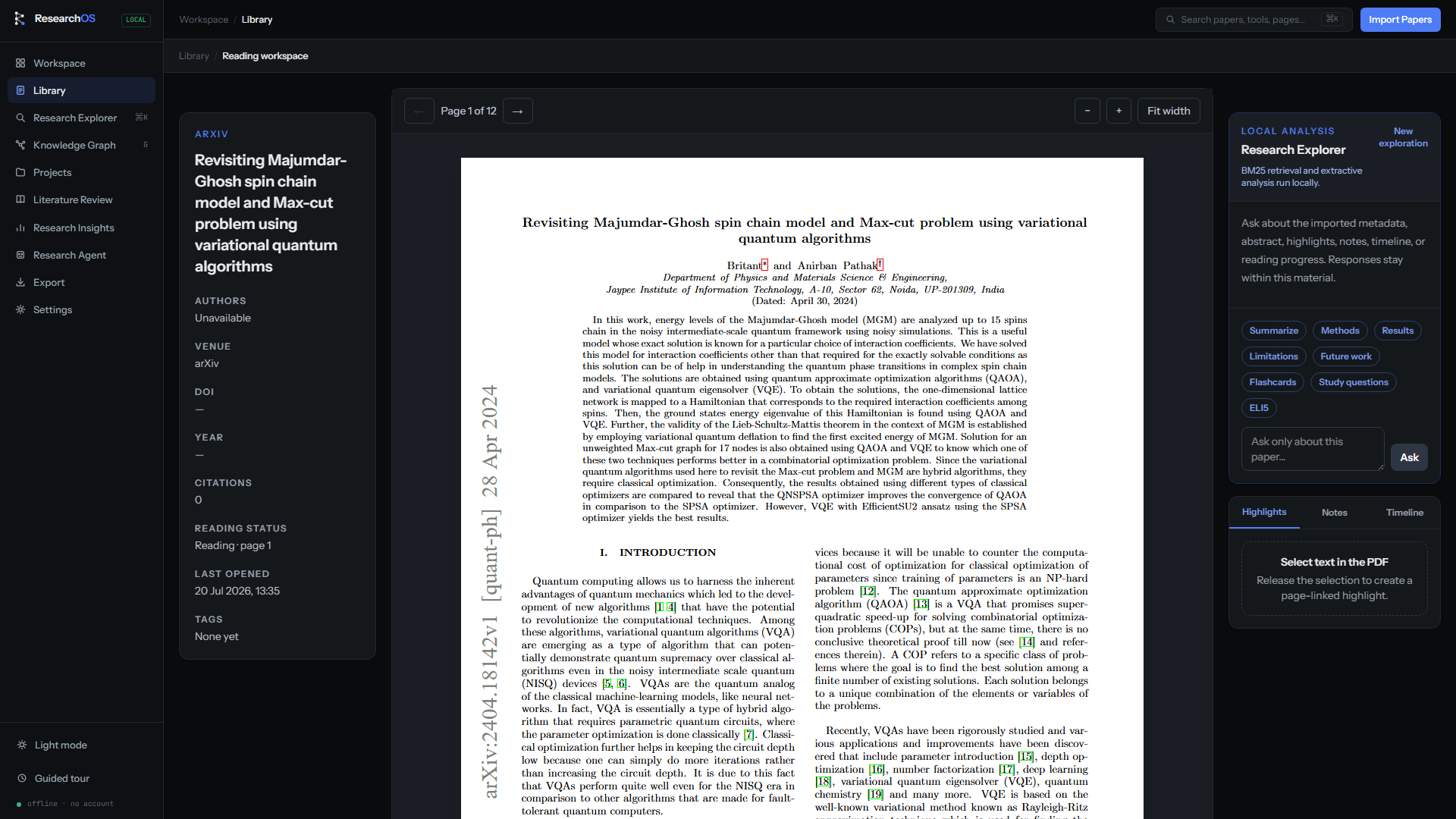
Read, annotate, and interact with research papers using built-in AI assistance.
-
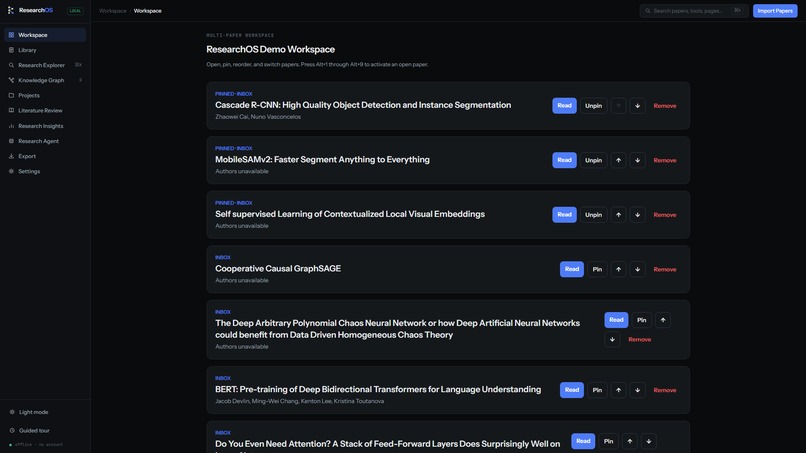
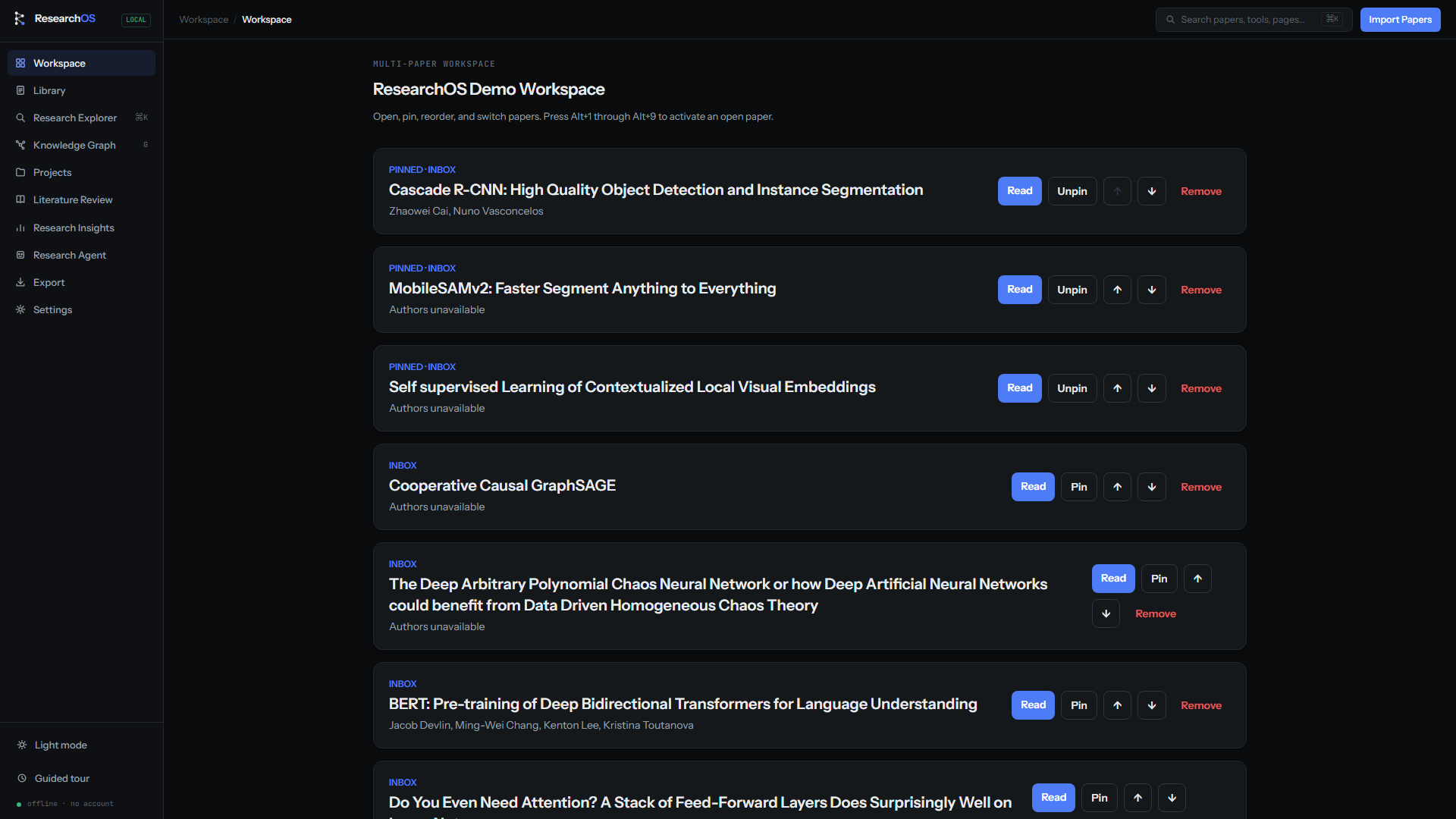
Organize active papers, pin important work, and manage research across multiple projects.
-
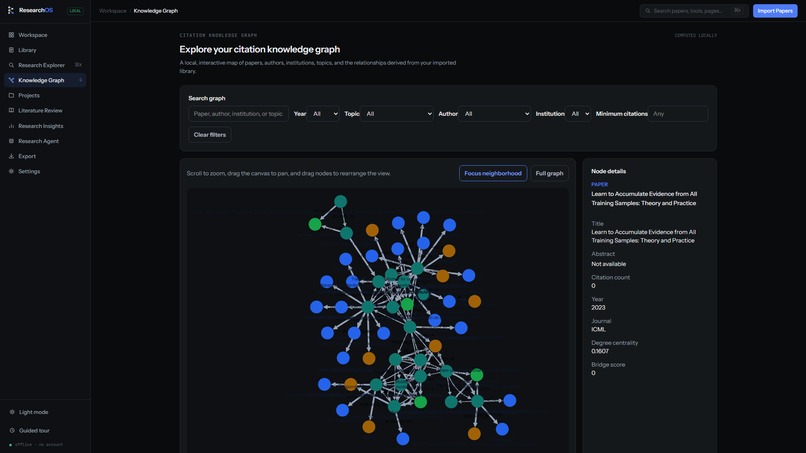
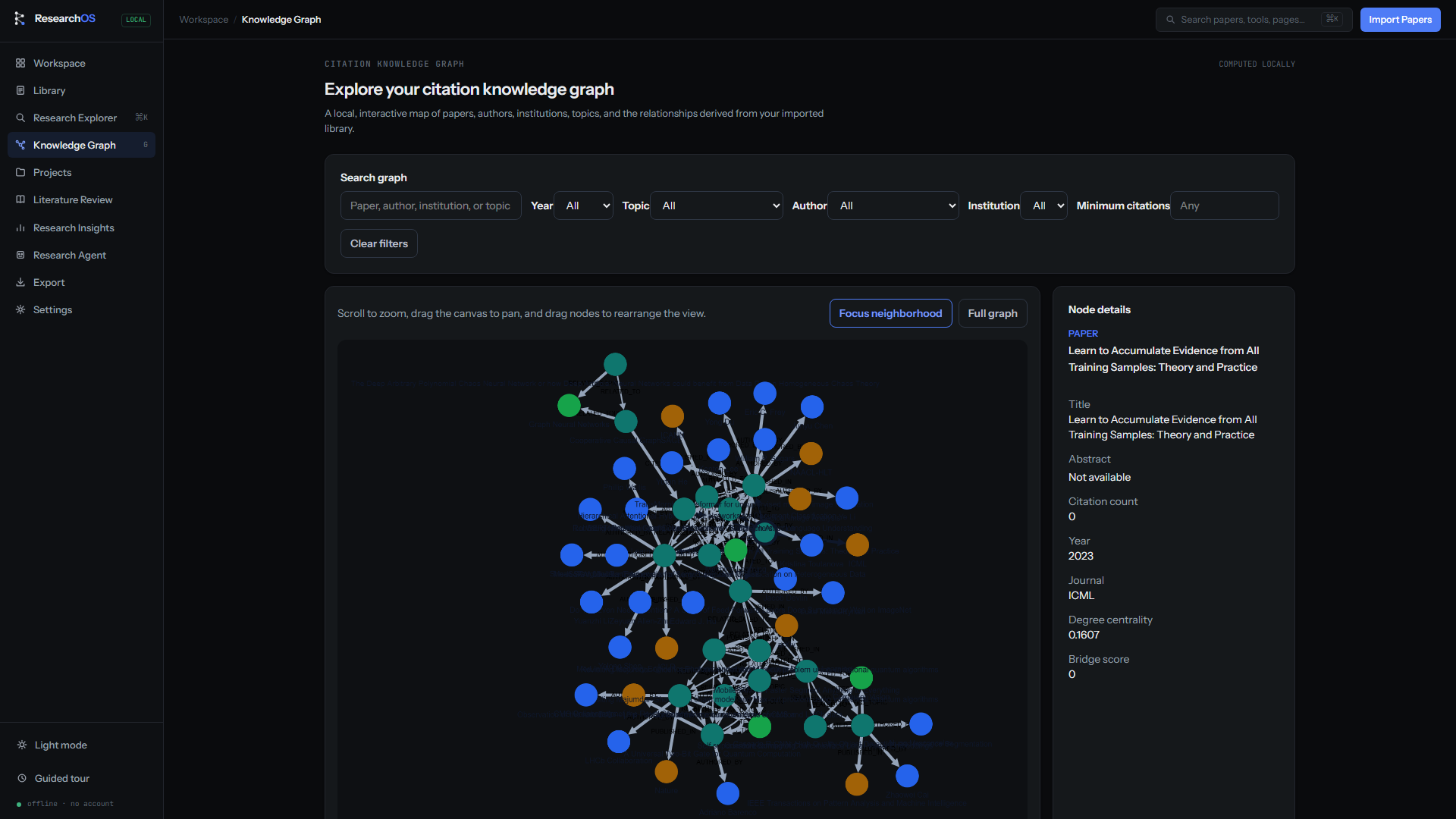
Interactive citation knowledge graph that visualizes relationships between papers, authors, and research topics.
-
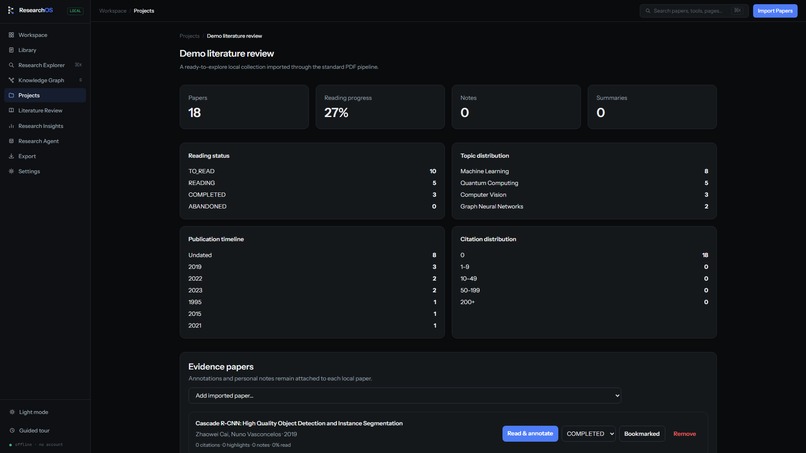
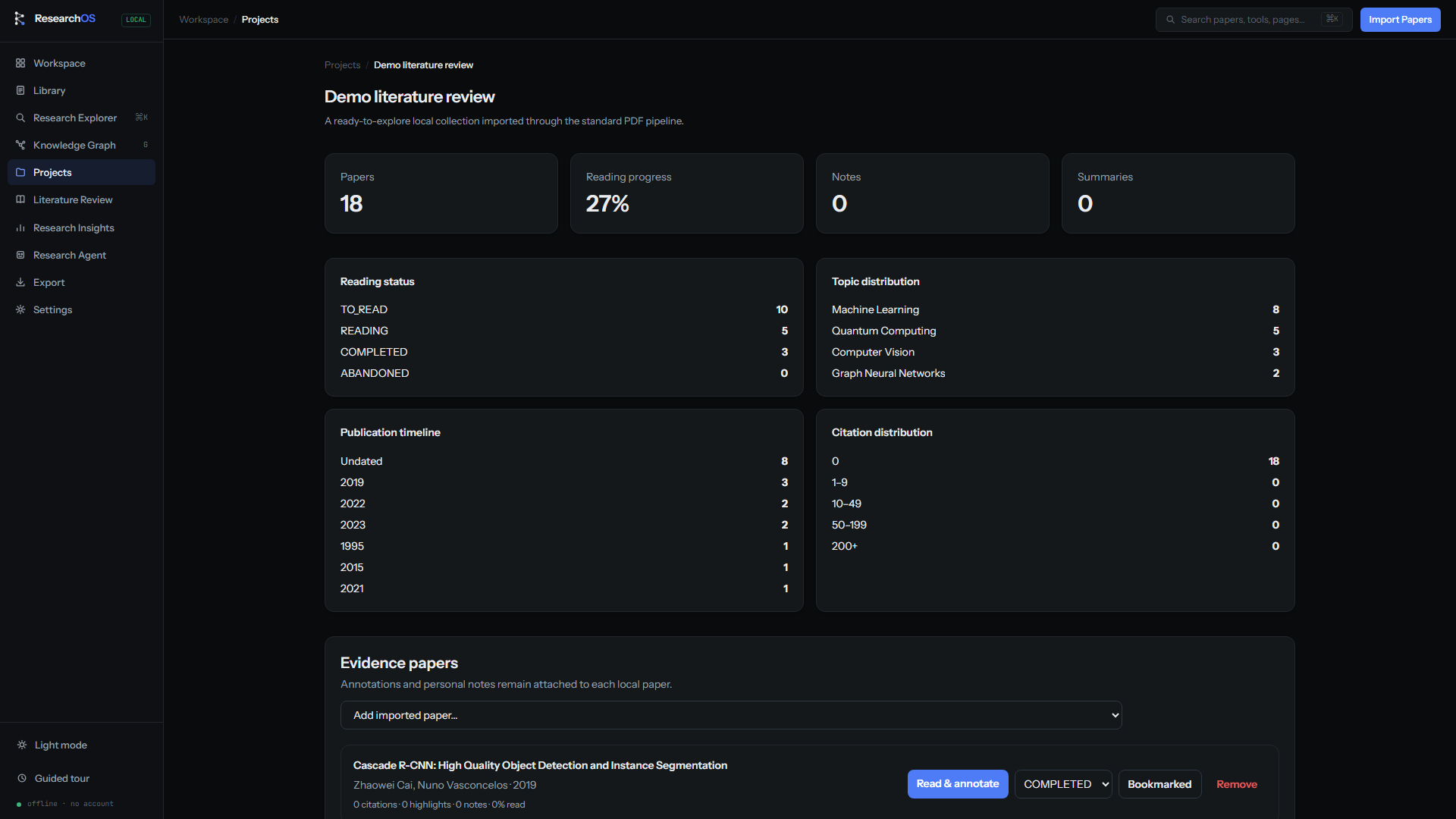
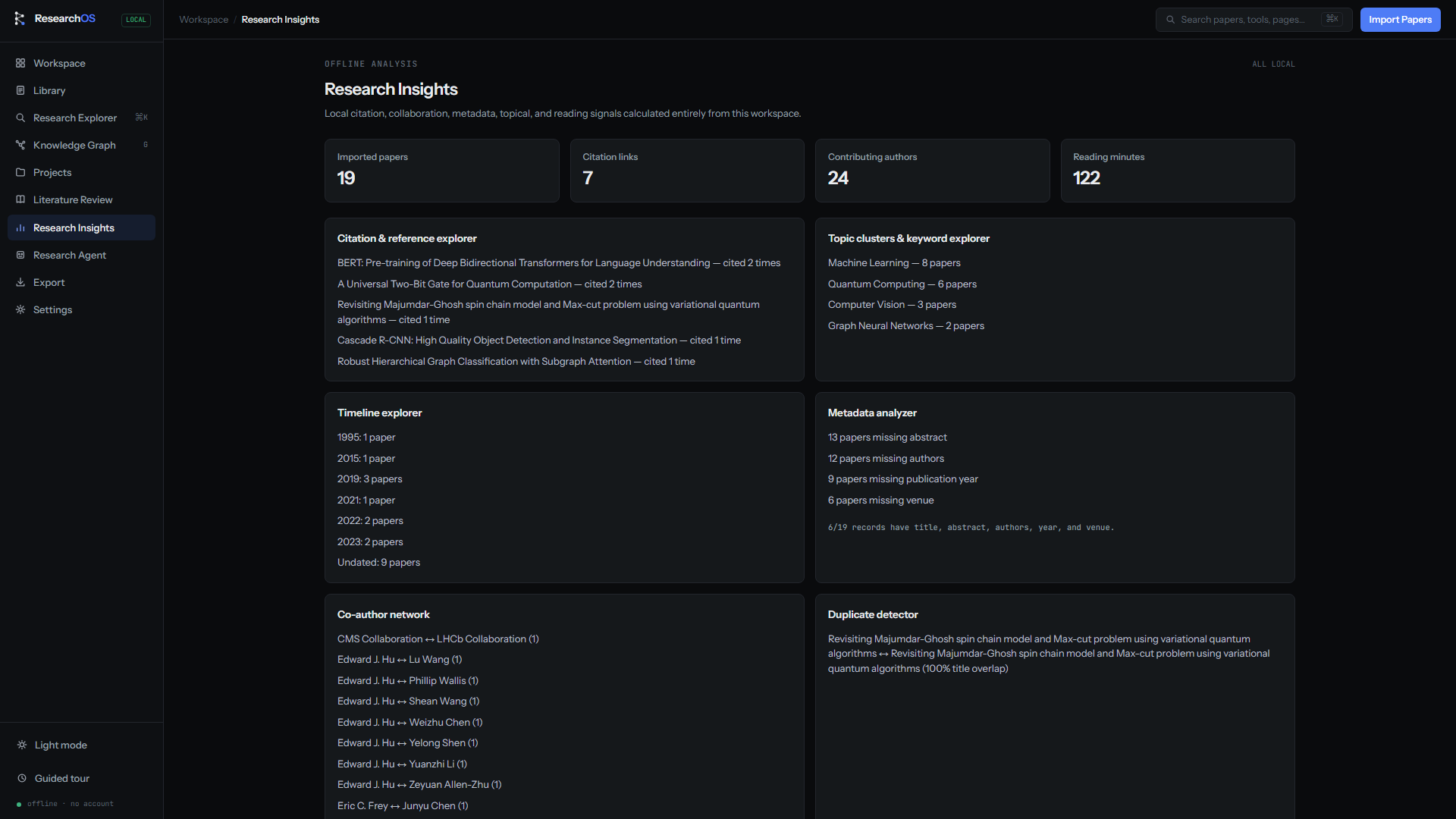
Track literature review progress, reading status, topic distribution, and project insights from a single dashboard.
-
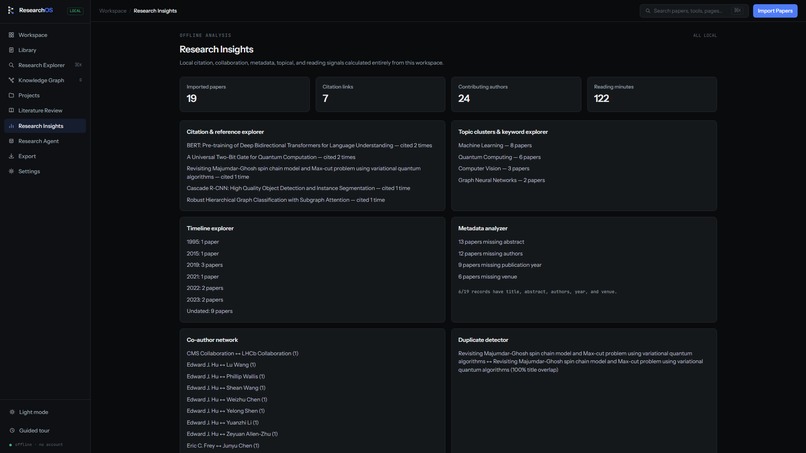
Project Overview
ResearchOS is an AI-powered, local-first research workspace built to simplify the modern research process. Researchers often juggle multiple disconnected tools for reading papers, taking notes, managing citations, organizing literature, and using AI assistants. This fragmented workflow creates unnecessary context switching and slows down scientific discovery.
ResearchOS brings these essential workflows together into one integrated application. It combines literature management, intelligent PDF reading, AI-powered paper understanding, citation analysis, knowledge graph visualization, research gap discovery, journal recommendations, and project organization in a unified workspace. By keeping research data local while integrating powerful AI capabilities, ResearchOS enables researchers to work more efficiently without compromising privacy or ownership of their work.
Our vision is to provide a single operating system for research that allows students, academics, and professionals to spend less time managing information and more time generating meaningful insights.
Inspiration
The idea for ResearchOS came from experiencing the fragmented nature of academic research firsthand. Reading papers, organizing notes, managing references, discovering related work, and using AI assistants often require switching between numerous applications and browser tabs. While AI has made individual research tasks easier, there is still no unified workspace where the entire research workflow exists in one place.
We wanted to build a platform that removes this friction by integrating every stage of the research process into a single, AI-native environment.
What it does
ResearchOS provides researchers with an end-to-end research workspace that includes:
- Literature management and organization
- Intelligent PDF reading and annotation
- AI-assisted paper understanding
- Citation analysis
- Interactive knowledge graph visualization
- Research gap discovery
- Journal recommendation support
- Research project organization
- Local-first document management
Instead of treating these as separate tools, ResearchOS connects them into a seamless workflow that keeps knowledge organized and accessible throughout the research lifecycle.
How we built it
ResearchOS was built using a modern full-stack architecture designed for performance, scalability, and maintainability.
Frontend
- Next.js
- React
- TypeScript
- Tailwind CSS
Backend
- Next.js API Routes
- Prisma ORM
- SQLite
AI & Research Infrastructure
- OpenAlex API
- GPT-5 via OpenAI
- Local-first document storage
- Knowledge graph generation
- Intelligent metadata extraction
Development was accelerated using OpenAI Codex for architecture planning, implementation, refactoring, debugging, and rapid iteration. Throughout development, we focused on creating modular, production-ready components rather than isolated prototypes.
Challenges we faced
One of the biggest challenges was designing a research workflow that felt unified instead of simply combining multiple independent tools. Integrating literature management, AI-powered analysis, citation workflows, and visualization into a cohesive user experience required several iterations of both the architecture and interface.
Another challenge was balancing powerful AI features with a local-first approach. We wanted users to benefit from modern AI capabilities while maintaining ownership and control over their research data.
Finally, ensuring smooth interaction between multiple data sources, asynchronous AI processing, and responsive user interfaces required careful engineering throughout the project.
Accomplishments
We're particularly proud that ResearchOS evolved beyond a collection of utilities into a cohesive research platform.
Some highlights include:
- A polished and modern user interface
- Integrated literature management
- AI-assisted research workflows
- Interactive knowledge graph visualization
- Citation intelligence
- Local-first architecture
- Modular and scalable codebase
- Production-quality demonstration
Rather than solving a single research problem, ResearchOS demonstrates how AI can support the complete research lifecycle.
What we learned
Building ResearchOS reinforced the importance of designing software around real user workflows instead of individual features. We also learned how thoughtful integration of AI can significantly improve productivity without overwhelming users.
The project strengthened our understanding of modern full-stack development, AI-assisted software engineering, modular architecture, and designing products that balance usability, performance, and privacy.
What's next for ResearchOS
ResearchOS is only the beginning.
Our roadmap includes:
- Multi-agent AI research assistants
- Semantic search across personal research libraries
- Automated literature review generation
- Collaborative research workspaces
- Advanced citation network exploration
- Plugin ecosystem
- Optional cloud synchronization while preserving local-first principles
- Deeper integrations with academic databases and publishing platforms
Our long-term vision is for ResearchOS to become the operating system researchers use every day—from discovering ideas to publishing new knowledge.
Built With
- ai
- api
- codex
- css
- github
- gpt-5
- graph
- javascript
- knowledge
- llm
- next.js
- node.js
- openai
- openalex
- prisma
- productivity
- python
- react
- research
- sqlite
- tailwind
- typescript


Log in or sign up for Devpost to join the conversation.