Inspiration
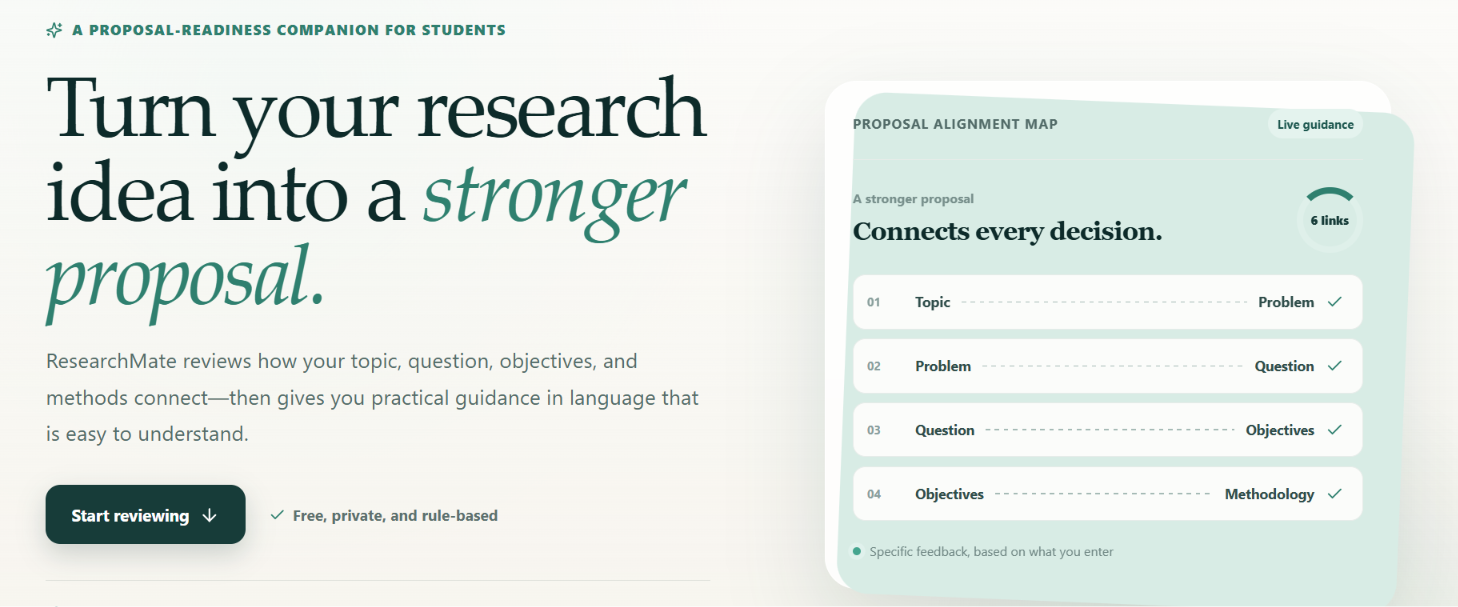
ResearchMate was inspired by my experience working with students who are new to academic research. Many students have promising ideas but it is hard for them to connect their research topic, problem statement, research questions, objectives, and methodology. They may understand what they want to study, yet find it difficult to turn that idea into a clear and logically structured proposal.
I wanted to create a simple educational tool that helps beginner researchers identify weaknesses in their proposal before presenting it to a teacher or supervisor.
What it does
ResearchMate allows a student to enter the main parts of a research proposal, including:
-Research topic -Problem statement -Research gap -Research question -General and specific objectives -Research approach -Population and sample -Data-collection methods -Data-analysis method -Ethical considerations
The application reviews these sections and provides structured feedback about strengths, missing information, vague wording, and possible mismatches. It also generates an overall readiness score, an alignment review, practical recommendations, and a proposal checklist.
ResearchMate is designed as a learning assistant rather than an automatic proposal writer. It encourages students to improve their own work and clearly states that its feedback does not replace a teacher or research supervisor.
How I built it
I built ResearchMate with React, TypeScript, Vite, and Tailwind CSS. I used Codex with GPT-5.6 to help plan the architecture, create reusable components, implement the analysis logic, identify errors, and improve the user experience.
The project uses a deterministic rule-based analysis engine so that the prototype can operate without requiring users to provide an API key. The analysis system checks factors such as field completeness, clarity, research-question structure, objective verbs, methodology alignment, and connections between different parts of the proposal.
Challenges
One of the biggest challenges was making the feedback specific instead of returning the same generic advice for every submission. The application needed to react differently to incomplete, vague, qualitative, quantitative, and well-developed research ideas.
Another challenge was evaluating alignment. Research proposals are complex, and an automated tool cannot completely understand academic quality. I therefore designed ResearchMate to provide guidance estimates rather than definite judgments.
Managing the scope was also important. Instead of building authentication, payments, or a large platform, I focused on one complete workflow that students could understand and test easily.
What I learned
Through this project, I learned more about:
Structuring a React and TypeScript application Separating business logic from interface components Designing rule-based text analysis Creating accessible and responsive forms Turning educational requirements into software rules Testing different input scenarios Using Codex iteratively for planning, implementation, debugging, and refinement Designing AI-related tools with academic integrity and clear limitations
Most importantly, I learned that educational technology should not only provide answers. It should help learners understand what is wrong, why it matters, and how they can improve it themselves.
What’s next
Future versions of ResearchMate could include secure AI-assisted feedback, multilingual guidance, teacher-defined evaluation rubrics, saved proposal versions, citation guidance, and exportable supervisor reports.
Built With
- codex
- github
- javascrip
- web-application

Log in or sign up for Devpost to join the conversation.