-
-
researchbuddy-homepage.png

Inspiration
I’m Allan Blythe, a solo developer driven to create tools that simplify learning for students like myself. The idea for ResearchBuddy sparked from my own frustrations with academic research—sifting through overwhelming information and feeling isolated when I hit roadblocks. I wanted to build a lightweight, distraction-free web app that not only delivers reliable research but also encourages collaboration among students. The Perplexity Hackathon 2025, with its emphasis on deep research, gave me the perfect platform to bring this vision to life. I imagined a tool with instant research , all wrapped in a futuristic UI to keep users engaged and inspired.
What It Does
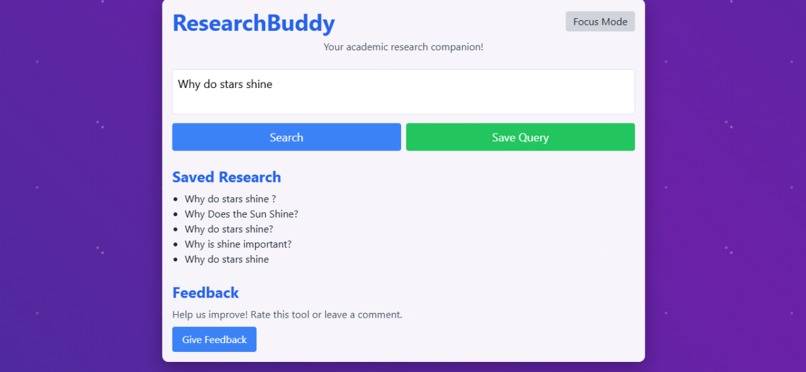
ResearchBuddy is a web app designed to streamline academic research for students. It uses the Wikipedia API to fetch summaries, citations, and related links for any topic you search—like “Why do stars shine?”—making it easy to dive deep into subjects. It features a “Focus Mode” to toggle a dark theme for distraction-free reading, lets you save queries to revisit later. The UI is sleek, with a starry gradient background that animates, creating a modern, engaging experience. It’s hosted on Vercel, ensuring it’s accessible and lightweight, even on low-spec devices like my Hisense U61.
How We Built It
As a solo developer, I built ResearchBuddy from scratch using a single-page app structure with HTML, CSS, and JavaScript. I chose Tailwind CSS for rapid, responsive styling and designed a starry gradient background to give it a futuristic feel. The core research feature now uses the Sonar API (Perplexity API) to fetch detailed summaries, citations, and related questions, providing deeper and more accurate results compared to the initial Wikipedia API implementation. I used local storage to save user queries and added a “Focus Mode” for toggling a dark theme. The app is deployed on Vercel for free hosting. To create the demo video, I recorded with OBS Studio and used ElevenLabs to generate a voiceover, overcoming my cold for a professional presentation.
Challenges We Ran Into
The biggest challenge was the delayed Sonar API key from the hackathon organizers—I had planned to use it for enhanced search capabilities but had to pivot to the Wikipedia API instead, which taught me to adapt quickly. Centering the app’s content vertically was another hurdle; it initially skewed toward the top of the page, but I resolved it with CSS flexbox adjustments after some trial and error. Finally, recording the demo while sick was tough, but ElevenLabs allowed me to clone my voice from a prior recording, ensuring a clear narration.
Accomplishments That We’re Proud Of
I’m incredibly proud of delivering a fully functional app as a solo developer under a tight hackathon timeline. The futuristic UI with its animated starry background stands out, creating an engaging experience that’s still lightweight on low-spec devices. Successfully recording and editing a professional demo video despite my cold, thanks to ElevenLabs, is another achievement I’m thrilled about. Most of all, I’m proud of adapting to the delayed API key and still submitting a strong entry for the Best Deep Research category.
What We Learned
This project was a steep learning curve! I deepened my understanding of HTML, CSS, and JavaScript, especially in handling asynchronous API calls with the Wikipedia API. Tailwind CSS taught me how to style efficiently and responsively. I also gained experience deploying on Vercel, ensuring my app performs well on limited hardware. Troubleshooting challenges like centering content and syncing data taught me resilience and problem-solving under pressure, skills I’ll carry into future projects.
What’s Next for ResearchBuddy
The future of ResearchBuddy is bright! Once I receive the Sonar API key from the hackathon organizers, I plan to integrate it to enhance the search capabilities, providing even deeper and more accurate research results.Integrating real-time chat with Firebase will be a big win—it adds a collaborative element that makes ResearchBuddy more than just a research tool. I’d like to expand the chat feature to include private groups and video calls, making collaboration more dynamic. Adding AI-driven insights to suggest related topics or summarize longer articles is another goal. I also plan to refine the UI further, adding more customization options for users. Post-hackathon, I’ll explore ways to scale ResearchBuddy for broader educational use, potentially partnering with schools or libraries to support student learning.
Built With
- HTML: For the app’s structure.
- CSS: Custom styles with Tailwind CSS for responsive design.
- JavaScript: For interactivity, API calls, and local storage.
- Sonar API (Perplexity API): Powers the research summaries, citations, and related questions.
- Wikipedia API: Used as a fallback for research queries.
- Vercel: Free hosting platform for deployment.
- OBS Studio: Used to record the demo video.
- ElevenLabs: Generated the voiceover for the demo video.
Try It Out
- Live Demo: Try ResearchBuddy here!
- GitHub Repository: Check out the code on GitHub!
- Demo Video: Watch the demo on YouTube!
Built With
- and
- and-local-storage.-wikipedia-api:-powers-the-research-summaries
- anonymous
- api-calls
- authentication.
- chat
- citations
- demo
- deployment.
- elevenlabs:
- enables
- firebase:
- follow-up
- for
- free
- generated
- hosting
- html:-for-the-app?s-structure.-css:-custom-styles-with-tailwind-css-for-responsive-design.-javascript:-for-interactivity
- obs
- platform
- questions.
- real-time
- record
- studio:
- the
- to
- used
- vercel:
- video.
- voiceover


Log in or sign up for Devpost to join the conversation.