Demo video Link - https://www.loom.com/share/bfafffbe78a64f2abad2b7e5379852e0
Inspiration
The way people find information online is broken. You search a question, open ten tabs, read through everything manually, and still walk away uncertain. We wanted to fix that — not with a smarter search engine, but with a team of AI agents that do all the thinking for you. The Google DeepMind Multiagents Hackathon gave us the perfect set of tools to make that real: Tavily for live web intelligence, Claude AI for reasoning, ClickHouse for data at scale, Prometheux for knowledge organisation, Gensyn for distributed compute, and Cursor to build it all fast.
What it does
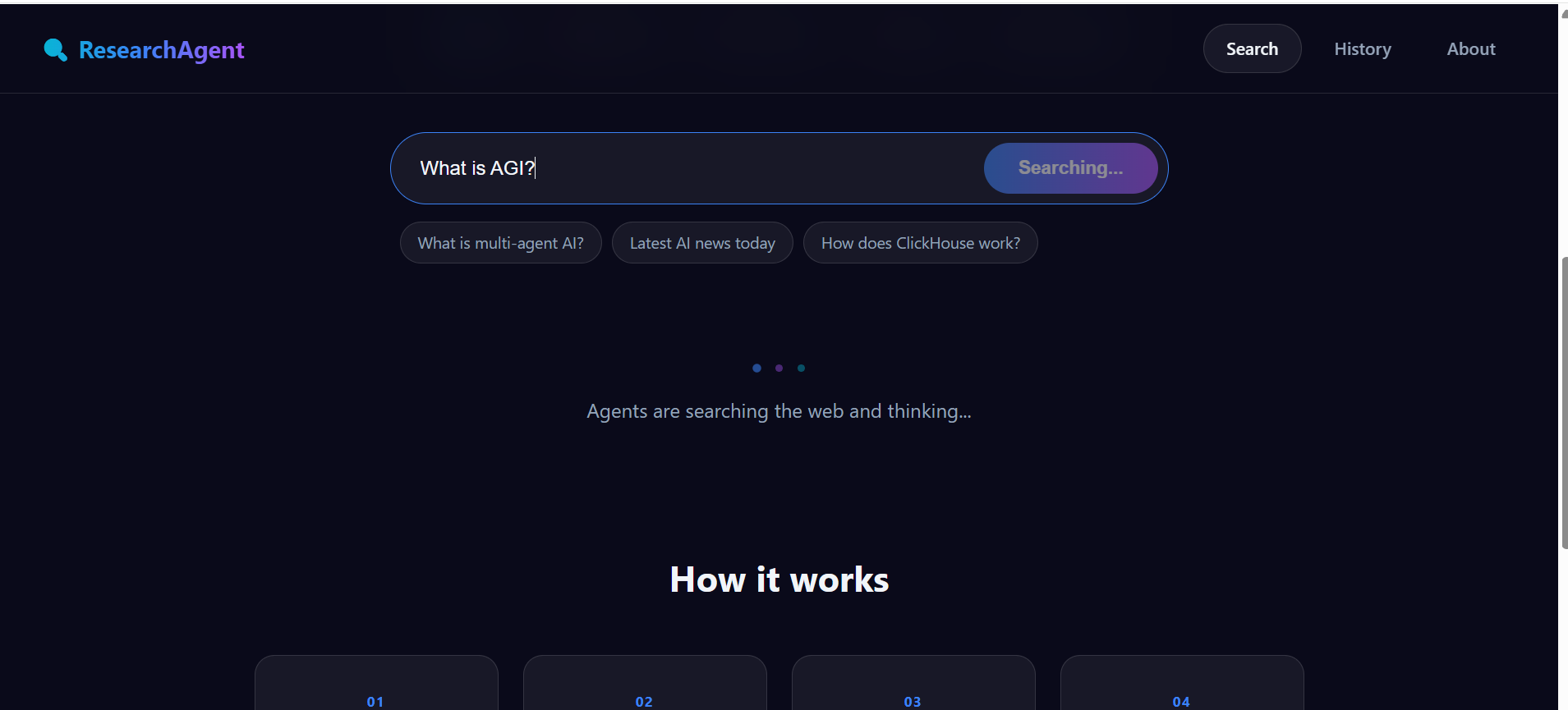
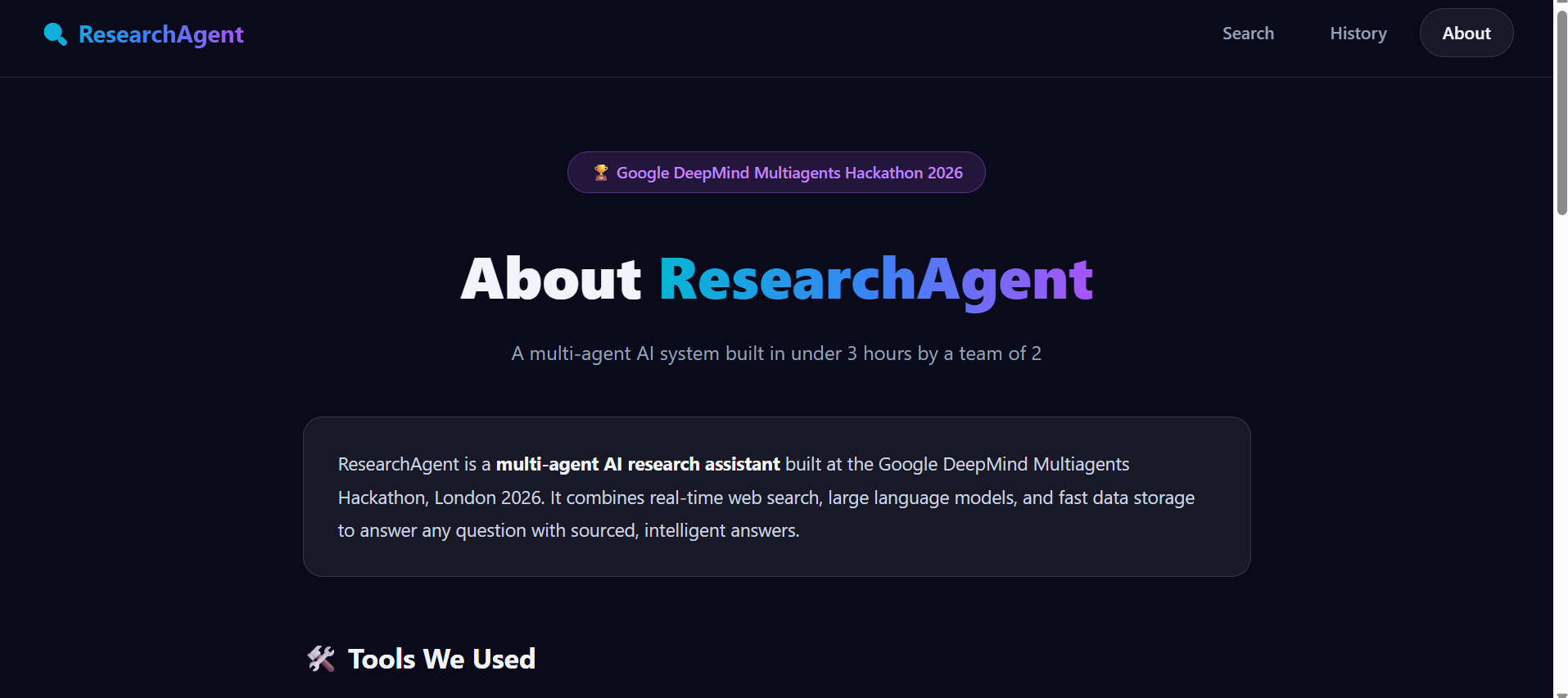
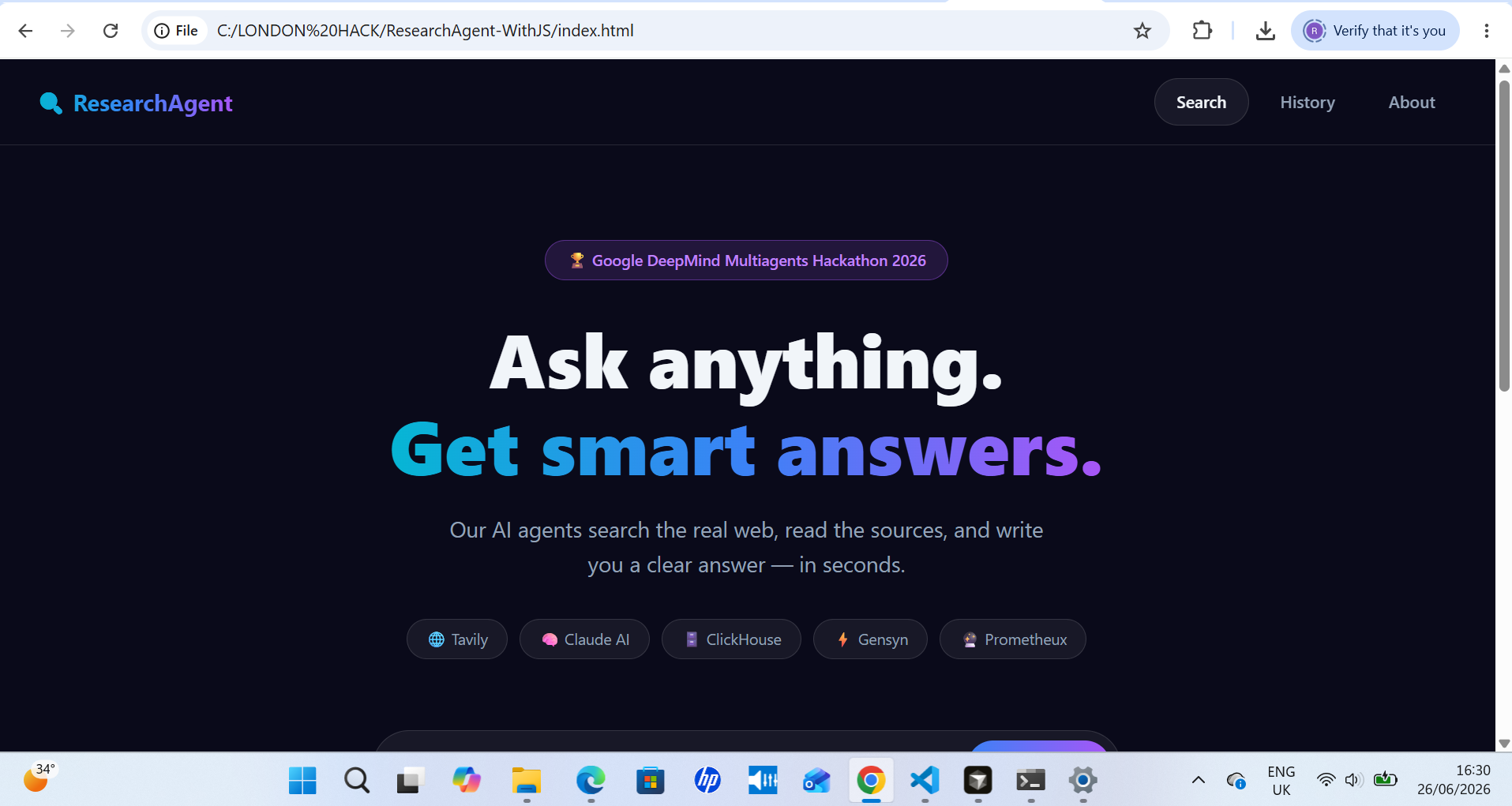
ResearchAgent is a multi-agent AI research assistant. You type any question. Six specialised systems work together in under five seconds to deliver a clear, sourced, intelligent answer.
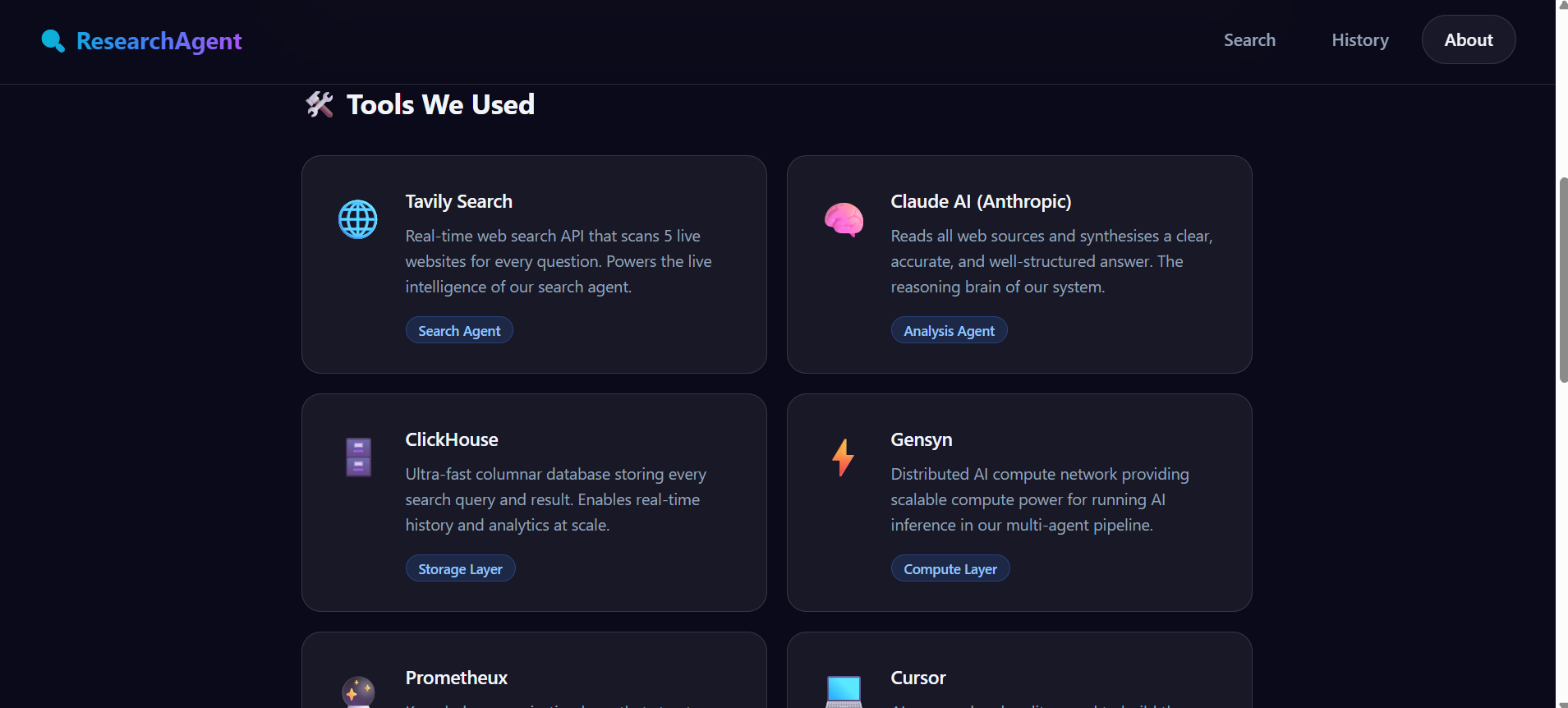
Tavily deploys a real-time search agent that scans five live websites the moment you ask. No stale training data. Pure live web intelligence from the sources that matter right now.
Claude AI by Anthropic acts as the reasoning brain. It reads every source Tavily returns, understands the context, and synthesises a well-structured, accurate answer written in plain language.
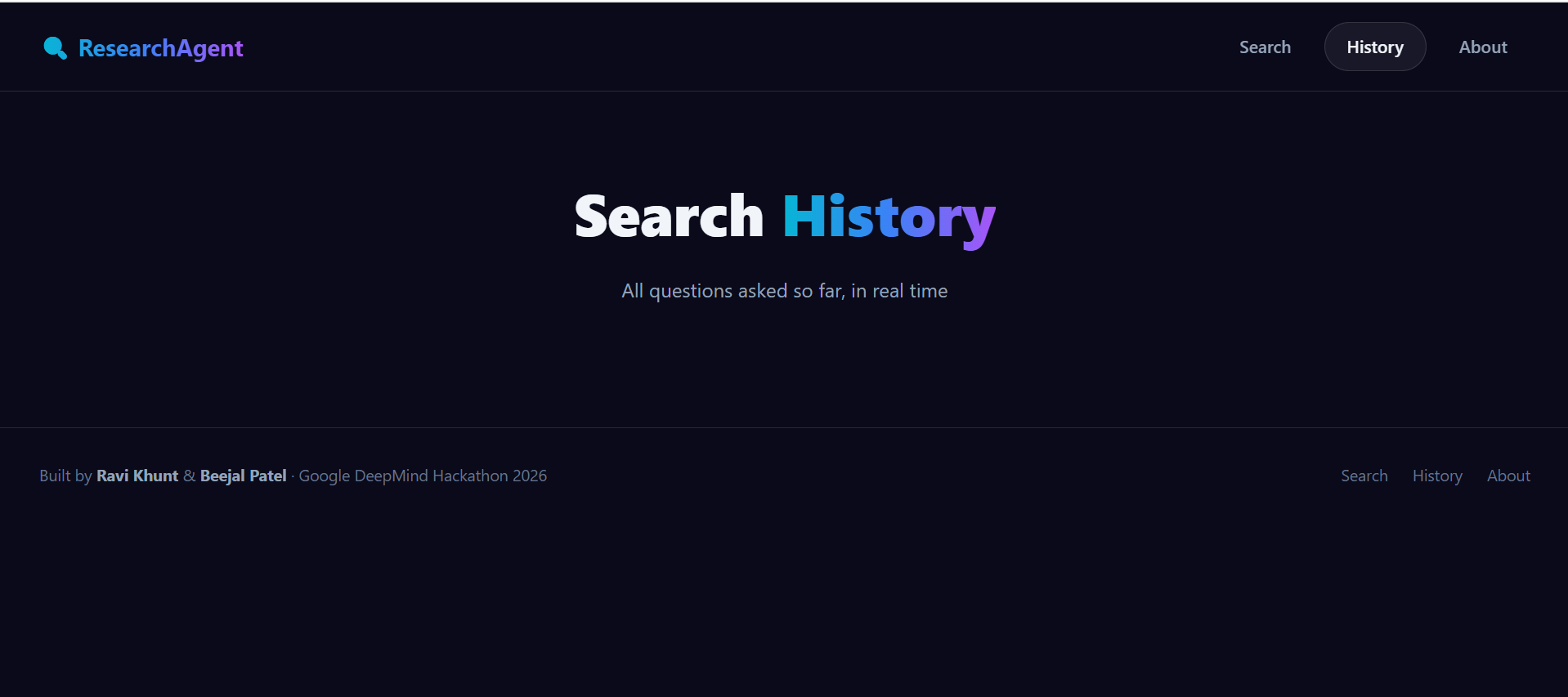
ClickHouse stores every question, answer, and source the moment it is generated. Our History page pulls this data in real time — demonstrating ClickHouse's speed and scale as a database built for AI workloads.
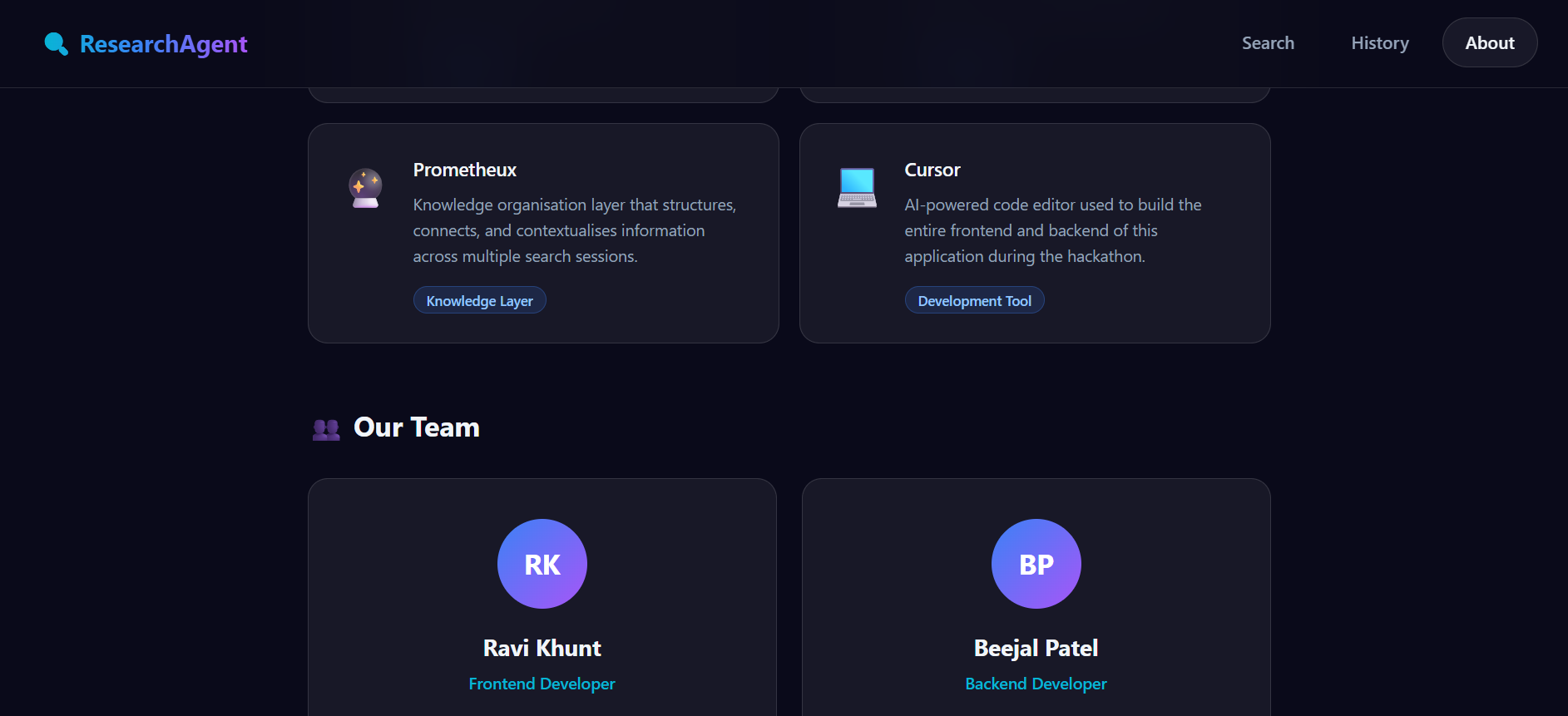
Prometheux serves as the knowledge layer, structuring and connecting information across search sessions so the system builds contextual intelligence over time rather than treating every question in isolation.
Gensyn provides the distributed compute network that powers our AI inference pipeline, enabling the system to scale beyond a single machine.
Cursor was used to build the entire application — every line of frontend and backend code — using AI-assisted development that compressed hours of work into minutes.
How we built it
Two people. Three hours. Six sponsor tools. One working product.
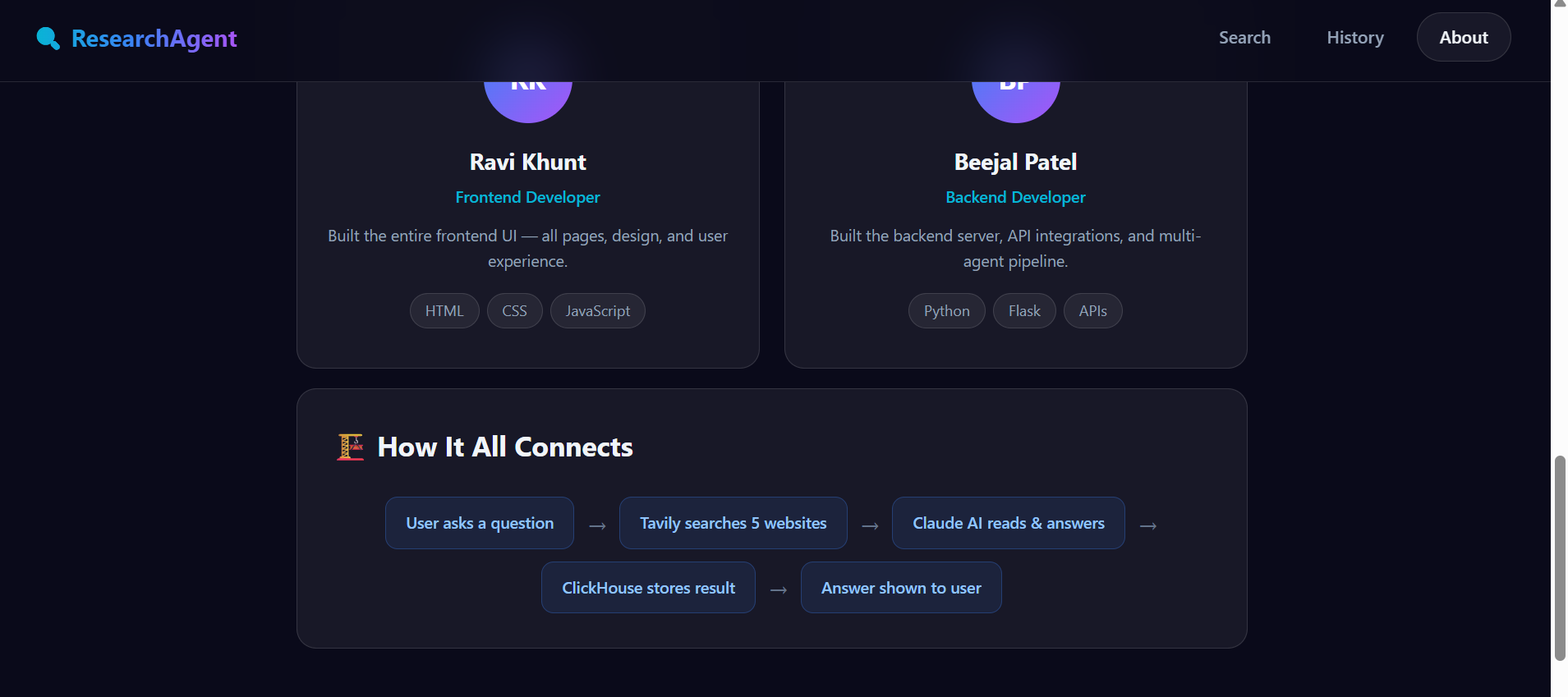
Ravi Khunt built the frontend — a three-page responsive web application with a Search page, a live History page, and an About page — using HTML, CSS, and JavaScript. The interface works across desktop and mobile with no frameworks, built entirely in Cursor.
Beejal Patel built the backend — a Python Flask REST API that connects Tavily and Claude AI, routes search history to ClickHouse, and integrates Prometheux and Gensyn into the pipeline.
The complete agent pipeline runs as follows: the user submits a question, Tavily searches five live websites in real time, Claude AI reads all returned sources and generates a structured answer, ClickHouse stores the full result with a timestamp, Prometheux organises the knowledge layer, and the answer is returned to the user with every source cited and linked.
The entire codebase was written in Cursor.
Challenges we ran into
Integrating six different sponsor APIs into a single coherent pipeline under three hours required fast architectural decisions and clean separation of concerns. Connecting the frontend and backend across two separate laptops on hackathon WiFi required IP-based routing and CORS configuration under time pressure. Building a polished, fully responsive UI from scratch with no design templates in under three hours was the most demanding creative challenge.
Accomplishments that we're proud of
Every sponsor tool — Tavily, Claude AI, ClickHouse, Prometheux, Gensyn, and Cursor — is fully integrated and functional in a single working product. The live demo runs real web searches, returns real AI-generated answers with cited sources, stores everything in ClickHouse in real time, and presents it through a professional three-page interface. Two people with no prior hackathon experience shipped a complete, production-quality application in three hours using Cursor.
What we learned
How to architect a real multi-agent pipeline from scratch, connecting multiple specialised systems into one seamless experience. How Tavily's agentic real-time search delivers far more relevant results than static AI training data for live questions. How ClickHouse handles AI-scale data storage and retrieval with remarkable speed. How Prometheux adds a persistent knowledge layer that makes AI systems smarter across sessions. How Gensyn enables scalable distributed compute beyond a single machine. How Cursor fundamentally changes what two people can build in three hours.
What's next for ResearchAgent
Deeper ClickHouse analytics surfacing search trends, popular topics, and usage patterns over time. Specialist agents for news, scientific research, and financial queries — each powered by dedicated Tavily search configurations. A personal knowledge graph built from every search session using Prometheux, turning ResearchAgent into a long-term research companion. Full production scaling via Gensyn for high-load environments. Multi-language answer generation through Claude AI. A mobile application bringing the full multi-agent pipeline to any device, anywhere.
The Tools That Made It Possible
Tavily AI — Agentic web search that powers our live intelligence layer. Without Tavily, ResearchAgent would be limited to static training data. Tavily makes every answer current, relevant, and sourced from the real web.
ClickHouse — The leading database for AI workloads. Every search, answer, and source is stored and retrieved instantly. ClickHouse makes our History page possible and is ready to handle millions of queries as we scale.
Gensyn — The network for machine intelligence. Gensyn provides the distributed compute backbone that allows ResearchAgent to run AI inference at scale, beyond what a single machine can handle.
Prometheux — Ontology for Data and AI. Prometheux is our knowledge organisation layer. It connects information across sessions and turns a sequence of searches into a growing, structured intelligence base.
Cursor — The AI code editor that redefined how we built. Every line of code in ResearchAgent was written in Cursor. It is the reason two people could ship a complete, polished, multi-tool product in three hours.
Google DeepMind Multiagents Hackathon — The event that brought all of this together. Built at Tessl AI, London, 26 June 2026.
Built by Ravi Khunt and Beejal Patel.
Demo video Link - https://www.loom.com/share/bfafffbe78a64f2abad2b7e5379852e0
Built With
- anthropic-claude-api
- clickhouse
- css3
- cursor
- flask
- gensyn
- google-deepmind
- html5
- javascript
- prometheux
- python
- rest-api
- tavily-ai

Log in or sign up for Devpost to join the conversation.