-
-
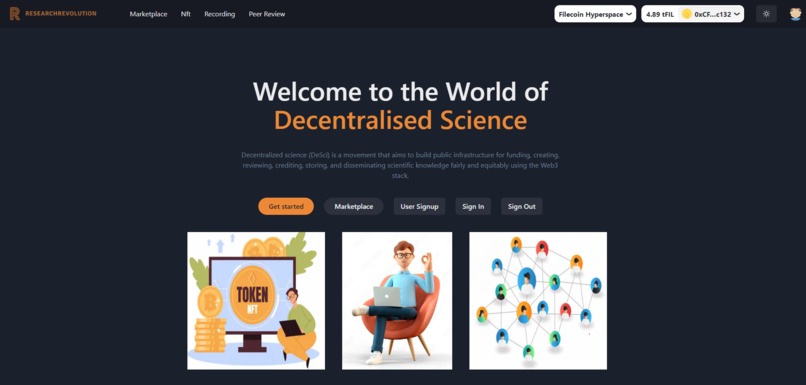
Landing pg
-
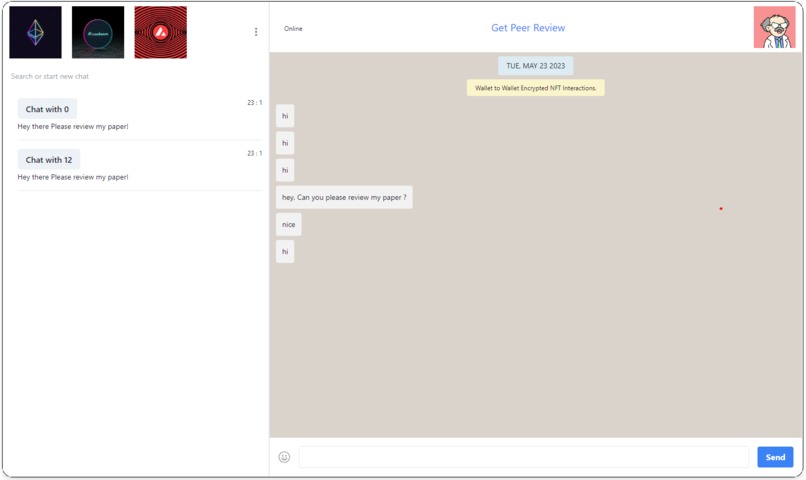
Peer-Review Polybase
-
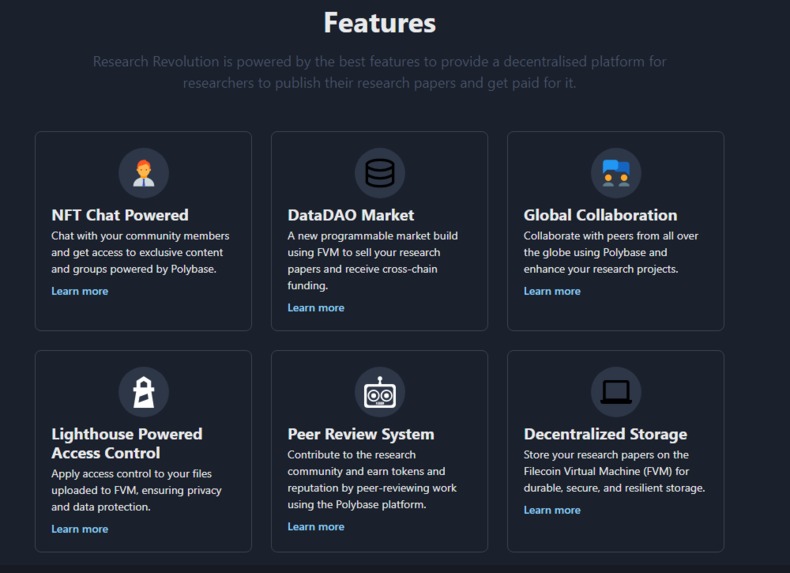
Features
-
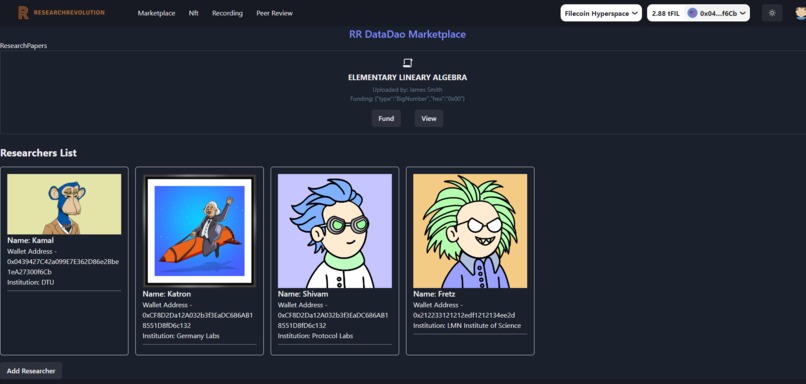
Marketplace
-
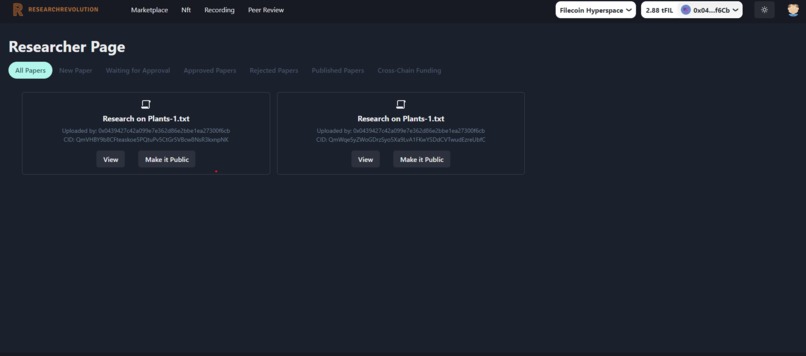
Researcher Page
-
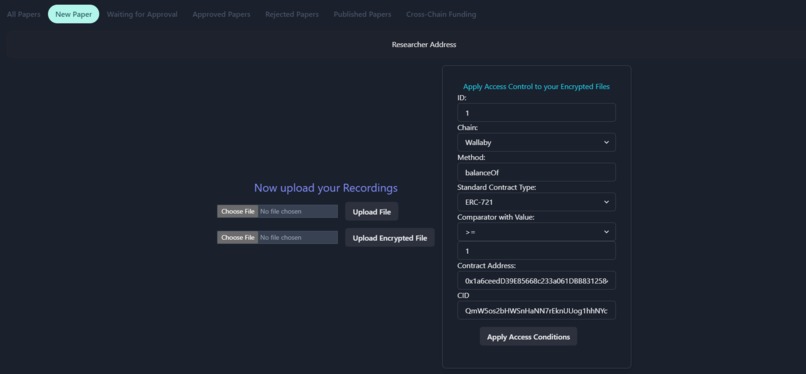
Lighthouse Encryption
-
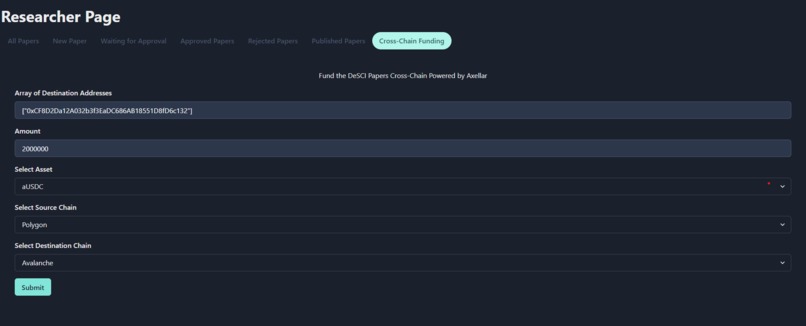
Cross-Chain Funding by Axellar


Inspiration
The Research Revolution project was inspired by the desire to unleash the future of science and address various challenges in the scientific community using Web3 technologies. The team recognized the potential of decentralized systems, blockchain, and smart contracts to revolutionize scientific publishing, funding, reproducibility, and collaboration.
What it does
Research Revolution (RR) is a platform that leverages Web3 technologies to provide solutions to key problems in the scientific community. It aims to enable open access publishing, ensure reproducibility and replicability of scientific results, explore innovative funding models, address intellectual property ownership, and enhance data storage and accessibility. RR facilitates collaboration among researchers, incentivizes contributions, and promotes the use of decentralized systems for scientific advancements.
How we built it
The Research Revolution platform was built using a combination of various technologies and frameworks. The key technologies used include:
Axellar: Axellar was utilized for cross-chain funding of research projects, enabling seamless financial transactions across different blockchain networks.
Polybase: Polybase was integrated into the platform to provide NFT-based chat functionality and peer-to-peer review capabilities, fostering collaboration and feedback among researchers.
FVM: Research papers are stored on the Filecoin Virtual Machine (FVM), ensuring decentralized and secure storage of scientific data. A DataDao Market is created to facilitate open sharing of research papers. RR Dao Contract with quad voting - https://github.com/legendarykamal/RR-Contract/blob/master/contracts/RQ.sol NFT Contract for Researchers to Encrypt their Files - https://github.com/legendarykamal/RR-Contract/blob/master/contracts/AINFT.sol
Lit Protocol: PKP keys provided by the Lit Protocol were employed for encrypting documents, ensuring privacy and data protection for researchers. Code Implementation-https://github.com/legendarykamal/ResearchRevolution/blob/master/src/pages/pkp.tsx
Tellor Oracle: The Tellor Oracle was utilized to fetch and provide on-chain data for research purposes, enabling access to reliable and trustworthy data sources.
Lighthouse SDK: Applying different Encryption Rules on the Documents . Code Link - https://github.com/legendarykamal/ResearchRevolution/blob/master/src/components/lighthouse/acesscontrol.tsx
Spheron: Spheron, a decentralized deployment framework, was used to ensure the secure and decentralized deployment of the Research Revolution platform. Deployment Link to Spheron - http://researchrevolution-e6e565.spheron.app/
The development process involved designing and implementing smart contracts, integrating blockchain-based authentication mechanisms, building user interfaces, and ensuring seamless integration of the various technologies.
Challenges we ran into
While developing Research Revolution, the team encountered several challenges. Some of the key challenges include:
Learning Curve: Familiarizing themselves with the intricacies of Web3 technologies, blockchain, and smart contracts required a significant learning curve for the team.
Integration Complexity: Integrating different technologies and ensuring seamless interoperability posed technical challenges, requiring careful design and implementation.
Security and Privacy: Ensuring the security and privacy of user data, especially in the context of decentralized systems, presented challenges that required robust solutions.
Adoption and Education: Promoting awareness and adoption of Web3 technologies in the scientific community proved to be a challenge, as traditional scientific practices often differ from the decentralized approach.
The team tackled these challenges through collaboration, research, and continuous iteration, ultimately overcoming the obstacles encountered during the development process.
While developing Research Revolution, the team encountered several challenges. Some of the key challenges include:
Learning Curve: Familiarizing themselves with the intricacies of Web3 technologies, blockchain, and smart contracts required a significant learning curve for the team.
Integration Complexity: Integrating different technologies and ensuring seamless interoperability posed technical challenges, requiring careful design and implementation.
Security and Privacy: Ensuring the security and privacy of user data, especially in the context of decentralized systems, presented challenges that required robust solutions.
What's next for Research Revolution
We would like to Improve the platform in the future.
Built With
- axellar
- fvm
- lighthouse
- lit
- nextjs
- polybase
- tellor


Log in or sign up for Devpost to join the conversation.