-
-
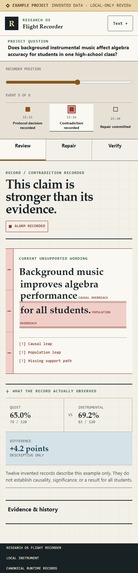
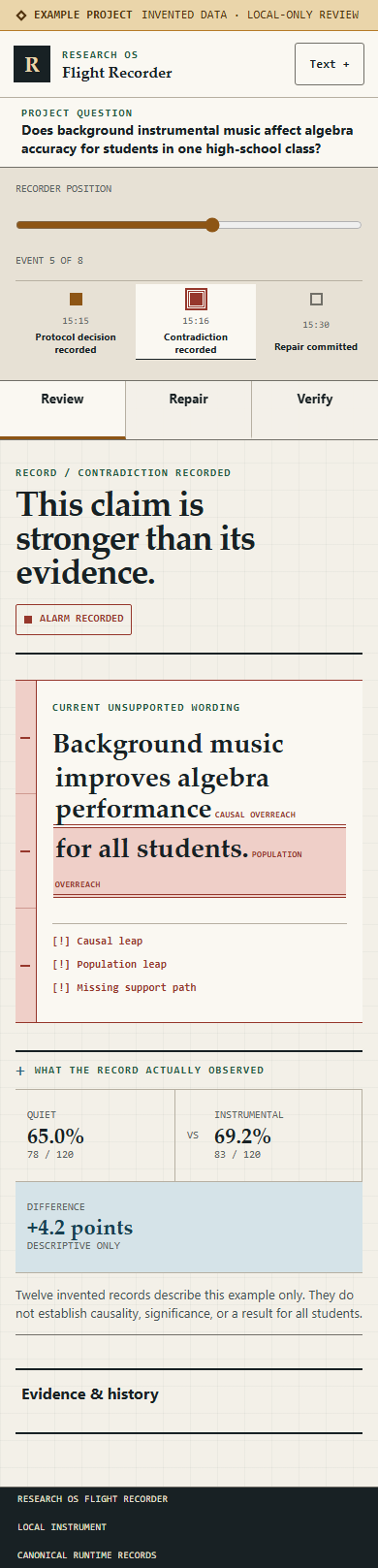
Review on a narrow viewport — the same local synthetic journey remains legible.
-

Repair on a narrow viewport — before/after wording and human authorization stay visible.
-
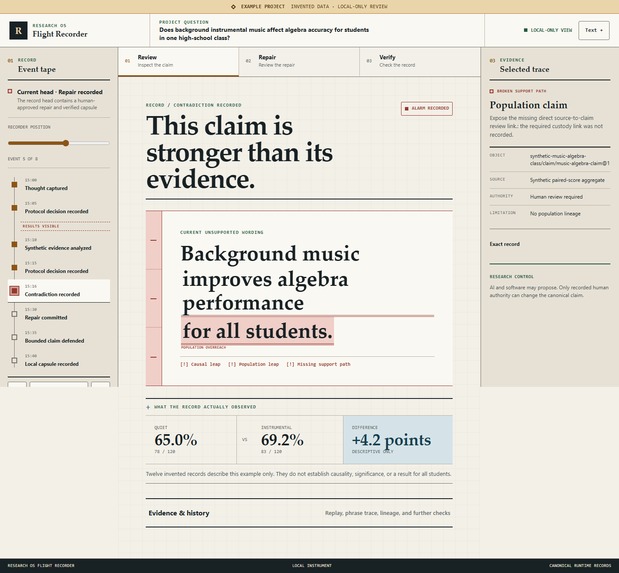
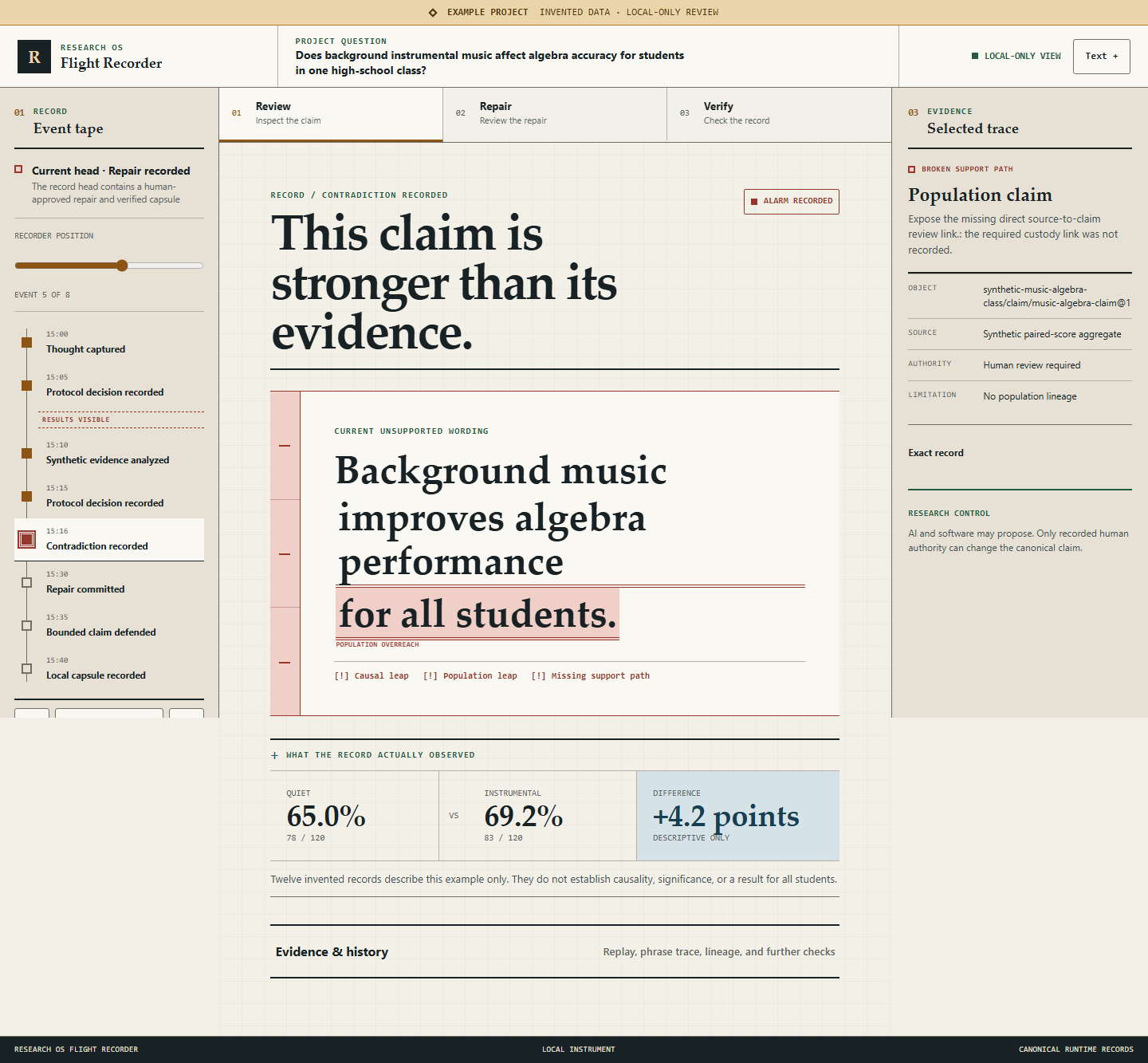
Review — replay the event tape and inspect the phrase that exceeds the observed evidence.
-

Verify on a narrow viewport — capsule verification and limitations remain explicit.
-
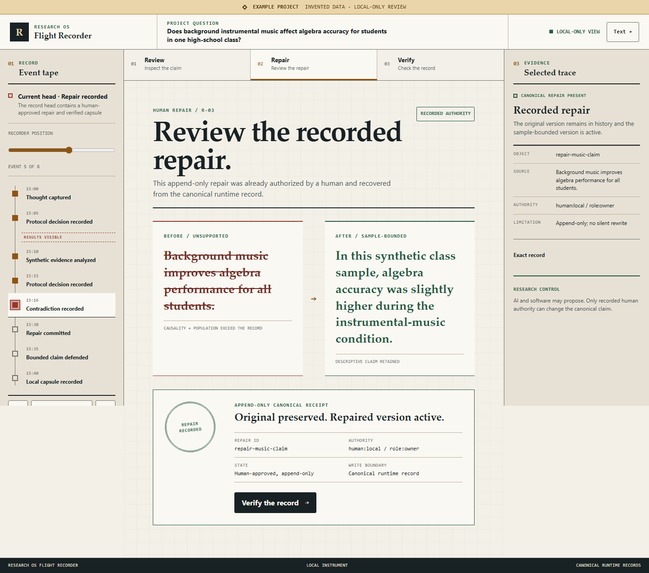
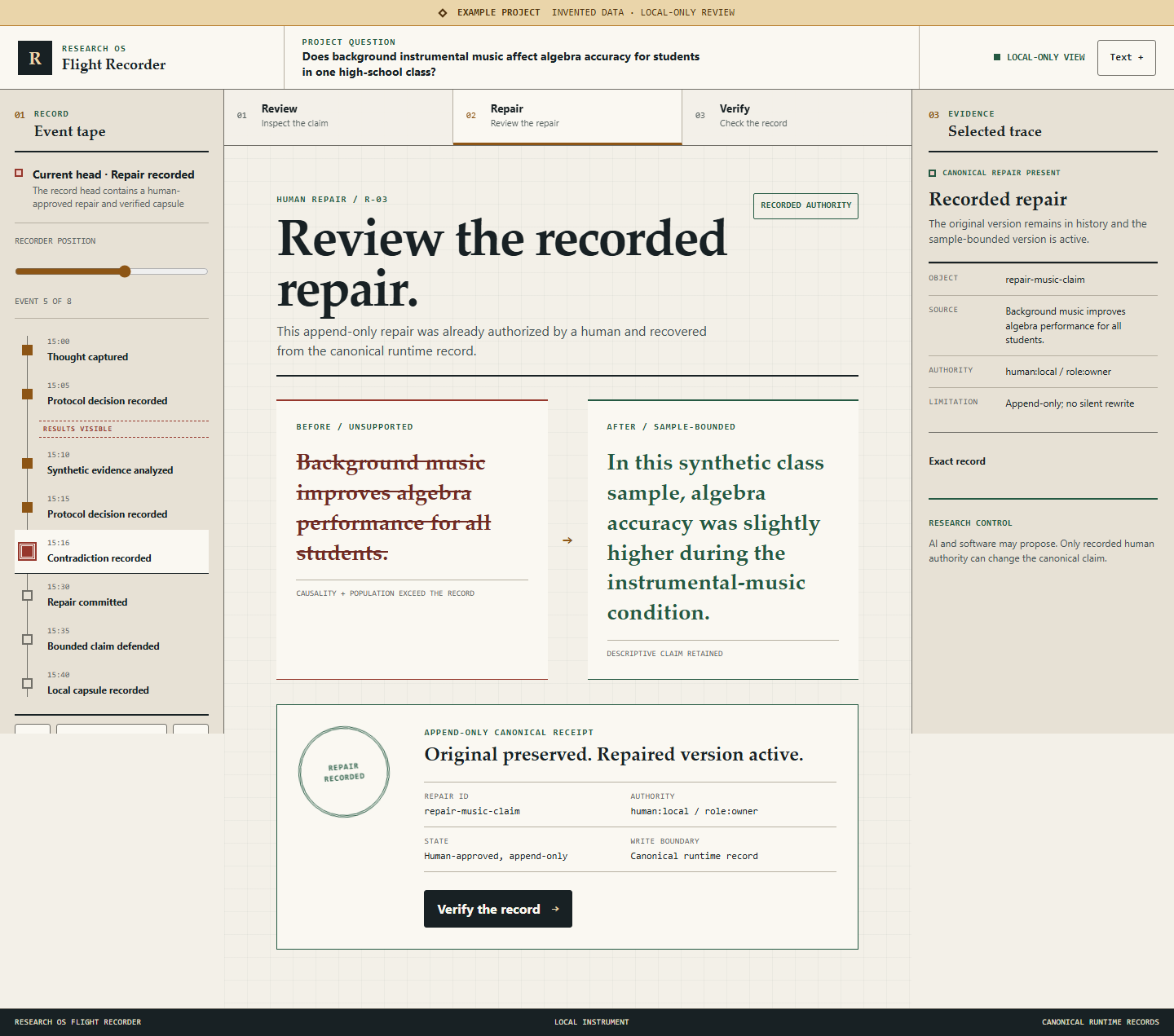
Repair — record a bounded human repair without erasing the original wording.
-
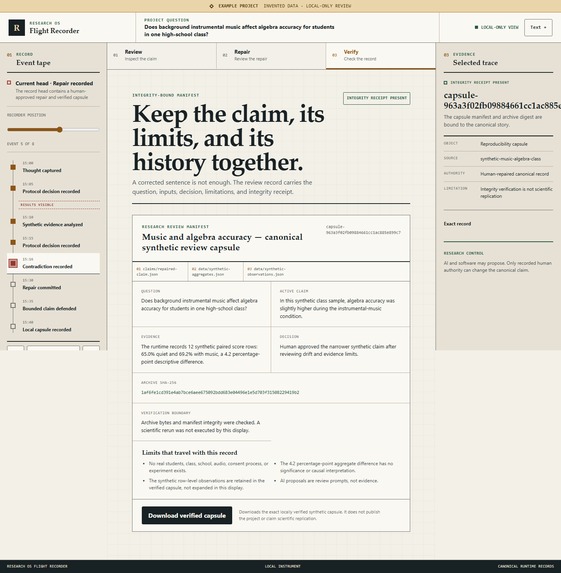
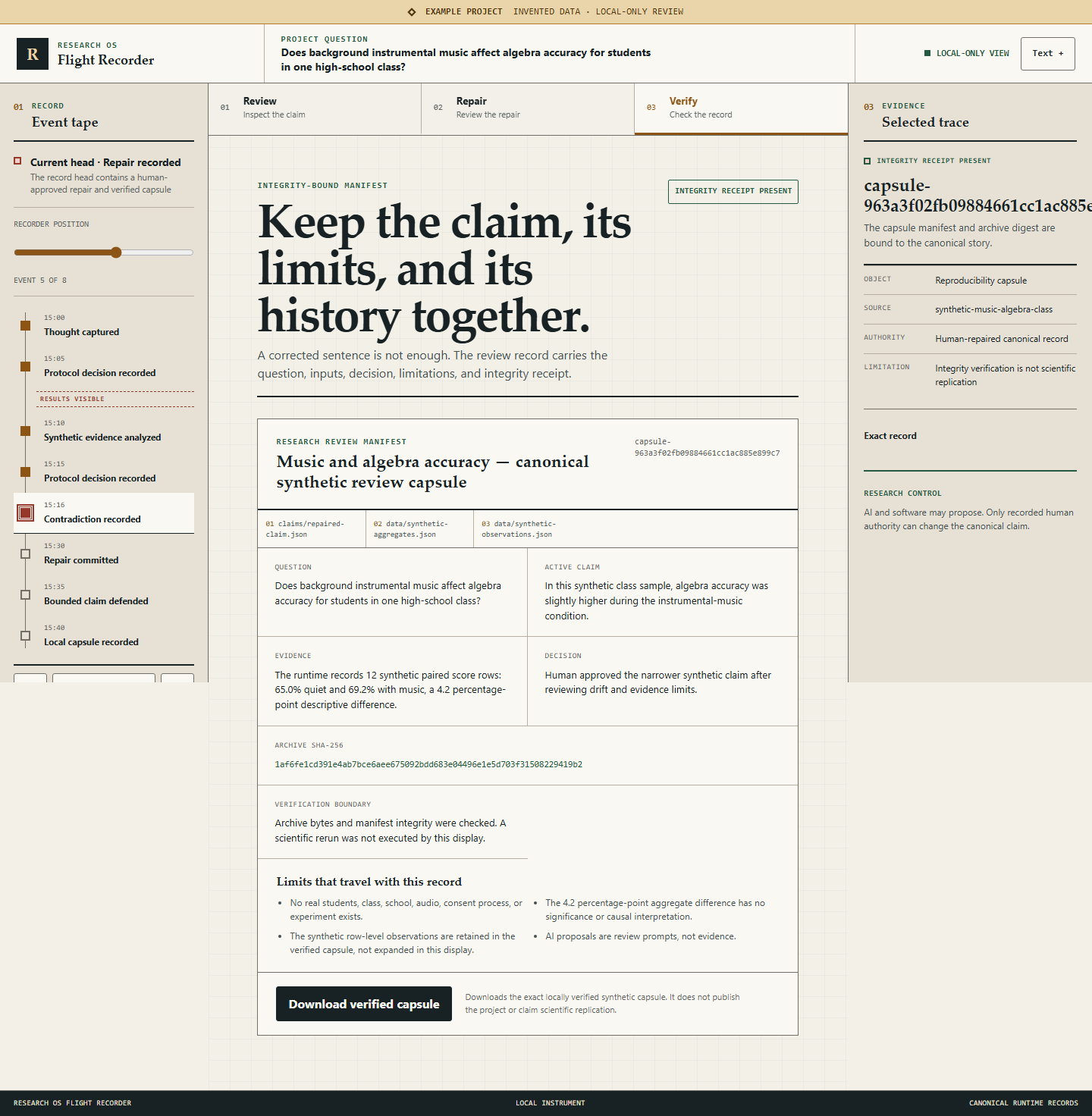
Verify — confirm the active claim, limits, lineage, and capsule digest.


Inspiration
AI can make a research conclusion look finished before anyone can reconstruct whether the reasoning supports it. Notes, datasets, notebooks, citations, and chat outputs often get disconnected from the decisions that changed a protocol or strengthened a sentence. Research OS — Research Flight Recorder makes that decision trail reviewable.
What it does
This is a complete OS2-backed research-integrity system, not a mobile-only project.
Research OS foundation
↓
Research Flight Recorder — significant Reverie add-on
↓
Browser-based judge experience + native Mobile V2 client
↓
Reproducibility and AI-authority boundary
The foundation supplies the typed research kernel, ResearchFS and deterministic archives, runtime, processes, permissions, action leases and receipts, query/package/API/SDK/MCP boundaries, evidence and computation contracts, Proof Gate and Defense boundaries, pairing, sync, entitlements, connectors, and security architecture.
Research Flight Recorder is the major Reverie addition. Its Review → Repair → Verify journey replays the event history, marks the result-first-known boundary, detects protocol drift, highlights phrase-level overreach, traces evidence custody and missing support, quarantines AI red-team output, records an explicit human Repair Commit, and exports a deterministic reproducibility capsule.
Judge experience
The browser Flight Recorder is the primary competition judge path over the underlying Research OS engine. It is loopback-only, read-only, and uses fixed synthetic data. The native SwiftUI Mobile V2 package is a separate 188.6 KB client of the same typed model and provides cross-platform depth; it is not the submission foundation.
How we built it
The primary competition package is the authenticated 1,216,870-byte OS2-backed Research OS + Research Flight Recorder archive. The public repository includes the full source, tests, provenance, rights boundary, SBOM, screenshots, a capability truth matrix, and a 21-second hierarchy-aware demo. The native package and its Apple-side validation report are disclosed separately; this Windows export does not claim to rerun those Apple-side checks.
Built during Reverie
Research OS existed before Reverie as a broader local-first research foundation. During the event, the significant competition-period addition was the coherent Research Flight Recorder layer and browser judge workflow: Journey Replay, the result-visibility boundary, Protocol Drift Alarm, Claim Sentence Heatmap, Evidence Chain-of-Custody, proposal-only local-AI red teaming, explicit Repair Commits, deterministic Reproducibility Capsule, synthetic judge mode, adversarial tests, and the competition-facing instrument. The pre-event foundation and post-cutoff commit chain are disclosed in the repository.
Challenges
The hard part was preserving a simple judge journey over a deep research model: reconstructing state deterministically, distinguishing post-result changes without accusing misconduct, mapping natural-language phrases to evidence and limitations, keeping AI proposal-only, making repairs append-only and human-authorized, and producing a privacy-safe export from a private project.
Accomplishments
A working browser Review → Repair → Verify flow over the Research OS engine.
Phrase-level evidence tracing with a visible missing support edge.
Immutable before/after wording and a reproducibility capsule digest.
Full-system source index and capability truth matrix separating demonstrated, foundation-tested, native-report-only, fixture-only, disabled, and future boundaries.
Adversarial integrity, runtime, privacy, export, and UI tests.
External validation evidence recorded for 42/42 Python checks, 48/48 XCTest checks, and 2/2 local StoreKit contract tests on iOS 26.1.
What I learned
Provenance must be captured during research instead of reconstructed afterward. A polished claim and a defensible claim are different objects. AI authority boundaries matter more than fluency. Researchers need repair workflows, not only warnings, and a simple client can sit on top of rigorous event and evidence models.
Truth boundary
All visible example data is invented. The browser is not a hosted service and cannot write canonical records. This package does not claim a scientific result, replication, production deployment, live AI provider, live RevenueCat purchase, App Store availability, accessibility certification, or organizer approval. The proposed 150/250 V3 expansion never produced a verified final delivery with source, provenance, tests, and receipts, so it is not counted as completed work; Atlas/planning context cannot promote it.
What's next
Future work, not completed work: mentor collaboration, broader research formats, paired desktop/mobile workflows, live RevenueCat/App Store setup, external user testing, independent accessibility review, institution deployment, and stronger reproducibility integrations.
Built With
- html
- javascript
- python
- revenuecat
- sqlite
- storekit
- swift
- swiftui
- xctest

Log in or sign up for Devpost to join the conversation.