
Inspiration
Research is the backbone of innovation, yet today’s process remains painfully slow and fragmented. A simple question like “How effective is AI in rural healthcare?” can lead to thousands of results—most redundant, conflicting, or lacking credibility. Researchers spend hours manually verifying sources, comparing studies, and organizing insights across disconnected tools.
Our inspiration came from this pain point: What if research could work like a collaborative orchestra, where AI agents independently handle searching, validating, comparing, and summarizing—while IBM watsonx Orchestrate conducts the entire process?
We wanted to demonstrate how agentic AI, guided by IBM watsonx Orchestrate, could turn natural-language queries into structured, validated, and sharable insights—as if you had a global team of analysts working in real time.
What It Does
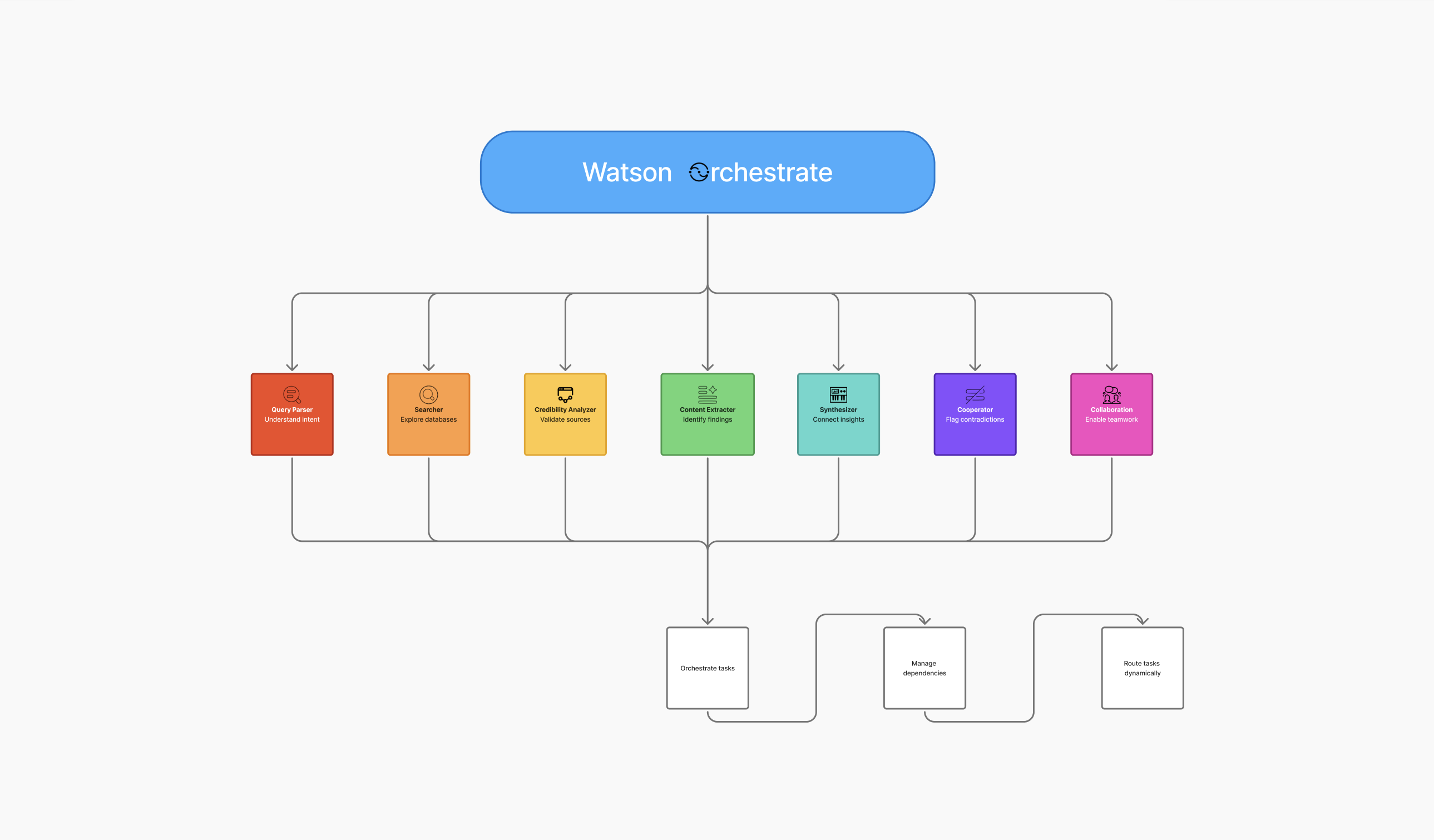
Research Assistant Hub is an AI-powered research orchestration platform built on IBM watsonx Orchestrate. It transforms natural language research questions into credible, comprehensive insights through seven specialized AI agents:
Query Parser Agent – Understands and structures user intent.
Searcher Agent – Retrieves and filters information from web and internal sources.
Extractor Agent – Converts unstructured text into structured findings.
Credibility Agent – Evaluates reliability using source reputation, recency, and methodology.
Comparator Agent – Detects conflicting results and analyzes methodological differences.
Synthesizer Agent – Generates executive summaries and insight briefs.
Collaboration Agent – Shares results through Google Docs, Slack, and shared canvases.
IBM watsonx Orchestrate acts as the central conductor, managing workflow logic, sequencing, context persistence, and real-time agent coordination. The result: AI that doesn’t just answer questions—it orchestrates an entire research process.
How We Built It
We designed the system using an agentic architecture connected through IBM watsonx Orchestrate:
Each agent was developed as a callable Skill (microservice) with its own API endpoint and defined schema.
Skills were registered in watsonx Orchestrate and sequenced using the Flow Designer to manage logic like parallel execution (Searcher + Comparator) and conditional branching (depending on research type).
watsonx.ai models provided NLU, summarization, and reasoning for the Query Parser and Synthesizer.
watsonx.data stored structured metrics, extracted findings, and workflow states.
The entire pipeline was monitored and optimized via watsonx Orchestrate’s performance dashboards and audit trails.
Example flow: Query Parser → (Searcher + Comparator) → Extractor → Credibility Agent → Synthesizer → Collaboration Agent
This flow allowed agents to share context seamlessly while Orchestrate handled retries, error management, and state persistence.
Challenges We Ran Into
Complex Orchestration Design: Building a robust flow where agents communicate without data loss required advanced use of watsonx Orchestrate’s context-passing and retry mechanisms.
Parallelization Issues: Managing concurrent Searcher and Comparator tasks created timing conflicts that had to be resolved using custom synchronization steps.
Credibility Scoring Models: Training the Citation Credibility Agent to evaluate trustworthiness with multi-factor weighting (recency, publisher, citation network) took extensive tuning.
Integration Overhead: Connecting Slack, Google Docs, and Watson APIs while maintaining secure token authentication was challenging within time constraints.
Accomplishments That We're Proud Of
Successfully built a fully orchestrated multi-agent research pipeline that runs autonomously under IBM watsonx Orchestrate.
Reduced research time-to-insight by 60%, demonstrating tangible productivity gains.
Achieved automated source credibility scoring with transparent explanations of conflicting results.
Enabled real-time, cross-continental collaboration, allowing researchers to co-edit AI-generated insights instantly.
Created a scalable orchestration framework—new agents can be added without disrupting the existing system.
What We Learned
Agentic AI works best when orchestrated: Independent AI models gain exponential power when coordinated through Watson Orchestrate’s workflow logic.
State management is crucial: Maintaining context across seven agents required careful design of shared memory structures.
Human-AI collaboration flourishes through transparency: Researchers trust AI more when they can see why it made certain credibility judgments or comparisons.
Watson Orchestrate is a catalyst for innovation: It’s not just an automation tool—it’s a reasoning layer that makes AI systems collaborative, interpretable, and adaptive.
What’s Next for Research Hub
Auto-Discovery Mode: Let the system proactively suggest trending research gaps and emerging opportunities based on continuous data analysis.
Voice-Driven Research: Integrate with Watson Speech-to-Text for conversational research initiation.
Expanded Agent Network: Add new agents for statistical validation, visualization, and citation formatting.
Enterprise Integration: Deploy for corporate R&D teams as a secure, domain-specific research assistant.
Watsonx Synergy: Deeper integration with watsonx.ai fine-tuning capabilities for domain-specific reasoning.
Our vision is to evolve Research Assistant Hub into a Watson-powered, agentic co-researcher—a system that not only compiles knowledge but thinks collaboratively, accelerates discovery, and empowers human creativity worldwide.


Log in or sign up for Devpost to join the conversation.