-
-
Architecture Diagram
Inspiration
The journey of Research Assistant Application began with a simple observation: research is time-consuming and often overwhelming. As developers and researchers, we noticed how much time was spent gathering, organizing, and validating information rather than analyzing and drawing conclusions. We wanted to create a tool that could automate these repetitive tasks while maintaining high-quality standards.
What it does
Research Assistant Application is a powerful AI-driven tool that transforms the research process. Using a sophisticated multi-agent system, it:
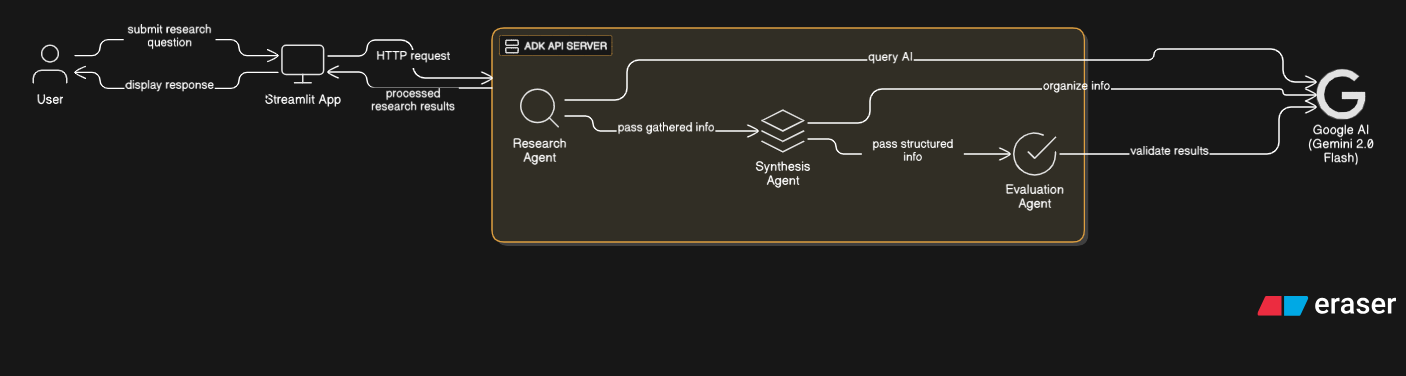
- Gathers Information: The Research Agent scours various sources to collect relevant data
- Organizes Content: The Synthesis Agent structures the information logically
- Validates Quality: The Evaluation Agent ensures accuracy and reliability
- Delivers Results: Produces well-formatted outputs in various styles (reports, debates, analyses)
How we built it
We architected the solution using modern technologies and best practices:
- Frontend: Built with Streamlit for an intuitive, responsive user interface
- Backend: Implemented using FastAPI and ADK (Agent Development Kit)
- Multi-Agent System: Designed with specialized agents for research, synthesis, and evaluation
- Cloud Infrastructure: Containerized with Docker and deployed on Google Cloud Run
- Version Control: Managed with Git and GitHub for collaborative development
Challenges we ran into
Building this system came with several significant challenges:
- Agent Coordination: Ensuring smooth communication between different AI agents
- Dependency Management: Resolving package version conflicts, especially with ADK
- Real-time Updates: Implementing progress tracking for long-running research tasks
- Cloud Deployment: Configuring the application for serverless deployment
- Environment Setup: Managing different configurations for local and cloud environments
Accomplishments that we're proud of
- Successfully implemented a multi-agent system that collaborates effectively
- Created a user-friendly interface that makes complex research tasks simple
- Achieved seamless cloud deployment with auto-scaling capabilities
- Built a flexible output system that adapts to different research needs
- Maintained high code quality and documentation standards
What we learnt
The development process provided valuable insights into:
- AI Systems: Designing and implementing multi-agent architectures
- Cloud Technologies: Working with Google Cloud Run and container orchestration
- Modern Web Development: Using Streamlit and FastAPI effectively
- DevOps Practices: Managing cloud deployments
- Software Architecture: Building scalable and maintainable systems
What's next for Research Assistant Application
- Enhanced AI Capabilities:
- Advanced source verification
- Improved context understanding
- Real-time fact-checking
- User Experience:
- Customizable research templates
- Interactive result refinement
- Collaborative research features
- Technical Improvements:
- Support for more output formats
- Integration with academic databases
- Enhanced API capabilities
- Infrastructure:
- Multi-region deployment
- Enhanced caching system
- Improved error handling and recovery


Log in or sign up for Devpost to join the conversation.