-
-
Rescu Ex AI
Inspiration
In critical situations like accidents, physical assaults, or sudden health failures, victims often panic, faint, or cannot physically interact with a smartphone. Existing safety apps fail because they require manual unlocking, typing, or assume the victim can talk clearly to an emergency responder. We wanted to build a hands-free solution that speaks and acts for the victim when they are completely incapacitated.
What it does
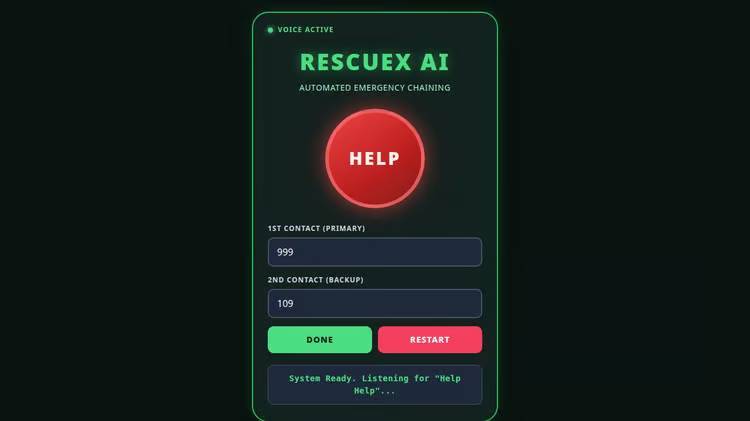
RescuEX AI is an autonomous, voice-activated emergency chaining engine. The moment a user shouts "Help, Help" or presses the main button, the system triggers three instant actions: it locks high-accuracy live GPS coordinates in the background, loops a pre-recorded emergency audio broadcast at maximum volume over the device speakers, and initiates an alternating 12-cycle cellular call chain between a primary and backup contact using the phone's native network line.
How we built it
We developed the core infrastructure using HTML5, CSS3, and JavaScript, styled with a high-visibility cyber-mint neon theme. We integrated the Web Speech API for real-time background voice recognition and the native Geolocation API for constant tracking. The fail-safe call switching system uses custom JavaScript interval logic linked with tel: URI protocols to push sequential calls to native mobile layers without requiring backend databases.
Challenges we ran into
Bypassing modern browser security restrictions to play audio and launch cellular dialers without prior touch interaction was a major obstacle. We solved this by designing an initial permission sync on page load and structuring a defensive workflow. Handling alternating call intervals securely while maintaining state tracking without a server backend also required rigorous logic testing.
Accomplishments that we're proud of
We successfully built a zero-touch, fail-safe SOS ecosystem that works directly within web architectures. We are incredibly proud of the alternating 12-cycle call loop engine, ensuring that if one contact is unreachable, the system automatically routes the call to the backup contact back and forth until a connection is attempted.
What we learned
We learned how to leverage hardware-level APIs like speech recognition and GPS directly through client-side scripting. We also mastered state management in asynchronous environments and discovered effective methods to design highly responsive, high-contrast user interfaces for stressful, real-world emergency scenarios.
What's next for RescuEX AI
Next, we plan to implement automated SMS broadcasting with real-time Google Maps links alongside cellular calls. We also intend to integrate lightweight, on-device AI models to detect distress keywords in multiple local languages and background noise patterns, transforming it into a universal safety companion.


Log in or sign up for Devpost to join the conversation.