Inspiration
During disasters, critical information is often scattered across messages, data sources, and teams. Responders must quickly understand what happened, who is at risk, what resources are available, and what action to take next.
We built RescueNet AI to transform Slack from a communication tool into an intelligent disaster-response coordination workspace.
What it does
RescueNet AI is a Slack-native multi-agent disaster response system.
A disaster report triggers an end-to-end workflow:
Incident Report → AI Agent Analysis → Risk Assessment → Resource Planning → Response Plan → Human Approval → Slack Coordination → Audit Trail
Specialized agents analyze hazards, affected populations, resources, logistics, and safety. RescueNet generates evidence-grounded recommendations with confidence and uncertainty information.
High-impact actions are never executed autonomously. A human coordinator must approve, modify, reject, or escalate them.
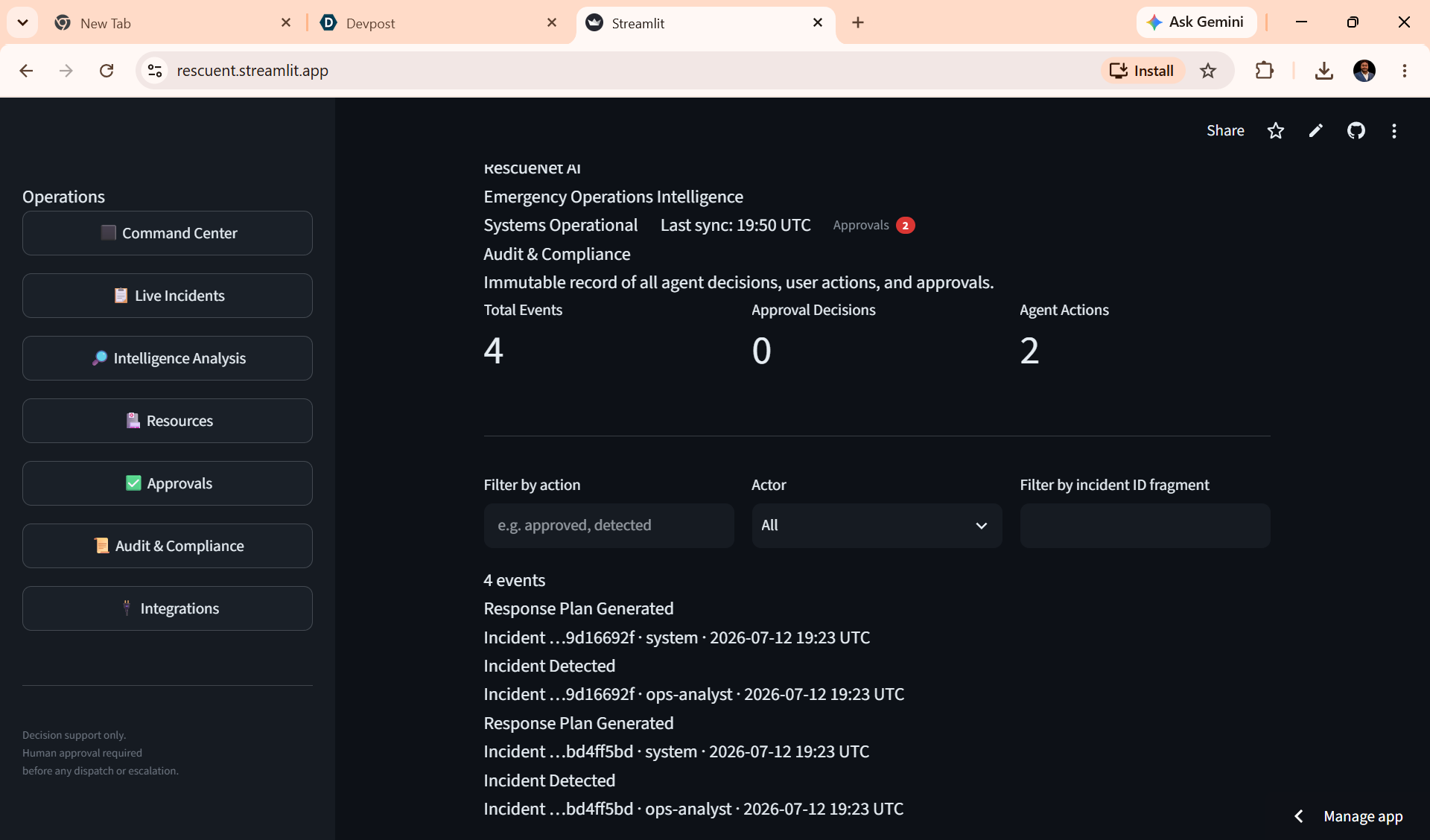
An interactive Streamlit Command Center provides operational visibility into incidents, agent activity, response plans, resources, approvals, and audit history.
How we built it
We built RescueNet AI as a modular agentic architecture with:
- Slack as the primary collaboration interface
- A supervisor/orchestrator coordinating specialized agents
- Shared incident state across the workflow
- Tool and external-data integrations for disaster intelligence
- Evidence, confidence, and failure tracking
- Human-in-the-loop approval gates
- Streamlit for visualization, simulation, analytics, and auditability
Each agent owns a specific responsibility and contributes structured outputs to the final response plan.
Challenges we ran into
The biggest challenge was building a real coordinated agentic workflow instead of multiple disconnected LLM calls.
We had to manage shared state, agent orchestration, external API failures, incomplete incident information, Slack interaction, and reliable demonstrations.
The hardest design decision was balancing AI autonomy with safety. RescueNet had to move fast while keeping consequential decisions under human control.
Accomplishments that we're proud of
We built an end-to-end workflow that turns an unstructured disaster report into structured, actionable intelligence.
We are especially proud of:
- Multi-agent collaboration around shared incident state
- Slack-native incident coordination
- Evidence and confidence-aware recommendations
- Resource and response planning
- Human approval before consequential actions
- Complete incident and decision auditability
- Graceful fallback when external services are unavailable
RescueNet AI demonstrates how humans and AI agents can work together during time-critical situations.
What we learned
We learned that successful agentic systems require much more than adding multiple agents.
Agents need clear responsibilities, shared state, reliable tools, orchestration, observability, failure handling, and safety boundaries.
We also learned that human-in-the-loop design should be part of the core architecture—not an afterthought—especially in high-impact applications.
What's next for RescueNet AI
Next, we plan to add more authoritative weather, geospatial, population, infrastructure, and humanitarian data sources.
We will expand:
- Geospatial reasoning and route intelligence
- Slack-native interactive workflows
- Multilingual emergency communication
- Agent evaluation, tracing, and observability
- Role-based access control
- Low-connectivity and offline response support
- Integration with verified emergency-response systems
Our vision is simple:
RescueNet AI should help response teams understand incidents faster, coordinate resources better, and make safer human-approved decisions when every minute matters.

Log in or sign up for Devpost to join the conversation.