-
-
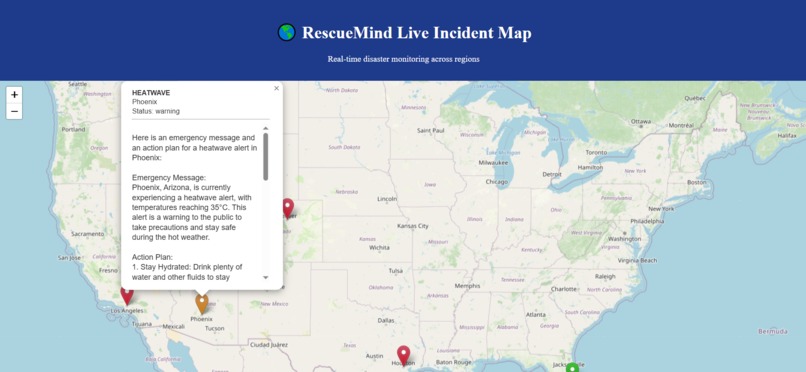
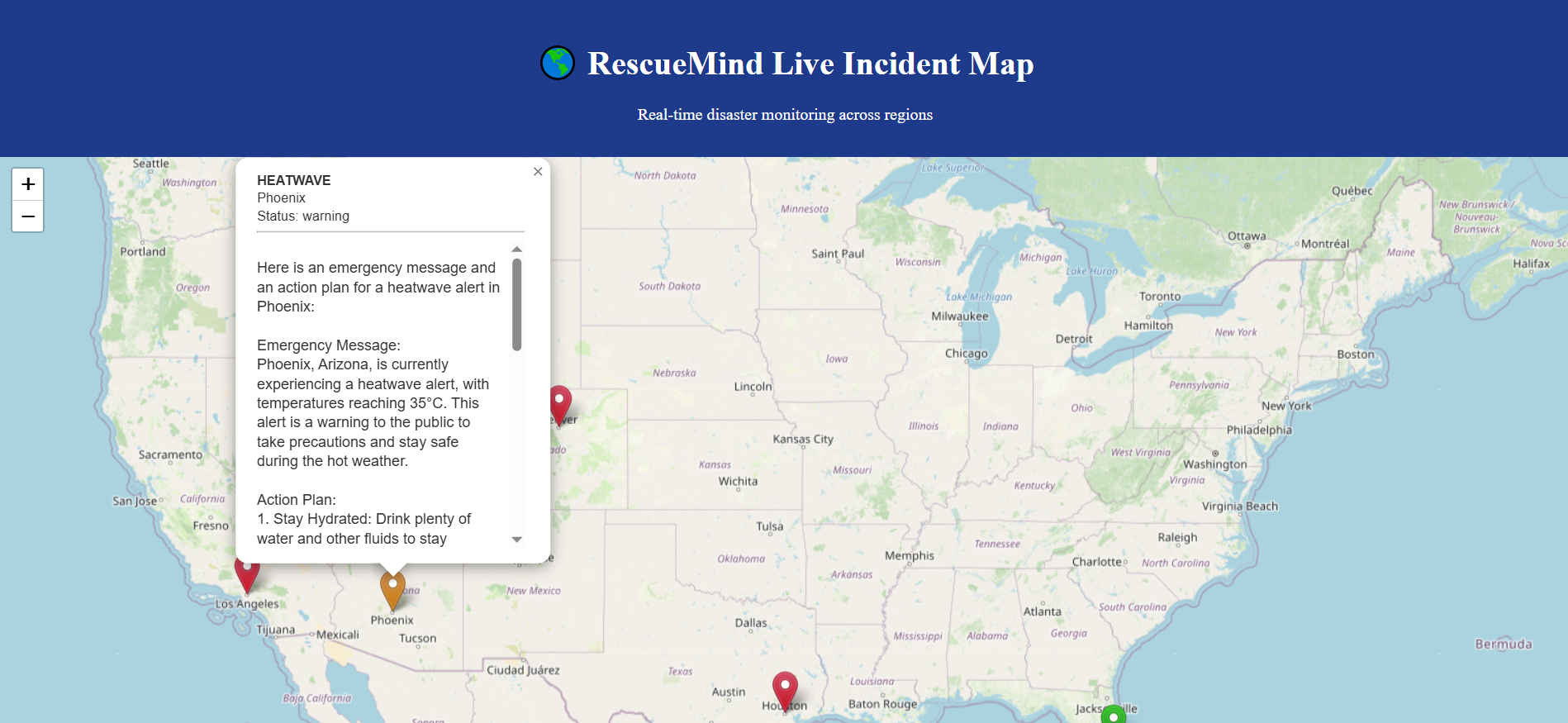
map rendering
-
logo
-
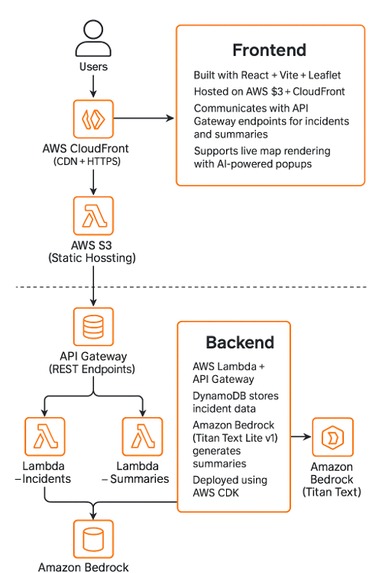
architecture
💡 ## About the Project** 🧭 **Inspiration The idea for RescueMind stems from a background in disaster risk reduction and a PhD in geography, where the challenges of timely and coordinated response are a daily reality. When a crisis hits — floods, earthquakes, or wildfires — responders often lack actionable intelligence fast enough to make decisions. The goal behind RescueMind was to leverage AI and serverless technologies to enable real-time triage, planning, and decision-making, accessible to any responder, anywhere in the world.
⚙️ What It Does RescueMind follows an intelligent Triage → Planning → Acting → Learning pipeline:
🔹 Triage Automatically classifies incidents by event status ("active", "warning", "contained", "resolved") using a combination of rules based on criteria like : -Weather conditions -Population density -Distance to critical infrastructure (hospitals, roads, shelters) 🔹 Planning Suggest adaptation and mitigation plan 🔹 Acting Persists the plan in DynamoDB, updates the map interface 🔹 Learning (optional) Writes back the decision rationale and outcomes to a short-term memory store for later analysis, audit, or reinforcement — creating a self-improving response model.
🛠️ ** How We Built It ** RescueMind is powered by a fully serverless and event-driven stack:
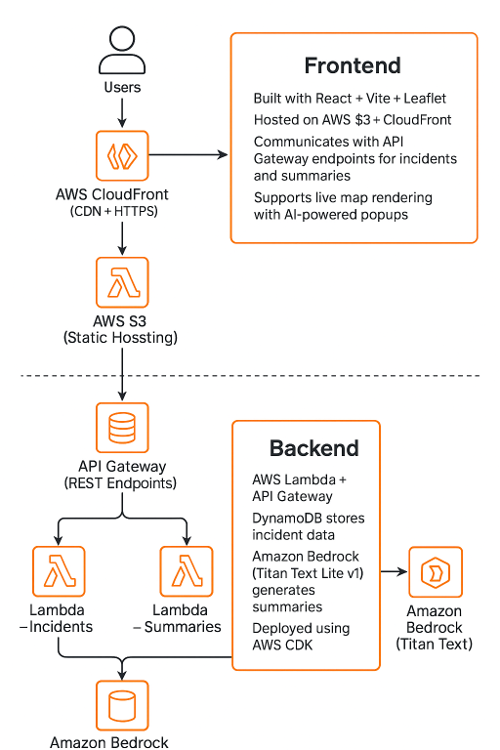
Component | Technology Frontend | React + Vite + Leaflet (real-time map rendering) Backend | AWS Lambda + API Gateway + DynamoDB AI Summaries | Amazon Bedrock (Titan Text Lite v1) Infrastructure | AWS CDK (TypeScript) Hosting | AWS S3 + CloudFront (global delivery)
🧗 *Challenges We Ran Into *
Deploying a secure, multi-service AWS pipeline with live data flow between AI models, Lambdas, and API Gateway required careful orchestration.
Key challenges included: Handling ESM/CommonJS incompatibilities in Lambda functions Configuring CORS between CloudFront and API Gateway Ensuring least-privilege IAM roles for Bedrock access Balancing performance and cost in a serverless deployment
🏆 *Accomplishments We’re Proud Of * ✅ The platform runs end-to-end — from incident ingestion to AI summary generation and live map rendering. ✅ Fully serverless architecture with zero maintenance overhead. ✅ Low-latency, scalable, and suitable for real-world emergency simulations. ✅ Smooth integration of Bedrock’s Titan model into a real-time response workflow.
📚 *What We Learned * AWS orchestration patterns simplify complex automation when properly designed. Integrating AI into operational systems requires careful consideration of latency, authentication, and data consistency. Using Infrastructure as Code (CDK) accelerates reproducibility and collaboration. Human-in-the-loop validation remains essential for safety-critical AI systems.
🚀 *What’s Next for RescueMind *
🌦️ Integrate live weather and satellite feeds (NOAA, Copernicus) for real-time awareness 🧩 Add multi-incident clustering for regional triage and coordination 🌍 Enable multi-language AI summaries with Bedrock models 📱 Build a PWA mobile companion app for field responders 🧠 Expand the learning memory into a feedback-driven prediction engine for continuous risk evaluation
Built With
- amazon-cloudfront-cdn
- amazon-dynamodb
- amazon-web-services
- bedrock
- cdk
- gpt
- lambda
- leaflet.js
- llm
- react
- s3