-
-
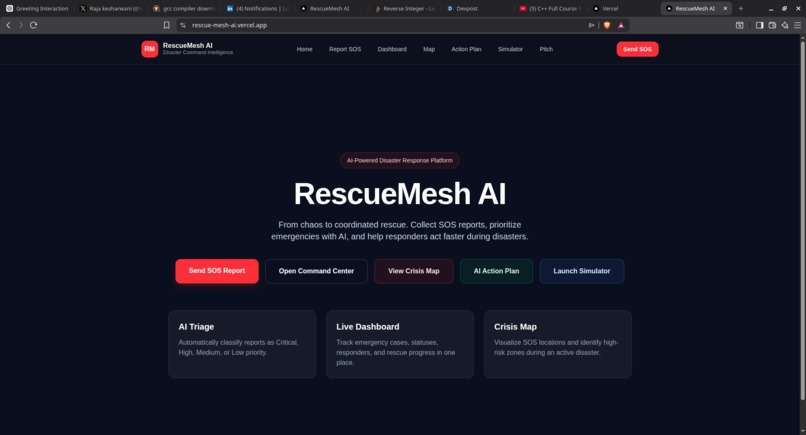
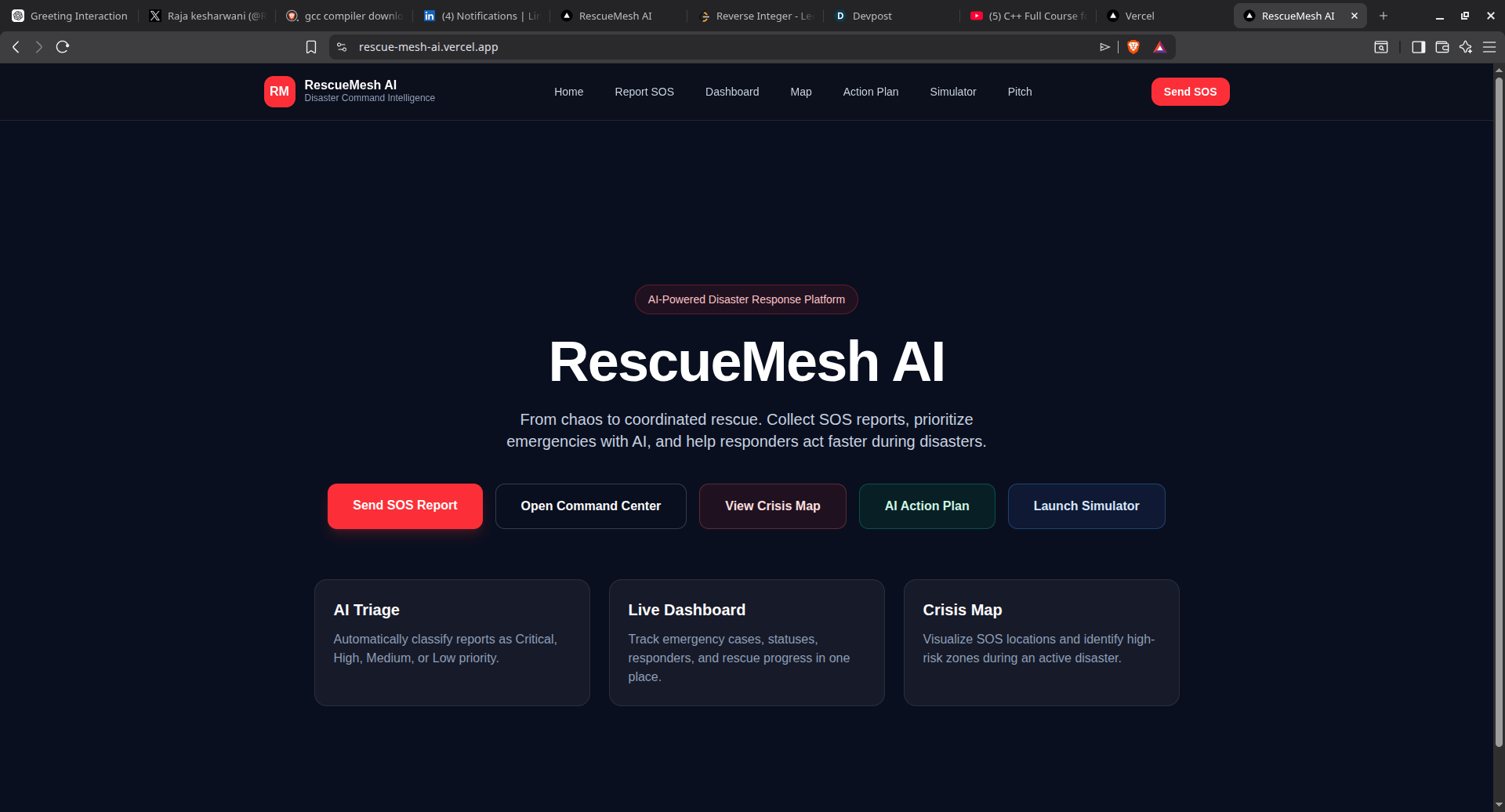
Home page
Inspiration
RescueMesh AI is inspired by the chaos that happens during natural disasters and emergency situations. During floods, earthquakes, wildfires, hurricanes, and large-scale accidents, people often send SOS messages through calls, forms, chats, and social media. These reports can become overwhelming for responders, and the most urgent cases may be delayed.
I wanted to build a system that turns scattered emergency reports into organized rescue intelligence. The goal is simple: help responders identify who needs help first, what resources are needed, and where teams should go.
What it does
RescueMesh AI is an AI-powered disaster response platform that helps emergency teams manage SOS reports and coordinate rescue operations.
Users can submit an emergency report with their location, incident type, number of people affected, and specific details. RescueMesh then analyzes the report and generates:
- A priority level: Critical, High, Medium, or Low
- A responder-ready rescue summary
- Recommended resources such as evacuation teams, medical responders, rescue boats, fire units, shelter support, food, and water
- A possible duplicate report warning
- Offline local saving when internet connectivity is unstable
The command dashboard allows coordinators to:
- View all emergency reports
- Filter by priority and status
- Assign responder teams
- Set estimated arrival times
- Track case status from Pending to Rescued
- Open a crisis map with priority-colored markers
- Generate an AI-style action plan for rescue sequencing and resource demand
I also built a disaster simulator so judges can instantly load a realistic crisis scenario and test the full workflow.
How I built it
I built RescueMesh AI using:
- Next.js for the application framework
- TypeScript for safer and more maintainable code
- Tailwind CSS for the interface design
- Leaflet and React Leaflet for the crisis map
- LocalStorage for prototype data persistence and offline SOS behavior
- Vercel for deployment
The app is structured around key pages:
/reportfor SOS submissions/dashboardfor emergency coordination/mapfor crisis visualization/commandfor the AI action plan/simulatorfor demo crisis data/pitchfor the hackathon presentation view
For the prototype, the AI logic is implemented as a rule-based triage system using emergency keywords, affected population size, incident type, and resource matching. This makes the demo fast, explainable, and reliable for hackathon judging. In a production version, this layer could be replaced or expanded with a real LLM API and verified emergency response protocols.
Challenges I faced
One major challenge was designing a product that felt useful in a real emergency while still being realistic to build during a hackathon. Disaster response is complex, so I focused on the most important workflow:
SOS report → AI triage → resource recommendation → responder assignment → map visualization → action plan
Another challenge was making the project global instead of region-specific. I adjusted names, phone numbers, incidents, and locations so the product feels useful for global emergency response teams.
I also faced technical challenges while integrating the map in Next.js because Leaflet depends on browser-only APIs. I solved this using dynamic imports, client components, Leaflet CSS, and a custom map component.
What I learned
I learned how to turn a broad emergency-response idea into a focused product workflow. I also learned how important it is to design for clarity during high-pressure situations. A disaster dashboard should not just look good — it should help people make decisions quickly.
Technically, I improved my understanding of:
- Next.js App Router
- TypeScript data modeling
- State management with React hooks
- LocalStorage persistence
- Offline-first prototype behavior
- Leaflet map integration
- Dashboard and command-center UI design
- Building a complete Devpost-ready product
Accomplishments that I am proud of
I am proud that RescueMesh AI is more than a simple form or chatbot. It includes a full emergency coordination flow:
- SOS reporting
- AI-style triage
- Duplicate detection
- Offline saving
- Resource matching
- Responder assignment
- ETA tracking
- Crisis mapping
- Disaster simulation
- AI command action plan
- Live deployment
The project feels like a real disaster command platform and can be demonstrated clearly in just a few minutes.
What's next
Future improvements include:
- Real AI integration with Gemini or OpenAI
- Supabase or Firebase for real-time multi-user data
- GPS-based location capture
- SMS and WhatsApp SOS intake
- Image-based damage assessment
- Multi-language emergency reporting
- Authentication for coordinators and responders
- Push notifications for assigned rescue teams
- Route optimization for responders
- Integration with local emergency services and NGO systems
RescueMesh AI is a prototype, but the vision is to become a practical disaster coordination layer that helps responders move from chaos to coordinated rescue.
Built With
- effect-ts
- nextjs
- typescript


Log in or sign up for Devpost to join the conversation.