Demo (Trupeer):https://app.trupeer.ai/view/40etRsIc5/rescue-ledger-audit-console-user-guide-roshan-and-mitesh
Inspiration
Manufacturers often reach audit week with messy operational data: duplicate shipments, conflicting units, orphan customer IDs, impossible quantities, and dates that contradict the production timeline. We built RescueLedger for the compliance officer who needs answers and evidence, not SQL queries.
## What it does
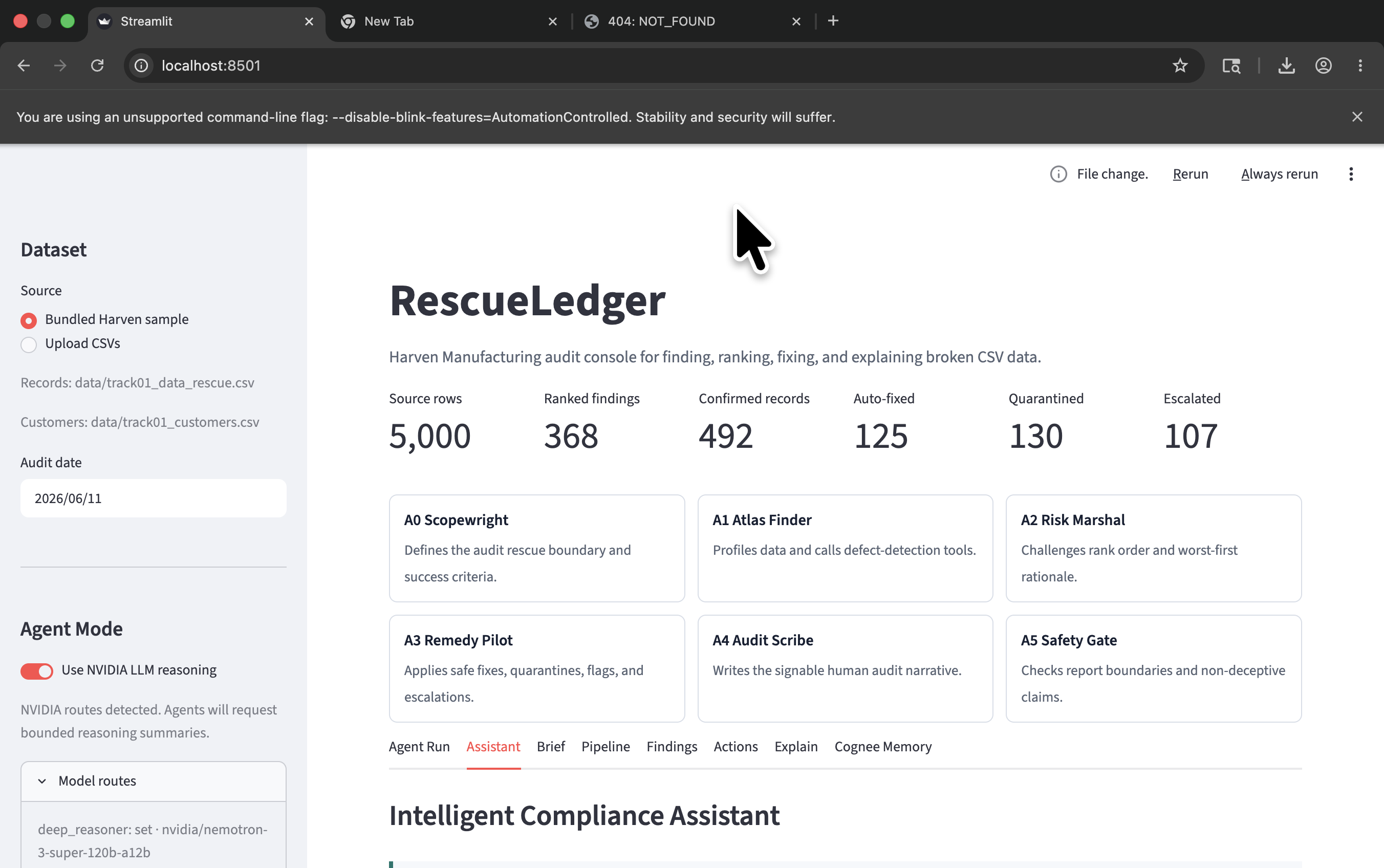
RescueLedger is an agentic data rescue console that finds broken manufacturing records, ranks the highest-risk issues, applies only defensible fixes, escalates unsafe corrections, and generates sign-off-ready audit documentation.
It includes:
- A visible multi-agent pipeline: Define, Find, Rank, Act, Explain, and Safety Gate.
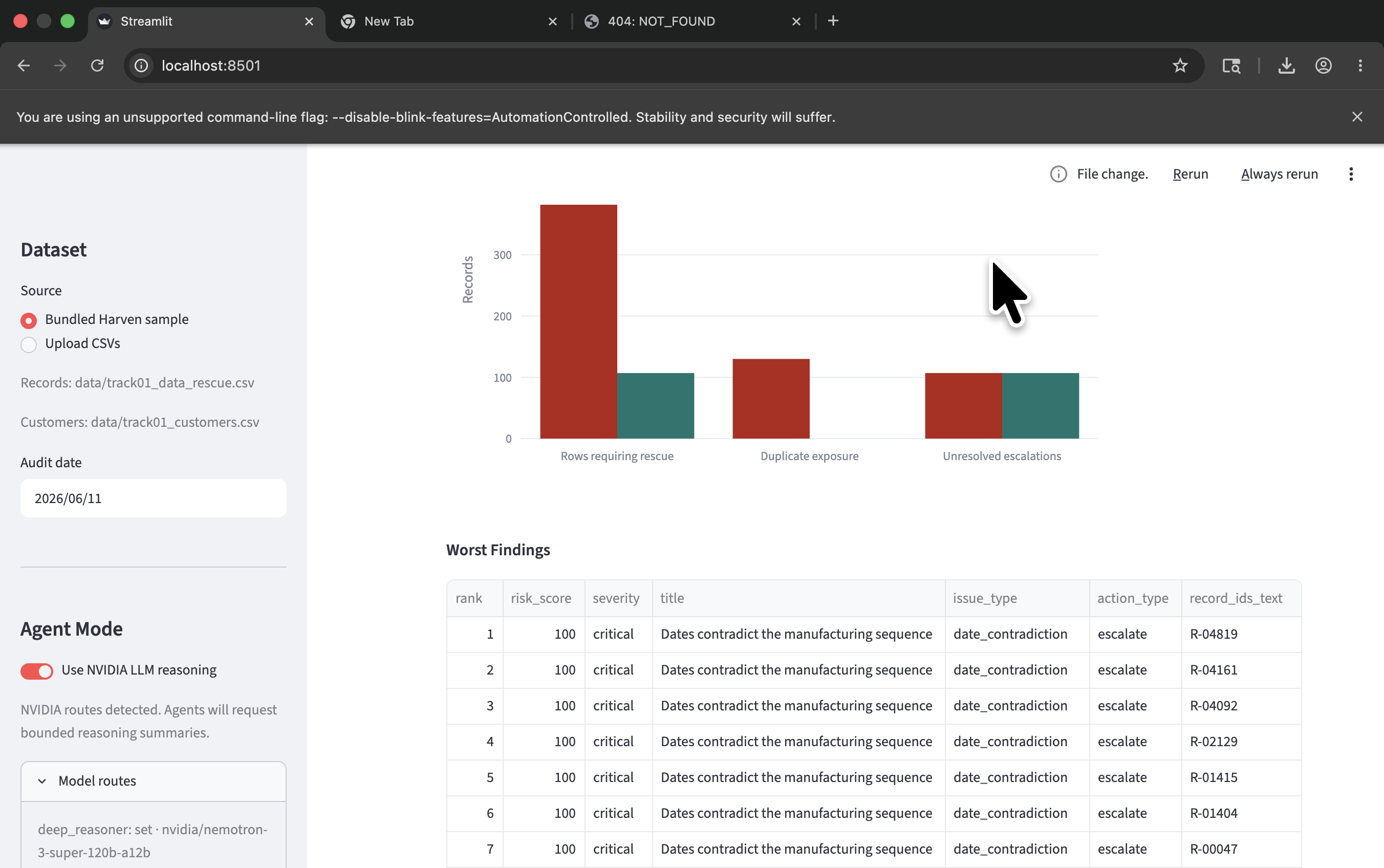
- Before/after dashboards showing clean export impact.
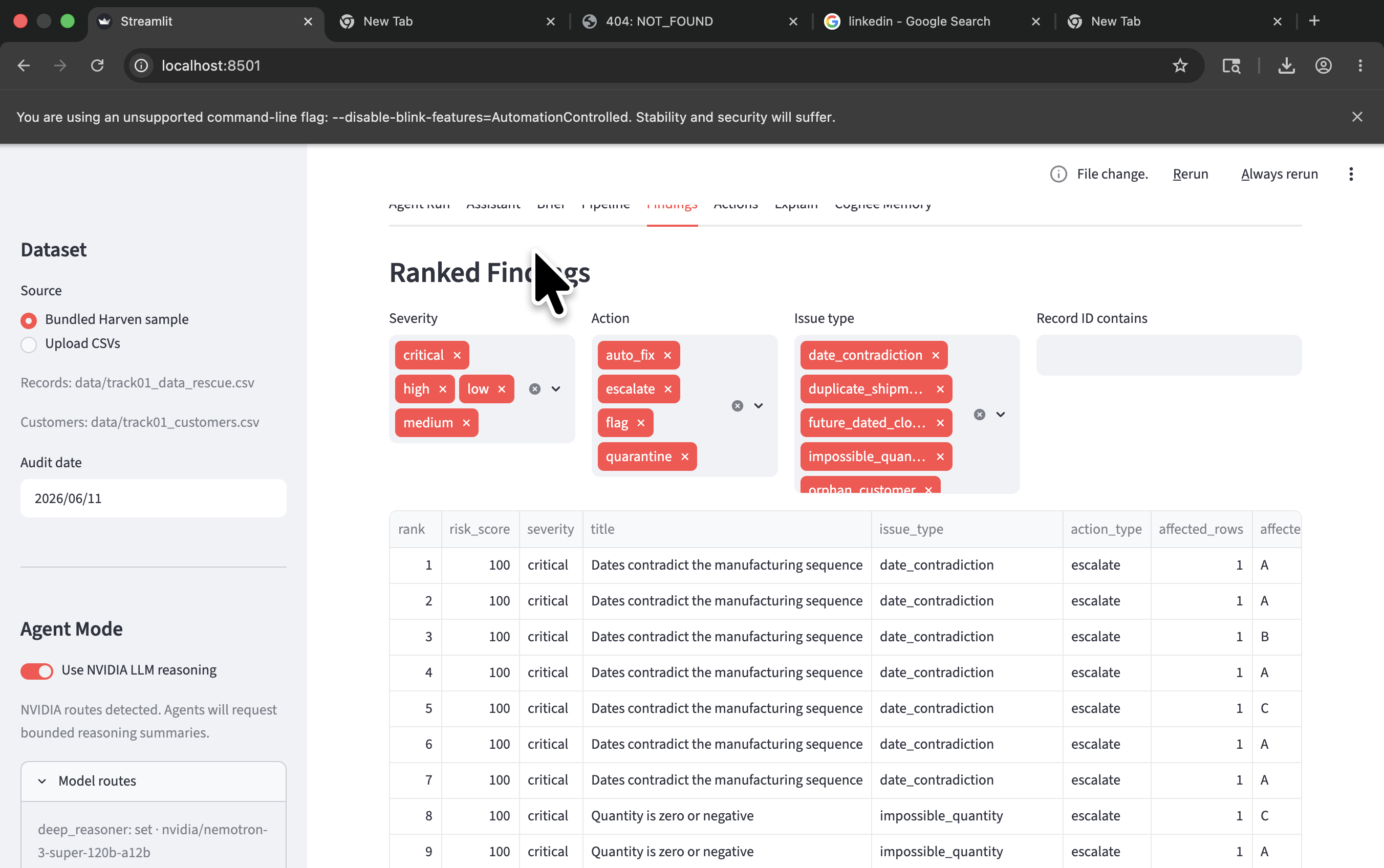
- Ranked findings with evidence and rule-backed reasons.
- Remediation logs for every action.
- A compliance assistant that answers questions with tables and charts.
- Deterministic PDF contract generation with two-party signature blocks.
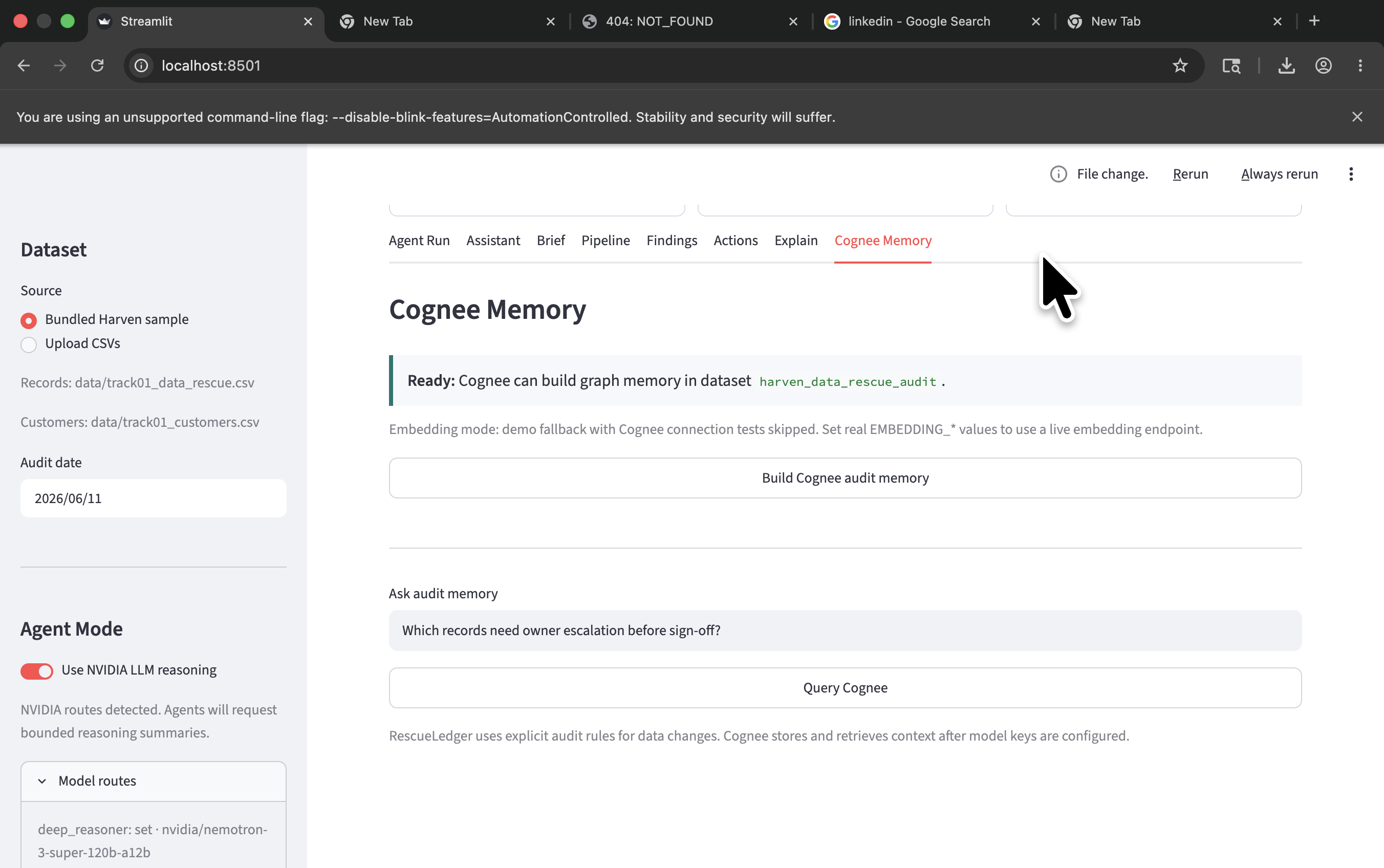
- Cognee-backed memory storage for audit context.
## How we built it
We built RescueLedger as a Streamlit application on top of a deterministic Python data-rescue pipeline. The pipeline reads the Track 01 CSVs, detects defects with explicit rules, scores findings, and creates clean exports plus audit evidence.
The agent layer wraps the pipeline with named agents:
- Scopewright defines audit scope.
- Atlas Finder profiles the data and finds defects.
- Risk Marshal reviews ranking logic.
- Remedy Pilot applies safe fixes and escalations.
- Audit Scribe drafts the human-readable summary.
- Safety Gate checks that claims are bounded and defensible.
We used NVIDIA Nemotron model routes for bounded reasoning summaries and intent parsing, while keeping data-changing actions deterministic. Cognee is used as the memory control plane for storing audit context. ReportLab powers PDF generation so contract documents can be generated quickly from structured JSON templates.
The risk score is intentionally explainable:
[ \text{risk} = f(\text{severity}, \text{confidence}, \text{row impact}, \text{audit exposure}) ]
The goal was not just to “clean data,” but to produce a trail a compliance officer could sign.
## Challenges we ran into
The hardest part was balancing agentic behavior with audit safety. We wanted the product to feel intelligent, but we could not let an LLM invent fixes for missing customers, dates, or quantities. We solved this by making LLMs explain and route, while deterministic tools perform the actual data actions.
Cognee integration also required care. Its default embedding connection check can block if no embedding endpoint is configured, so we added a demo-safe storage mode and clear UI status for graph extraction.
PDF generation had to be practical, not decorative. We added a proper execution page with signature areas for both Harven and the counterparty so the generated contract can immediately support workflow routing.
## Accomplishments that we're proud of
- Built a full Track 01 pipeline from product brief to working product.
- Detected and ranked hundreds of seeded data issues across 5,000 manufacturing rows.
- Created a visible agent trace that shows tools, reasoning summaries, and actions.
- Generated clean CSVs, action logs, findings JSON, narrative reports, and signed contract PDFs.
- Kept all remediation decisions explainable and rule-backed.
- Built the UI for a compliance officer, not an engineer.
## What we learned
We learned that “agentic” audit software needs restraint. The best agent is not the one that changes everything automatically; it is the one that knows which changes are safe, which need evidence, and which must be escalated.
We also learned that memory systems like Cognee are most useful when they store structured audit context, not raw noise. A compact, readable memory packet makes downstream retrieval and explanation much more reliable.
## What's next for RescueLedger
Next, we want to add:
- Real embedding-backed Cognee graph extraction and retrieval.
- More upload profiles for other regulated datasets.
- Human approval workflows for escalated records.
- E-signature provider integration.
- Source-system writeback after owner approval.
- More domain templates for supplier audits, batch records, inventory reconciliation, and CAPA documentation.

Log in or sign up for Devpost to join the conversation.