Inspiration## Inspiration
When a production system goes down, engineers often have to manually inspect logs, check telemetry, compare deployments, identify the root cause, decide on a recovery strategy, execute the fix, and then verify that the service has actually recovered.
We wanted to turn this repetitive incident-response workflow into an agentic system that can investigate, decide, act, verify, and document—while still keeping a human in control of high-risk production actions.
That led to RescueFlow AI, an autonomous SRE incident-response agent built for the Taskmaster track.
What RescueFlow AI Does
RescueFlow AI receives an operational incident such as a payment API outage and manages the response as a multi-step workflow:
- Detects and analyzes the incident.
- Checks service health and telemetry.
- Reads recent application logs.
- Examines deployment history.
- Uses Gemini to correlate the evidence and identify a probable root cause.
- Generates a recovery recommendation.
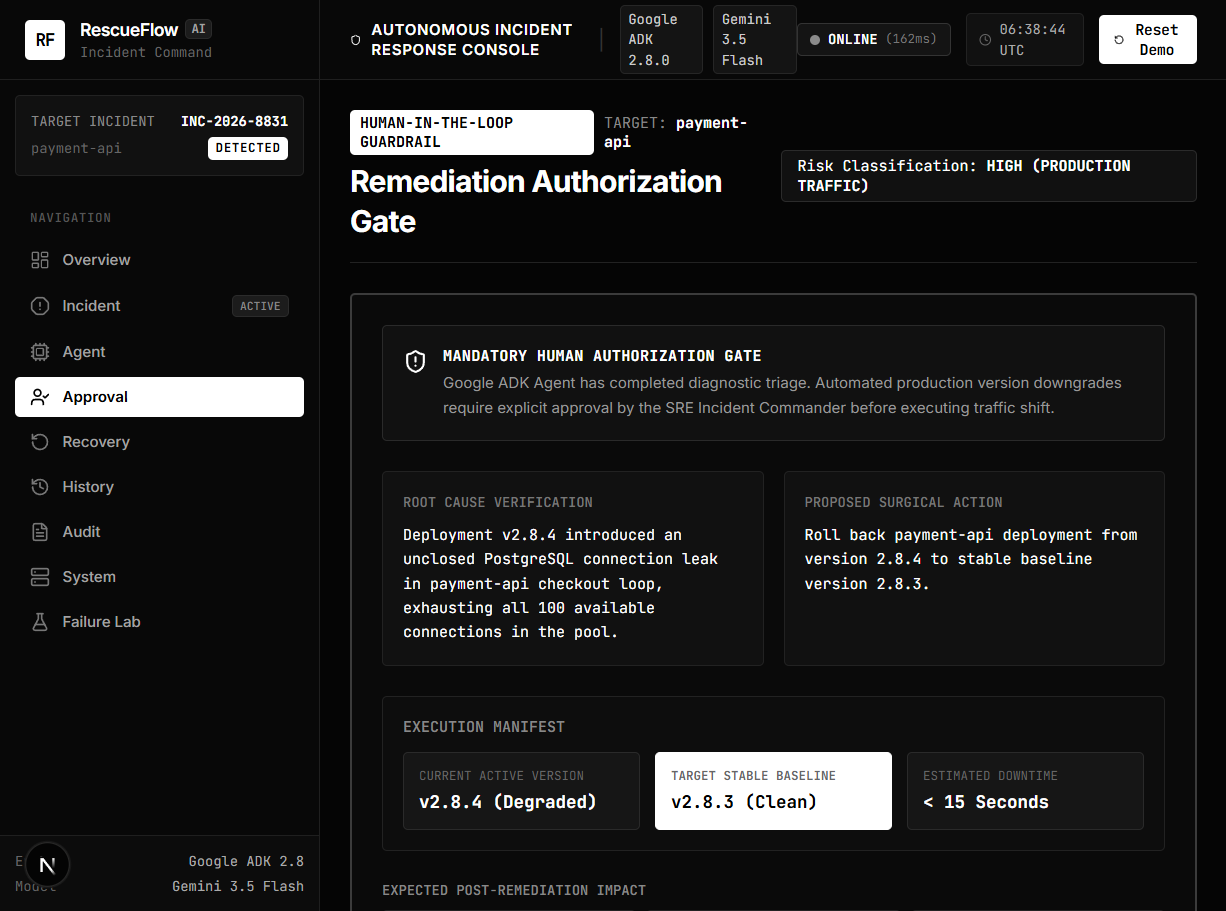
- Stops at a human-approval gate before a high-risk production action.
- Executes the approved rollback.
- Verifies service recovery using post-remediation telemetry.
- Stores the incident lifecycle and audit trail in Firestore.
The result is not simply an AI-generated answer. RescueFlow performs an operational workflow and produces measurable evidence of the action taken.
How We Built It
The project was built as a full-stack application with:
- Next.js for the incident command dashboard.
- FastAPI for the backend API.
- Google ADK 2.8.0 for agent orchestration.
- Gemini 3.5 Flash through Google Cloud/Vertex AI for incident analysis and decision support.
- Google Cloud Firestore for persistent incident state, investigation results, remediation history, and audit logs.
- Google Cloud Run for backend deployment.
- Python-based SRE tools for health checks, log inspection, deployment analysis, rollback, and recovery verification.
The application also includes a controlled simulated incident environment so the complete workflow can be reproduced consistently during testing and demonstration.
What We Learned
The biggest lesson was that building an agentic system is very different from building a chatbot.
A useful agent needs:
- Clear tools and tool boundaries.
- Persistent state.
- A structured workflow.
- Human approval for risky actions.
- Verification after executing an action.
- Failure handling and escalation.
- An audit trail showing what happened.
We also learned that the frontend should not pretend that an agent is working. The UI should reflect actual backend state, tool execution, approvals, and verification results.
Challenges We Faced
One of the biggest challenges was moving from a simulated frontend workflow to a real backend-driven agent workflow.
We also had to handle:
- Connecting Gemini and Google ADK to existing operational tools.
- Persisting incident state in Firestore.
- Handling rollback failures safely.
- Keeping the agent from performing high-risk remediation without approval.
- Deploying the FastAPI backend to Cloud Run.
- Making the frontend communicate with the deployed backend.
- Designing a clear interface that lets a judge understand the agent's actions quickly.
Another practical challenge was handling cloud-resource limitations while still preserving a reproducible architecture and demonstration workflow.
Why It Matters
Incident response is usually time-sensitive and operationally repetitive. RescueFlow AI demonstrates how an agent can take a real-world operational objective and turn it into an end-to-end action workflow:
Investigate → Understand → Plan → Approve → Execute → Verify → Record
Our goal is to move incident response from simply "telling engineers what to do" toward "helping systems actually do the work safely."
What it does
How we built it
Challenges we ran into
Accomplishments that we're proud of
What we learned
What's next for RescueFlow AI
Built With
- 3.5
- adk
- agentic
- agents
- ai
- artificial
- cloud
- devops
- engineering
- fastapi
- firestore
- gemini
- generative
- intelligence
- next.js
- observability
- python
- response
- run
- site
- typescript
- vertex
