-
-
Page 12
-
Page 4
-
Page 5
-
Page 9
-
Page 1
-
Page 3
-
Page 8
-
Page 10
-
Page 11
-
Page 6
-
Page 2
-
Page 7
🥗 RescueAI – Intelligent Food Redistribution Platform
Inspiration
Every day, restaurants, hotels, bakeries, and catering services discard large quantities of perfectly edible food while millions of people continue to face food insecurity. Existing donation processes are often slow, uncoordinated, and lack an efficient way to prioritize food before it expires.
We wanted to build a solution that bridges this gap by combining AI-inspired decision-making with intelligent logistics. Our goal was to create a platform that makes food donation simple, fast, and data-driven, ensuring that surplus food reaches the right NGO before it becomes waste.
What it does
RescueAI is an intelligent food redistribution platform that connects food donors with nearby NGOs through an automated rescue workflow.
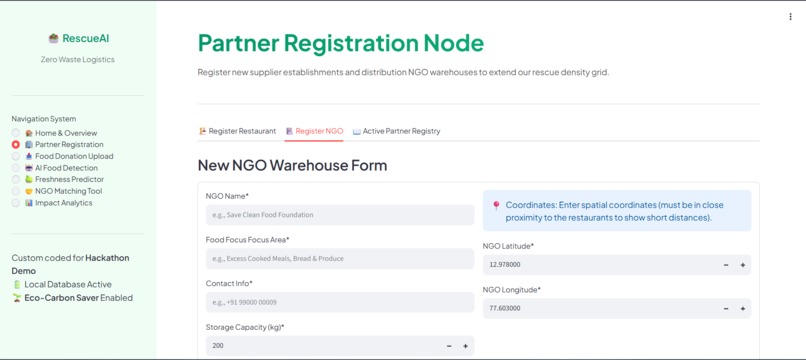
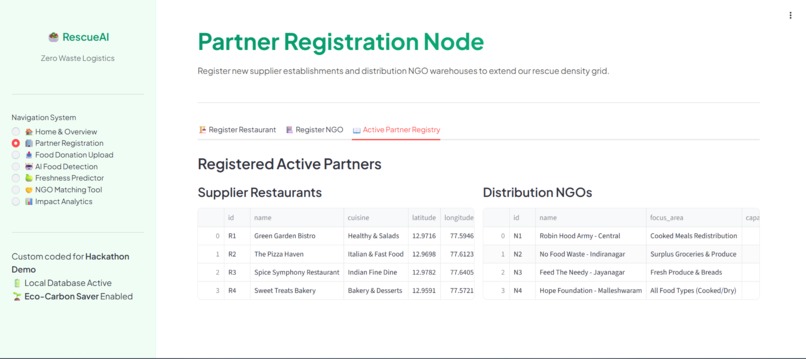
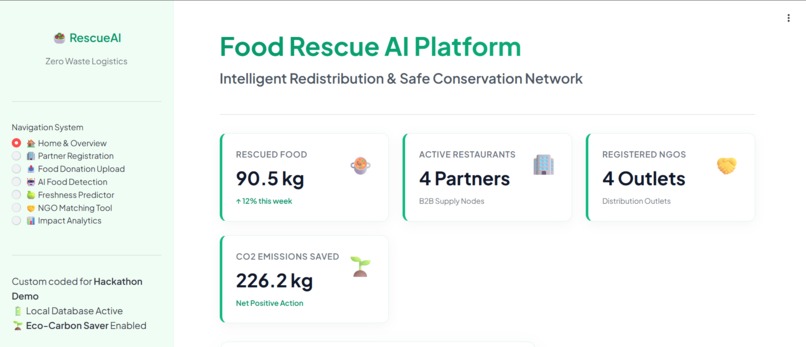
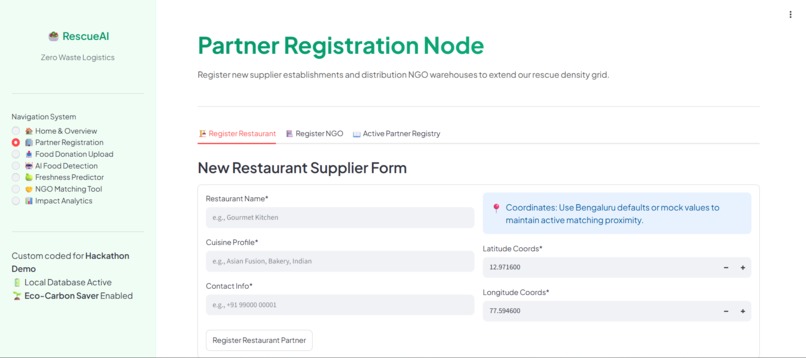
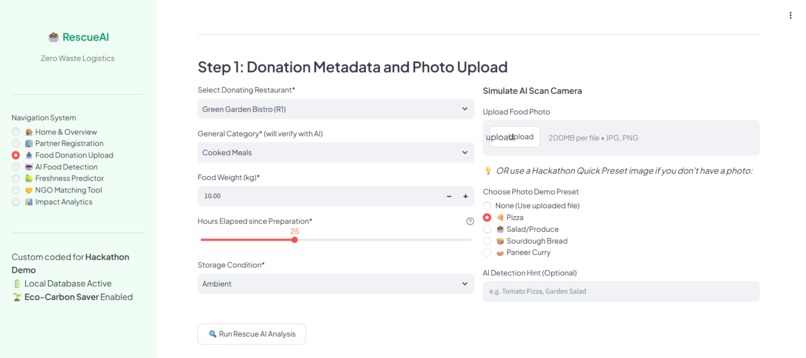
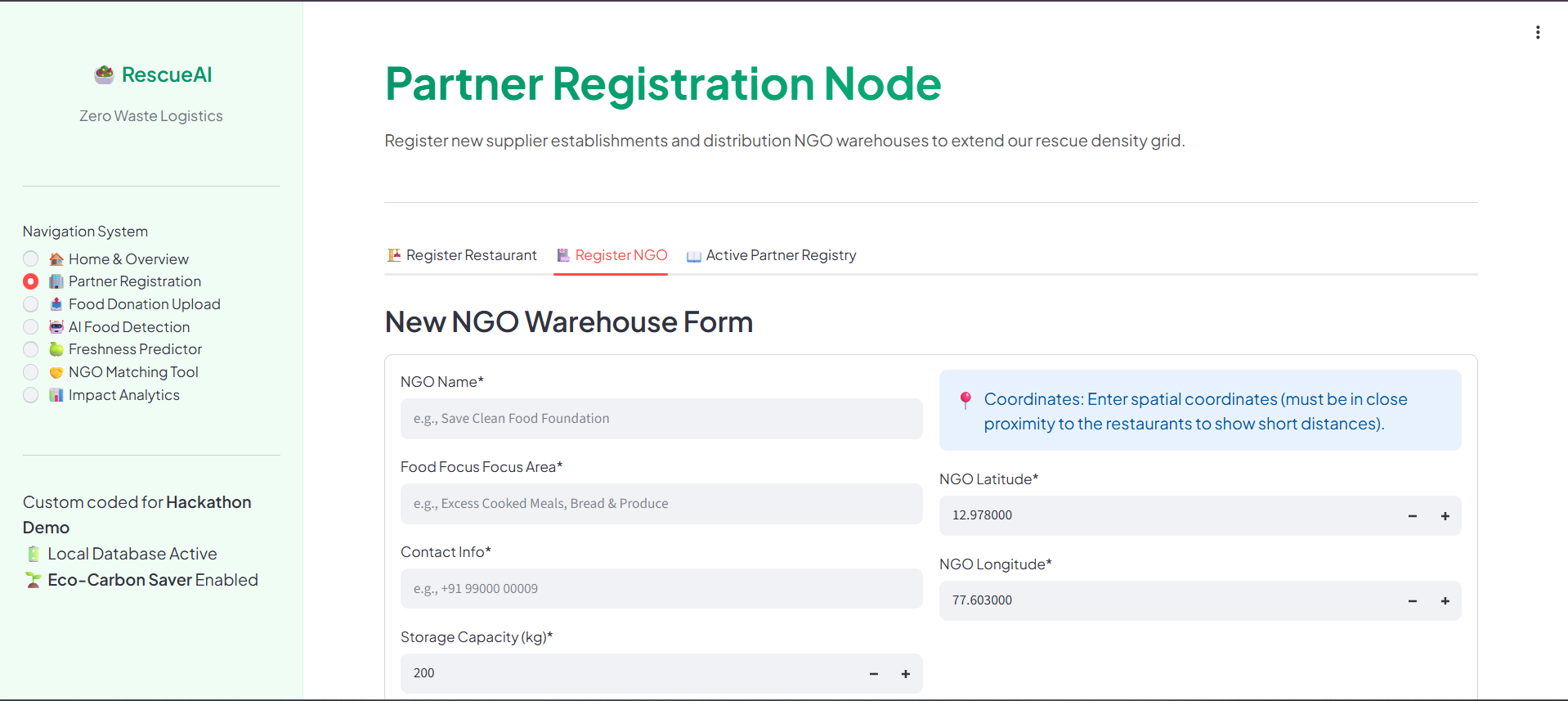
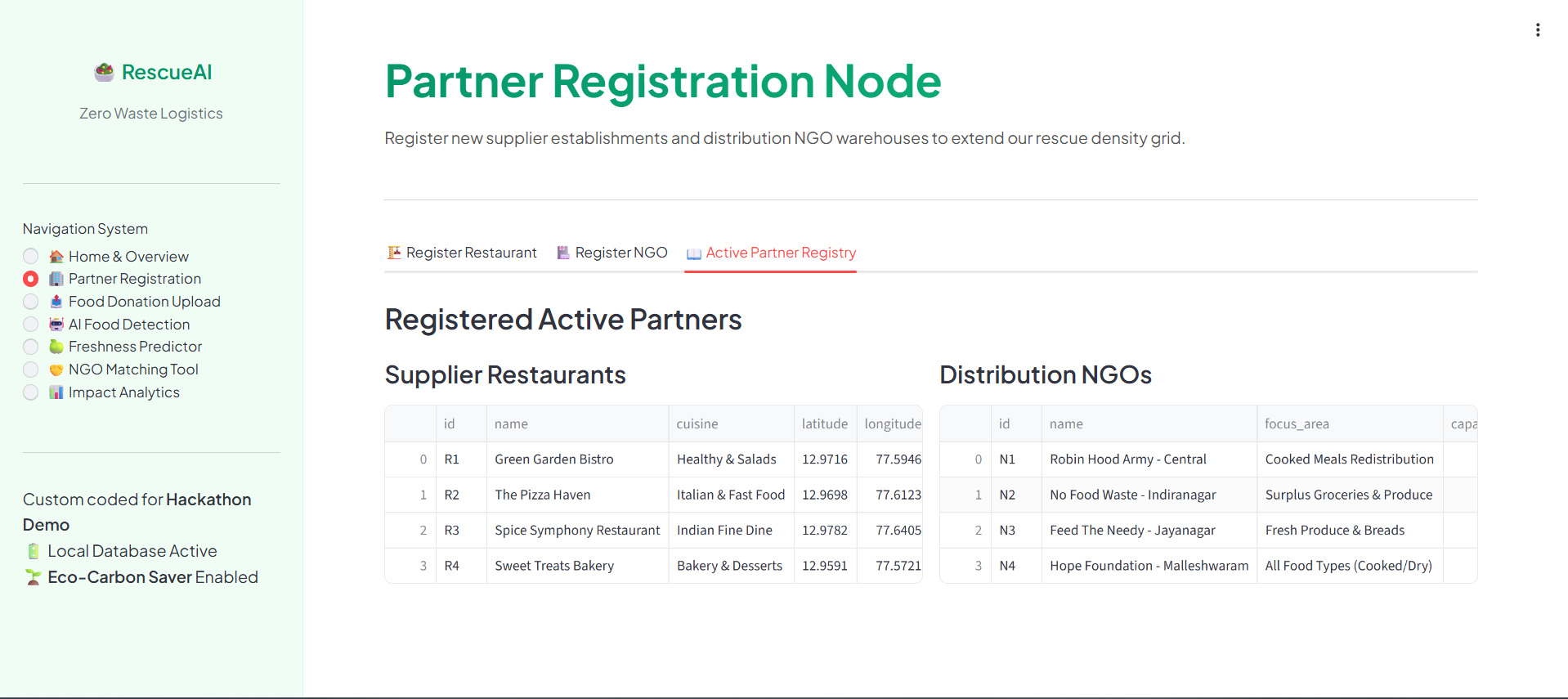
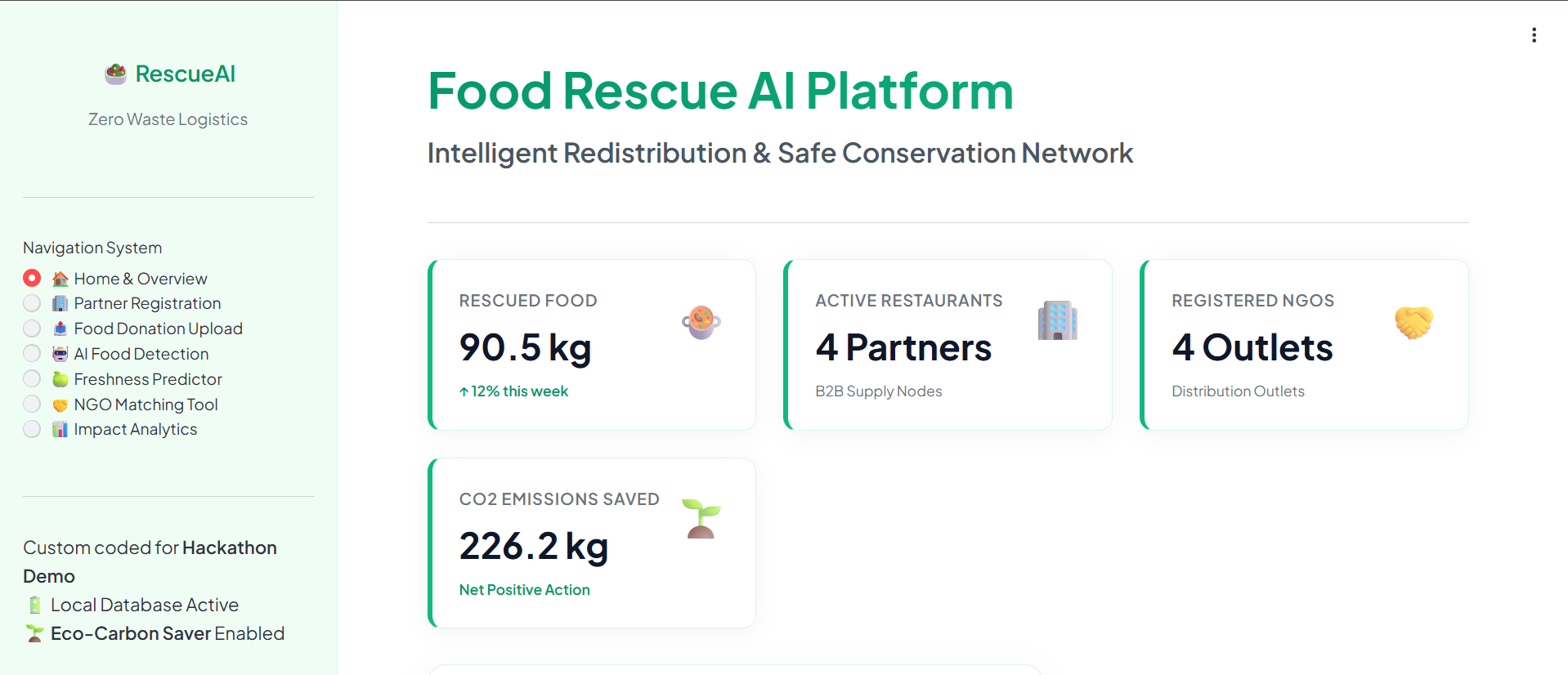
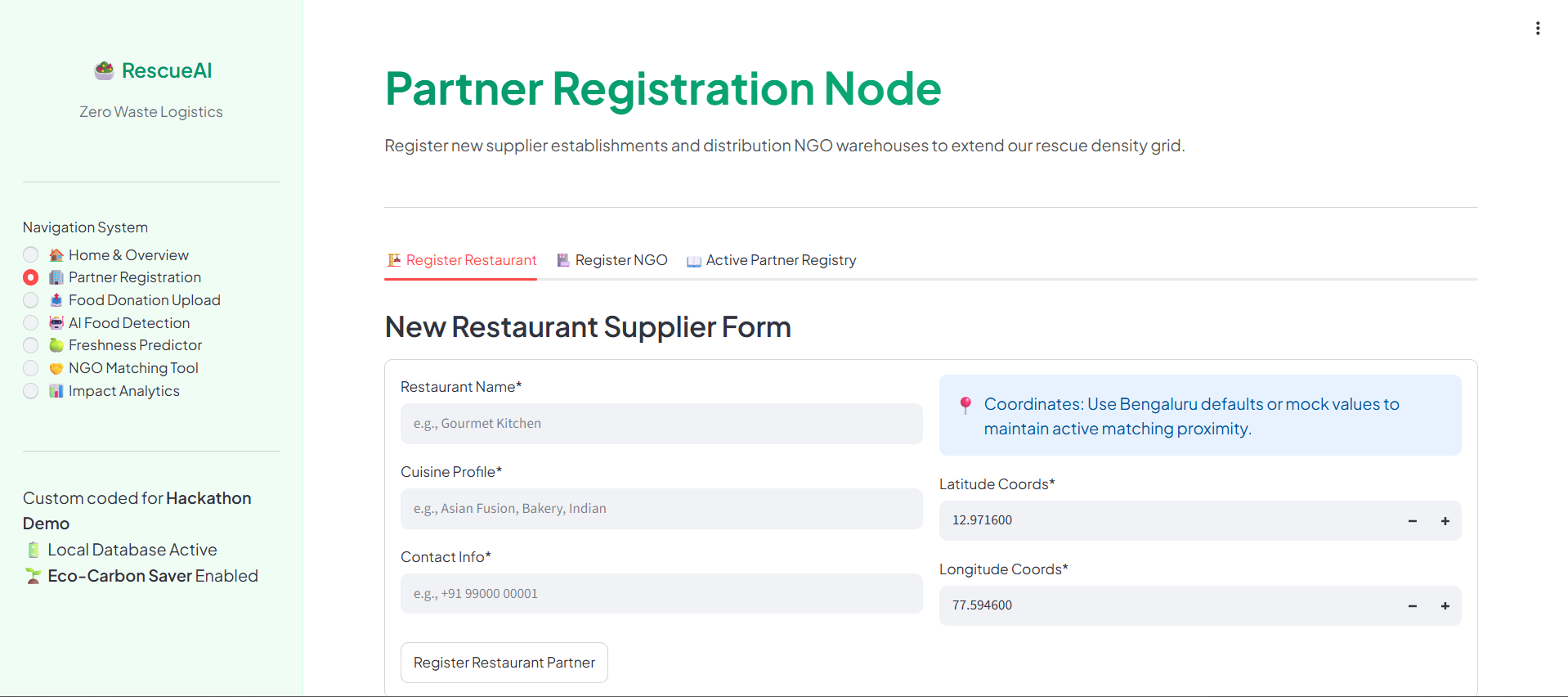
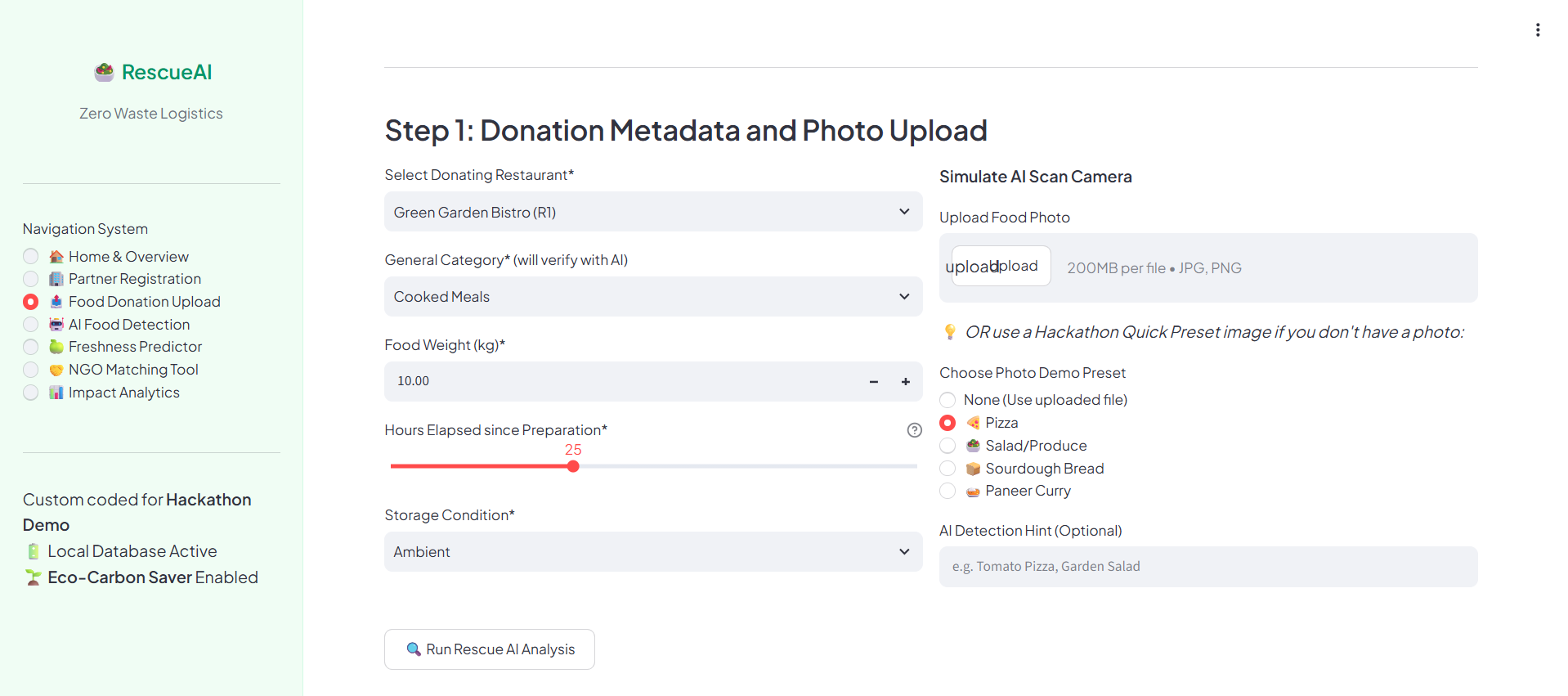
The platform allows restaurants to register, upload surplus food details, estimate food freshness, identify the closest suitable NGO, and track the environmental impact of every successful donation.
Key features include:
- 🍽️ Restaurant and NGO registration
- 📤 Food donation upload with image support
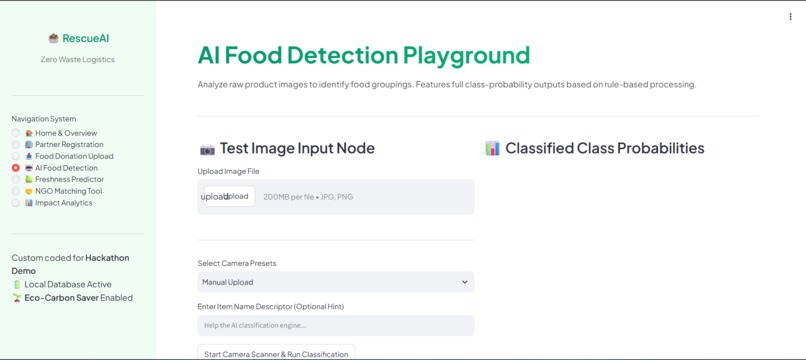
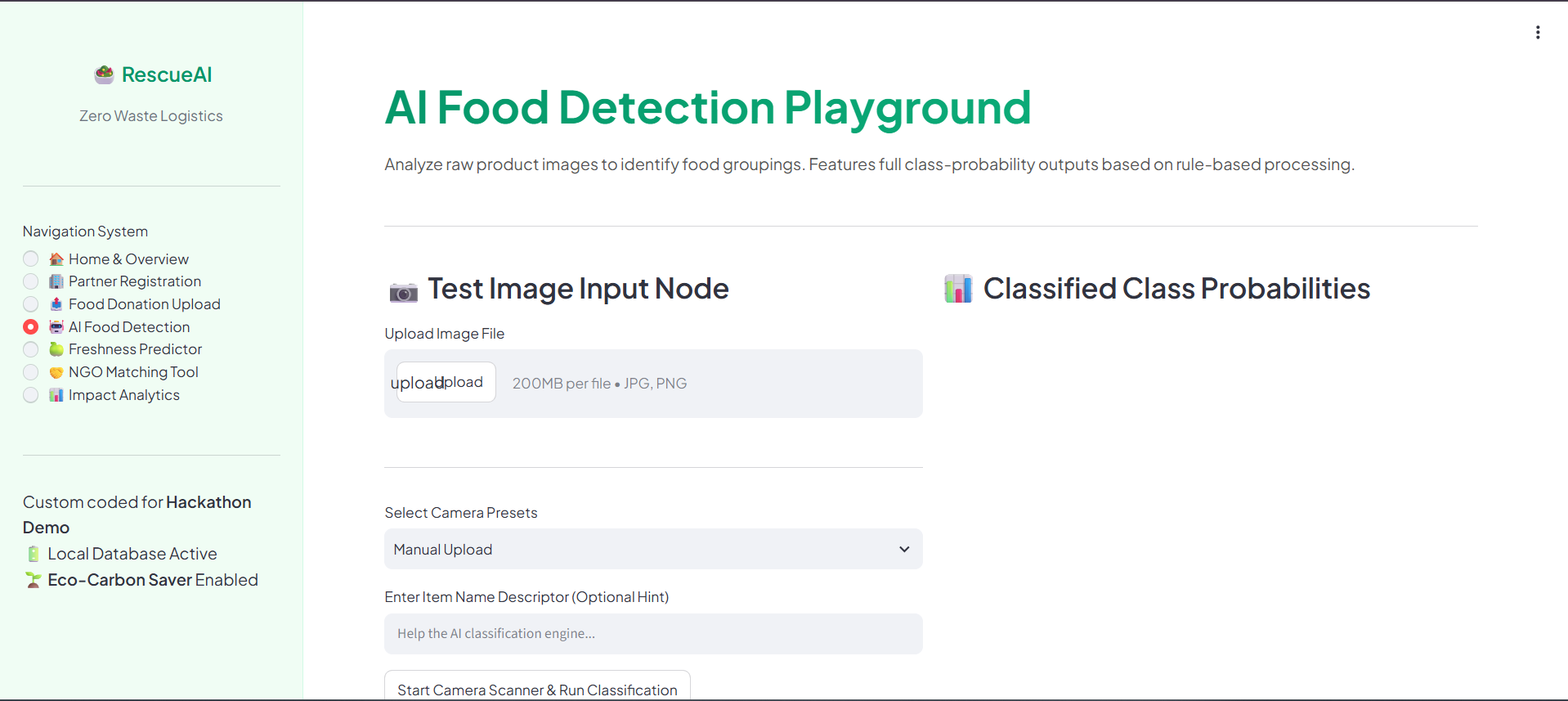
- 🤖 AI-inspired food category detection
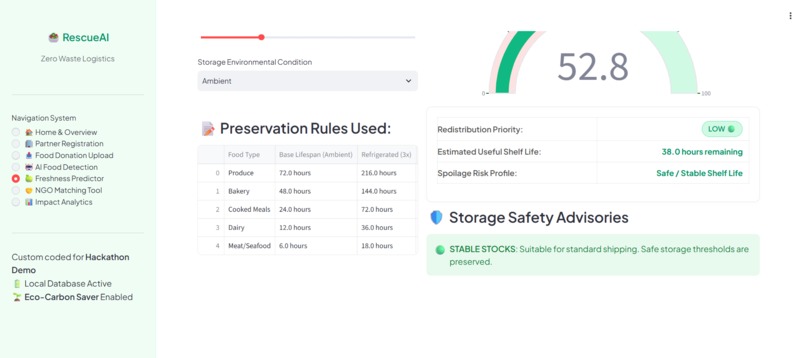
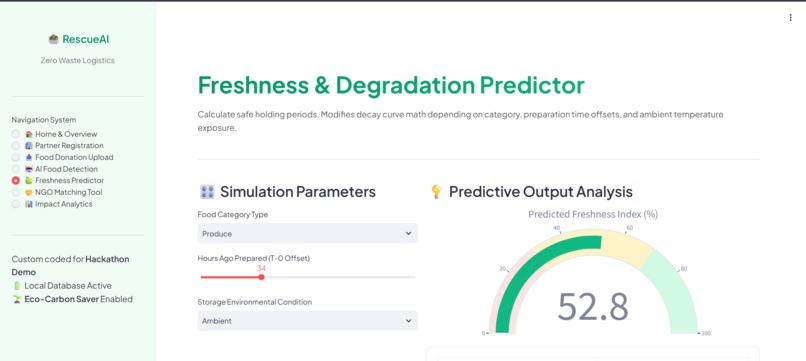
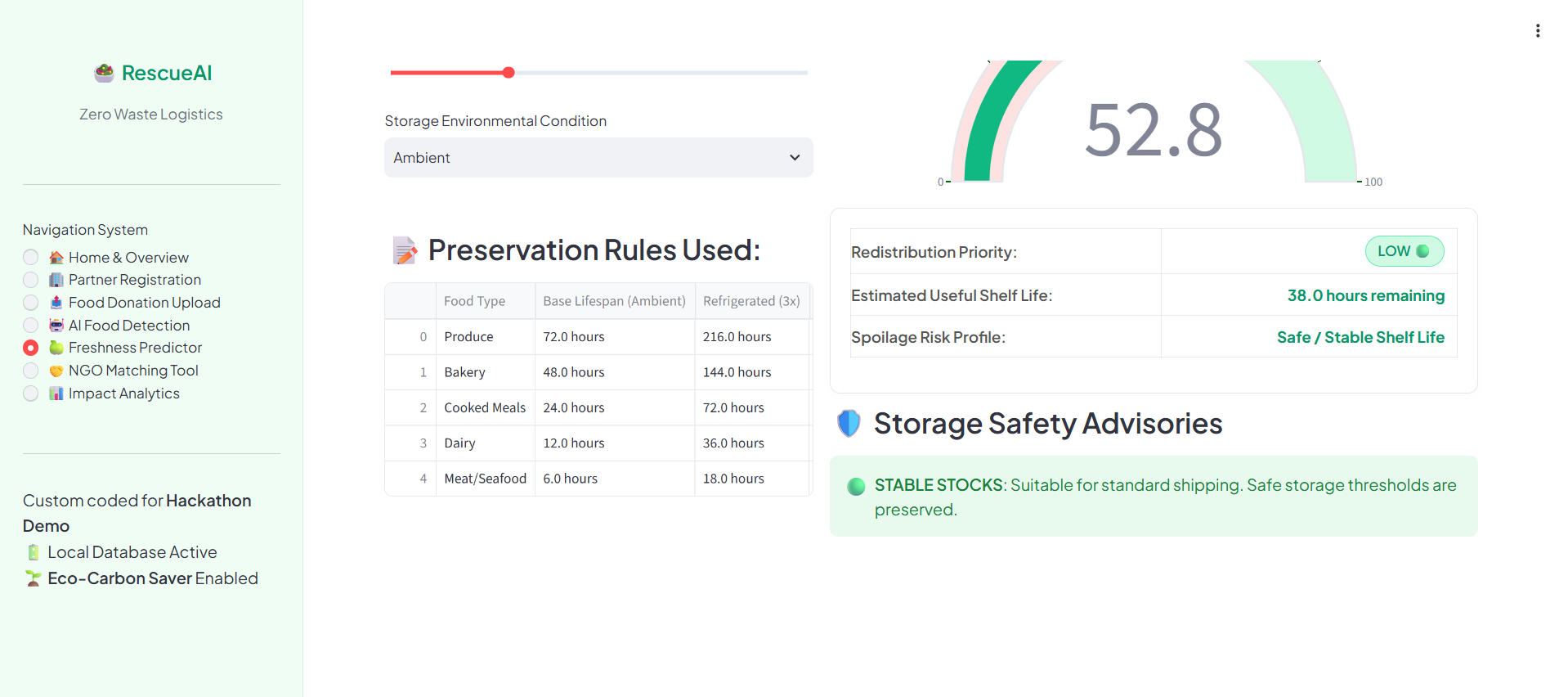
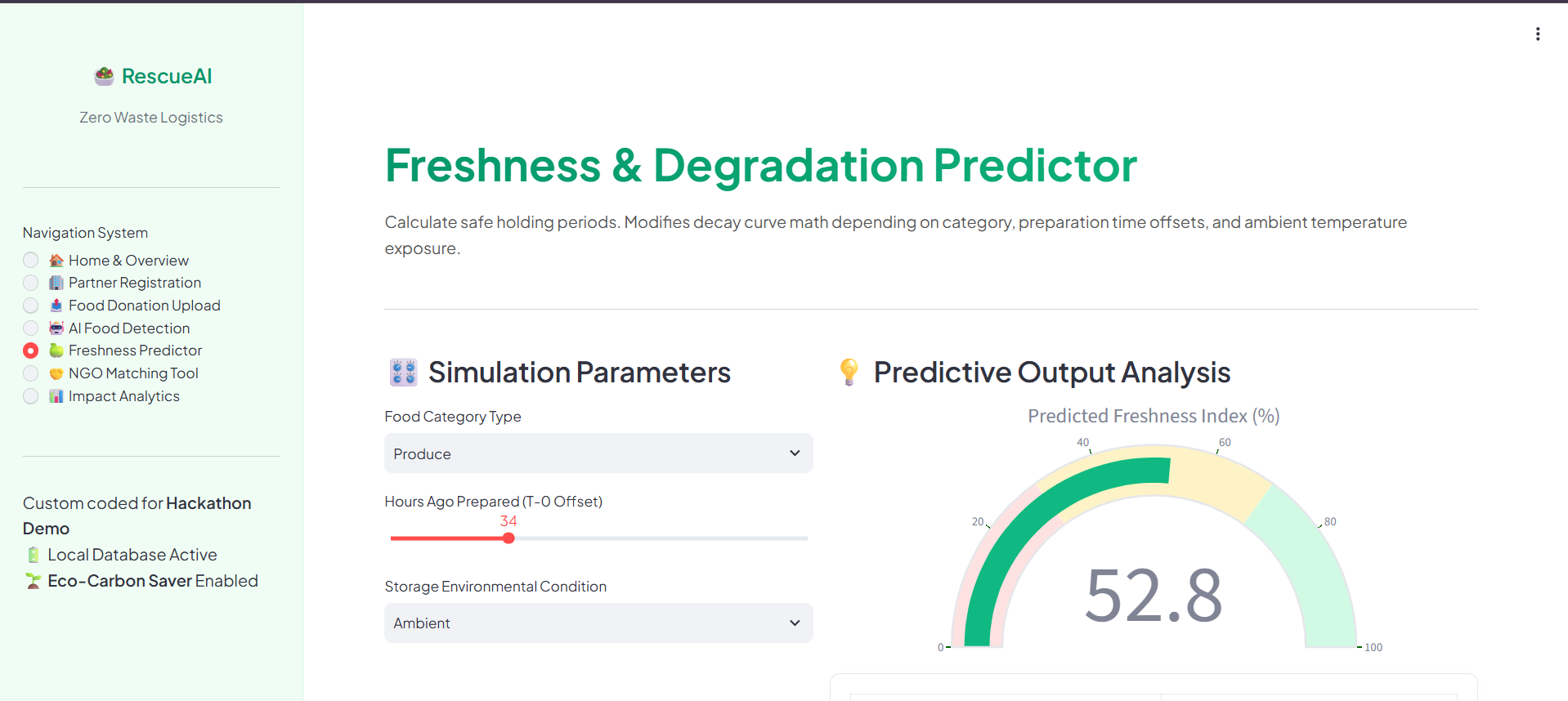
- 🍏 Freshness prediction based on storage conditions and elapsed time
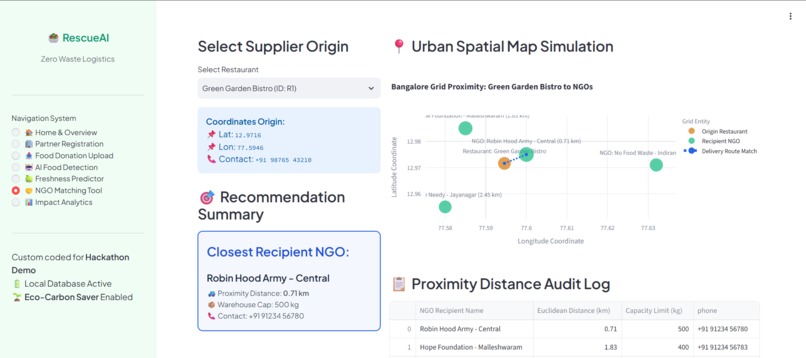
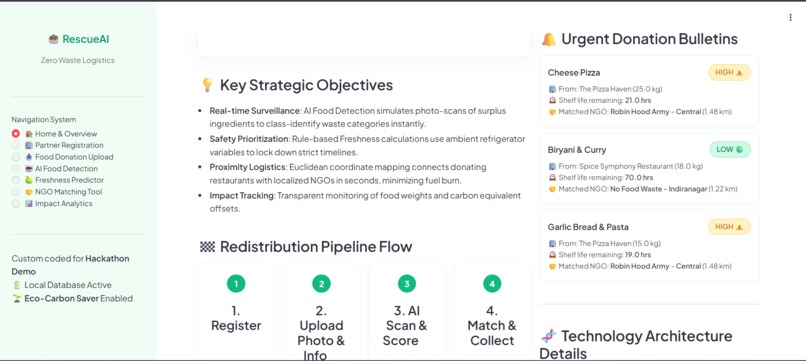
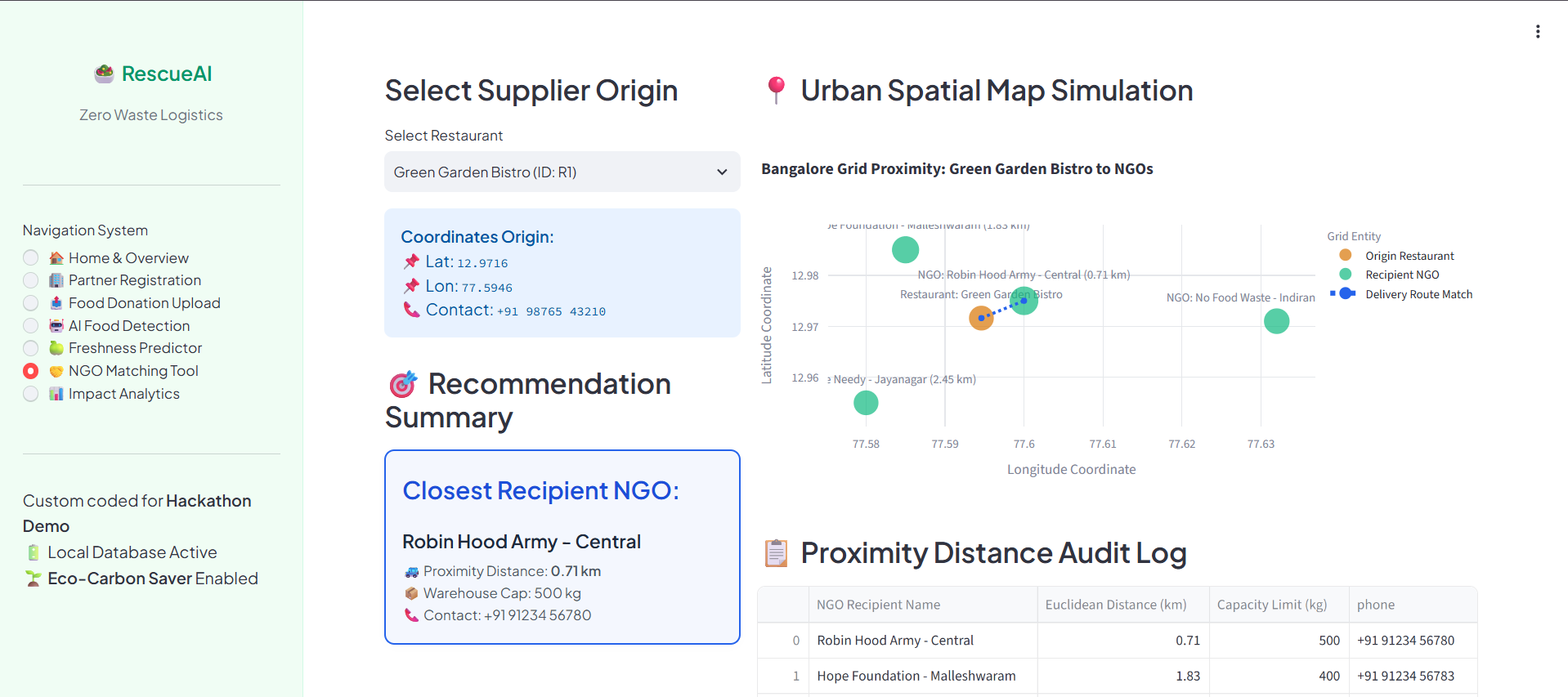
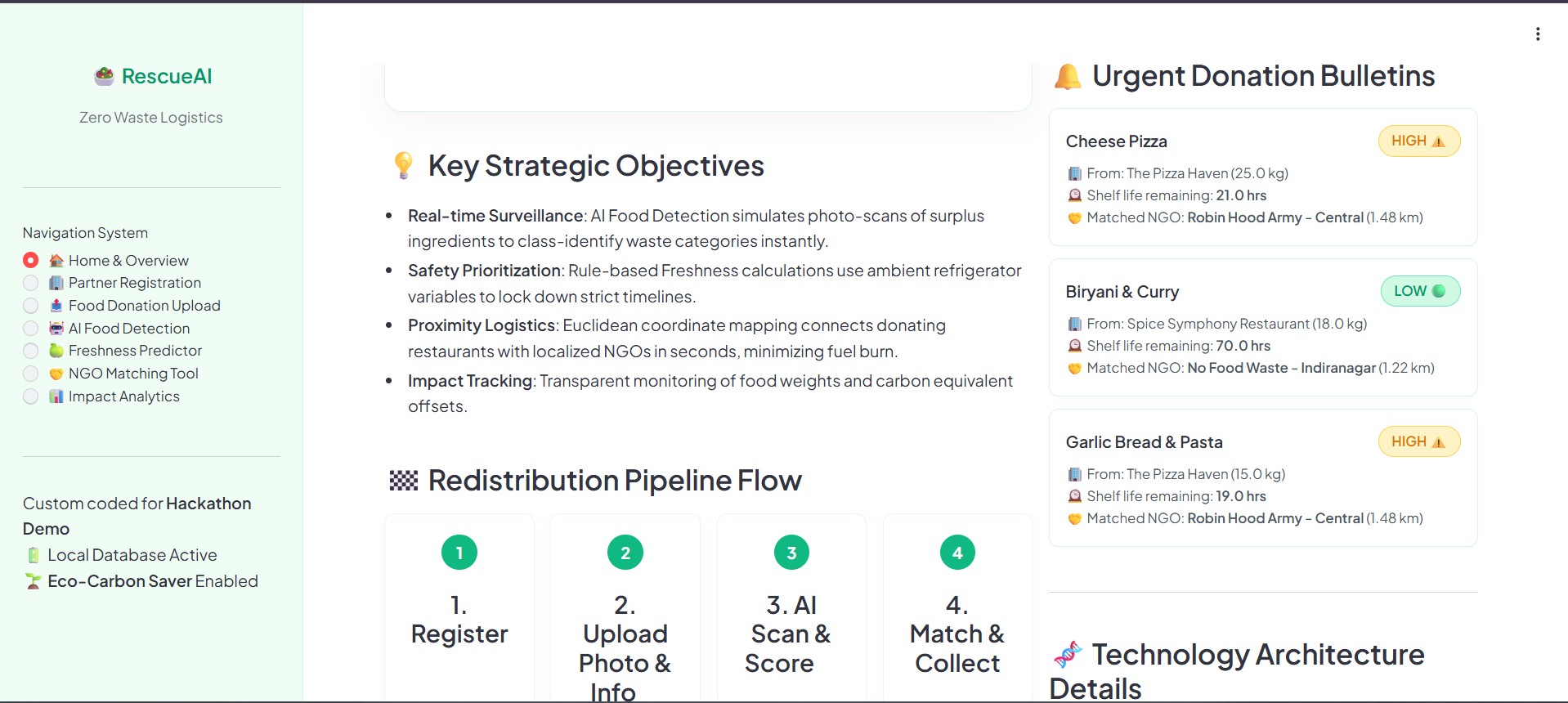
- 📍 Smart NGO matching using location-based distance calculations
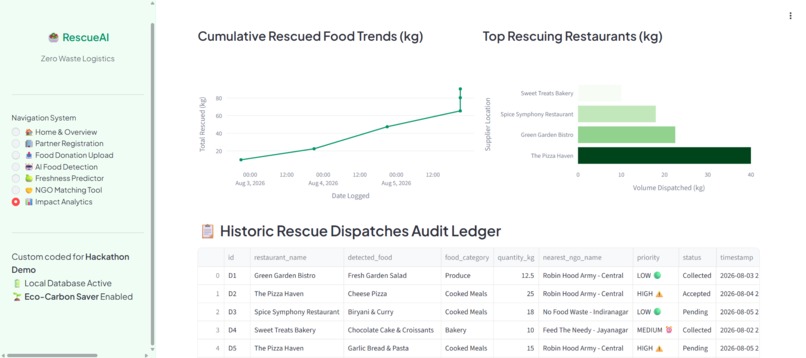
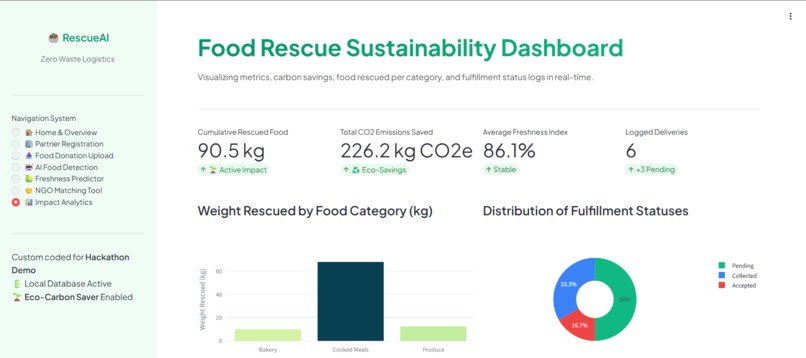
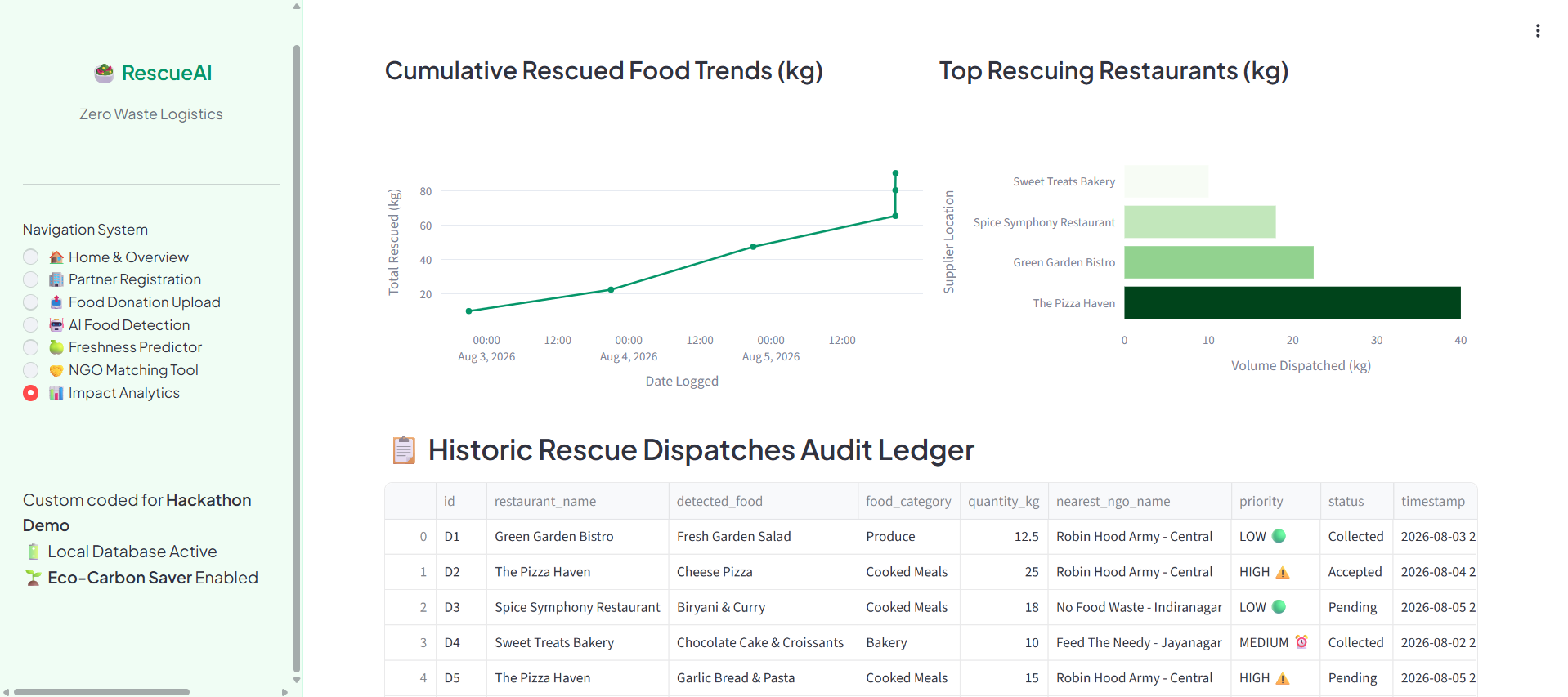
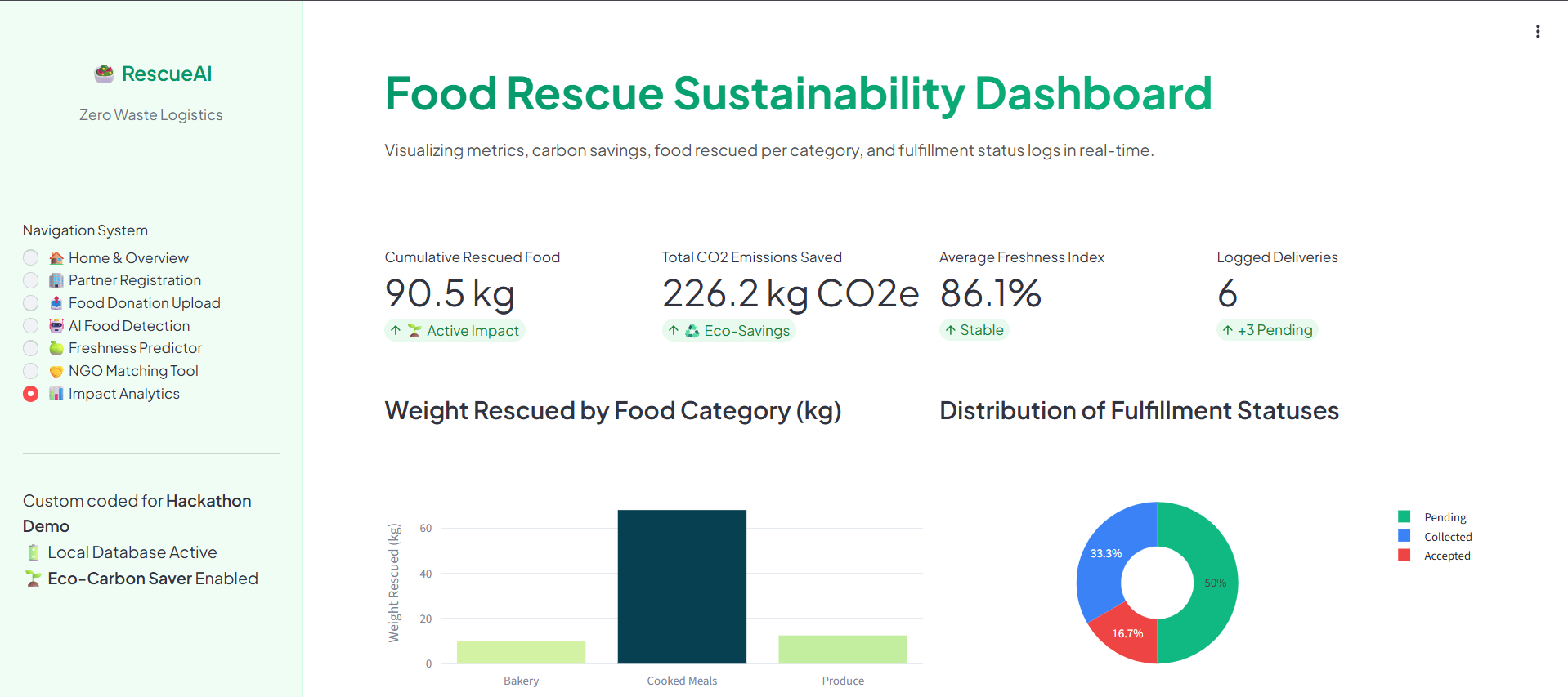
- 📊 Interactive analytics dashboard showing rescued food, carbon savings, and donation trends
How we built it
RescueAI was developed as a responsive web application using modern Python-based technologies.
Frontend
- Streamlit
- Plotly for interactive visualizations
Backend Logic
- Python
- Rule-based AI simulation for food classification
- Freshness prediction algorithm
- NGO recommendation engine
Data Storage
- Local JSON database for restaurants, NGOs, and donations
The application follows a complete donation workflow:
Restaurant Registration
↓
Food Upload
↓
Food Category Detection
↓
Freshness Prediction
↓
Priority Assignment
↓
Nearest NGO Matching
↓
Donation Confirmation
↓
Impact Analytics
The AI behind RescueAI
Instead of relying on heavy deep learning models, RescueAI uses lightweight explainable AI-inspired algorithms suitable for rapid deployment and demonstration.
Food Detection
The uploaded food image is classified into predefined food categories with an associated confidence score.
Freshness Prediction
Food freshness is estimated using:
- elapsed preparation time
- storage environment
- predefined safe storage windows
A simplified freshness model is calculated as
[ Freshness = \max\left(0,;100\left(1-\frac{Elapsed\ Time}{Safe\ Storage\ Window}\right)\right) ]
Based on the remaining safe time, donations are prioritized as:
- 🚨 Critical
- ⚠️ High
- ⏰ Medium
- 🟢 Low
Smart NGO Matching
The nearest NGO is determined using Euclidean distance between registered coordinates:
[ Distance=\sqrt{(x_2-x_1)^2+(y_2-y_1)^2} ]
This enables quick recommendation of the closest available charity partner while minimizing transportation time.
Carbon Impact
The platform estimates greenhouse gas emissions avoided using
[ Carbon\ Saved = Food\ Weight \times 2.5\ \text{kg CO}_2\text{e} ]
This provides users with a measurable sustainability metric for every completed donation.
Challenges we ran into
Building RescueAI involved several interesting challenges:
- Designing an intuitive end-to-end donation workflow.
- Creating an explainable freshness prediction model without requiring large training datasets.
- Developing an NGO matching algorithm that was simple, transparent, and fast.
- Keeping the application lightweight while still demonstrating AI-driven decision making.
- Designing interactive dashboards that effectively communicate social and environmental impact.
What we learned
Throughout this project we learned:
- Designing user-centered workflows for social impact applications.
- Building responsive data dashboards using Plotly.
- Applying rule-based AI techniques when large datasets are unavailable.
- Implementing location-based recommendation systems.
- Quantifying environmental impact through meaningful sustainability metrics.
- Rapidly developing and deploying a functional MVP for hackathon environments.
What's next for RescueAI
We envision RescueAI evolving into a production-ready platform with features such as:
- Real computer vision models for food recognition (YOLO or TensorFlow)
- Live GPS routing using Google Maps APIs
- Firebase cloud backend with authentication
- Real-time NGO notifications via SMS and email
- Volunteer pickup and delivery tracking
- Predictive demand forecasting for NGOs
- Multi-city deployment with multilingual support
- Carbon credit reporting and ESG dashboards for organizations
By combining AI, sustainability, and community collaboration, RescueAI aims to reduce food waste, improve food accessibility, and create measurable environmental impact—one rescued meal at a time.

Log in or sign up for Devpost to join the conversation.