-
-
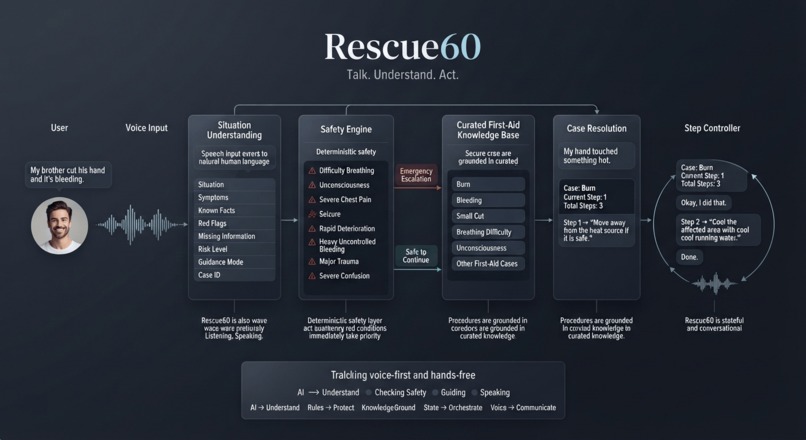
agent workflow
-
logo
The Problem
In an emergency, knowing what to do is not always enough. People can panic, have limited medical knowledge, or struggle to read instructions while actively helping someone. We wanted to build something that feels less like a chatbot and more like a calm voice companion that stays with you during an emergency. That idea became Rescue60: a voice-first AI agent designed to understand what is happening and guide a user through first-aid steps one at a time.
What Inspired Us
We were inspired by a simple question:
What if, during an emergency, you could simply talk to an AI instead of stopping to read a screen?
A person could say, "My brother cut his hand and it's bleeding," and Rescue60 can understand the situation, identify the relevant first-aid procedure, and guide the person through it conversationally. The goal isn't to replace medical professionals. The goal is to make reliable first-aid guidance easier to access when someone is stressed and needs immediate help.
How We Built It
Rescue60 is built as a voice-based, stateful AI agent.
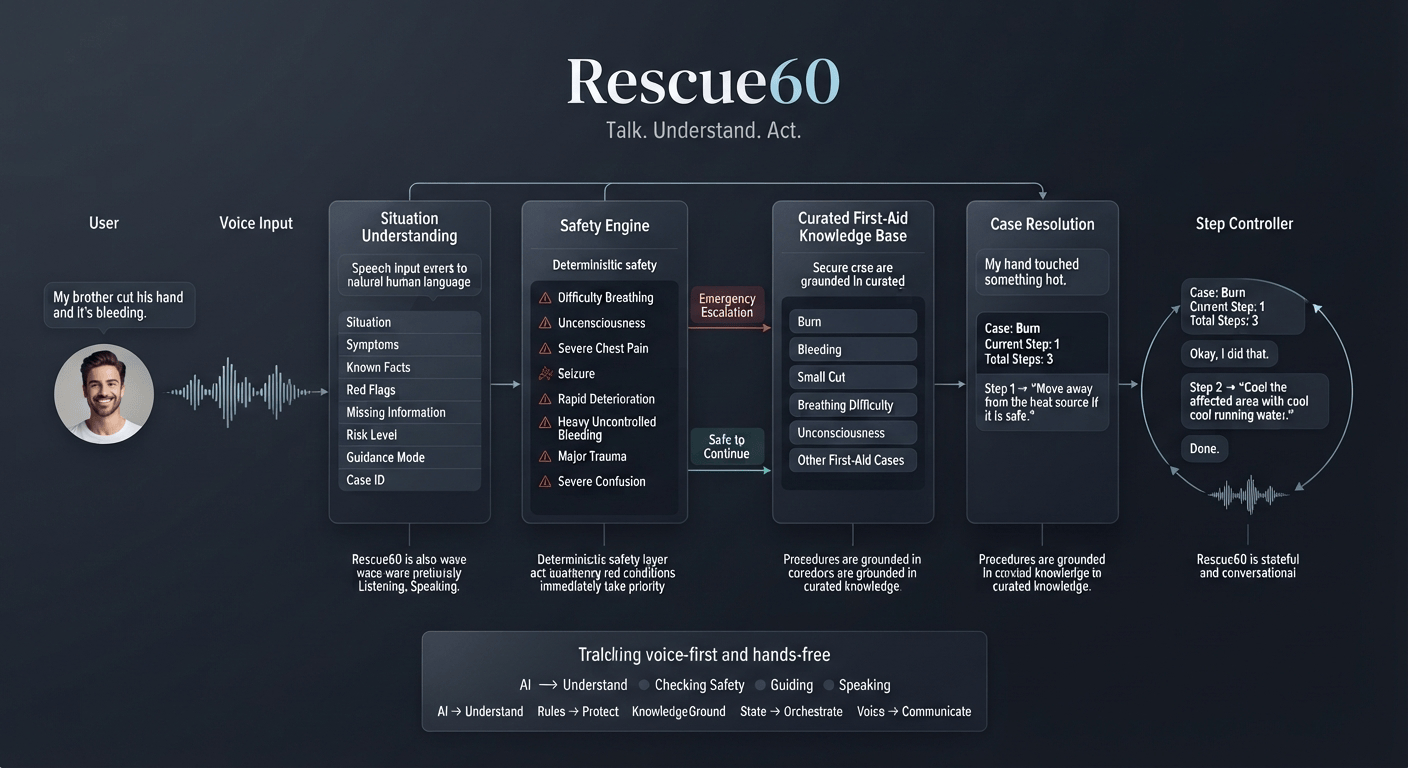
The system follows a controlled pipeline:
Voice Input → Situation Understanding → Safety Engine → Knowledge Base → Step Controller → Voice Response The AI is responsible for understanding natural language and identifying the situation. However, we deliberately do not let the model freely invent medical procedures. Instead, curated first-aid procedures are stored in a structured JSON knowledge base. For example, once the system identifies a burn, the agent retrieves the corresponding procedure and walks through the predefined steps sequentially.
This separation gives us:
- AI flexibility for understanding natural language
- Deterministic medical guidance from the knowledge base
- Safety rules for emergency escalation
- Session state for maintaining the current case and step
- Voice interaction so the user can keep their attention on the person they're helping
The Agent
Rescue60 maintains the state of each conversation.
It knows:
- what happened
- which symptoms were mentioned
- which emergency red flags were detected
- what information is missing
- which first-aid case is active
- which step the user is currently on
For example:
User: "She burned her hand."
Rescue60: "Okay. Let's go step by step. Move away from the heat source if it is safe."
After the user confirms, the system advances to the next step. This makes the interaction conversational rather than a static list of instructions.
Safety First
One of the biggest design decisions we made was to put a Safety Engine outside the language model. Certain red flags trigger deterministic escalation rules. For example, situations involving severe breathing difficulty, unconsciousness, seizures, severe chest pain, or uncontrolled heavy bleeding can trigger an emergency state. The model cannot override these safety rules. This architecture helps reduce the risk of a language model generating inappropriate instructions in a high-stakes situation.
What We Learned
Building Rescue60 taught us that creating an AI agent for a high-stakes environment is very different from simply connecting an LLM to a prompt.
We learned the importance of:
- separating reasoning from deterministic actions
- maintaining conversational state
- designing explicit safety boundaries
- grounding responses in curated knowledge
- handling incomplete and ambiguous user input
- designing for voice rather than text
- thinking about failure cases before adding more AI capabilities
One of our biggest lessons was that more AI is not always better. For medical guidance, giving the model complete freedom can introduce unnecessary risk. A better architecture is to let the AI handle what it is good at—understanding language and context—while deterministic components control what the system is allowed to do.
Challenges
The biggest challenge was balancing natural conversation with safety and control. Users rarely describe emergencies in structured language. They might say:
"He fell and he's not responding." or: "I think she touched something really hot."
The system has to understand these natural descriptions without assuming facts that were never provided. Another challenge was designing the interaction so that the user receives one manageable step at a time, instead of being overwhelmed by a long block of instructions. Finally, building the voice experience introduced another layer of complexity: the system needs to listen, understand, respond, and continue the conversation while maintaining the current emergency state.
What's Next
Rescue60 is currently focused on establishing the core voice-agent architecture. Our next steps include improving real-time voice interaction, expanding the curated first-aid knowledge base, improving multilingual support, strengthening safety evaluation, and testing the agent against realistic emergency scenarios.
Our long-term vision is simple: When someone doesn't know what to do, Rescue60 should be there to help them take the next safe step.
Built With
- agent
- fastapi
- first-aid
- gemini-api
- python
- text-to-speech
- voice-ai

Log in or sign up for Devpost to join the conversation.