Inspiration
As someone who's been wanting to join academia since I was a first year, finding a professor or research lab that was willing to let an unexperienced undergrad join was quite hard. I didn't have the training like some high schoolers received by joining specific programs, nor did I have the capability to jump straight into graduate level coursework as an undergrad like some of my peers, so I spent quite some time bouncing around different fields hoping to gain some experience. Now that I've finally found my research areas, I would like the future generation of students to not go through the same struggles, especially with professors these days offloading the mundane tasks to Claude because it doesn't take months to train and does whatever is told because the purpose of academia is to not just to publish new papers and advance the state of the art models, but to train the future generation of students who will eventually take their place. Research fundamentally is quite boring at the start. You're forced to read endless papers and conduct painfully slow ablation studies while trying to figure out how to recreate the author's results, so I wanted to create a platform that players can use as a form of digital time sink that was still productive to replace the boringness of research. Rather than wasting time on YouTube or other forms of digital entertainment, I think digital platforms that are educational and fun with algorithms built to keep users entertained AND benefit from their entertainment is much better than building platforms with recommendation systems designed entirely for wasting time, selling their data, and more, and that is why I made ReScratch.
What it does
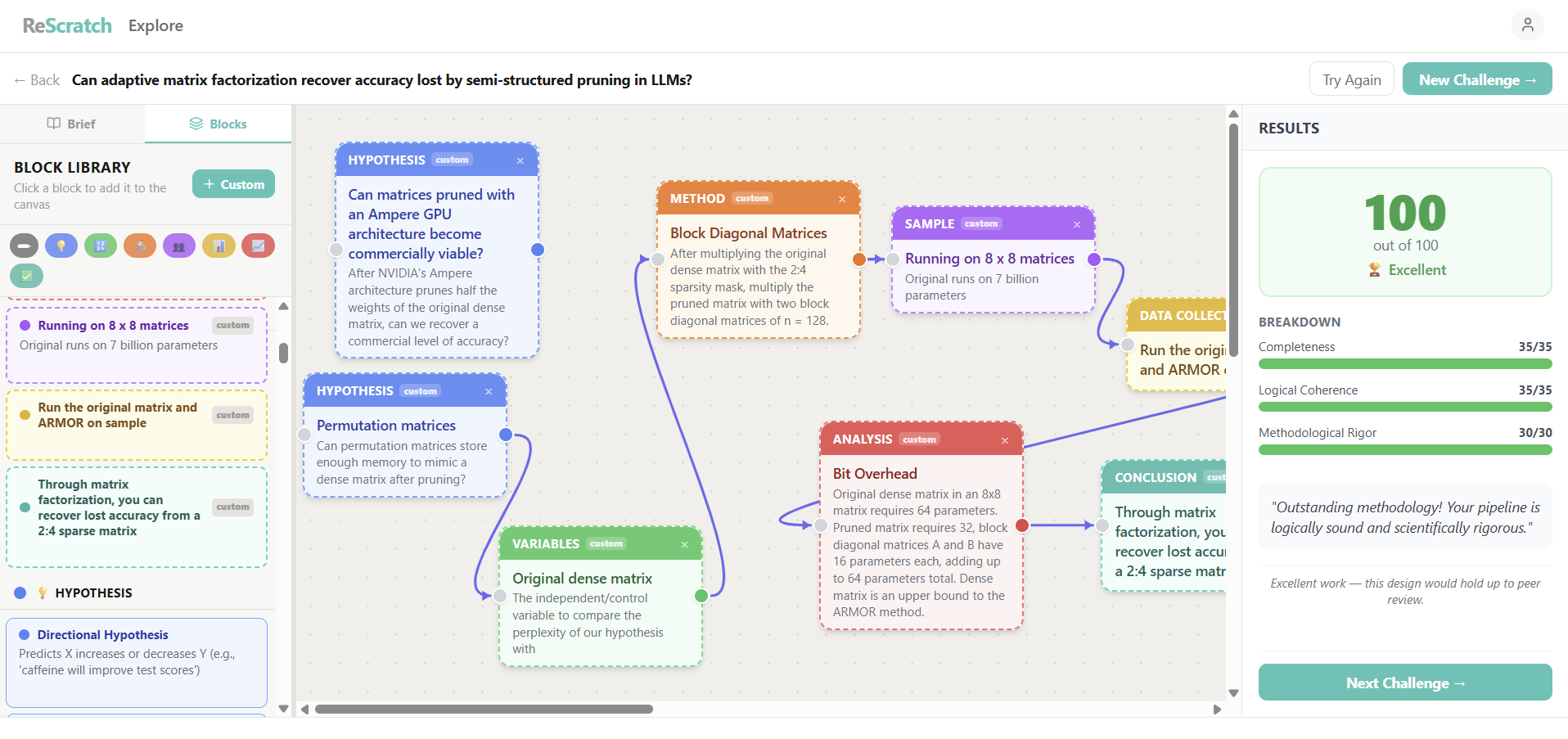
ReScratch is a visual puzzle game that teaches players how to approach the ivory tower of research. They're given a real research scenario, whether it's a basic lab that you'll see in high school to state of the art papers in academia. The purpose is to get students familiar with the process of analyzing experiments and conducting ablation studies through a question, context, and a set of constraints. They're then tasked to construct a study design by snapping blocks together on a free canvas with a hypothesis, a variable, a method, sample, data collection, analysis, and conclusion. Once connecting them in the right order, a rule engine that I created as a benchmark works alongside Gemini 2.5 Flash to score a user's experiment pipeline across three sections (completeness, coherence, and methodology), and explains why they lost points and what they can do next.
The first mode is the standard lab where they can browse a library of challenges from five different domains (Science, Technology, Engineering, Mathematics, and Human & Social Sciences), and a broken lab mode drops users into a pre-built pipeline with errors that they have to find and fix.
There's also a Create feature where users can upload any research paper, PDF, or text excerpt of an experiment they would like to test themselves on, and Gemini converts this into a playable challenge for you by parsing the context to extract a background, context, hints, and even a custom rule engine scoring system to give feedback.
All of these scores are tracked and logged into user profiles, tracking progress of tasks completed, average scores, and
How we built it
Frontend: Tailwind CSS, Framer Motion, Three.js, React, Vite, Zustand. Backend: FastAPI, Uvicorn
Challenges we ran into
Biggest challenge was actually trying to set up the lab environments for all 160 labs. I had to manually go in and fine tune the scoring system and offloaded the rest to Gemini API, but this wasn't scalable so I couldn't have a large repository of labs/experiments. I would have loved to add more labs that were relevant to the other three tracks, but didn't have the expertise or knowledge to do so. After that, it was sleeping in my car (cold af). Thinking of a good UI and then building it myself because even nano banana couldn't generate good enough pointilism examples. Running out of usage (Claude Pro really fell off these days). Free gemini api ran out of usage so upgraded to paid.
Accomplishments that we're proud of
The UI, which I had to relearn because it's been a year since I've touched anything design related, and I also forgot to renew my Figma Pro so I just did things using MS Paint and bouncing ideas with Claude. Setting up the scripts, the challenge schema, and the routing for the labs and challenges.
What we learned
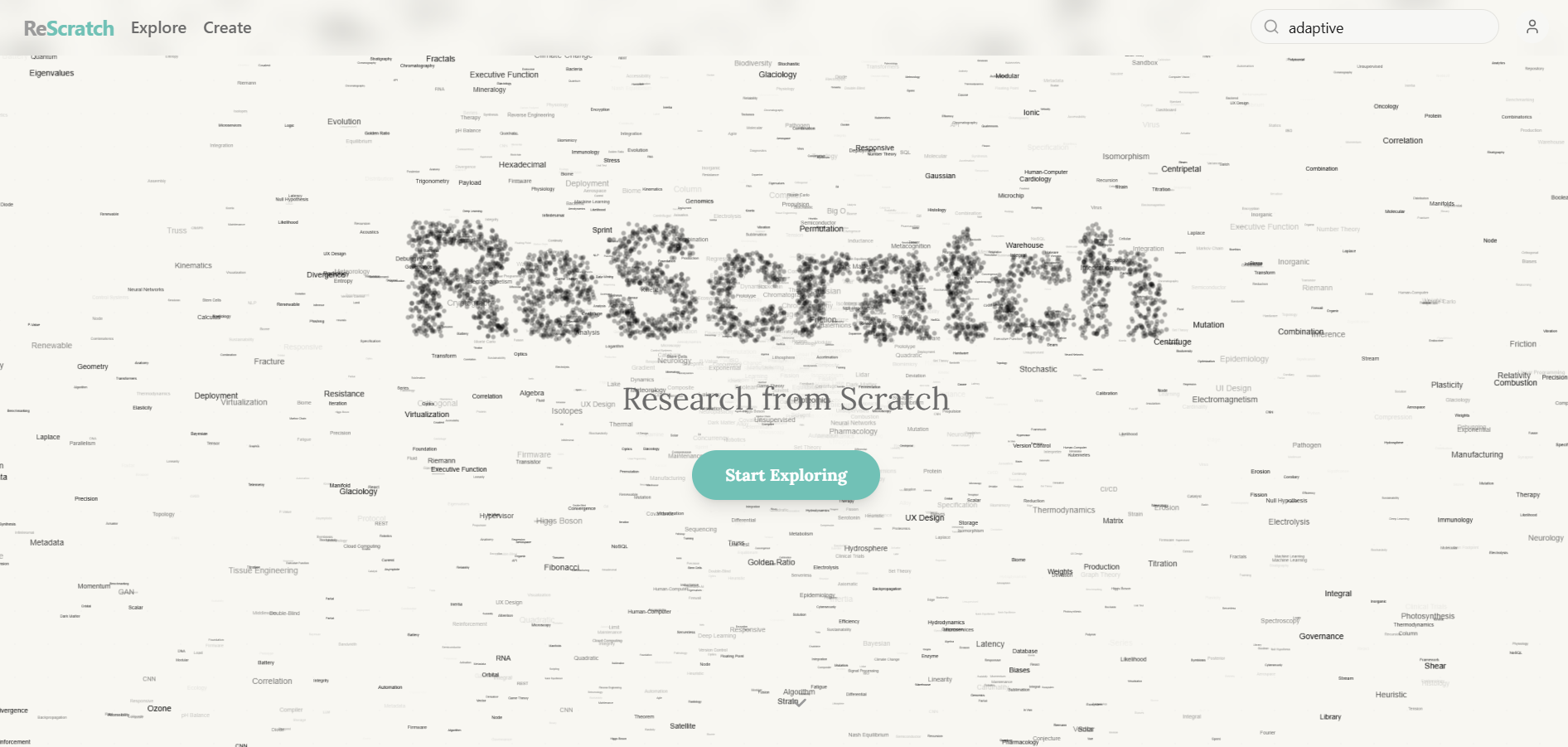
Research is quite hard to benchmark on what's right or wrong. There is no clear boundary or answer of whether someone truly understands what they've read or not, and that's the hardest part of both teaching new students and also building tools to help new students. How to use framer motion, as the UI revolved around it is quite useful. I also had to touch up more on pointilism and building a point cloud system to represent words.
What's next for ReScratch
What's next? I'm keeping that a secret. Come find out at LA Hacks.


Log in or sign up for Devpost to join the conversation.