-
-
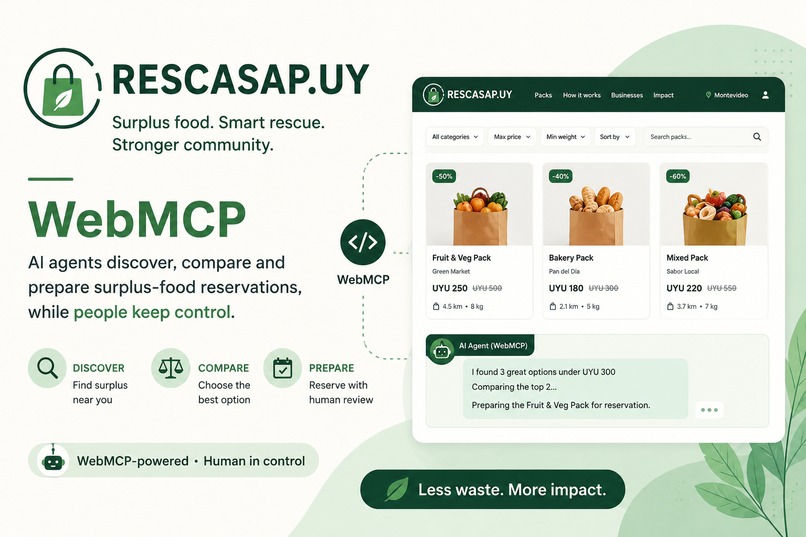
RESCASAP.UY WebMCP experience: AI agents discover, compare and prepare surplus-food reservations while humans keep final control.
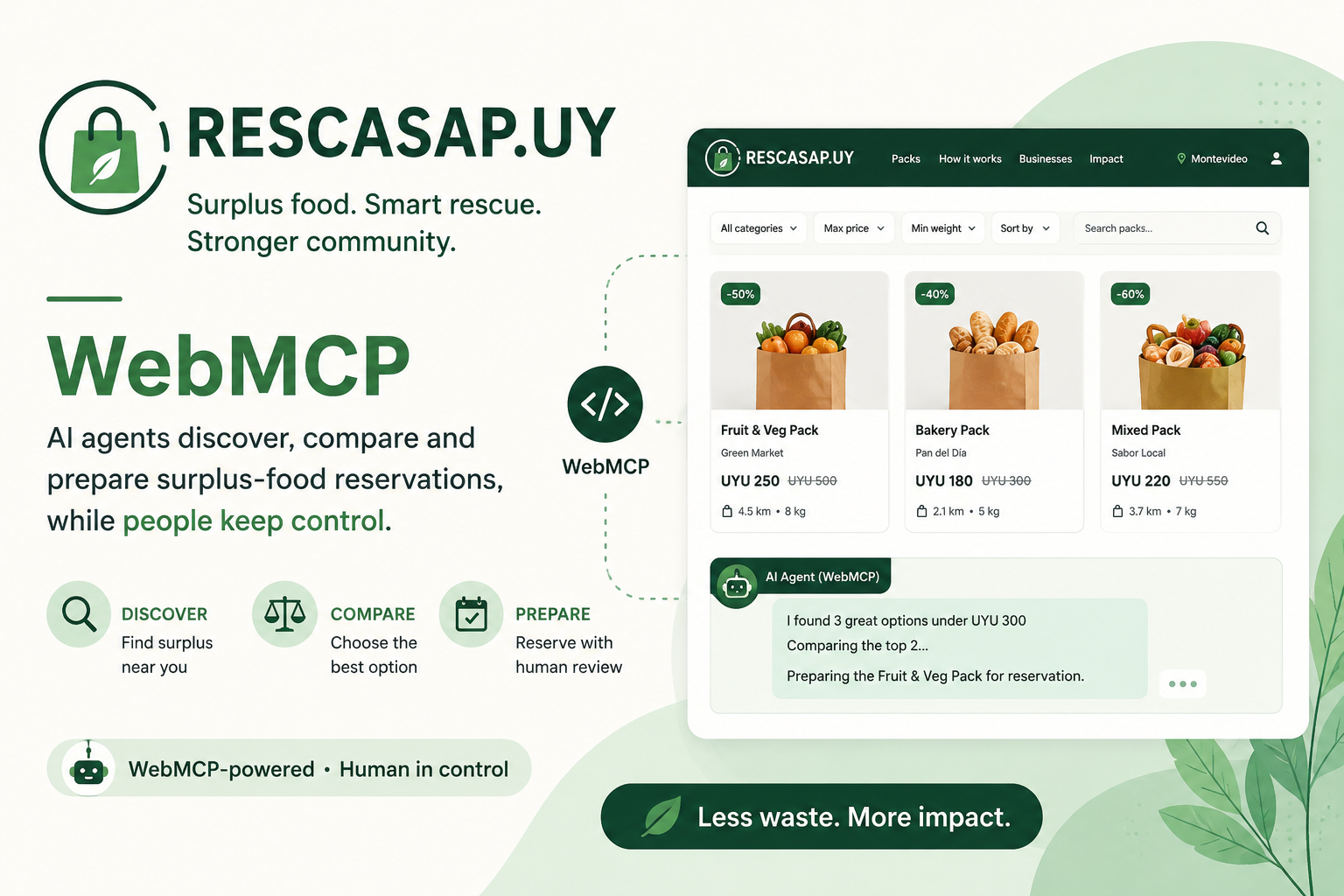
Inspiration
Every day, local businesses end up with perfectly good food that must be sold quickly or goes to waste. At the same time, people are looking for more affordable ways to buy food.
RESCASAP.UY was created to connect those two realities: helping businesses recover value from same-day surplus while giving people nearby access to food at reduced prices.
The WebMCP challenge gave us the opportunity to take that idea one step further: instead of making people manually browse, filter and compare every option, we asked what would happen if an AI agent could interact directly with the marketplace on their behalf.
What it does
RESCASAP.UY is a surplus-food rescue marketplace built for Uruguay.
Businesses can offer discounted rescue packs before food goes to waste, while users can discover available options and choose what works best for them.
For the WebMCP experience, RESCASAP exposes a small set of purpose-built tools that allow an AI agent to:
- Find and rank available rescue packs using constraints such as price, food weight, category and urgency.
- Compare multiple packs by price, savings, estimated weight, pickup window and neighborhood.
- Prepare a selected pack for reservation by opening the checkout experience for human review.
The agent handles the repetitive discovery and comparison work, but the consequential action remains human-controlled: it never completes the final reservation or initiates a payment by itself.
How we built it
The WebMCP integration is implemented directly inside the RESCASAP web application through typed, imperative site tools.
Three WebMCP tools power the challenge experience:
find_rescue_packscompare_rescue_packsprepare_pack_reservation
Their inputs use bounded schemas, their outputs are concise and verifiable, and every agent action is reflected visibly in the interface.
The application is built with TypeScript, React, Vinext and Cloudflare infrastructure. The production architecture includes Cloudflare D1/SQLite with Drizzle ORM, Supabase authentication and Mercado Pago marketplace payments.
For judging, we created a dedicated /demo route that requires no account, API keys, database setup or payment method. It uses an isolated in-memory dataset while running the same product interface and WebMCP tool implementation.
This makes the complete agent experience immediately testable by evaluators without touching real customer, merchant or payment data.
Human–agent collaboration
A core principle of the project is that AI should remove mechanical work without hiding important decisions from the person using it.
The agent can search, filter, rank, compare and prepare an action, while the user remains in control of the final commitment.
The demo itself was produced through human–agent collaboration: while I recorded the experience, an AI agent operated the web workflow being demonstrated.
Challenges
One of the biggest challenges was deciding where agent autonomy should stop.
A food marketplace contains time-sensitive inventory and potentially consequential actions such as reservations and payments. Instead of giving the agent unrestricted control, we designed a clear boundary: discovery and preparation can be automated, while the final reservation remains a human decision.
Another challenge was making the experience easy for judges to reproduce. The WebMCP demo therefore runs without authentication, secrets or payment credentials and resets automatically with the browser session.
We also had to make agent actions visible in the actual interface so users can verify what the agent found, compared or prepared instead of trusting an invisible automation.
What we learned
WebMCP changes the relationship between an AI agent and a website.
Instead of relying on visual interpretation or fragile browser automation, a website can expose a small set of intentional, structured capabilities designed specifically for agents.
We learned that the most useful agent experience is not necessarily the one that automates everything. It is the one that gives the agent enough capability to remove repetitive work while preserving transparency and human control where it matters.
What's next
The next step for RESCASAP.UY is to continue developing the real marketplace in Uruguay: onboarding more local businesses, increasing available rescue inventory and improving location-aware discovery.
The WebMCP layer can evolve alongside the marketplace, giving people an increasingly natural way to discover and compare surplus food through AI while keeping reservations and payments safe and user-controlled.
RESCASAP.UY turns a simple idea — rescue food before it becomes waste — into an experience that humans and AI agents can navigate together.
Built With
- cloudflare
- hatgpt
- next.js
- react
- sqlite
- supabase
- typescript
- vinext
- webmcp

Log in or sign up for Devpost to join the conversation.