-
-
-
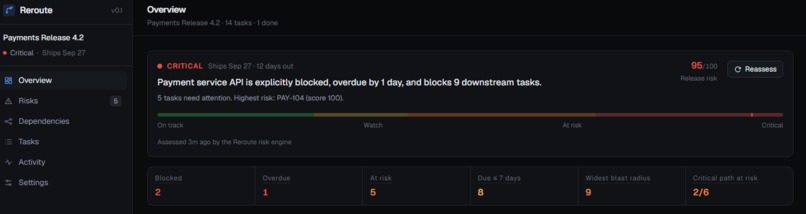
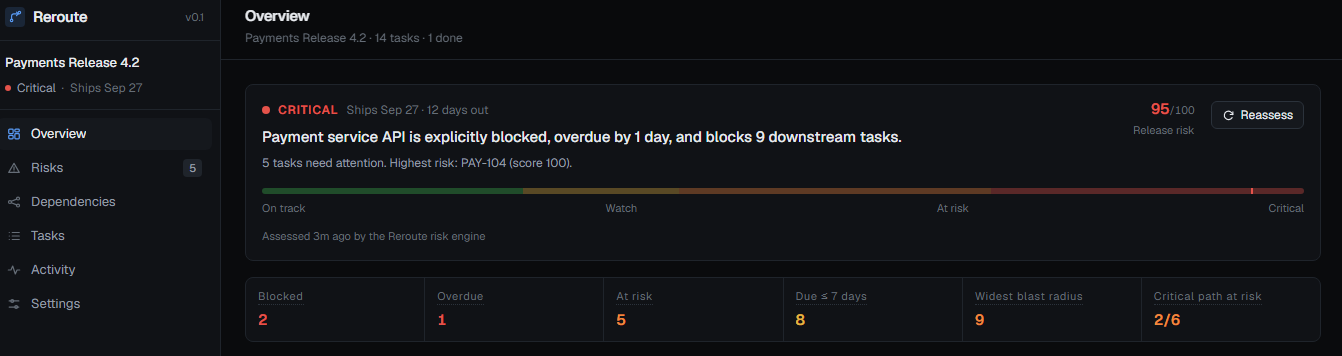
The high-level Overview Dashboard displaying the real-time critical release health score and key risk metrics at a glance.
-
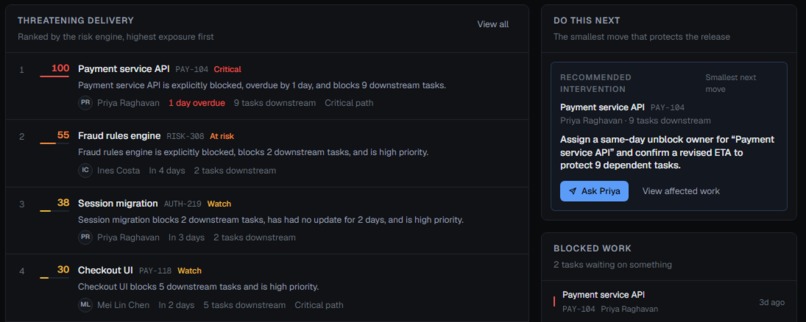
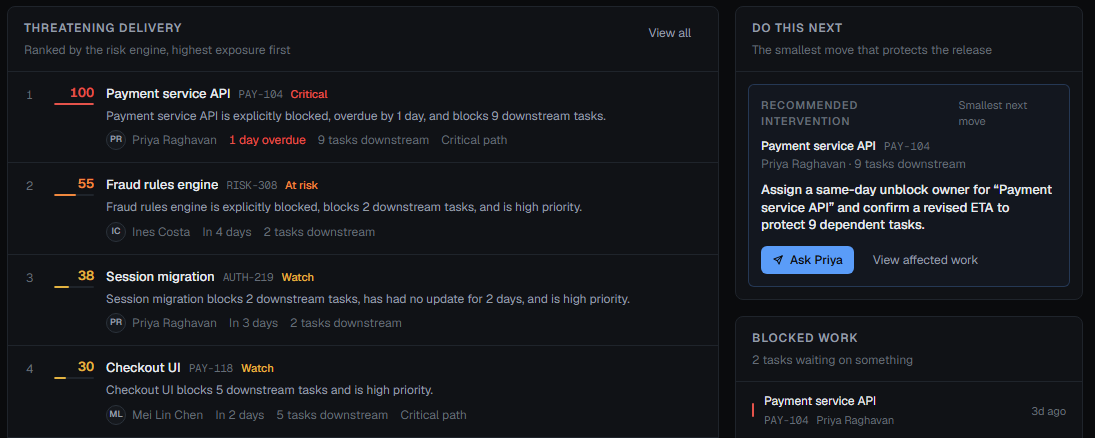
The Action Center highlighting the highest-exposure threats alongside the AI-recommended "Smallest Next Move" intervention.
-
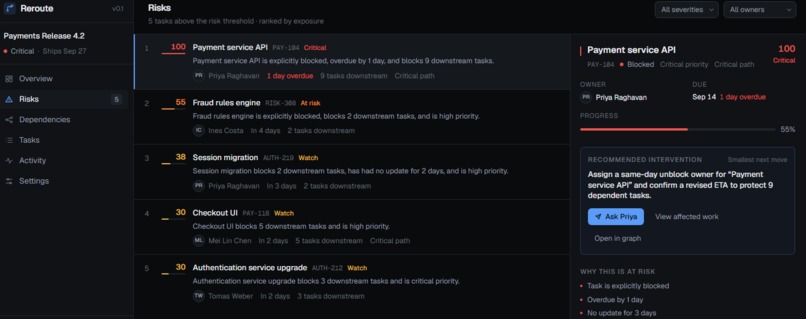
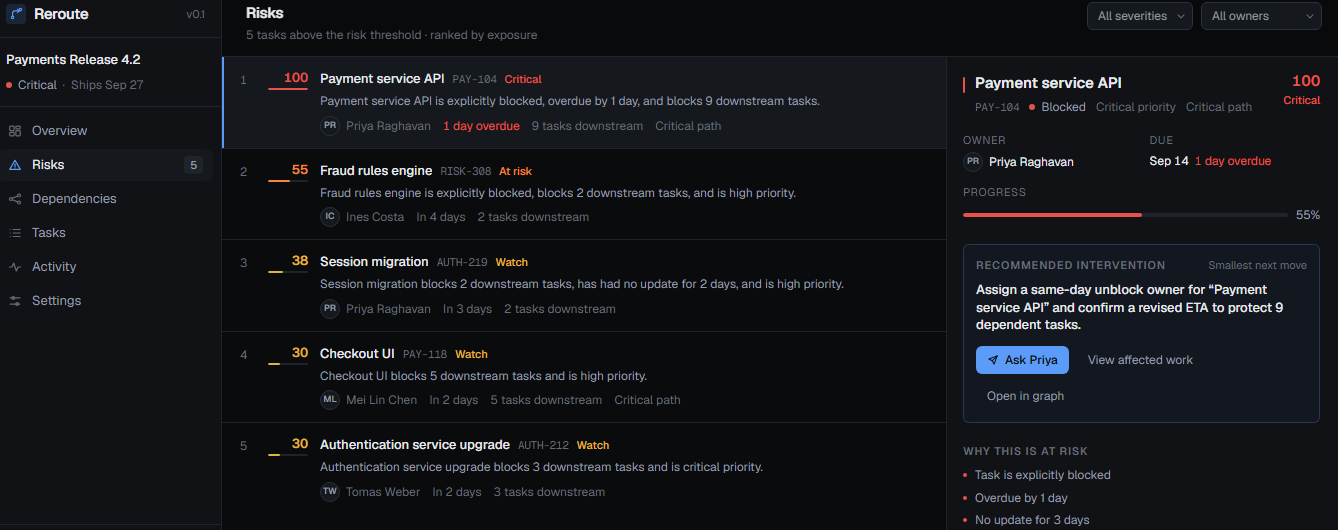
The detailed Risks View breaking down why a specific task is flagged and providing a one-click button to message the owner.
-
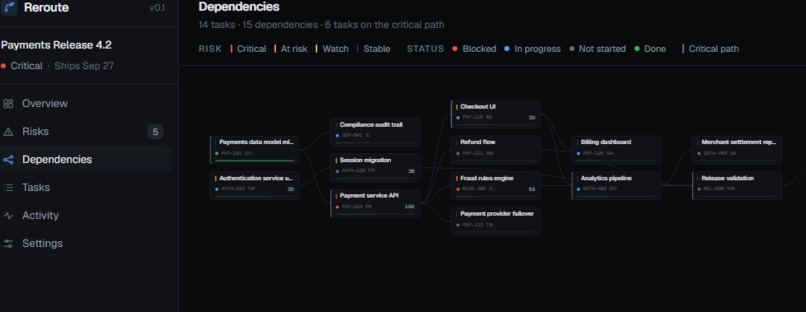
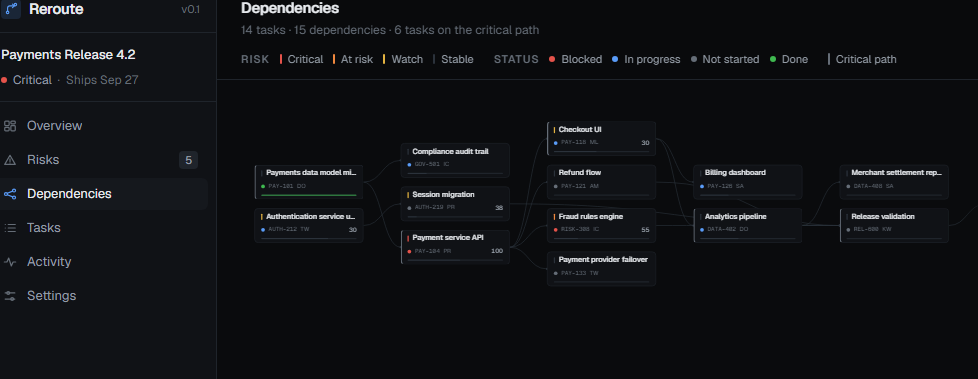
The interactive Dependency Graph (DAG) visualizing the project's critical path and the blast radius of blocked tasks.
-
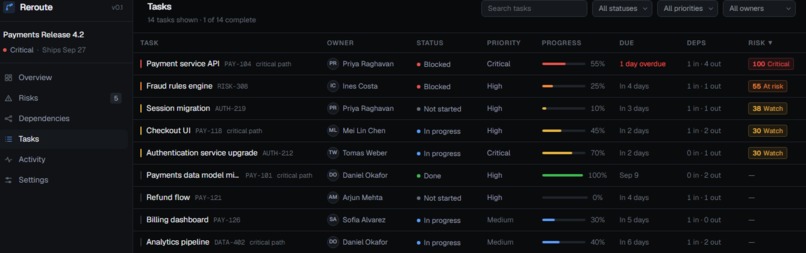
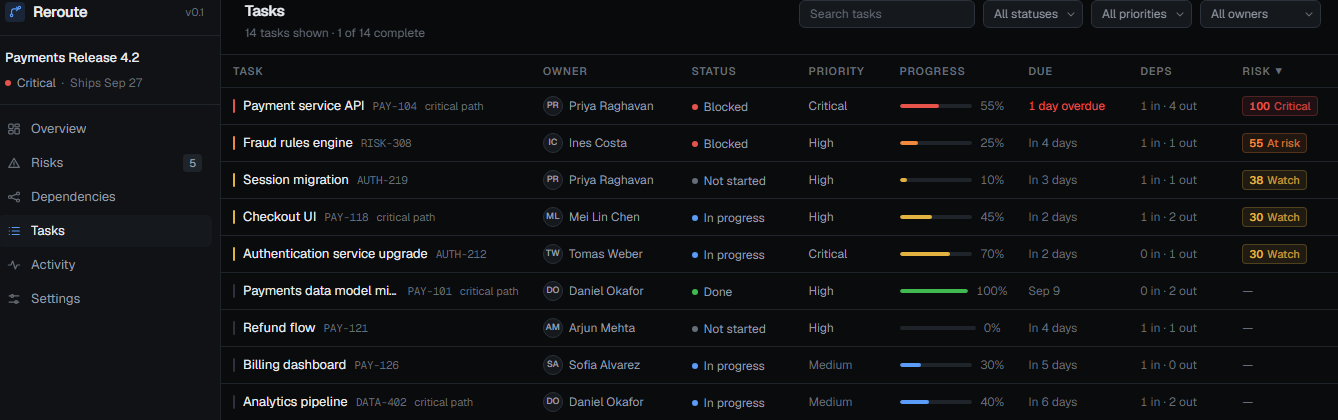
The comprehensive Tasks Directory offering a sortable, detailed breakdown of all project tasks, their progress, and calculated risk scores.
Inspiration
Every project manager, engineering lead, and founder knows the feeling: you look at a project board, see a dozen tasks marked "In Progress," and have no idea if the release is actually going to ship on time. Most task management tools act as passive ledgers--they tell you what is late, but they don't tell you the blast radius or how to rescue the delivery.
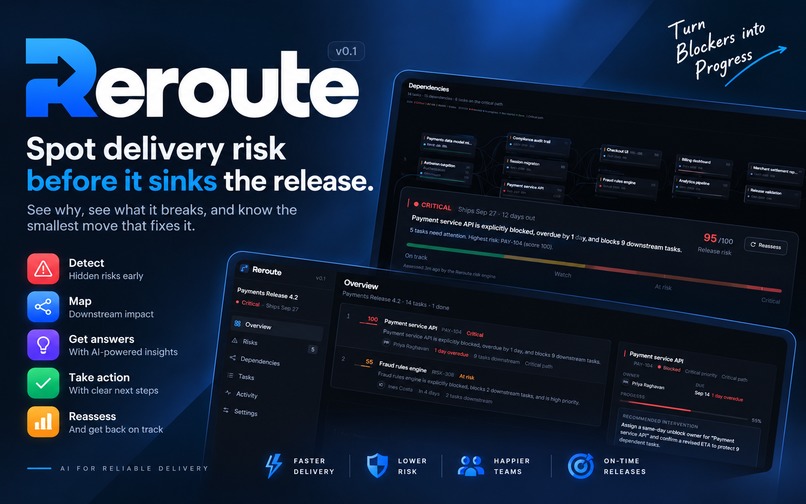
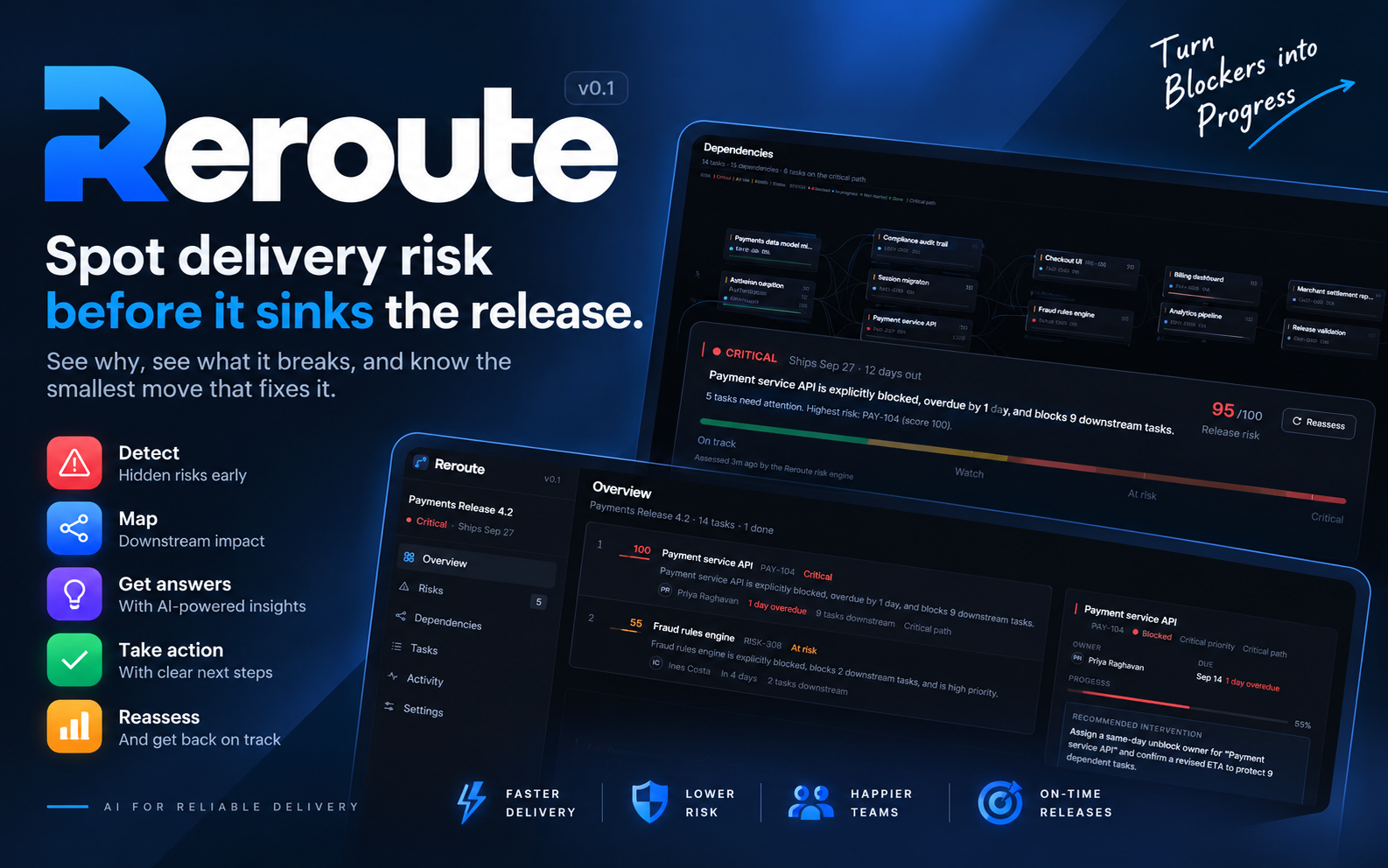
We realized that the world doesn't need another generic AI task tracker. Teams need an active intervention layer. We built Reroute because we wanted a tool that spots delivery risks early, explains exactly why a task is threatening the release, maps the downstream impact, and gives leaders the exact question to ask to unblock the work.
What it does
Reroute is an AI delivery-rescue agent. Users can upload a standard CSV export of their project board.
Reroute then:
- Maps Dependencies: Instantly builds a dependency graph of the project.
- Detects Risk: Calculates a transparent delivery-risk score based on deadlines, task progress, stale updates, and downstream impact.
- Explains the Blast Radius: Visually shows exactly which downstream tasks will fail if a current blocker isn't resolved.
- AI Update Extraction: Reads messy, human-written task updates and uses AI to extract structured insights (e.g., Is this blocked? What is the reason?).
- Generates Interventions: Proposes the lowest-impact reroute and drafts a targeted question for the task owner to immediately unblock the work.
How we built it
We optimized for speed, clarity, and a highly responsive user experience:
Frontend: Built with Next.js, React, TypeScript, and Tailwind CSS. We used SVG canvas rendering to build an interactive Directed Acyclic Graph (DAG) that visualizes dependencies and blast radii.
Backend: Powered by Python and FastAPI. We used NetworkX for the complex graph traversal and blast-radius math.
AI Layer: We integrated the google-genai SDK to parse unstructured, conversational task updates into strict, actionable JSON payloads (is_blocked, blocker_reason, suggested_unblock_question).
Data Pipeline: A robust, custom CSV ingestion engine that gracefully handles relative and absolute dates, validates schema integrity, and catches dependency orphans on the fly.
Challenges we ran into
Our biggest challenge was deciding where not to use AI. Early on, we realized that asking an LLM to calculate project dates and risk scores resulted in a "black box" that project managers wouldn't trust. To solve this, we strictly separated our architecture:
The Risk Engine is entirely deterministic, mathematically calculating exposure using graph traversal so the score is 100% transparent.
The AI Agent is strictly used as a semantic extraction layer--translating messy human updates into structured data that feeds the math engine.
Additionally, building a responsive, auto-scaling dependency DAG in the browser that didn't overwhelm the user required significant trial and error with layout algorithms.
Accomplishments that we're proud of
Bridging Math and Generative AI: We are incredibly proud of our hybrid architecture. Instead of lazily feeding everything into an LLM, we successfully combined deterministic graph mathematics (NetworkX) for trustworthy risk scoring, with Generative AI acting strictly as an intelligent semantic parser for messy human data.
The Blast-Radius Visualization: Building an interactive, auto-scaling Directed Acyclic Graph (DAG) in the browser that cleanly highlights the downstream impact of a single blocked task. It creates a real "Aha!" moment during the demo.
A "Day-One" Usable Product: We managed to avoid the trap of building a flimsy "AI wrapper." By focusing on a sharply defined workflow--uploading a CSV and immediately getting an intervention plan-we built a polished, full-stack tool that project leads can actually use tomorrow.
Flawless Team Execution: We successfully divided a complex full-stack architecture (Next.js frontend, FastAPI backend, AI agent, data pipeline) across our team of Data Science students.
What we learned
We learned that the most valuable AI products don't try to replace the human--they arm the human with the exact context needed to make a great decision. By forcing the LLM to adhere to strict JSON contracts via structured outputs, we were able to bridge the gap between messy human communication and rigid graph mathematics.
What's next for Reroute
For our next phase, we want to build direct integrations into GitHub Issues, Jira, and Slack. We also plan to introduce a "Handoff Doctor" module: when an engineer goes on leave or transfers a project, Reroute will interview them conversationally to create an interactive, AI-grounded handoff workspace for the rest of the team to query.
Built With
- fastapi
- networkx
- next.js
- node.js
- pydantic
- python
- react
- tailwind-css
- typescript
- vercel


Log in or sign up for Devpost to join the conversation.