-
-
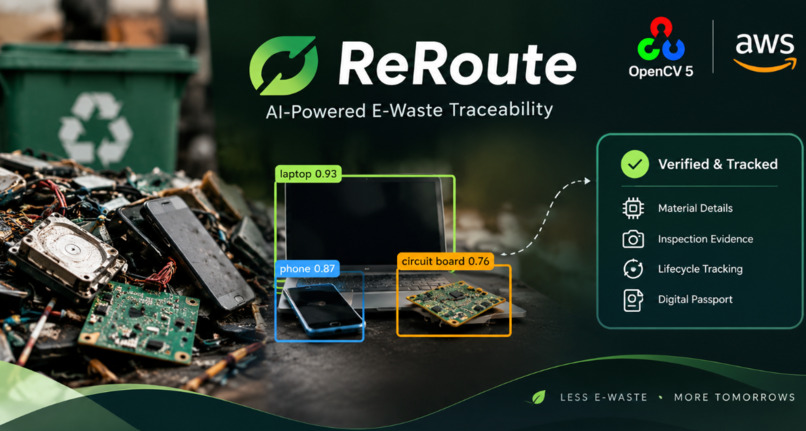
Re-route
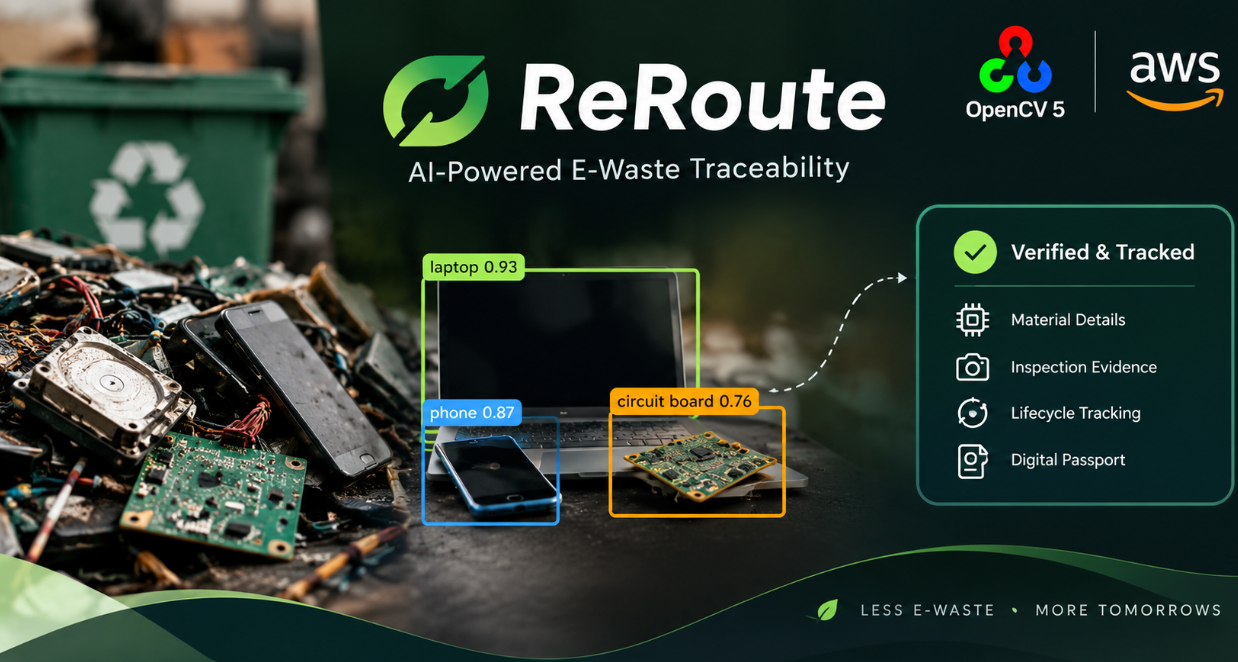
Inspiration
In 2022, the world generated 62 million tonnes of electronic waste, yet only 22.3% was documented as formally collected and recycled. Behind this global challenge is a practical problem: e-waste often reaches collection centres without reliable information about its identity, condition, handling requirements, or suitable destination.
We wanted to bridge the gap between collecting electronic waste and making informed, traceable decisions about it. This inspired us to build ReRoute, a platform that transforms physical e-waste evidence into structured material records, with AI-assisted inspection, human verification, and accountable lifecycle tracking.
What it does
ReRoute creates a traceable digital record for each e-waste material lot.
- Image quality assessment: OpenCV 5 checks images for blur, exposure, clipping, and resolution issues.
- Object detection: YOLOv8 identifies visible objects and provides classes, confidence scores, and bounding boxes.
- Adaptive inspection: Image quality and detection results influence whether the system retries processing, requests a retake, or sends the case for human review.
- AI-assisted interpretation: Amazon Bedrock can help structure material information when configured.
- Human verification: Uncertain findings are presented for operator review rather than automatically treated as facts.
- Safety and routing controls: Deterministic rules govern whether a lot can proceed to downstream actions.
- Digital Material Passport: Evidence, inspection results, verification decisions, and lifecycle information are connected to a material record.
The prototype uses synthetic facility data to demonstrate routing logic; it does not claim that these facilities are verified real-world recyclers.
How we built it
We built ReRoute as a web application connected to a separate computer-vision service.
The frontend uses Next.js, React, TypeScript, and Tailwind CSS. The vision service uses Python, FastAPI, OpenCV 5, and YOLOv8. OpenCV handles image-quality assessment, preprocessing, cropping, and annotated evidence, while YOLOv8 detects visible objects.
Amazon Bedrock Nova Pro supports structured material interpretation when the required AWS configuration and model access are available. The application also integrates with AWS services such as Amplify, S3, and DynamoDB where configured.
The inspection workflow follows a bounded observe → decide → act → evaluate loop. Its results influence the next processing step, while deterministic application logic enforces verification and safety requirements.
The web application is hosted on AWS Amplify, while the FastAPI vision service currently runs on Render. This separation is important to our actual deployment architecture.
Challenges we ran into
1. Real-world image quality: E-waste can be damaged, poorly lit, blurred, or mixed with other objects. We implemented an OpenCV quality gate so unsuitable images can be rejected before object detection.
2. Unreliable detections: General-purpose pretrained object-detection weights do not necessarily perform well on e-waste categories. We had to account for low-confidence and ambiguous results instead of treating every prediction as correct.
3. AI confidence versus safety: A confident visual prediction does not establish the composition or safety of an item. We separated AI-assisted interpretation from deterministic safety controls and human verification.
4. End-to-end cloud integration: The web app, vision service, and AWS integrations have different deployment and configuration requirements. Verifying actual service behavior and distinguishing live integrations from mock fallbacks remains essential.
5. Traceability: A detection is only useful operationally when its source evidence and subsequent decisions remain connected. This drove our focus on material records, lifecycle tracking, and auditability.
Accomplishments that we're proud of
- Built an integrated prototype connecting image-quality checks, object detection, inspection decisions, and human review.
- Implemented a bounded inspection loop in which image quality and detection results influence subsequent actions.
- Created a workflow that prevents unresolved inspections from automatically progressing to downstream actions.
- Connected inspection evidence with the concept of a Digital Material Passport and material lifecycle tracking.
- Added automated tests for important Python inspection logic and web-side integration logic.
- Evaluated the prototype on a small set of sample images, including degraded variants, to explore when the system should request a retake or human review.
Our biggest accomplishment is the workflow design: ReRoute goes beyond identifying objects by connecting visual evidence to verification, controlled decisions, and traceability.
What we learned
We learned that building useful AI systems is not just about model predictions. It is also about handling uncertainty, validating inputs, defining clear decision boundaries, and making failures visible.
OpenCV quality checks can prevent some unsuitable images from reaching the detector, but they cannot guarantee that every usable-looking image contains enough evidence. Similarly, YOLO confidence is not a substitute for ground-truth evaluation or human judgment.
We also learned to distinguish a designed integration from a verified deployment. Cloud services, persistent storage, and model access must be tested in their actual environment before they can be claimed as fully operational.
Most importantly, we learned to design AI as one component in a controlled workflow rather than as the final authority.
What's next for ReRoute: AI-Powered E-Waste Traceability
Our next steps are focused on making ReRoute more reliable and useful beyond a prototype.
- Improve detection quality: Build a representative, labelled e-waste dataset and evaluate precision, recall, and class-wise performance.
- Strengthen traceability: Verify persistent storage, access control, and audit integrity across the complete material lifecycle.
- Connect real facilities: Replace synthetic facility data with current, validated facility records and documented material-acceptance capabilities.
- Verify cloud deployments: Test AWS integrations end to end and improve monitoring, error handling, and deployment reproducibility.
- Validate with operators: Work with collectors, aggregators, and recycling professionals to measure review time, routing suitability, and practical usefulness.
- Expand material passports: Improve the evidence and lifecycle information available to downstream handlers.
Our long-term vision is to make every material lot easier to understand, verify, and trace—helping connect the people who collect e-waste with the people who can process it responsibly.
Built With
- amazon-bedrock
- amazon-cloudwatch
- amazon-dynamodb
- amazon-web-services
- artificial-intelligence
- computer-vision
- digital-material-passport
- e-waste-management
- fastapi
- image-processing
- next.js
- opencv-5
- python
- react
- sustainability
- tailwind-css
- typescript
- yolov8

Log in or sign up for Devpost to join the conversation.