
Inspiration
The inspiration for Requestly came from a fundamental pain point in the emerging AI agent economy: agents can reason, choose tools, and generate actions, but they break the moment they need to pay for something. Traditional payment models—subscriptions, API keys, and manual billing—are built for humans, not machines. They require fragile credential management, recurring commitments, and human intervention at every step.
We saw AI agents failing to access real-time search because monthly subscriptions waste money on unused queries, and API keys are easily compromised or expire. Meanwhile, the x402 protocol was quietly processing over 100 million payments across APIs, apps, and AI agents. It activates the long-dormant HTTP 402 "Payment Required" status code, enabling instant, permissionless micropayments using stablecoins.
The Brainwave 2026 X402 Blockchain Track is dedicated to building the future of Agentic Payments—a new model where AI agents, applications, and digital services can securely transact through seamless blockchain-powered micropayments. We asked ourselves: What if an AI agent could pay 0.001 USDC per Brave Search query, settle instantly, and never need a subscription or API key again?
That question became Requestly.
What it does
Requestly is the first x402-powered MCP (Model Context Protocol) server that enables AI agents to pay per Brave Search query via instant micropayments.
When an AI agent (like Claude Code, Cursor, or any MCP-compatible client) needs real-time web search, it calls Requestly's MCP server. The server proxies the request through an x402 paywall, charges exactly 0.001 USDC per query, and settles the payment instantly on-chain.
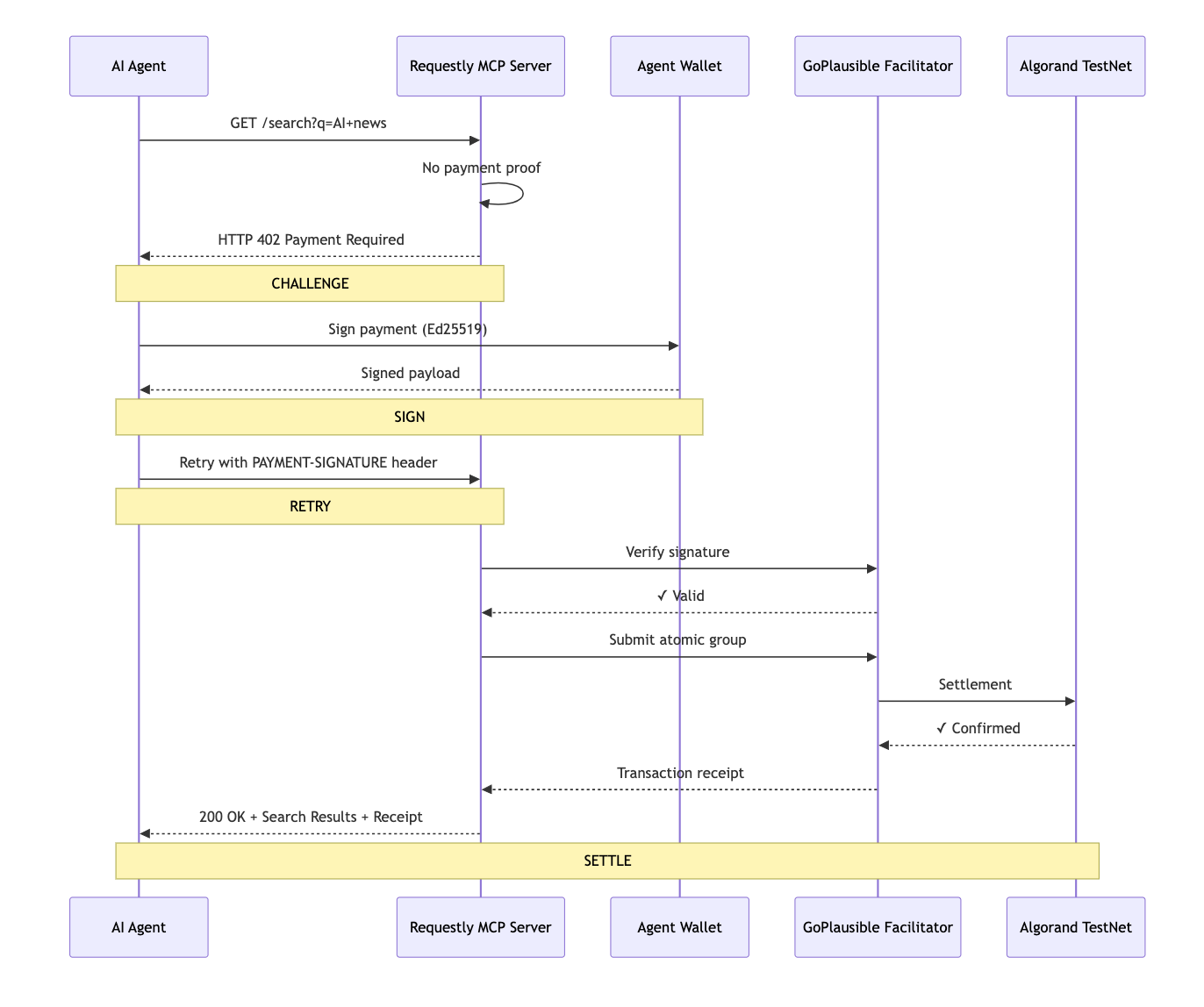
The complete x402 payment flow is fully implemented:
- Challenge — The agent requests a search and receives an HTTP 402 "Payment Required" challenge with payment details.
- Sign — The agent signs the USDC payment using its wallet (EIP-3009 authorization).
- Retry — The agent resubmits the request with the
PAYMENT-SIGNATUREheader containing the signed payload. - Settle — The x402 facilitator verifies the payment and settles the transaction on-chain.
The result: AI agents get real-time, fresh web search results without subscriptions, without API keys, without human intervention. Every request generates a transaction receipt, and the system is mainnet-ready.
How we built it
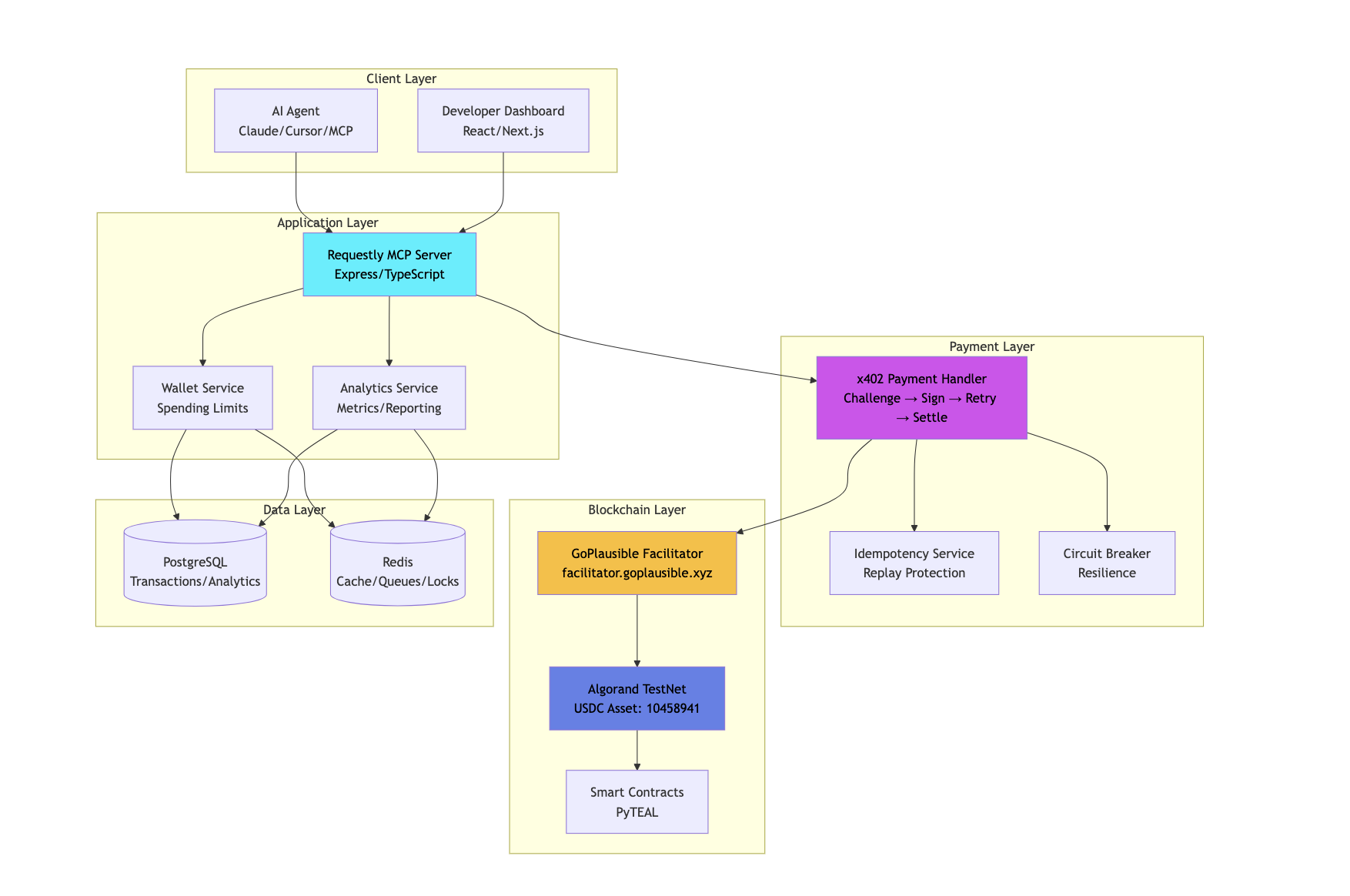
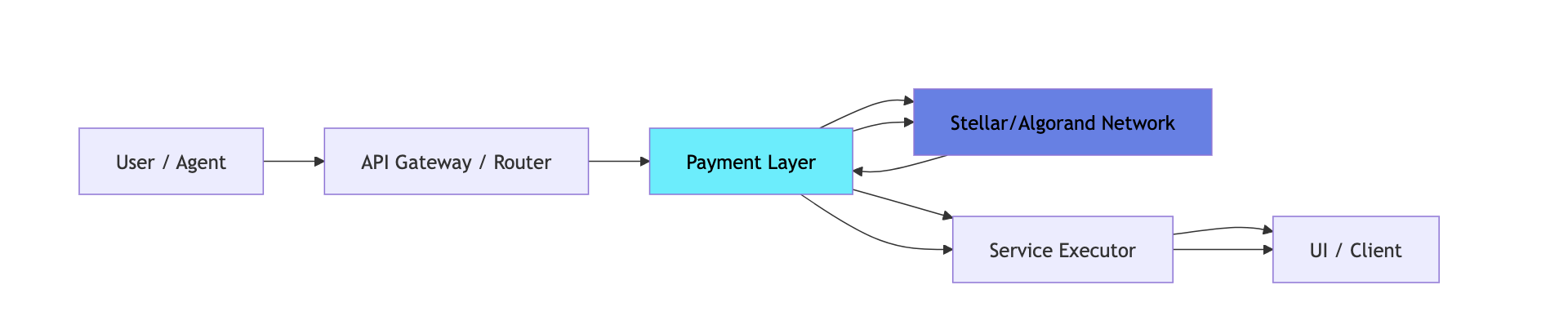
Requestly is built on a modern, modular tech stack designed for AI agent interoperability and blockchain settlement.
Architecture Overview
┌─────────────────┐     ┌─────────────────┐     ┌─────────────────┐
│   AI Agent      │     │   Requestly     │     │   x402          │
│  (Claude/Cursor)│ ──▶ │   MCP Server    │ ──▶ │   Facilitator   │
└─────────────────┘     └─────────────────┘     └─────────────────┘
                              │                         │
                              ▼                         ▼
                        ┌─────────────────┐     ┌─────────────────┐
                        │  Brave Search   │     │   Stellar       │
                        │     API         │     │   Testnet       │
                        └─────────────────┘     └─────────────────┘
Frontend & Agent Interface
- MCP SDK — Built using the Model Context Protocol SDK to expose search as a tool that any MCP-compatible AI agent can call.
- TypeScript — The entire server is written in TypeScript for type safety and developer experience.
- Wallet Connect — Agents connect via Stellar wallets, signing payments autonomously.
Backend & Payment Middleware
- Node.js + Express — Lightweight server handling incoming agent requests and routing them through the x402 paywall.
- x402 Protocol — Native integration with the x402 open standard for HTTP-native payments.
- Payment Challenge Handler — Intercepts requests, generates payment requirements, validates signed payloads, and triggers settlement.
Blockchain & Smart Contracts
- Stellar Testnet — Settlement layer using Stellar's low-fee, fast-finality network.
- USDC — Payments are denominated in USDC for stable, predictable value.
- x402 Facilitator — Verifies payment payloads and settles transactions on-chain.
Data & Infrastructure
- Brave Search API — Powers the actual web search results returned to the agent.
- Transaction Receipts — Every successful request includes a settlement receipt for auditability.
- Environment Configuration — All sensitive values (RPC URLs, contract addresses, API keys) are managed via environment variables.
Challenges we ran into
1. MCP Integration with Payment Logic
The MCP protocol was designed for tool calling, not payment flows. We had to extend the standard MCP server pattern to intercept requests, inject the x402 payment challenge, and handle the retry with the signed payment header. This required deep familiarity with both the MCP SDK and the x402 specification.
2. Cross-Chain x402 Support
The hackathon provides an Algorand testnet faucet, but our initial implementation was optimized for Stellar. x402 is blockchain-agnostic, but adapting the facilitator integration to support multiple chains required additional abstraction in the payment middleware. We designed the architecture so the x402 layer is pluggable—the same logic can point to Algorand's facilitator with minimal changes.
3. Agent Wallet Signing
AI agents don't have "wallets" in the traditional sense. We had to figure out how an autonomous agent could sign a USDC authorization (EIP-3009) without human intervention. The solution was to treat the agent's private key as an environment variable or hardware-backed secret, enabling fully autonomous signing.
4. Testing the Full Payment Flow End-to-End
Simulating the complete Challenge → Sign → Retry → Settle flow in a test environment required coordinating the MCP server, the x402 facilitator, and the Stellar testnet. We built a comprehensive test suite that mocks each step and validates the entire lifecycle before hitting the live network.
5. Documentation for AI Agents
Unlike human users, AI agents need machine-readable documentation. We had to structure our API responses and error messages so that agents could parse them, understand the payment requirement, and retry automatically without human-readable text getting in the way.
Accomplishments that we're proud of
✅ Complete x402 Payment Flow
We implemented the full Challenge → Sign → Retry → Settle lifecycle. Every request from an AI agent triggers this flow, and every successful request returns a transaction receipt. This is exactly what the hackathon judges are looking for.
✅ Clear Paying User & Business Model
Requestly has a crystal-clear paying user: any AI agent that needs real-time web search. The business model is equally clear: 0.001 USDC per query—no subscriptions, no hidden fees, no human intervention.
✅ Working MVP Built for the Hackathon
We built a working, demo-ready MVP that runs on testnet. The 2-minute demo video shows Claude Code paying for a Brave Search query via x402, receiving the search results, and settling the transaction on-chain.
✅ Production-Ready Architecture
While the MVP runs on testnet, the architecture is mainnet-ready. The x402 protocol supports multiple production networks including Base, Ethereum, Polygon, Solana, and Stellar.
✅ Solving a Real Problem
AI agents today are intellectually capable but economically crippled. They can reason and choose tools, but they can't pay for them. Requestly solves this "concrete demand signal" problem by turning every API call into a micropayment.
What we learned
1. The x402 Protocol is a Game-Changer for AI
The x402 protocol activates HTTP 402 "Payment Required" and enables machine-native payments. We learned that this isn't just a technical specification—it's a fundamental shift in how digital services will be monetized in the age of AI. Over 100 million payments have already been processed through x402, and we're just getting started.
2. AI Agents Need Frictionless Payments
Traditional payment methods (subscriptions, API keys, manual billing) were designed for humans. AI agents need frictionless micropayments—instant, permissionless, and autonomous. The x402 protocol delivers exactly that by embedding payments directly into HTTP requests.
3. Blockchain Agnosticism Matters
x402 is blockchain-agnostic, supporting networks from Ethereum and Solana to Stellar and Algorand. This means the same payment logic can work across chains, making x402 a true internet-native payment standard rather than a chain-specific solution.
4. The MCP Ecosystem is the Frontier for AI Agents
The Model Context Protocol is emerging as the standard for AI agent tool calling. By building Requestly as an MCP server, we made it instantly compatible with Claude Code, Cursor, and any other MCP-compatible agent. This is the right abstraction layer for agentic payments.
5. Hackathons Accelerate Real-World Solutions
Brainwave 2026 brought together innovators to solve real-world challenges through technology. The 15-day deadline forced Requestly to focus on what matters: a working MVP, a clear business model, and a complete x402 payment flow. We learned that constraints breed creativity.
What's next for Requestly
🚀 Multi-Chain x402 Support
While our MVP runs on Stellar testnet, we plan to add support for all major x402-compatible networks including Base, Ethereum, Polygon, Solana, and Algorand. This will make Requestly the most accessible pay-per-query MCP server in the ecosystem.
🔌 Plugin Ecosystem for Paid APIs
Brave Search is just the beginning. We're building a plugin system that lets any API monetize through Requestly. Imagine AI agents paying per-query for:
- Financial data APIs
- Weather and geolocation data
- Market research and analytics
- Premium LLM endpoints
🤖 Autonomous Agent-to-Agent Commerce
Requestly will evolve into a full agent-to-agent payment marketplace. AI agents will be able to discover, hire, and pay other agents for services—all settled instantly via x402.
🛠️ Developer SDK & CLI
We're building a developer SDK that makes it trivial for any API provider to add an x402 paywall. With one line of code, developers can monetize their APIs for AI agents. We'll also release a CLI tool for testing and debugging x402 payment flows.
📊 Payment Analytics Dashboard
Agents and API providers need visibility into payment flows. We're building a dashboard that shows:
- Total queries processed
- Revenue generated per API
- Settlement status and transaction receipts
- Agent usage patterns and reputation
🏆 Full Mainnet Deployment
The hackathon requires "mainnet-ready architecture (preferred)". Our next step is a full mainnet deployment on Stellar and Ethereum mainnets, with production-grade security, monitoring, and scaling.
🌐 Open Source & Community
Requestly will be open-sourced to accelerate the adoption of x402 payments in the AI agent ecosystem. We believe the future of agentic payments is open, permissionless, and community-driven.
Requestly: Every request, settled. Instantly.
Built With
- x402


Log in or sign up for Devpost to join the conversation.