-
-
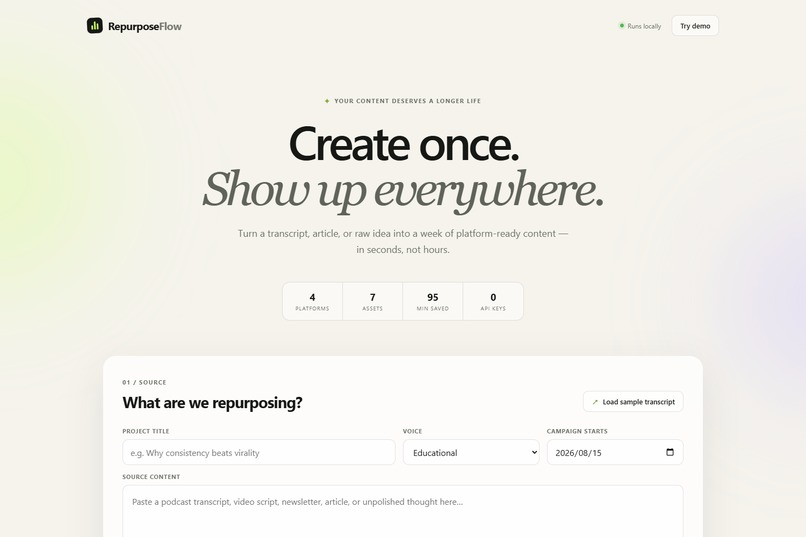
RepurposeFlow turns one long-form source into an entire platform-ready social campaign.
-
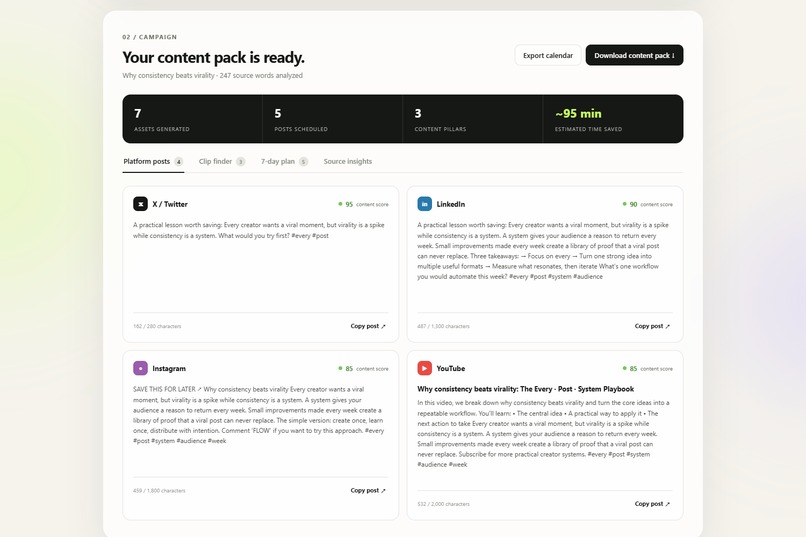
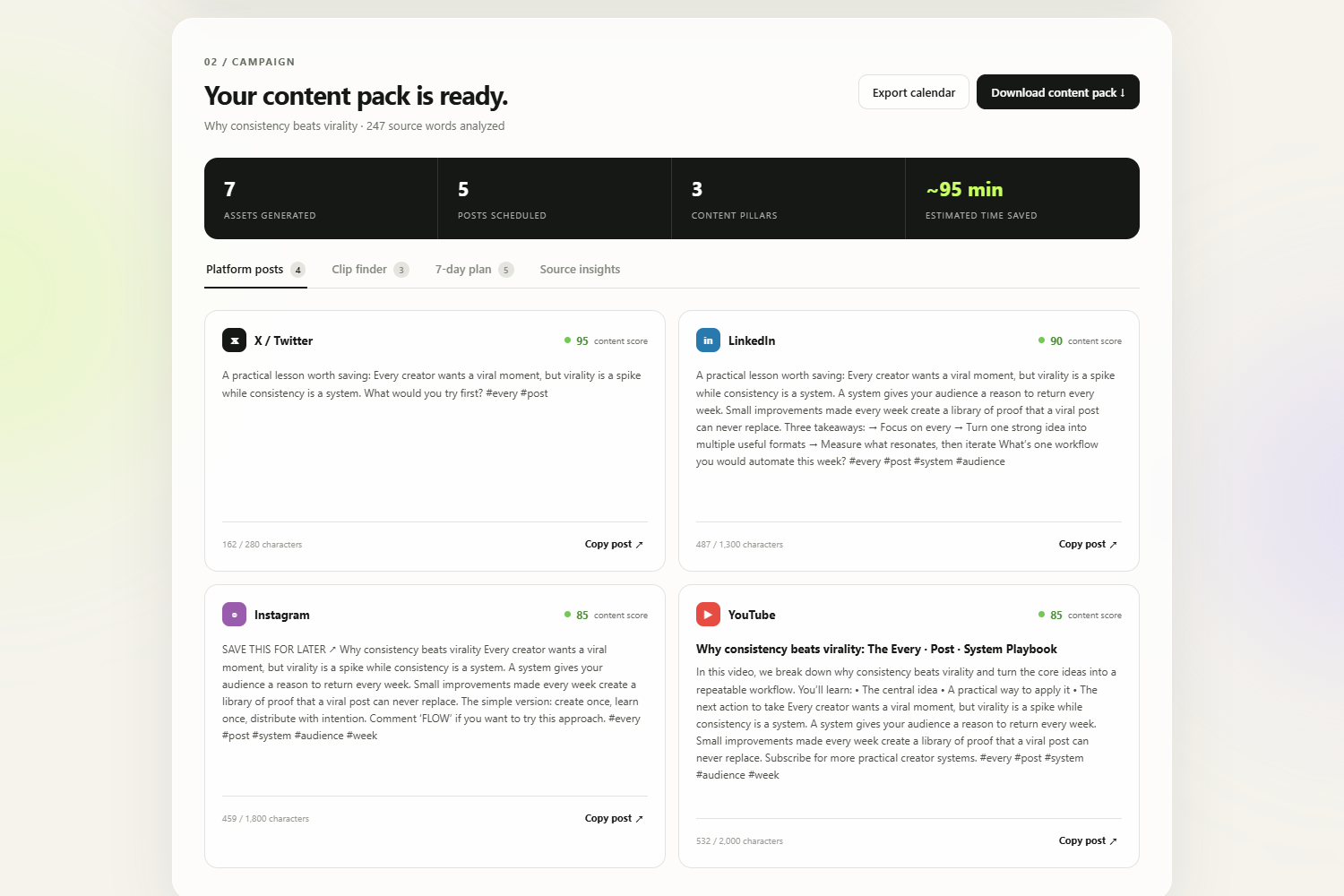
Tailored posts for X, LinkedIn, Instagram, and YouTube with platform-aware limits and content scores.
-
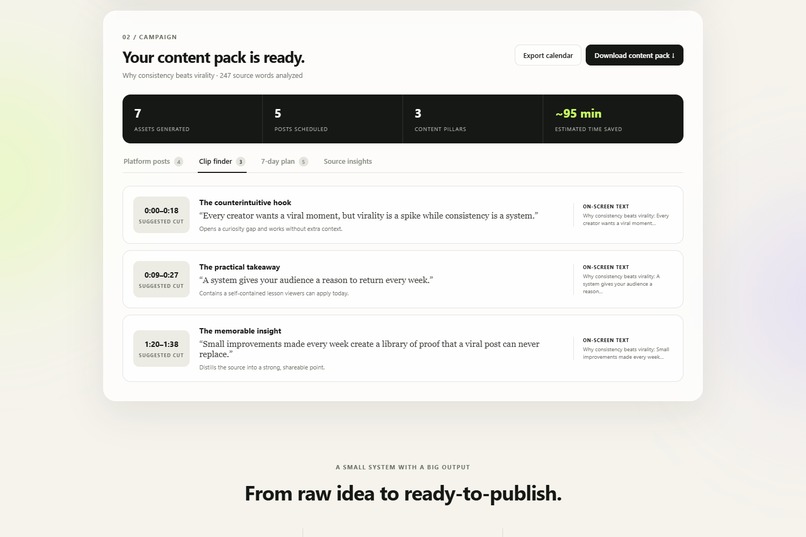
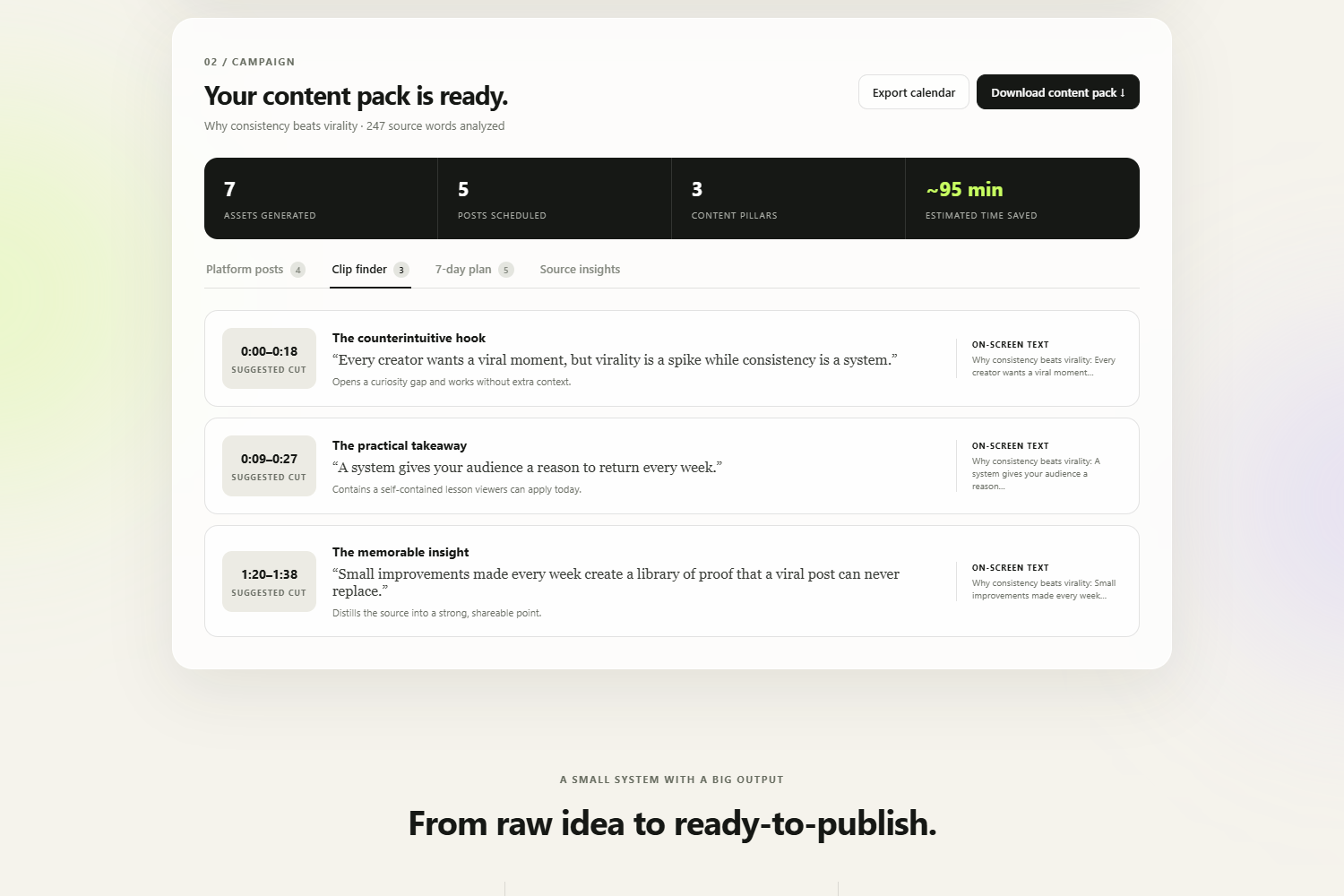
RepurposeFlow identifies self-contained video moments and suggests timestamps, hooks, and on-screen text.
-
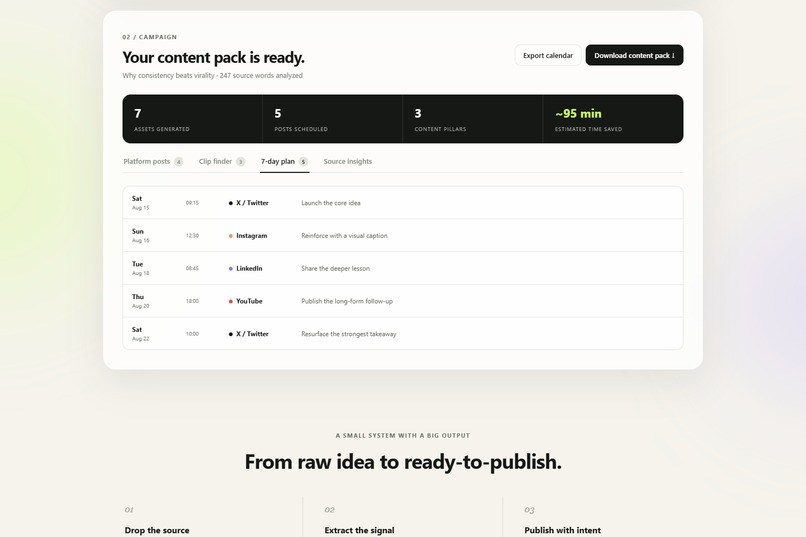
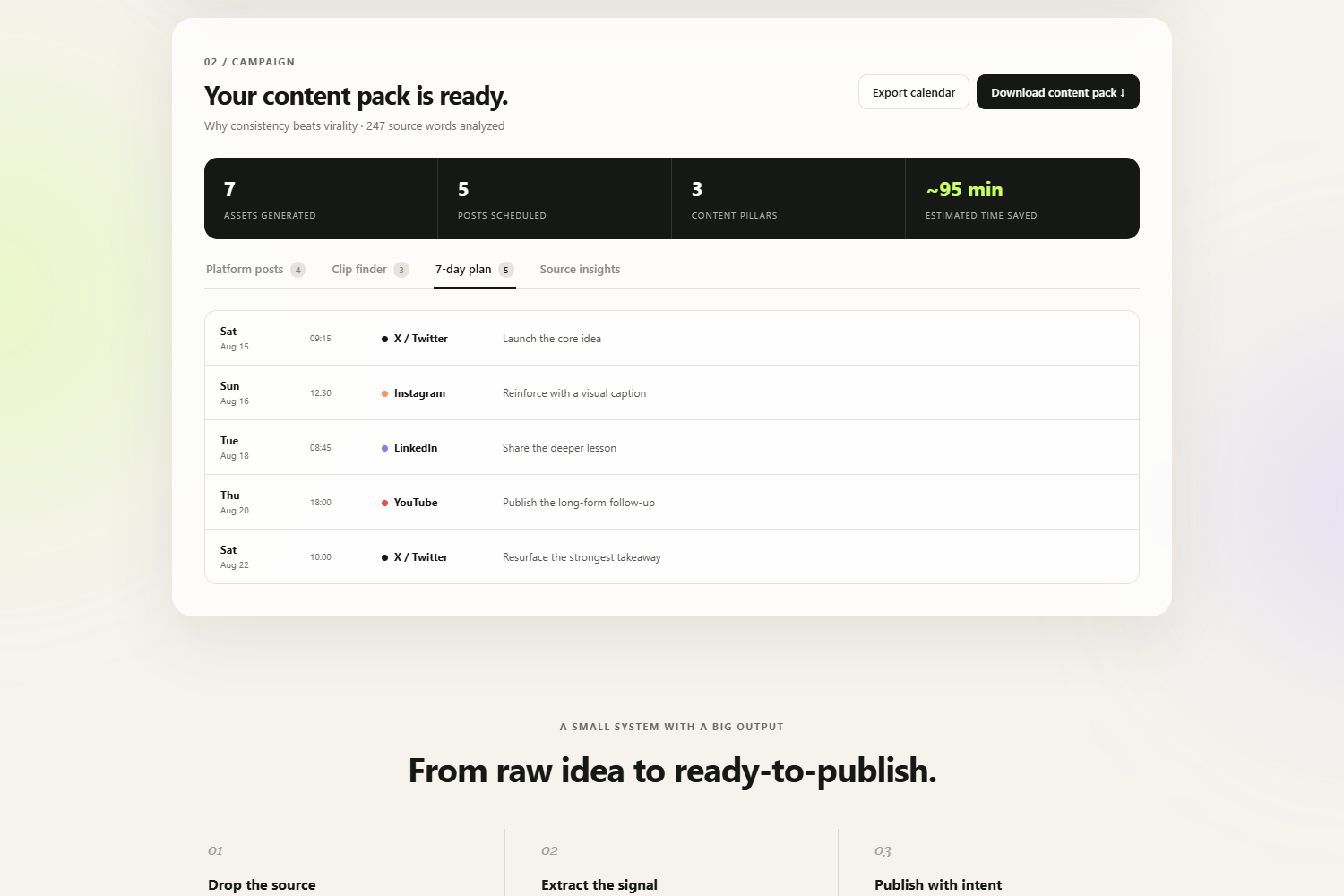
Generated content becomes a deliberate cross-platform schedule that creators can export as CSV.
-
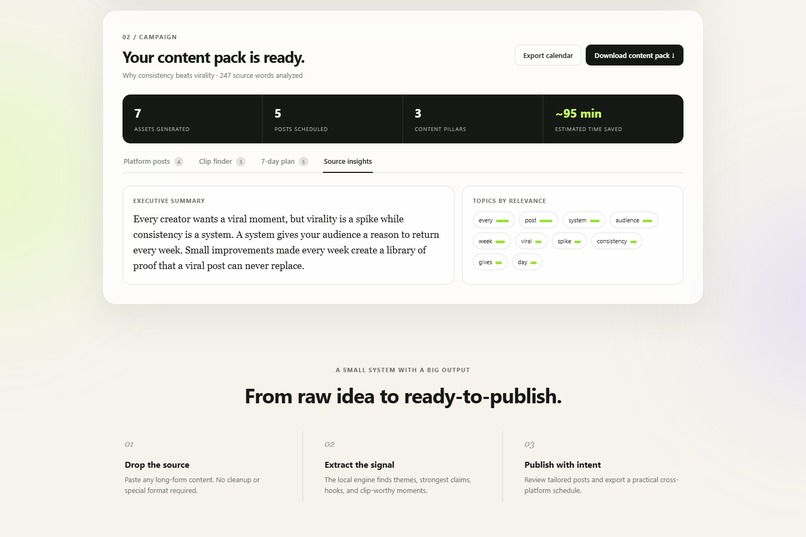
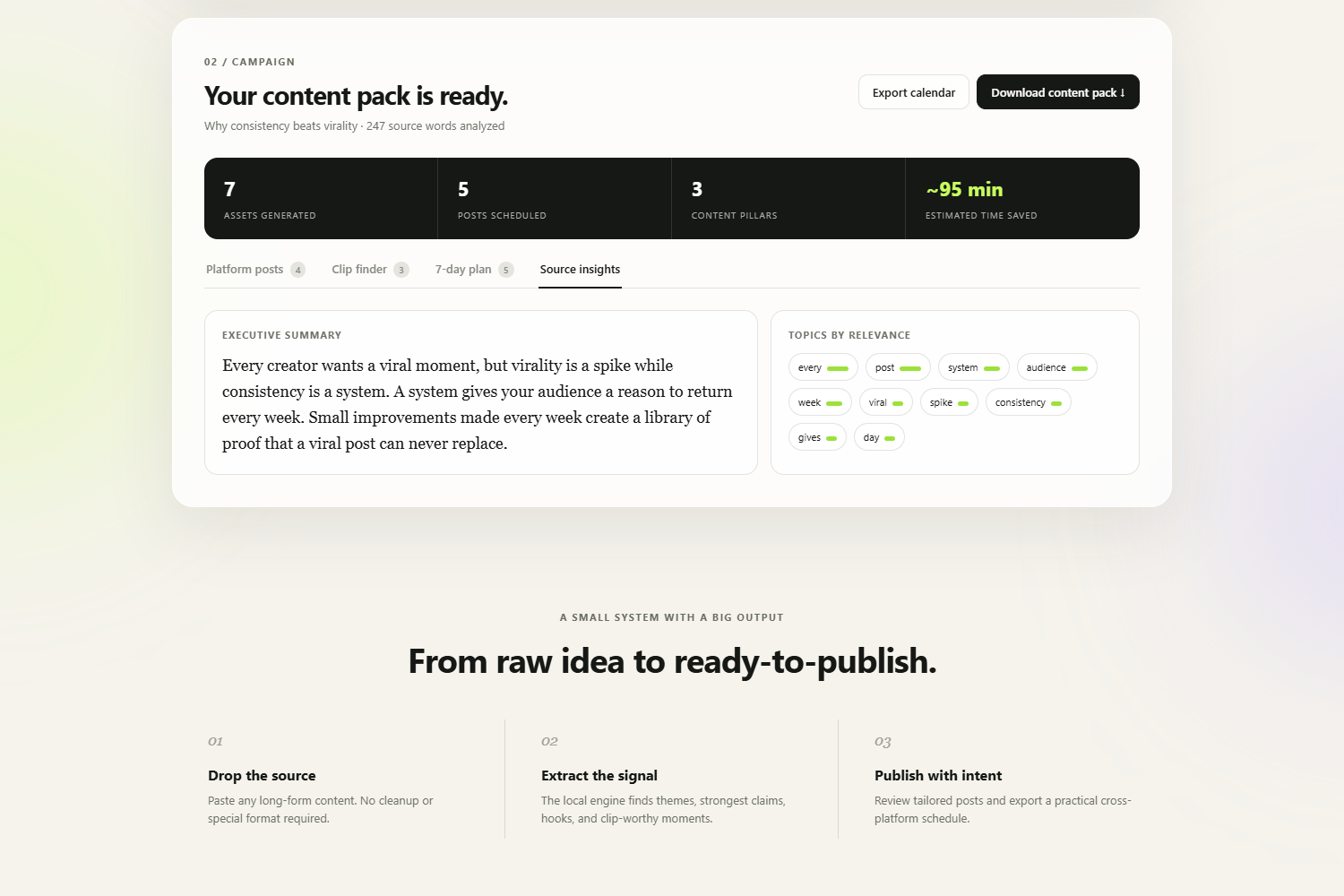
Local analysis extracts an executive summary, weighted topics, and reusable content pillars.
Inspiration
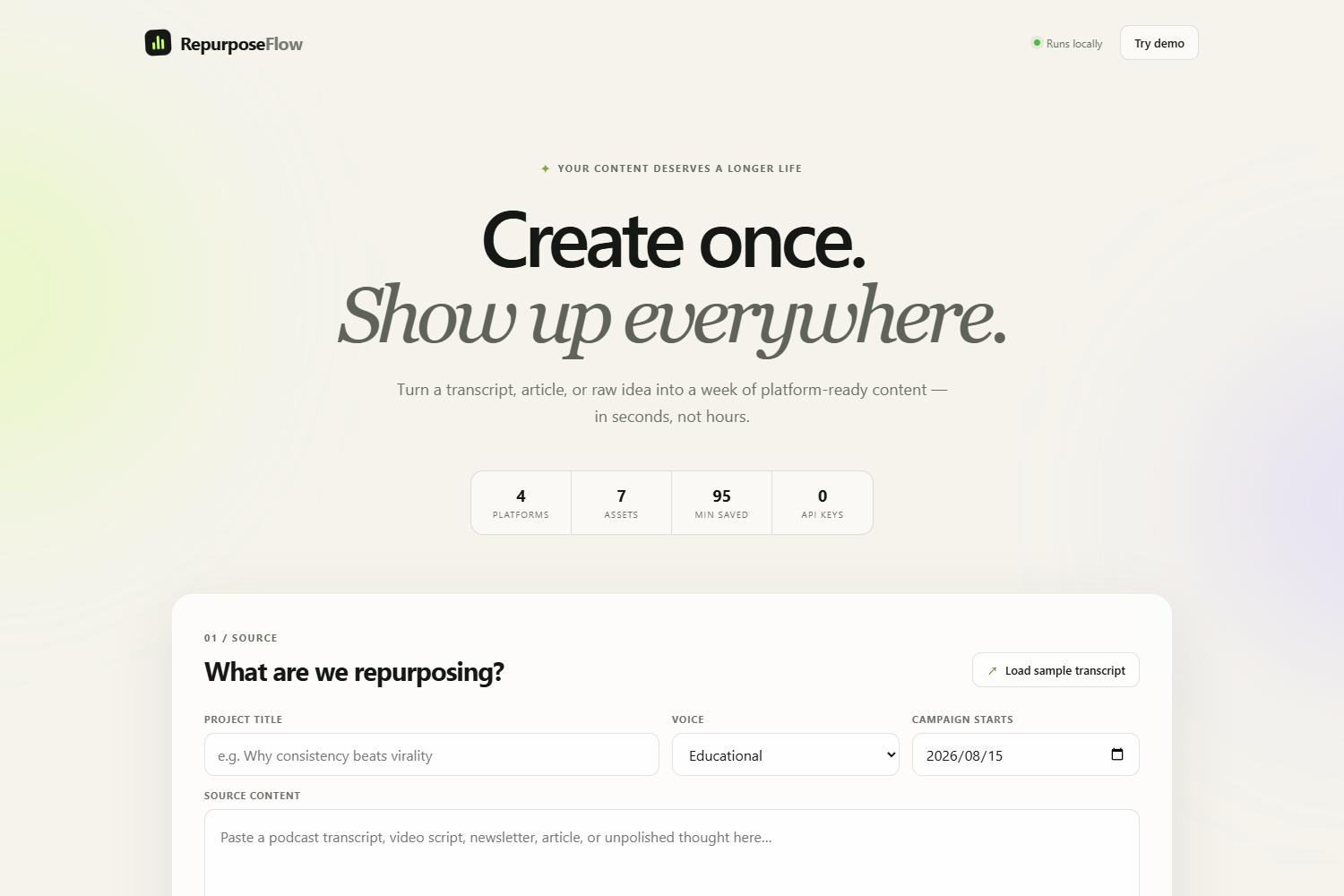
Creating the original content is only half the work. After recording a podcast, writing an article, or publishing a video, creators still spend hours extracting highlights, rewriting captions for different platforms, finding short-form clips, adding metadata, and planning when to publish. We built RepurposeFlow to remove that repetitive work. Our goal was simple: help one strong idea travel further while keeping the workflow private, reliable, and accessible without paid APIs or complicated setup.
What it does
RepurposeFlow turns a transcript, article, newsletter, video script, or rough idea into a complete social media campaign. In one click, it: Generates tailored posts for X, LinkedIn, Instagram, and YouTube Scores each post for its hook, clarity, call to action, and platform fit Identifies three short-form video moments with estimated timestamps Suggests hooks, overlays, and explanations for each clip Extracts a summary, keywords, and content pillars Creates a seven-day cross-platform publishing calendar Exports the content pack as JSON and the calendar as CSV Everything runs locally, so creators do not need an account, internet connection, or API key.
How we built it
Inspiration Creating the original content is only half the work. After recording a podcast, writing an article, or publishing a video, creators still spend hours extracting highlights, rewriting captions for different platforms, finding short-form clips, adding metadata, and planning when to publish. We built RepurposeFlow to remove that repetitive work. Our goal was simple: help one strong idea travel further while keeping the workflow private, reliable, and accessible without paid APIs or complicated setup. What it does RepurposeFlow turns a transcript, article, newsletter, video script, or rough idea into a complete social media campaign. In one click, it: Generates tailored posts for X, LinkedIn, Instagram, and YouTube Scores each post for its hook, clarity, call to action, and platform fit Identifies three short-form video moments with estimated timestamps Suggests hooks, overlays, and explanations for each clip Extracts a summary, keywords, and content pillars Creates a seven-day cross-platform publishing calendar Exports the content pack as JSON and the calendar as CSV Everything runs locally, so creators do not need an account, internet connection, or API key. How we built it We built the content-analysis engine in Python using only the standard library. It performs sentence segmentation, weighted keyword extraction, sentence ranking, platform-aware content shaping, clip-time estimation, and heuristic quality scoring. The ranking system combines several signals: [ S = R + P + 0.3L + A ]where: (R) represents keyword relevance (P) rewards important sentence positions (L) favors sentences with an effective length (A) rewards actionable language A lightweight local HTTP server exposes the generation engine through a JSON API. The frontend uses semantic HTML, responsive CSS, and vanilla JavaScript. It provides tone controls, input validation, tabbed campaign results, copy actions, and downloadable exports. The complete application has zero third-party runtime dependencies and starts with one Python command.
Challenges we ran into
The main challenge was producing useful content without depending on a remote generative AI service. Basic keyword frequency creates noisy topics, while purely extractive summaries often lack the structure required for finished social posts. We addressed this by combining term weighting, positional relevance, sentence-length preferences, action-language detection, platform constraints, and structured writing patterns. This keeps the output deterministic and explainable while still producing practical drafts. Another challenge was translating one source into genuinely different platform formats rather than copying the same caption four times. Each platform therefore has its own structure, character limits, calls to action, and content-scoring criteria. Finally, we wanted judges to reproduce the project immediately. Avoiding databases, build tools, credentials, and external services required careful scope decisions, but made the final product more reliable and accessible.
Accomplishments that we're proud of
Built a complete, working automation rather than a mockup Turned one source into seven content assets and a publishing plan Created distinct outputs for four social platforms Added explainable content scores and clip recommendations Implemented real JSON and CSV export workflows Made the application private and functional offline Achieved zero third-party runtime dependencies Built a polished interface that works on desktop and mobile Added automated tests and browser-level workflow verification Reduced an estimated 95 minutes of repetitive work per campaign
What we learned
We learned that useful automation does not need to hide every decision inside a black box. Creators benefit from seeing why a moment was selected, which topics were identified, and how a post was scored. We also learned that content repurposing is not simply summarization. Each platform has a different audience expectation, structure, and ideal level of context. Successful automation must preserve the central idea while changing its packaging. Most importantly, privacy and reproducibility can be product features. Building without mandatory cloud services made RepurposeFlow easier to demonstrate, understand, and run.
What's next for RepurposeFlow
Future versions could include: Optional local and hosted language-model integrations Creator-specific brand voice profiles Direct audio and video transcription Automatic subtitle and thumbnail generation OAuth publishing integrations for social platforms Reusable campaign templates Performance analytics and content recommendations Team review and approval workflows Feedback loops that improve suggestions using previous post performance Our long-term vision is for RepurposeFlow to become a private content operations assistant that takes creators from one original idea to an entire measurable campaign.
Built With
- api
- automation
- content
- css3
- csv
- design
- git
- html5
- javascript
- json
- language
- local-first
- media
- natural
- privacy
- processing
- python
- responsive
- rest
- social

Log in or sign up for Devpost to join the conversation.