-
-
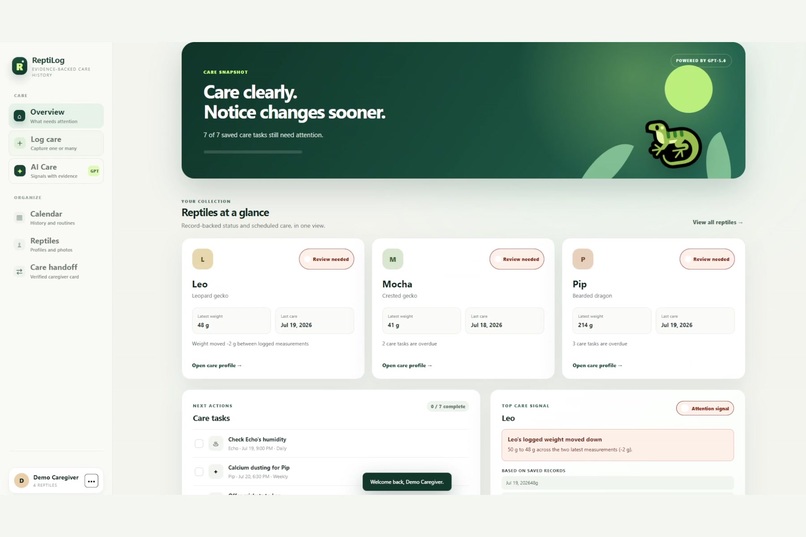
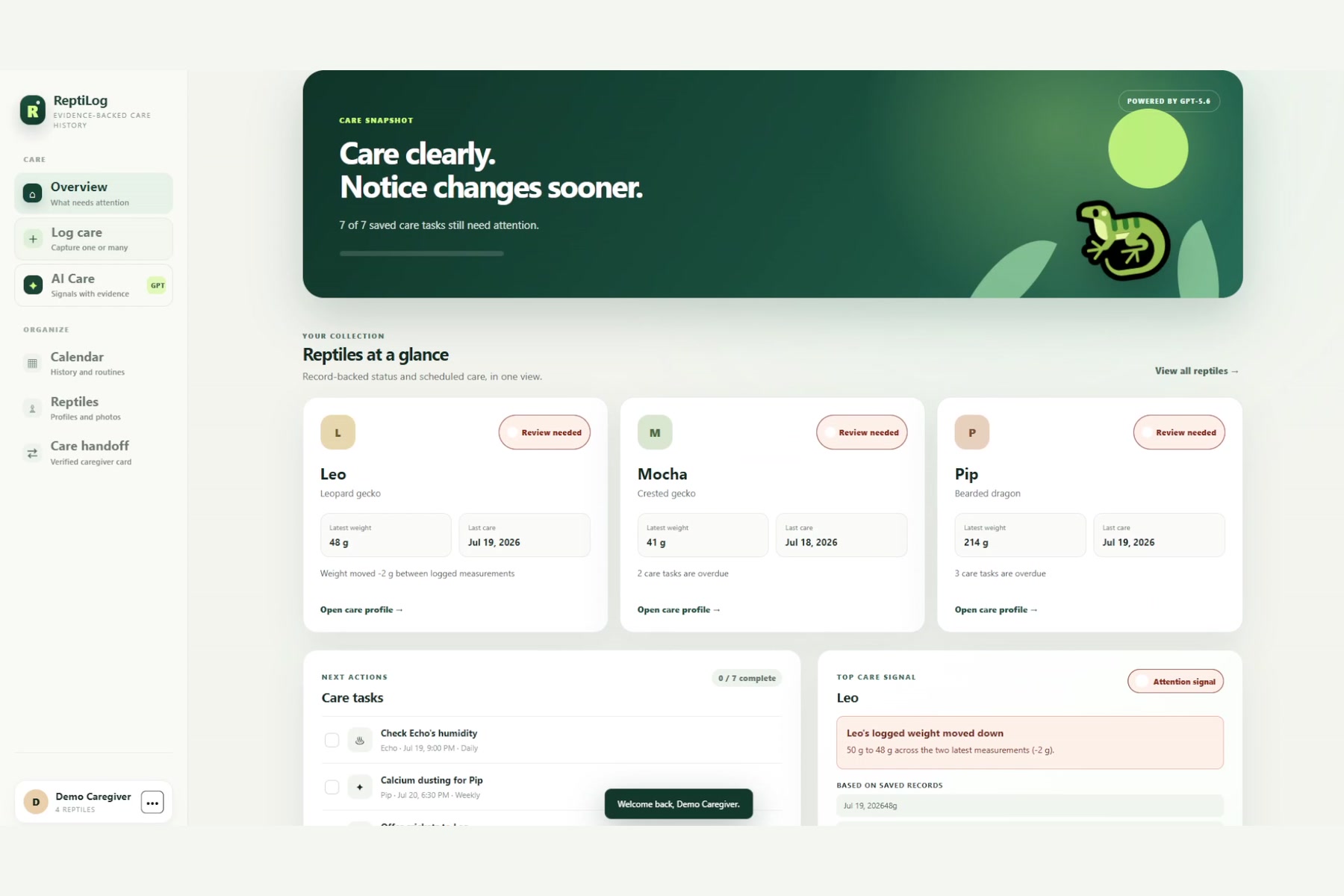
Built with Codex, this dashboard turns account-scoped data into tasks, recent activity, and priorities across multiple reptiles.
-
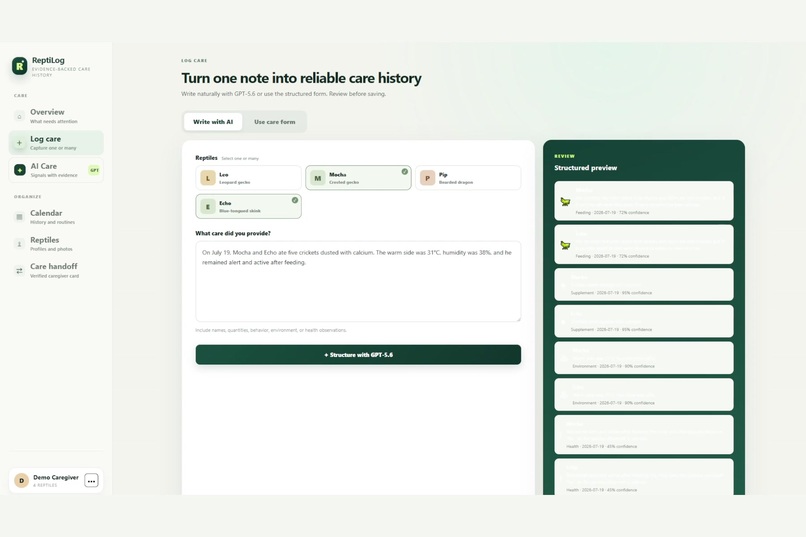
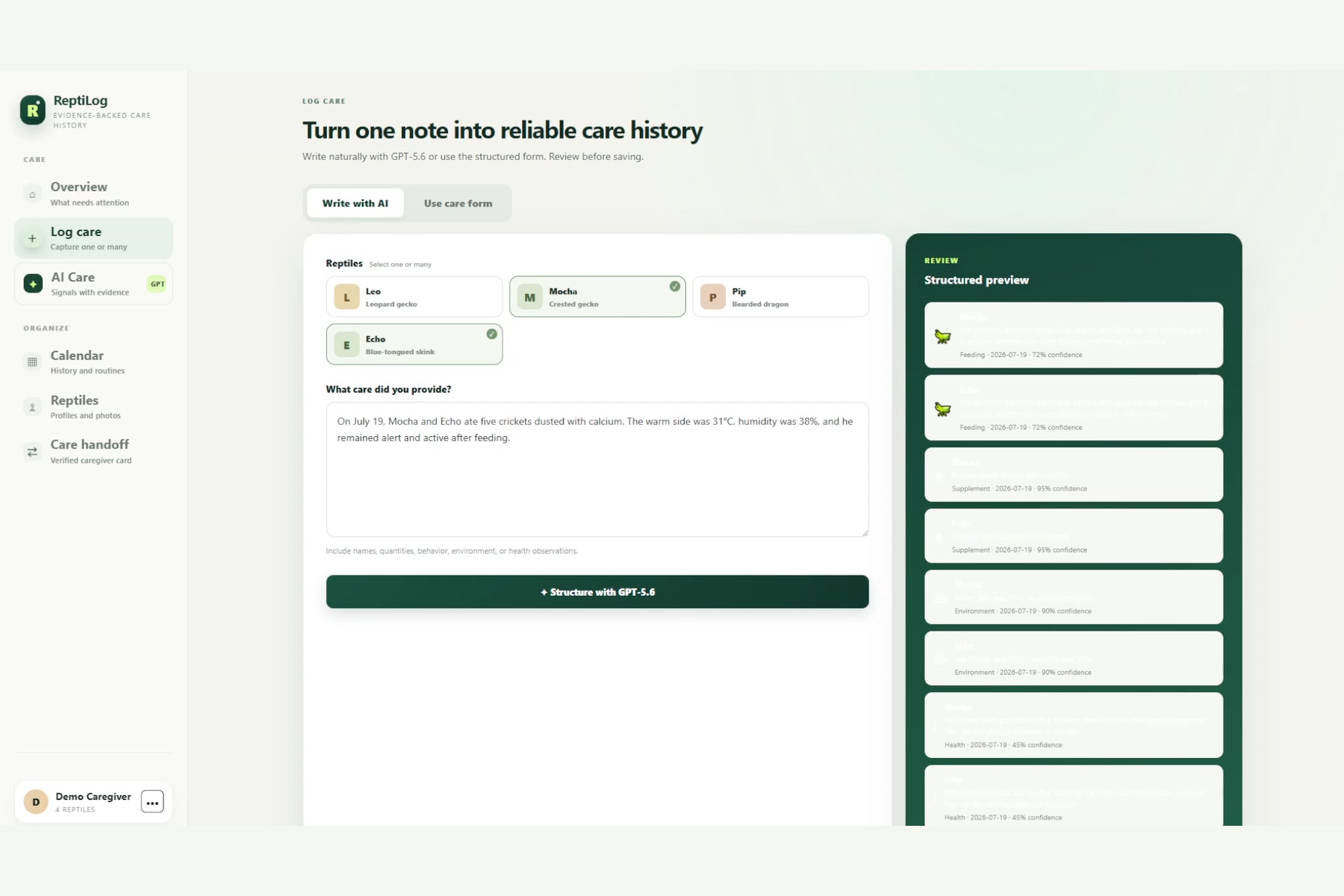
GPT-5.6 turns one natural-language observation into editable care records—nothing is saved before owner review.
-
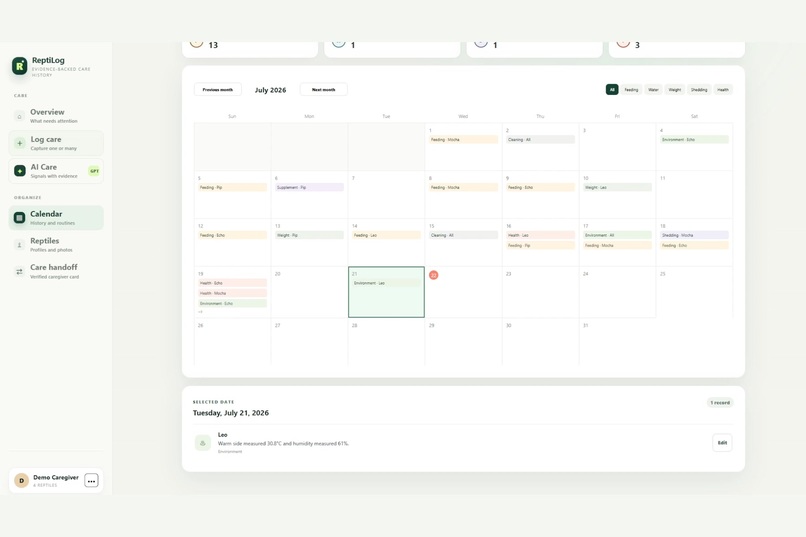
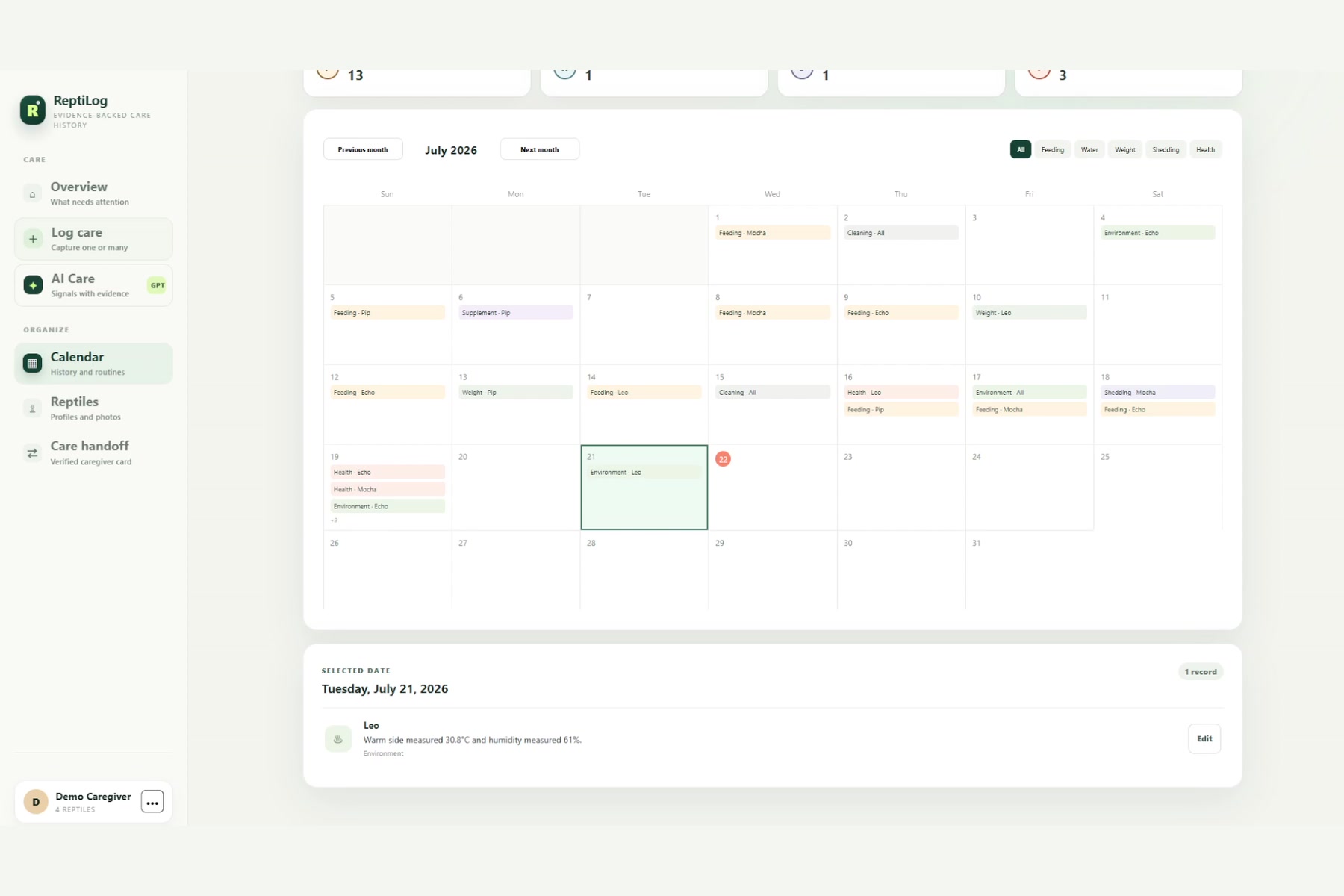
Every observation stays dated and editable. The July 21 record appears directly below the calendar for quick verification.
-
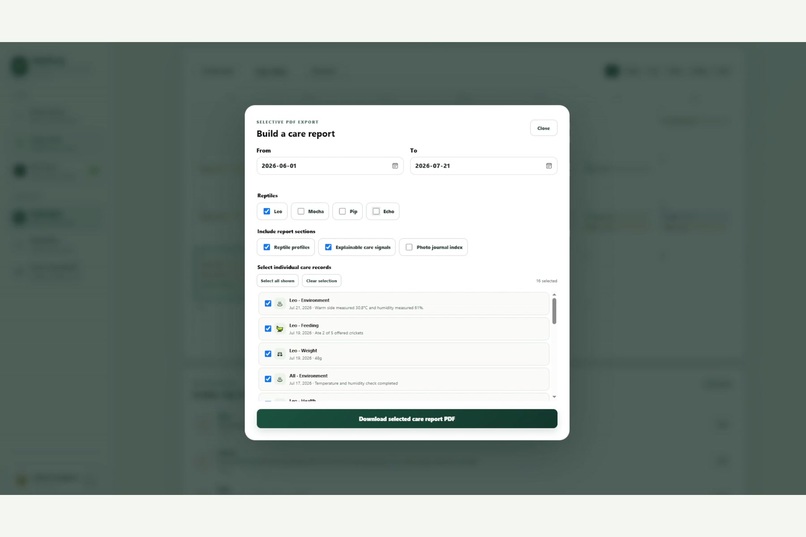
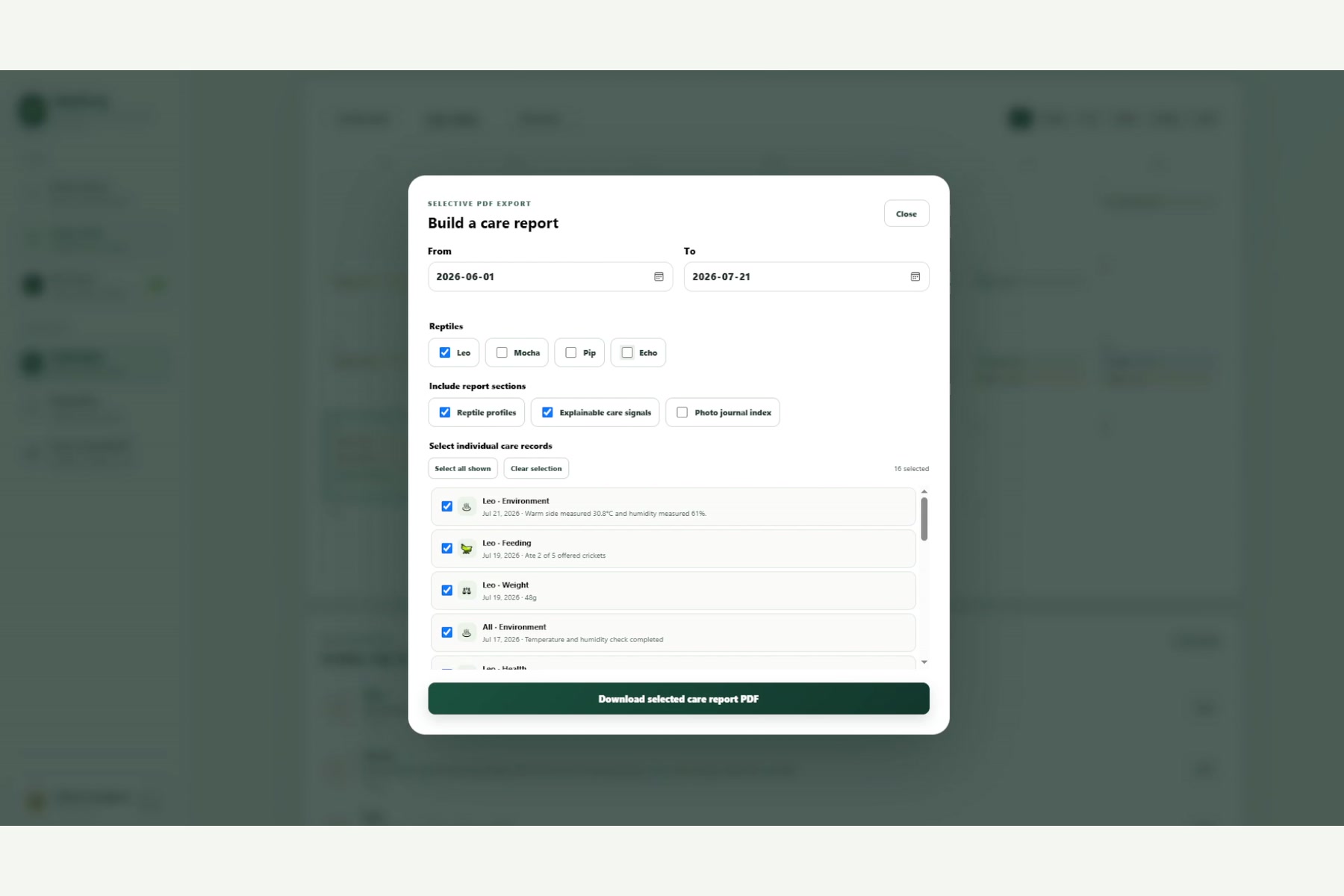
Owners choose exactly which dates, reptiles, signals, and records leave their private care history in a shareable PDF.
-
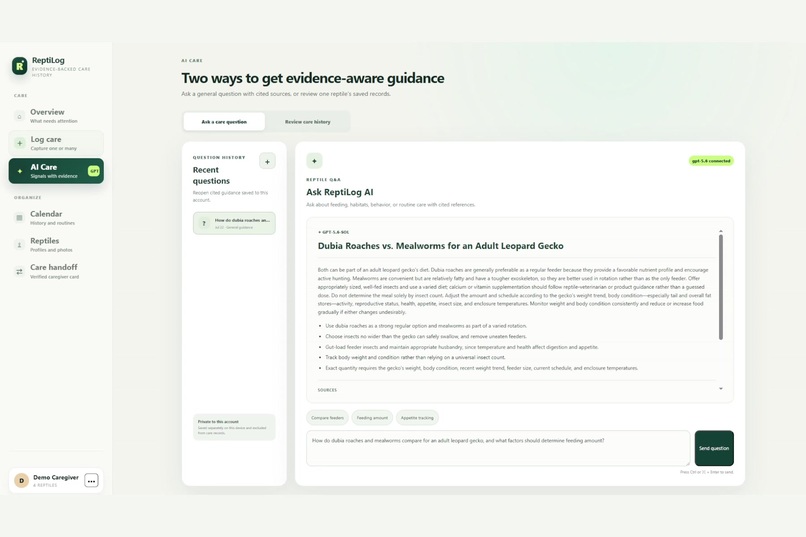
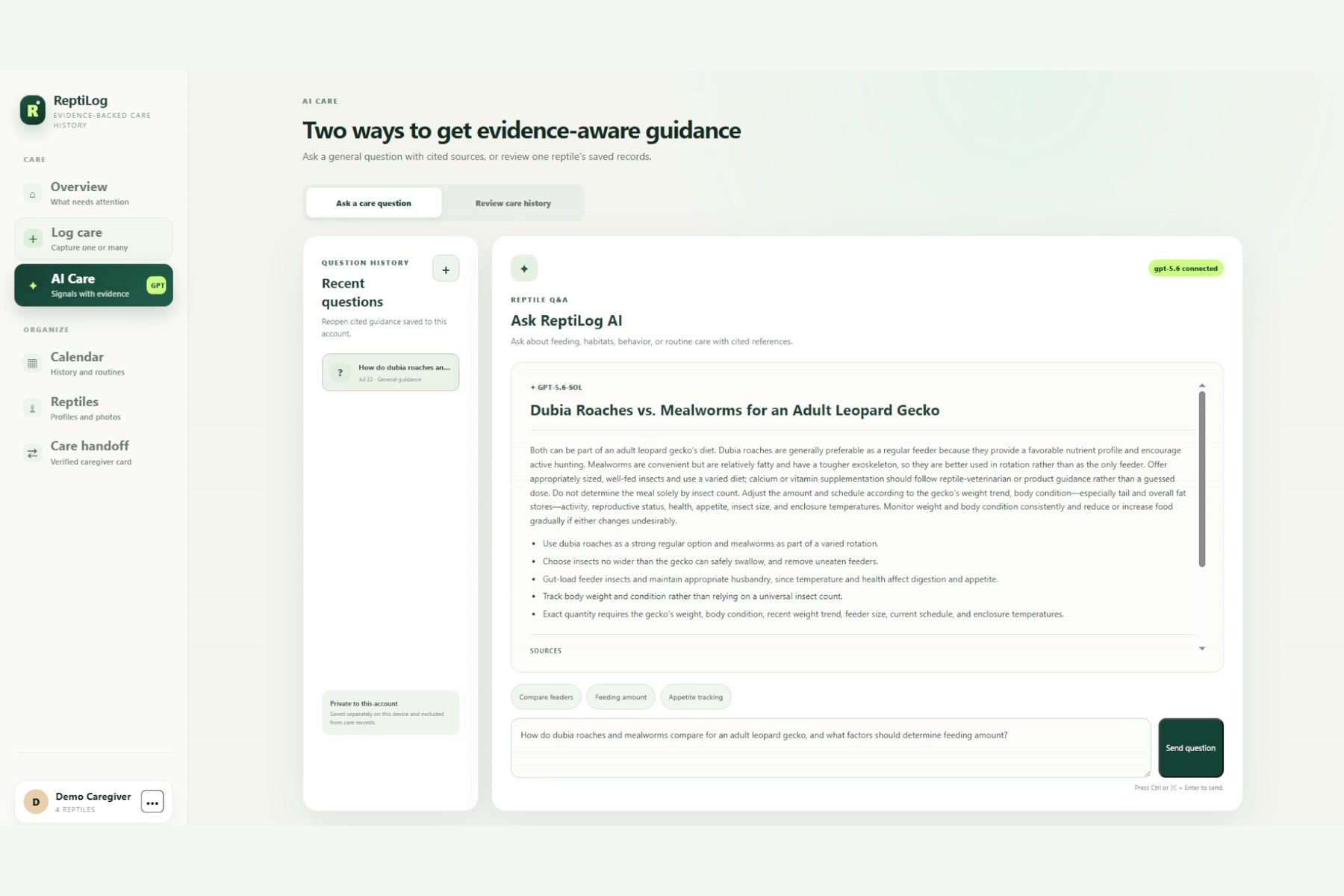
GPT-5.6 provides cited guidance from a server-managed source catalog; missing or unknown source IDs are rejected.
-
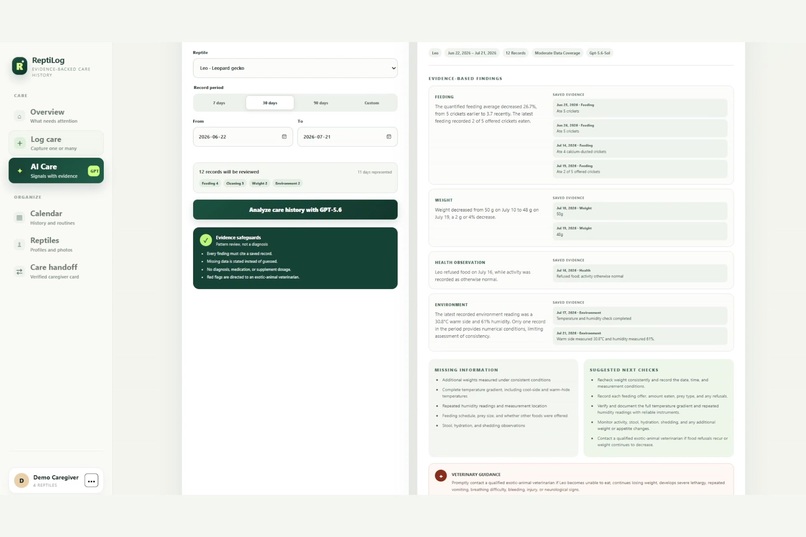
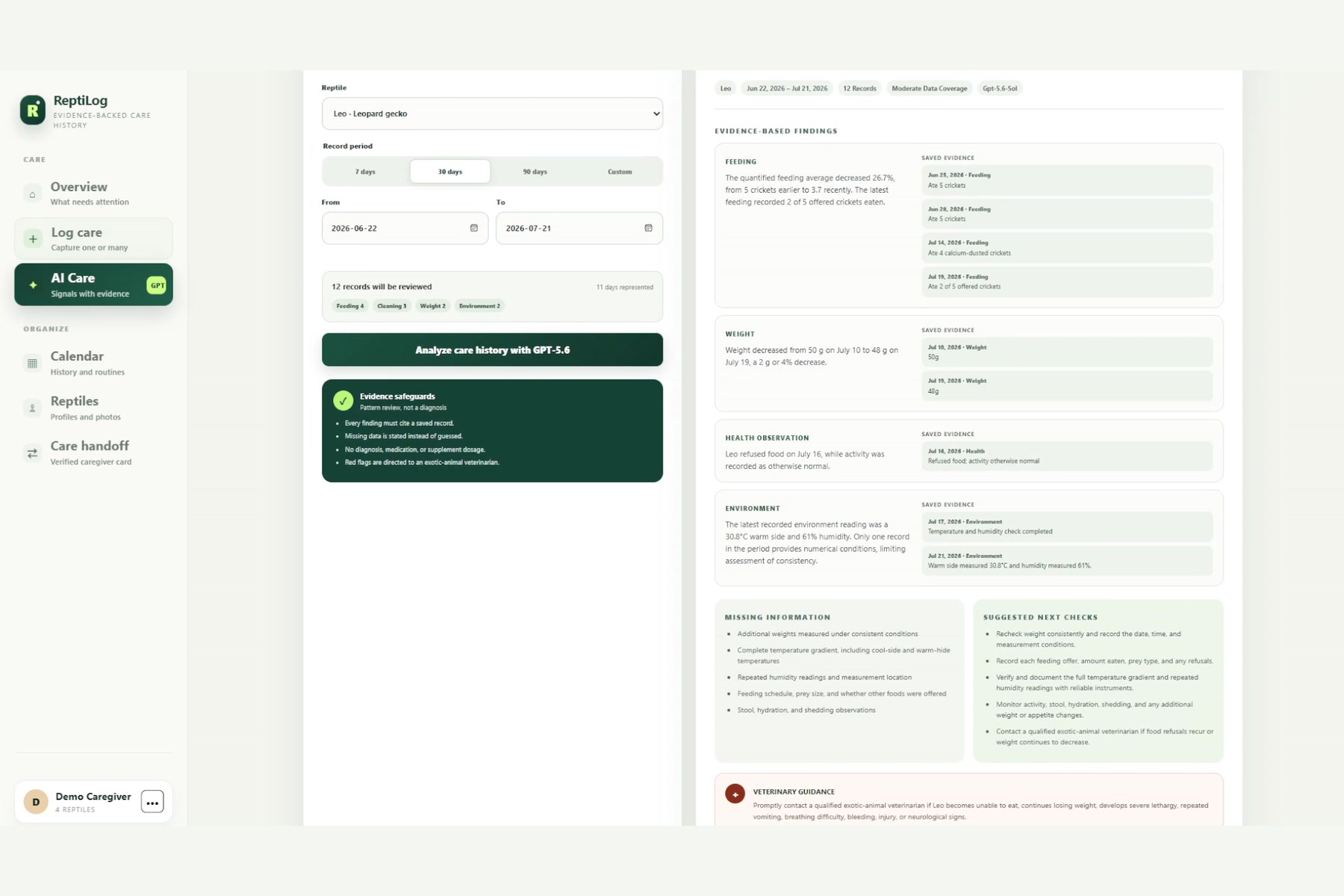
Codex helped turn GPT-5.6 analysis into a tested flow: deterministic metrics first, exact saved-record evidence after.
-
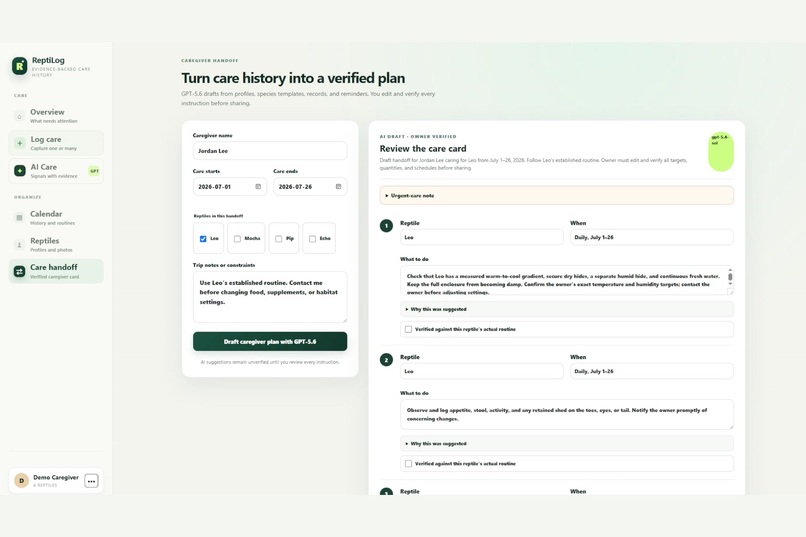
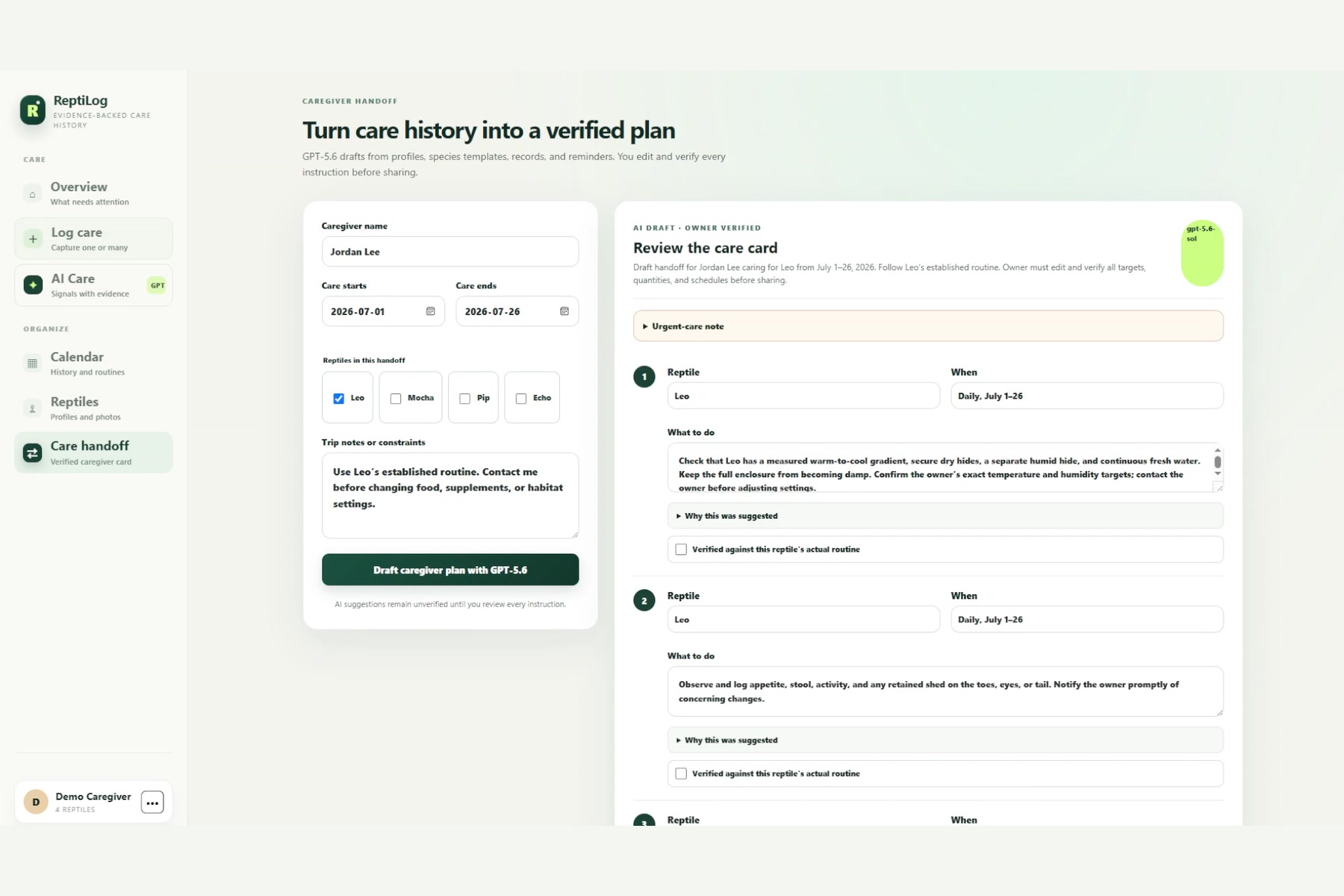
GPT-5.6 drafts a plan from saved care context; the owner edits and verifies every instruction before export.
Inspiration
ReptiLog AI began with a problem from my own life.
While caring for lizards, I realized how difficult it is to remember every feeding, shed, weight change, habitat adjustment, supplement, and health observation—especially when caring for several animals. Because they are small and their changes can be subtle, details that feel easy to remember can eventually be forgotten or mixed up between reptiles.
The challenge becomes even clearer when care is shared. If I travel or someone else needs to take over, that person needs more than a quick message. They need the correct history, current routine, and clear instructions for each animal.
I built ReptiLog AI to turn those everyday observations into an organized and shareable care history. My goal is to help owners manage multiple reptiles with less uncertainty and hand off care without losing the context behind each animal.
What it does
ReptiLog AI is a consumer care companion for multi-reptile households.
Owners can:
- Manage multiple reptile profiles with species, habitat, weight, birth date, and profile photos
- Record care naturally with GPT-5.6 or use a complete structured form without AI
- Track feeding, weight, shedding, hydration, supplements, cleaning, health, and habitat observations
- Review and edit saved records by date on a calendar
- Add dated photos to the correct reptile
- Create repeating care reminders
- Export selected dates, reptiles, sections, and individual records as a PDF
- Prepare verified Caregiver Handoff instructions for travel or shared care
The home screen turns saved account data into a practical overview of registered reptiles, scheduled care, recent activity, and record-derived care priorities.
AI Care
AI Care provides two focused GPT-5.6 experiences.
Reptile Care Q&A
Owners can ask general reptile-care questions. GPT-5.6 produces concise guidance using source IDs from a server-managed veterinary source catalog.
The server validates those IDs before displaying the answer. Missing, duplicate, or unknown source IDs are rejected rather than shown as valid references.
Care History Review
Owners select one reptile and an exact date range. Before GPT-5.6 analyzes the history, ReptiLog calculates deterministic information such as the submitted record scope, feeding activity, and weight change.
Every AI finding must cite an exact record ID that was included in the request. The server rejects fabricated evidence IDs, unsupported findings, diagnosis, medication instructions, and supplement dosages.
This keeps the analysis connected to the selected reptile’s actual dated history instead of turning it into an unrestricted health chatbot.
Natural-language care logging
ReptiLog AI also uses GPT-5.6 to turn a natural-language observation into editable structured records.
An owner can describe feeding, supplements, habitat conditions, and behavior in one note. GPT-5.6 separates that note into relevant care records, but nothing is saved automatically. The owner reviews the structured preview before adding it to the history.
AI remains optional. The manual care form creates the same type of dated history without calling the model.
Caregiver Handoff
Caregiver Handoff is designed for travel and shared household care.
The owner selects the caregiver, dates, reptiles, and relevant context. GPT-5.6 creates a draft using only the submitted profiles, saved records, reminders, owner notes, and reviewed care templates.
Each task includes the reptile, schedule, action, reason, and evidence source. If a required detail is missing, the system instructs the caregiver to confirm it with the owner instead of inventing a feeder quantity, supplement dosage, temperature, or humidity value.
The owner can edit every task and must verify every instruction before the handoff can be finalized or exported as a PDF.
Safety and owner control
ReptiLog AI organizes observations and supports care continuity. It does not diagnose disease, prescribe medication, or replace a qualified exotic-animal veterinarian.
The safety design is implemented as part of the application contract:
- General answers require validated source IDs
- Care History Review findings require exact submitted record IDs
- Medication and supplement dosage instructions are rejected
- Missing information must be acknowledged instead of guessed
- AI-generated care records must be reviewed before saving
- Caregiver instructions must be verified by the owner before export
- Urgent concerns are directed to qualified exotic-animal care
What the demo shows
The demonstration follows the core product workflow:
- Enter the account-separated demo workspace
- Review the multi-reptile household overview
- Record care with GPT-5.6-assisted natural language
- Create another record with the structured care form
- Verify the saved record on July 21 in the calendar
- Ask a reptile-care question and review its sources
- Analyze one reptile’s selected care-history period
- Select records for PDF export
- Review reptile profiles and photo support
- Generate, edit, verify, and export a Caregiver Handoff
How I built it
ReptiLog AI uses a dependency-light HTML, CSS, and JavaScript client with a Node.js server.
The server connects to GPT-5.6 through the OpenAI Responses API while keeping the API key out of the browser. Each AI workflow uses a strict structured-output schema followed by application-level source, evidence, and safety validation.
The Build Week demo stores data in account-specific browser-storage namespaces. This keeps the sample account separate from newly created accounts on the same browser. It is demo infrastructure, not production authentication, cloud storage, or cross-device synchronization.
The application is deployed on Render. GitHub Actions runs formatting, syntax, account-isolation, product smoke, AI-safety, evidence-validation, input-boundary, and server checks.
How I used Codex
I used Codex throughout the project—from early product structure to final testing and submission preparation.
Codex helped me:
- Implement and refactor the browser client and Node.js server
- Build the calendar, profiles, reminders, photo journal, and PDF workflows
- Design the structured GPT-5.6 contracts
- Add source and record-evidence validation
- Separate browser data by account
- Diagnose interaction problems in dialogs, buttons, navigation, profiles, and authentication state
- Build automated safety evaluations and product smoke tests
- Review security boundaries and prevent server secrets from reaching the client
- Improve responsive UI consistency and English product copy
- Prepare and verify the GitHub repository and deployment
I made the key product and safety decisions: preserve a complete manual workflow, separate general Q&A from record-bounded analysis, validate model output after generation, avoid presenting AI as veterinary authority, and make the owner the final verifier of caregiver instructions.
Challenges I ran into
The hardest challenge was making AI useful without making it sound medically authoritative.
A prompt alone was not enough. I needed deterministic metrics, strict schemas, a controlled source catalog, exact evidence IDs, server-side validation, explicit safety language, and visible owner approval.
Another challenge was keeping a large amount of care information understandable. Multi-reptile profiles, dated records, reminders, health observations, and AI output could easily create an overly dense interface. I repeatedly simplified the navigation, labels, status presentation, and core workflow so the product would feel like one connected experience rather than a collection of features.
I also needed the application to remain useful when GPT-5.6 was unavailable. That led to the complete structured form, editable calendar, local care signals, reminders, photos, and PDF export working independently from the model.
What I learned
I learned that trustworthy AI products need more than a good response. Trust comes from showing where information came from, stating what is missing, validating generated output, and giving the user final control.
I also learned that AI is most valuable when it improves an existing workflow. In ReptiLog AI, GPT-5.6 does not replace care records. It helps owners create, understand, and safely communicate those records.
Codex helped me move quickly across product design, implementation, debugging, testing, and documentation while still allowing me to make the final product and safety decisions.
Accomplishments that I’m proud of
I am proud that ReptiLog AI demonstrates a complete care loop:
Record care → verify the history → review grounded signals → share owner-approved instructions
The project supports multiple reptiles without blending their histories, provides both AI and non-AI input methods, validates AI evidence on the server, and turns saved care context into a practical handoff that another person can follow.
What’s next
A production version would replace browser storage with authenticated database and object storage, add cross-device synchronization, introduce server-scheduled push notifications, expand the reviewed veterinary source catalog, and strengthen species templates through expert review.
ReptiLog AI demonstrates a practical goal: care clearly, notice changes sooner, and hand off responsibility without losing the history behind each reptile.
Built With
- actions
- codex
- css3
- github
- gpt-5.6
- html5
- javascript
- localstorage
- node.js
- openai
- render

Log in or sign up for Devpost to join the conversation.