-
-
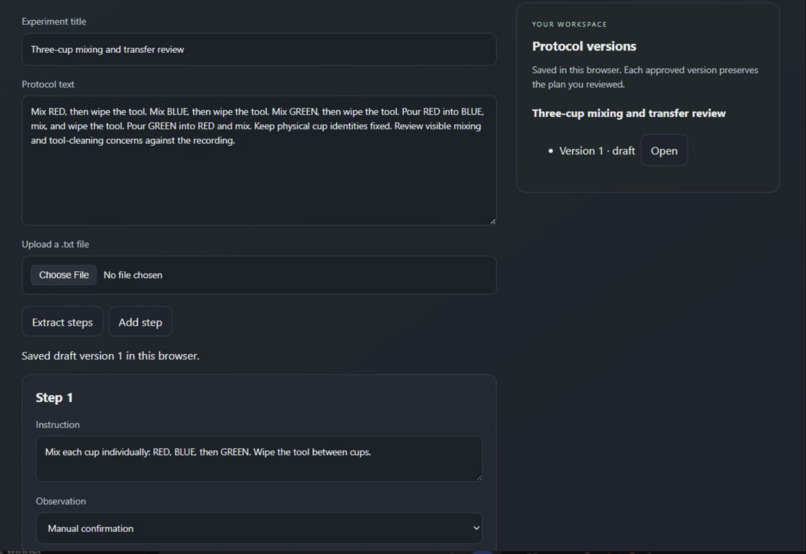
Build a structured procedure with source references and saved versions.
-
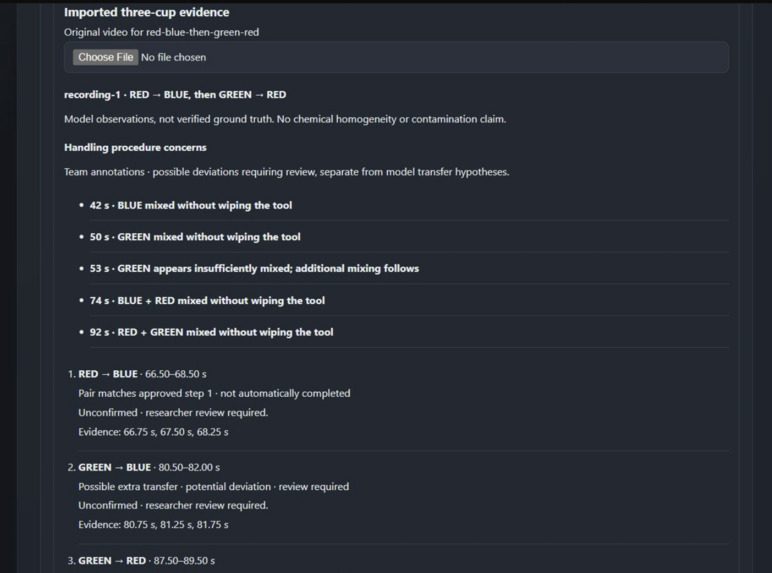
Review saved transfer hypotheses, timestamps, and possible procedural deviations.
-
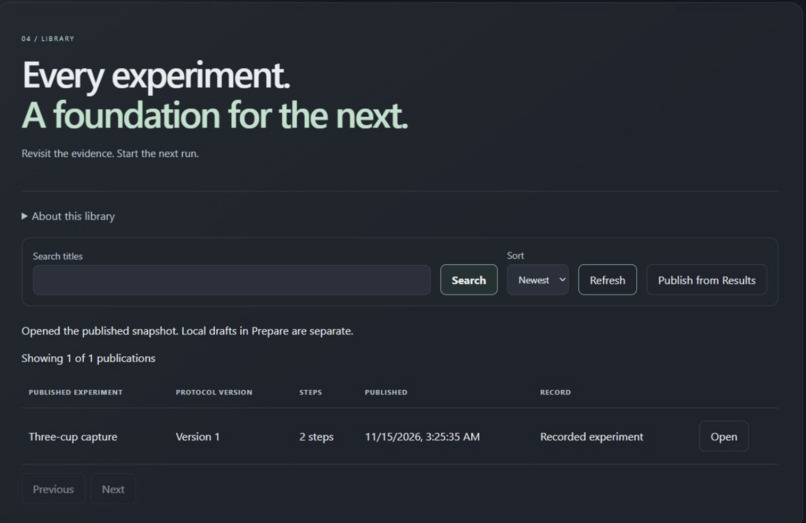
Preserve experiment reviews and procedures for future reference.
Inspiration
By the time an experiment gives you a surprising result, the moment that might explain why may be hours behind you. In a 2016 Nature survey, more than 70% of respondents reported having failed to reproduce another scientist’s experiment. A separate 2015 analysis estimated that approximately $28 billion was spent annually on irreproducible preclinical research in the United States. Nature survey · Economic analysis
For us, that problem felt familiar. At NYU Tandon, Ryan studied inflammation by treating macrophages under different conditions and using qPCR to measure expression of IL-6, a gene involved in the inflammatory response. When two samples responded differently, understanding how they had been handled was part of figuring out why. Ryan’s enzyme assays at the Summer Science Program and Rupesh’s research at Georgia Tech gave us a reason to build something we would have wanted at the bench.
In our own lab work, we saw how easily a small variation could slip by while we were focused on the next step. We wanted a way to return to those moments: to inspect a possible mistake, investigate a safety concern, or understand an unexpected result worth exploring further.
That became ReproLab, a workspace that connects the procedure, the experiment, and the evidence. Our goal is to help researchers carry out experiments more carefully, make their work easier to repeat, and preserve the details that could turn a surprising result into a discovery.
What it does
A written procedure captures the plan. ReproLab helps researchers examine what actually happened. It brings preparation, camera footage, evidence review, and experiment history into one workspace, addressing three gaps: unclear instructions before an experiment, missed deviations during execution, and missing context when someone tries again.
Prepare - make the plan reviewable
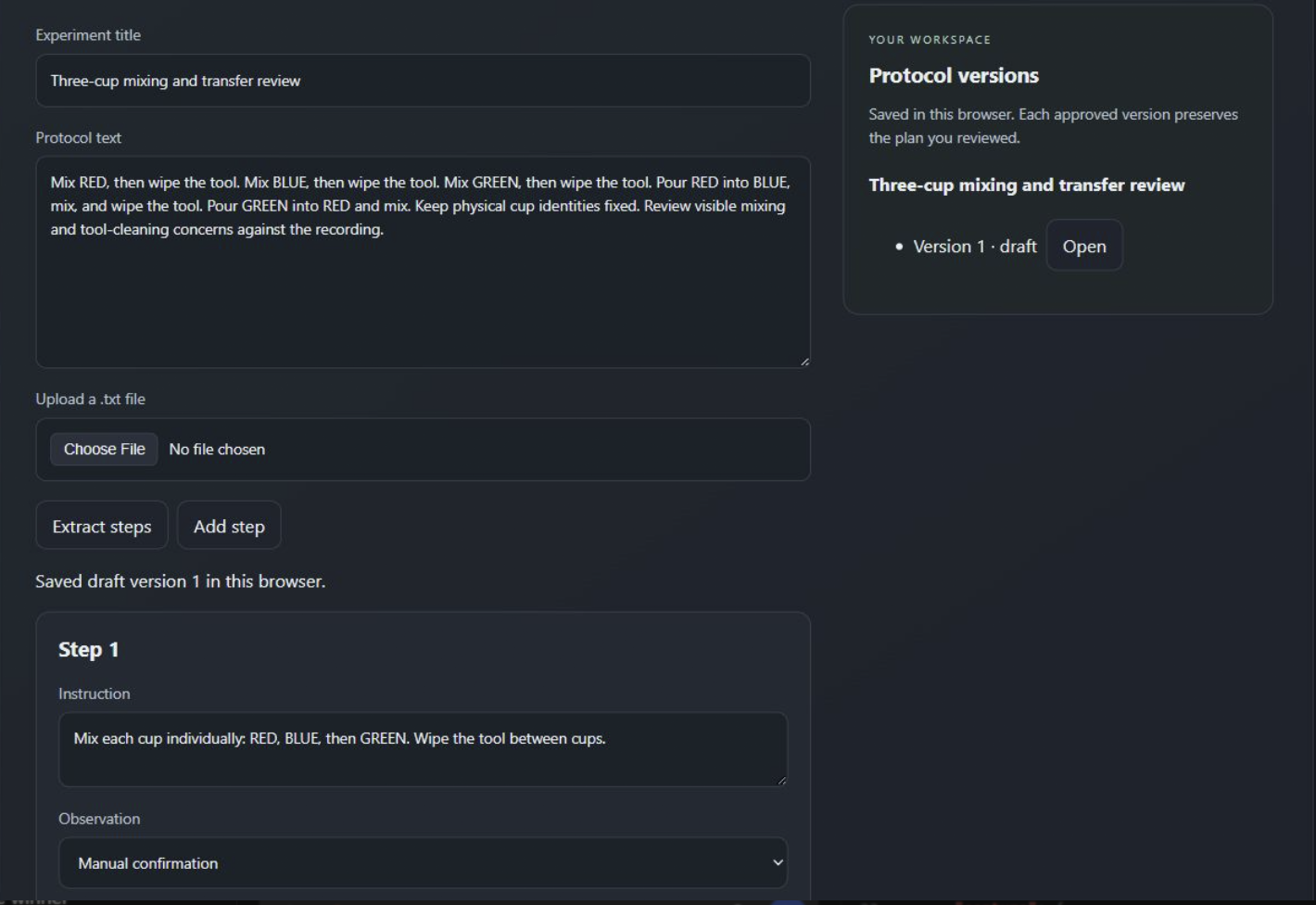
Researchers can write or import protocol text, use Gemini to extract a structured draft, and review the steps before approving a version. Missing information stays visible for clarification rather than becoming an invented instruction. The approved version preserves the procedure against which the experiment should be reviewed.
Monitor - connect actions to evidence
The camera takes center stage, with the approved procedure and observations beside it. Researchers can capture webcam footage or review a recording with saved Gemini analysis.
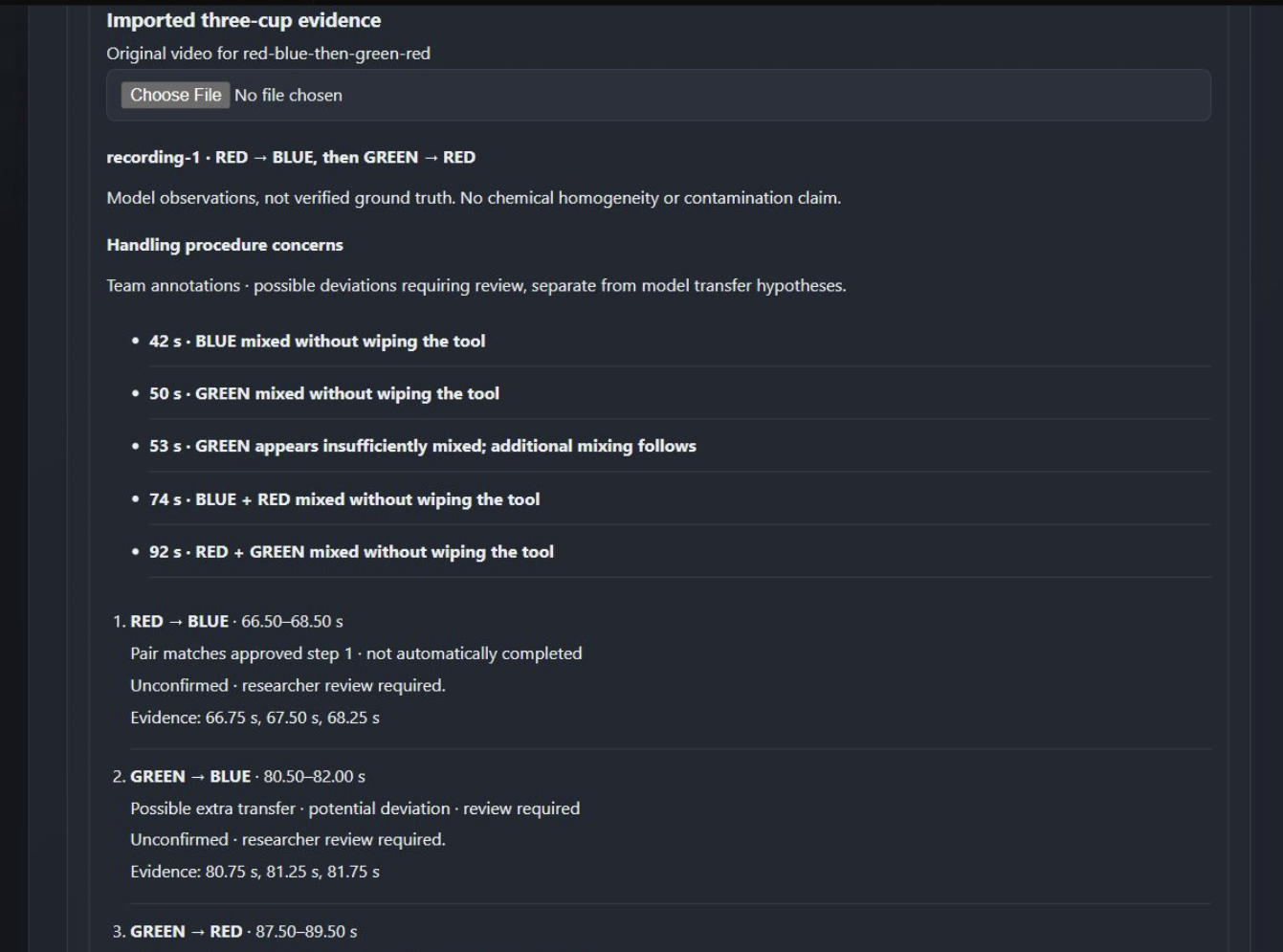
In our three-cup pilot, proposed transfers appear as timestamped events. Clicking Watch returns to the supporting moment in the original video. A separate comparison layer highlights possible extra transfers, repeated actions, and ordering differences. Model hypotheses, person reports, and human confirmations remain distinct, so uncertainty cannot quietly become a completed step.
Results - review before drawing conclusions
Saved monitor sessions bring recorded observations, flags, and person reports together for inspection. Researchers can review the record and publish a finished run with an optional recording. Finishing a session does not automatically mean the procedure was followed correctly; the evidence remains available for that judgment.
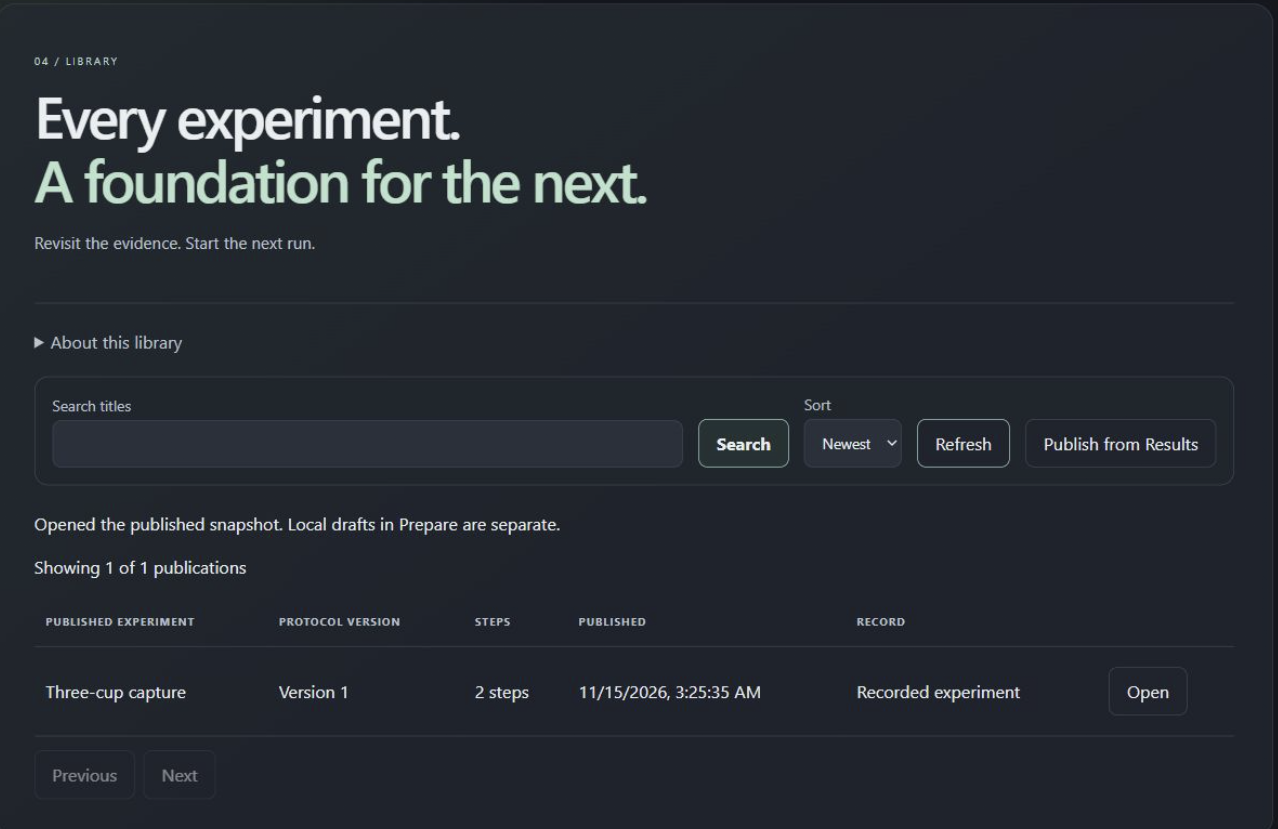
Library - give the next experiment a starting point
MongoDB Atlas stores supported experiment records and replication history, helping researchers revisit an earlier procedure and its recorded context before starting another run.
Together, these features help researchers investigate procedural mistakes and potential safety concerns with evidence they can inspect. ReproLab supports saved-video analysis and includes a live-camera pipeline that sends short, overlapping clips to Gemini. Imported recording analyses can be saved for Results and Library review.
How we built it
We built ReproLab in two connected layers:
The researcher’s workspace: A React and TypeScript interface brings protocol preparation, camera capture, evidence review, and experiment history together. Gemini helps extract reviewable steps from protocol text, while MongoDB Atlas stores supported monitor sessions, published experiments, and replication records. We designed the Monitor around a large video stage, with the approved procedure and timestamped evidence alongside it.
The video-analysis pipeline: We initially explored custom image classification and color-based measurements, but changing liquid colors and limited real-world training data pushed us toward Gemini for understanding recorded actions. Our Python pipeline compresses longer recordings into overlapping windows, requests observations, reconciles repeated detections, and maps timestamps back to the original footage. A separate rules engine compares the proposed actions with the experiment’s approved procedure.
We deliberately kept the approved procedure out of the video model’s observation prompt. Gemini describes what appears to happen; deterministic code checks the sequence for possible deviations. This matters when an extra transfer occurs between two otherwise correct steps - a checklist could miss it even though both expected actions eventually happened.
Using Cursor and Codex, we developed the interface and analysis tools in separate Git worktrees so both streams could progress in parallel. We tested invalid timestamps, mismatched recording identities, uncertain observations, and repeated events before connecting genuine results to the Monitor. The result is a review workflow where a researcher can select a proposed transfer, jump to its supporting footage, and distinguish the model’s hypothesis from a person’s confirmation.
Challenges we ran into
Our team became smaller before we could start. Flight groundings a few days before the event prevented two teammates from joining us. With two people left, we had to narrow the scope and divide the work between the video-analysis pipeline and the application, while still bringing both together into one demo.
We couldn’t get a dedicated webcam for the bench. A fixed camera would have given us a more consistent view and made it easier to test a capture-to-analysis workflow. Without one, we focused on recorded footage and connecting saved analysis to the Monitor. That let us test the evidence-review experience, and continuous live inference was functioning but not to the highest degree.
Recognizing a color is not the same as understanding an experiment. A physical BLUE cup can contain clear water, blue dye, or a mixture after several transfers. Our early color-based and custom-model approaches could not reliably capture that context. We shifted toward Gemini video observations while keeping uncertain identities open for human review.
Spills and contamination require different kinds of evidence. Detecting a visible spill was harder than identifying a transfer, especially with clear liquid, reflections, and obstructed views. Cross-contamination was even more difficult: seeing a tool move between cups does not prove what it carried or whether contamination occurred. We kept spills and missed cleaning steps as researcher-reported concerns as first, eventually pivoting into being able to detect it with the live view after hours of fine tuning.
Correct steps can still hide an incorrect sequence. In our first recording, the two approved transfers appeared alongside an additional GREEN → BLUE pour. Checking only whether the expected actions occurred would miss that extra event. We had to preserve the full sequence and show the possible deviation even though the intended second transfer happened afterward.
Turning model output into useful evidence took more than an API call. Large recordings required compression and overlapping analysis windows. That introduced duplicate detections, timestamp offsets, and the risk of linking a result to the wrong recording. Working across Cursor and Codex branches also meant reconciling response formats and interface expectations. We added validation and focused tests so that clicking Watch returns to the right moment, while model hypotheses and human confirmations remain separate.
Accomplishments that we're proud of
Getting genuine video analysis into a working product. We moved beyond synthetic examples and short test clips to analyze an entire roughly 97-second experiment. Gemini returned three candidate transfers, and our Monitor connected them to the original footage so a reviewer could inspect the evidence.
Preserving the mistake that a checklist could miss. Our demonstration included an extra GREEN → BLUE transfer between the two approved actions. We kept that event visible as a possible deviation instead of treating the experiment as correct simply because both expected transfers eventually happened.
Making imperfect AI output useful. The hardest part was connecting video processing, model responses, protocol comparisons, and the interface without losing context. We built checks for recording identity and timestamps, preserved uncertainty, and kept human confirmations separate from model hypotheses. That turned a JSON response into something a researcher could actually review.
Learning how to build effectively with coding agents. Neither of us came into the weekend with deep computer science experience. We used Cursor and Codex to tackle unfamiliar engineering work, dividing tasks across isolated worktrees and using tests and concrete handoffs to check that the pieces fit. We learned to give the agents specific problems, inspect their outputs, and reconsider an approach when the evidence did not support it.
Following through as a two-person team. Losing two teammates to flight disruptions meant taking on more than we had planned. We narrowed our scope, leaned on our research experience, and used the resources available to us to keep moving. We’re proud that we turned an ambitious idea into a working demonstration, and that we can explain both what it does and what still needs work.
What we learned
The most surprising lesson was that an experiment can contain every correct step and still have gone wrong. In our first recording, both approved transfers happened, but there was an extra pour between them. That changed how we thought about the problem. Checking off instructions was not enough; we needed to preserve the sequence, including actions the protocol never asked for.
We also ran into the difference between what a camera can show and what a scientist wants to know. A video might show a fork moving between cups, but that alone cannot establish contamination. Liquid might look uniform without being chemically homogeneous. Our early model-training experiments forced us to confront those limits. We had to decide which questions the footage could reasonably answer and which needed other measurements. That distinction shaped both our move toward Gemini and the claims we were willing to make about its output.
Coming from research backgrounds rather than deep software-engineering experience, we initially underestimated how much meaning could be lost between components. A timestamp measured from the start of a clip can point to the wrong action in the full recording. Two detections can describe the same pour rather than two separate events. Those seemed like implementation details until we realized they could change the scientific interpretation.
Working with coding agents made that lesson even sharper. Cursor and Codex could each produce code that worked locally while making different assumptions about the same data. We became more effective when we agreed on what an observation meant, what information had to survive each handoff, and how we would test a disagreement. The hard part was deciding what “correct” meant across the whole system.
What's next for ReproLab
Our next step is to take ReproLab back to the environments that inspired it. We’d like to reach out to researchers we’ve worked with at NYU and Georgia Tech to explore a small, supervised pilot using lab-approved cameras and procedures. We would start with a clearly observable task, such as transfers between labeled containers, and ask whether the evidence ReproLab surfaces actually helps someone review their work.
Before expanding to more complex experiments, we need to test across different operators, lighting conditions, camera angles, and recordings annotated by researchers. We want to understand both what the model misses and how often it raises concerns that turn out to be harmless. An assistant that constantly interrupts the researcher could become another distraction at the bench.
We also want to close the loop between review and the experiment record. Saving imported observations and human corrections alongside the protocol in MongoDB Atlas would let researchers return to a decision later and understand why it was made. From there, we can work toward shorter analysis windows that bring useful feedback closer to the action.
Longer term, we’d like to more consistently investigate spills, tool-cleaning steps, and other visible procedural events. Each would need its own evaluation; seeing a possible missed cleaning step would still not prove contamination. Any lab pilot would also need clear agreements about consent, recording access, retention, and whether footage can leave the institution.
The question we want to answer is practical: when a result surprises someone, can ReproLab help them find the moment worth looking at again?

